Why Residential Lawn Care Makes All the Difference
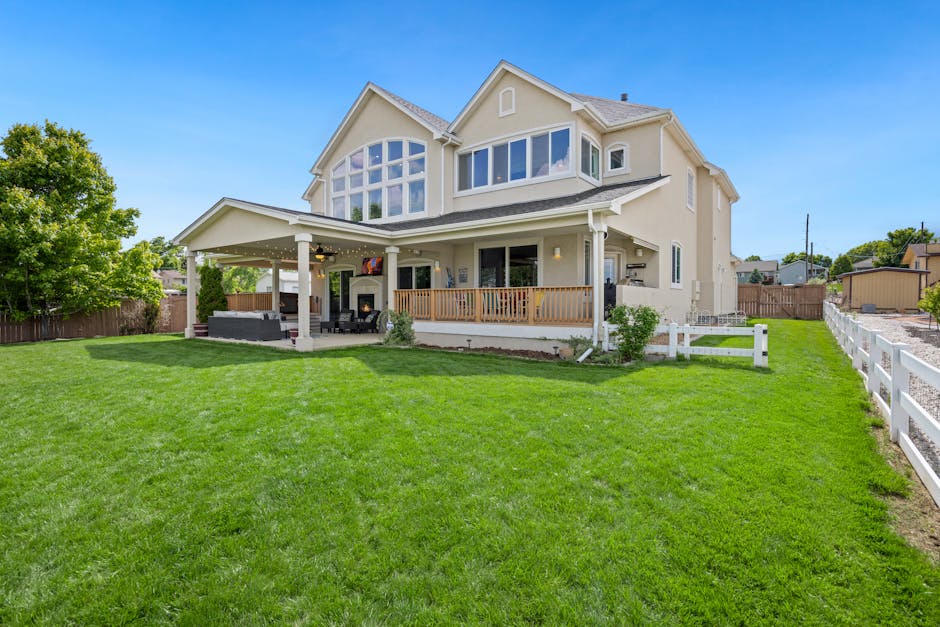
Residential lawn care is the secret weapon behind every stunning yard in your neighborhood. The difference between a patchy, weedy lawn and that perfect green carpet next door isn’t luck—it’s a systematic approach to turf health.
Quick Answer for Homeowners Seeking Lawn Care Services:
- Basic mowing visits: $50-$100 per service in Ontario
- Seasonal packages: $1,200-$2,500 for complete care
- Services included: Mowing, trimming, edging, fertilization, weed control
- Frequency: Every 7-10 days during growing season
- Best value: Full-service contracts vs. one-off visits
Whether you’re tired of spending weekends behind a mower or frustrated with brown patches that won’t go away, professional residential lawn care delivers results that DIY efforts often can’t match.
As one satisfied customer noted: “After the first visit with Weed Man I noticed the weeds were disappearing… My lawn looks so beautiful and it is a pleasure to look at my lawn and say ‘job well done.'”
The truth is simple: Great lawns don’t happen by accident. They’re the result of proper timing, the right treatments, and consistent care throughout the growing season.
Handy residential lawn care terms:
What Is Residential Lawn Care & Why It Matters
Residential lawn care is the comprehensive health program for your yard. It’s much more than just running a mower across the grass—it’s about creating a thriving outdoor ecosystem that makes your property shine.
Professional residential lawn care combines science with seasonal timing to keep your turf healthy year-round. This means understanding soil biology, knowing when to apply treatments, and recognizing how proper maintenance supports both property value and water conservation.
Definition & Benefits of residential lawn care
Residential lawn care includes all the essentials: regular mowing, strategic fertilization, weed control, pest management, and seasonal treatments that keep grass looking its best.
The benefits go beyond nice-looking grass. Your lawn becomes a natural extension of your outdoor living space, perfect for family activities or simply enjoying morning coffee on the patio.
Well-maintained lawns help maintain neighborhood standards and protect your investment. A healthy, professionally cared-for lawn signals that the property is well-maintained throughout.
How healthy lawns support the environment
Healthy lawns are environmental workhorses. Your well-maintained turf acts as a natural carbon capture system, pulling carbon dioxide from the air and storing it in the soil. A typical residential lawn can lock away hundreds of pounds of carbon each year.
Established lawns excel at runoff control, with dense root systems absorbing rainfall more effectively than bare soil. This means less erosion, better water filtration, and reduced strain on storm drainage systems.
For homeowners interested in supporting local wildlife, incorporating pollinator strips into the lawn care plan creates balance between maintained appearance and habitat for beneficial insects.
Scientific research on sustainable turfgrass continues to show how proper lawn care practices support both aesthetic goals and environmental responsibility.
Core Residential Lawn Care Services & Typical Visit
When you hire a professional residential lawn care company, you’re getting much more than someone to cut your grass. The difference between a neighborhood kid with a mower and a professional crew is like comparing a quick haircut to a full salon experience. More info about Lawn Care & Maintenance
What’s included in a standard residential lawn care visit?
Every professional residential lawn care visit starts with proper mowing technique. Your crew will cut grass to the optimal height for your specific grass type, following the rule of never removing more than one-third of the blade length.
The magic happens with trimming and edging. While the mower handles the main lawn area, string trimmers clean up around trees, fences, and flower beds. Professional edging creates those crisp, clean lines along sidewalks and driveways.
Professional crews handle debris management by blowing grass clippings off all hard surfaces. Depending on your lawn’s condition, they’ll either mulch the clippings back into the lawn or collect them completely.
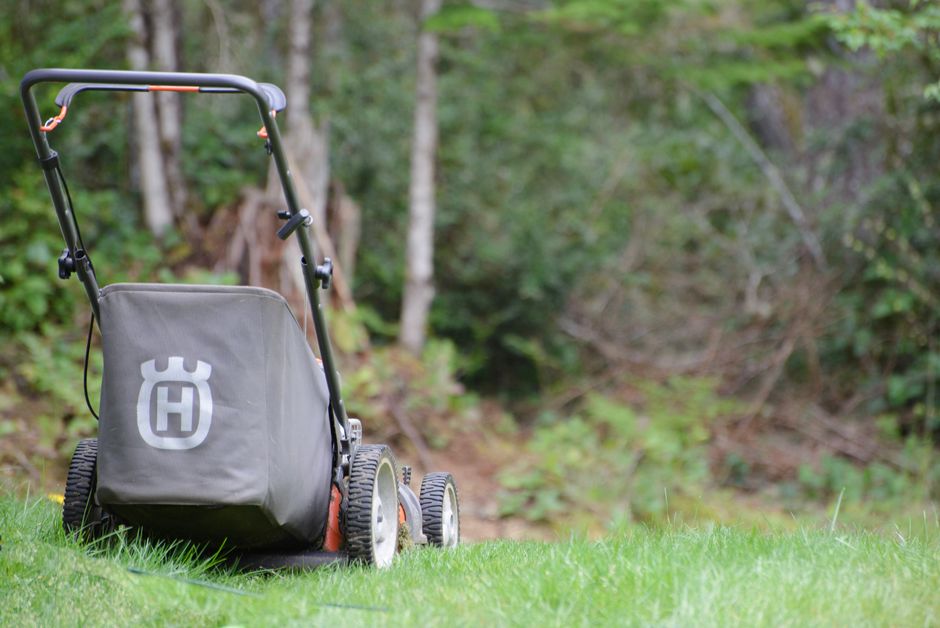
Professional equipment makes a huge difference. Commercial-grade mowers create cleaner cuts that heal faster and look better than typical homeowner equipment.
Experienced technicians perform a visual inspection during each visit, noting any issues like pest problems or disease symptoms. Many companies leave detailed service notes about what was done and what to watch for.
Add-on & specialized services homeowners love
Several specialized services can transform your lawn from “decent” to “the envy of the neighborhood.”
Core aeration removes small plugs of soil to reduce compaction and improve air, water, and nutrient penetration to grass roots. If you’ve got clay soil or heavy foot traffic, annual aeration can make a dramatic difference.
Overseeding works with aeration to thicken existing turf and introduce improved grass varieties. The combination can transform thin, patchy lawns in just one growing season.
Soil testing reveals pH levels, nutrient deficiencies, and organic matter content, allowing for targeted fertilization programs instead of generic treatments.
Grub control targets soil-dwelling pests that can devastate lawns by feeding on grass roots. Professional treatment programs prevent the heartbreak of watching your lawn get eaten from underneath.
Dethatching removes the layer of dead grass and debris that builds up between soil and green grass, allowing better air and water penetration while reducing disease risk.
Residential Lawn Care Pricing in Ontario & Beyond
When it comes to residential lawn care, understanding the investment helps you make smart decisions for your property. Let’s be honest—pricing varies widely based on your specific needs, but we can give you a realistic picture of what homeowners typically invest.
These are average costs based on internet data and not actual costs for Lawn Care Plus.
Per-visit pricing ranges dramatically depending on your lawn size and location. Small lawns under 2,000 square feet might run $50-$165 per visit, while medium-sized properties between 2,000-4,000 square feet typically see costs of $55-$225 per visit.
Larger lawns covering 4,000-8,000 square feet generally cost $75-$300 or more per visit. If you’re lucky enough to have a rural property, expect to pay $150-$900 per acre—though the wide range reflects the huge variation in property complexity and regional pricing.
Seasonal packages often provide better value than individual visits. Standard maintenance programs with 20-25 visits typically run $1,200-$3,600 per season. Full-service care that includes mowing, fertilization, and weed control ranges from $1,800-$5,400 per season. Premium estate services can reach $2,500-$7,500 or more, depending on your property’s needs.
2025 cost outlook for residential lawn care
Several trends are shaping lawn care pricing this year. Fuel costs continue to impact service delivery, with many companies adding seasonal fuel surcharges to cover transportation expenses. The ongoing labor shortage in landscaping has driven wage increases across the industry, which naturally affects service pricing.
The good news? Technological improvements in equipment efficiency and route optimization help some companies maintain competitive pricing while actually improving service quality. Many homeowners are also finding that seasonal contracts provide cost predictability—you know exactly what you’ll spend, and companies can offer better rates for committed customers.
Factors that swing your residential lawn care quote
Your final residential lawn care quote depends on several key factors that directly impact the time and effort required for your property.
Property size and layout obviously matter, but it’s not just about square footage. A compact lawn with lots of trees, flower beds, and decorative features often takes longer to maintain than a larger, open space. Those obstacles require careful maneuvering and detailed trimming work.
Grass condition plays a huge role in pricing. Overgrown lawns need multiple passes and extra time, while regularly maintained properties are quick and efficient to service. This is why consistent care often costs less per visit than sporadic cleanups.
Service frequency affects both cost and results. Weekly service during peak growing season costs more than bi-weekly visits, but your lawn will look significantly better with more frequent attention.
Accessibility challenges like steep slopes, narrow gates, or difficult access points may require specialized equipment or extra time. Properties in remote locations or outside a company’s primary service area typically include travel time and fuel costs in their pricing.
The key is finding a service provider who understands your specific needs and can provide transparent pricing that reflects the actual work required for your property.
DIY vs Professional Lawn Care: Cost & Benefit Showdown
The decision between DIY and professional residential lawn care involves weighing time, effort, expertise, and results.

Is it cheaper to mow yourself?
At first glance, buying your own mower seems like the obvious money-saving choice. But the real numbers tell a different story.
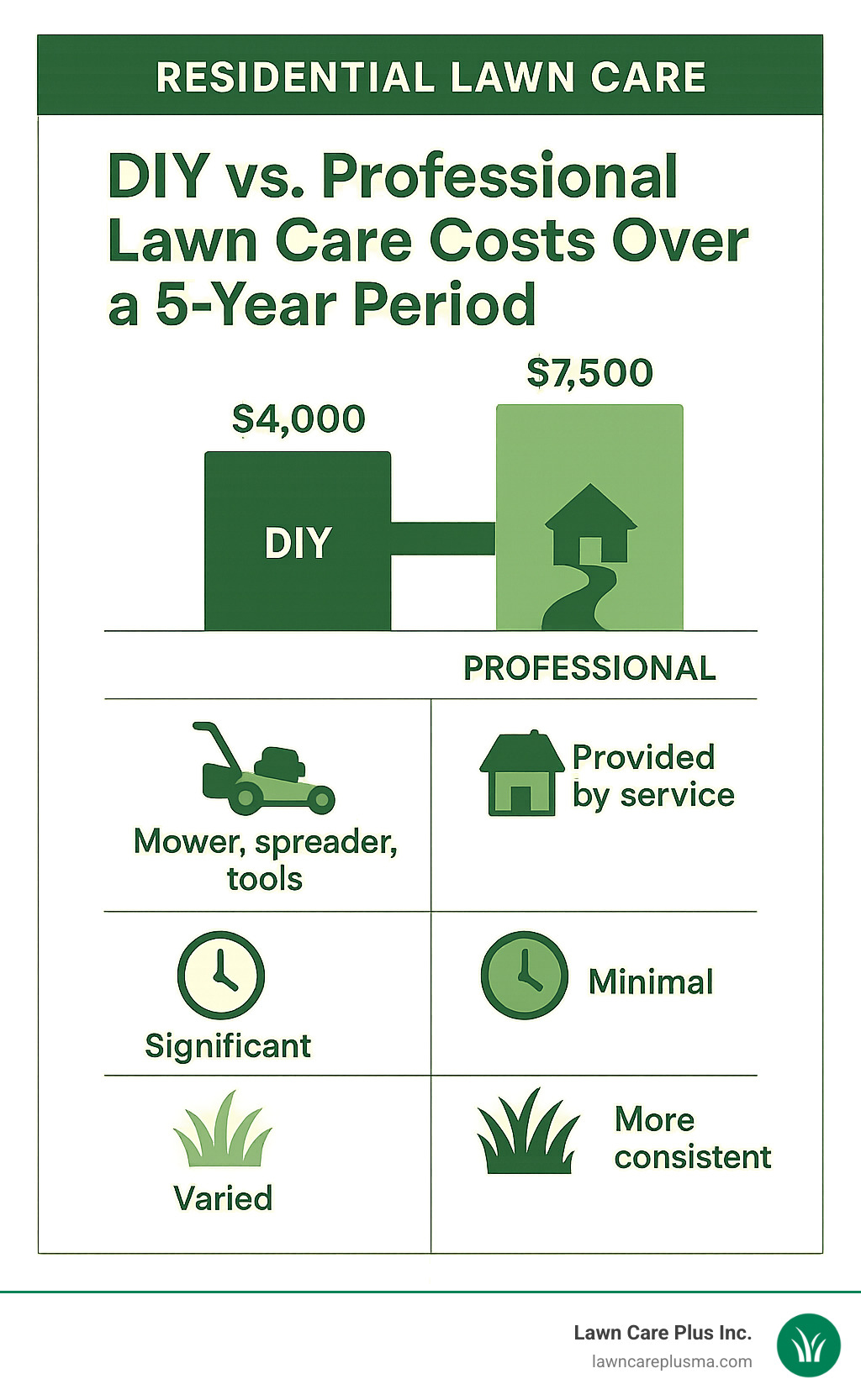
The equipment investment can be eye-opening. A decent lawn mower runs $300 to $2,100, depending on yard size. Add a string trimmer ($100-$400), edger ($150-$450), fertilizer spreader ($50-$200), and basic tools ($100-$300), and you’re looking at significant upfront costs.
Annual operating costs include fuel and oil ($60-$180 per season), fertilizer and weed control products ($100-$750 per season), equipment maintenance ($75-$300 per season), plus replacement parts ($50-$200 per season). These are average costs based on internet data and not actual costs for Lawn Care Plus.
The time investment is significant. The average homeowner spends 2-4 hours per week on lawn maintenance during growing season. Over 20 weeks, that’s 40-80 hours annually—time you could spend with family or relaxing.
When you factor in the opportunity cost of your time, DIY lawn care becomes less of a bargain. If your time is worth $25 per hour, those 60 hours represent $1,500 in value.
Why hiring pros pays off
Professional residential lawn care offers advantages beyond saving time on weekends.
Consistent scheduling means your lawn gets care when it needs it, not when you finally have a free Saturday. Rain delays, vacation plans, and busy schedules won’t derail your lawn’s maintenance program.
Expert diagnosis is perhaps the biggest advantage. Experienced technicians spot problems early—identifying grub damage, disease symptoms, or nutrient deficiencies before they become expensive disasters.
Equipment quality makes a real difference. Commercial-grade mowers create cleaner cuts that heal faster and look better than homeowner equipment.
Warranty and guarantee protection gives peace of mind. Most professional services will return to address issues at no additional cost.
Comprehensive care often includes treatments that would be expensive for homeowners to provide themselves. While tools like Pest Problem Solver can help identify issues, professional diagnosis often provides more reliable results.
Professional lawn care isn’t just about convenience—it’s about getting better results with less stress at a comparable total cost when you factor in your time and equipment ownership costs.
Seasonal Residential Lawn Care Calendar & Pro Tips
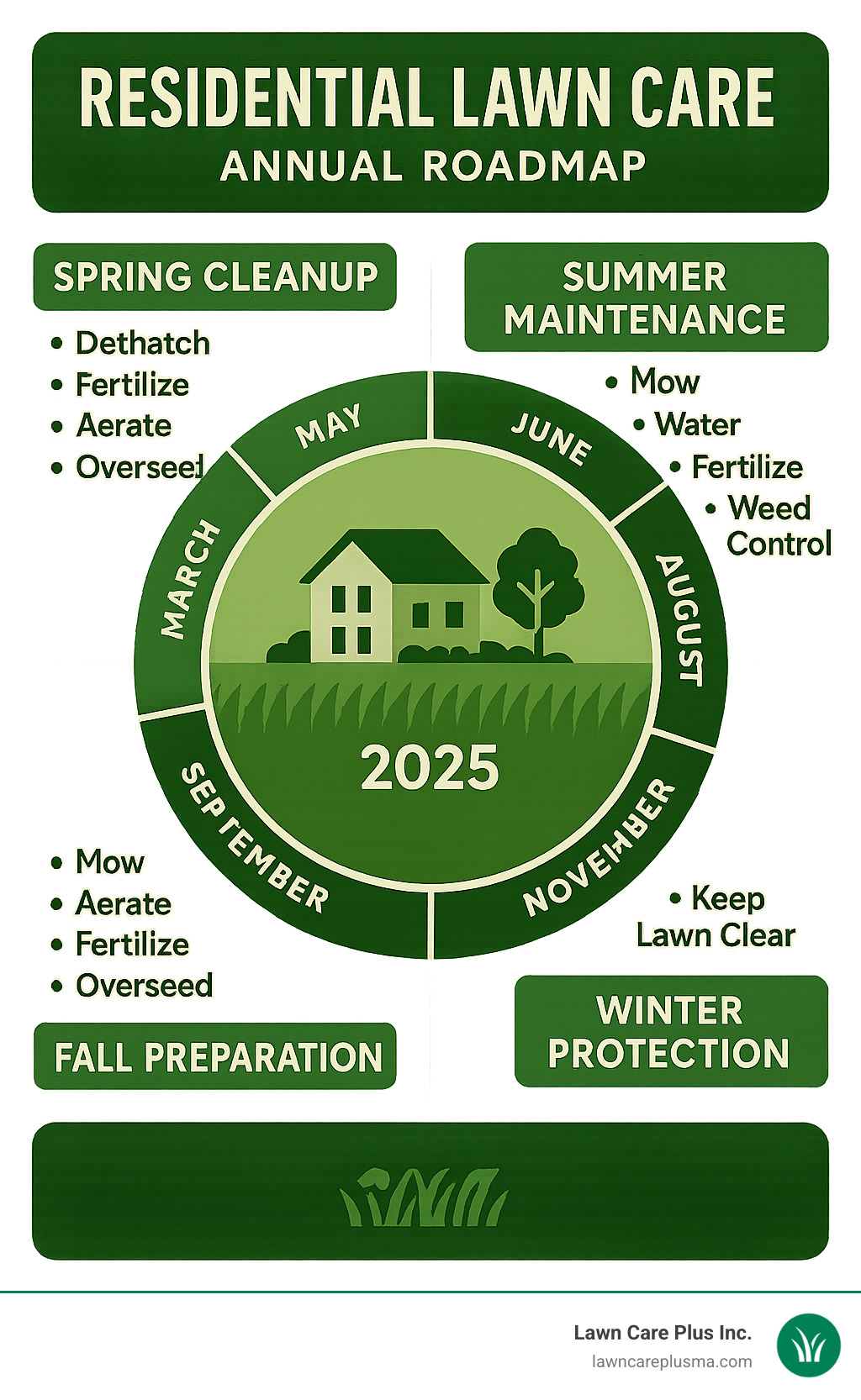
Getting the timing right is everything in residential lawn care. Your lawn responds to temperature, moisture, and daylight hours. Work with nature’s calendar for dramatically better results. More info about Spring Lawn Care
Spring tasks for a head-start lawn
Spring is when your lawn wakes up from winter, and those first few weeks set the tone for the entire growing season.
Early spring is about clearing the slate. Once snow melts, rake away winter debris. Those soggy leaves and twigs block sunlight and trap moisture that can lead to fungal problems.
The pre-emergent herbicide application is your secret weapon against crabgrass. Apply when soil temperatures hit around 55°F (usually March to early April). Miss this window, and you’ll fight weeds all summer.
Late spring brings real action. Your grass is growing faster, so establish that regular mowing routine. The first fertilizer application gives your lawn the energy boost it needs after winter dormancy.
Spring is the best time for major lawn repairs. Cool, moist conditions are perfect for overseeding bare spots and addressing compaction with core aeration.
Summer survival strategies for residential lawns
Summer lawn care is about helping your grass survive the heat rather than pushing growth.
Deep watering is the foundation of summer survival. Most homeowners water too often and too shallow, creating weak, surface-level roots. Instead, water deeply but less frequently. Your lawn needs about an inch of water per week.
Raising your mowing height to 3 inches during summer heat is like giving your grass a sun hat. Taller grass shades soil, reduces water evaporation, and develops stronger root systems.
Mulching grass clippings back into the lawn provides up to 25% of your lawn’s nitrogen needs. Plus, they act as natural mulch to help retain moisture.
During heat waves, reduce foot traffic on stressed areas and avoid fertilizing when temperatures soar above 85°F. Sometimes the best thing is to leave your lawn alone and let it rest.
Fall revival & winterization checklist
Fall is when the magic happens for residential lawn care. While neighbors focus on raking leaves, smart homeowners know this season makes or breaks next year’s lawn.
Core aeration in September or October gives your lawn room to breathe after a long, compacted summer. Those small holes allow air, water, and nutrients to penetrate deep into the root zone.
Overseeding combined with aeration is the closest thing to a lawn makeover. Fall’s cool temperatures and increased moisture create perfect conditions for new grass to establish strong roots before winter.
Potassium-rich fertilizer is your lawn’s winter coat. Unlike nitrogen, which promotes leafy growth, potassium strengthens cell walls and improves cold tolerance.
Final mowing preparations matter more than you think. Keep mowing until growth stops, but gradually lower your cutting height for the last few cuts. Grass that’s too long going into winter can mat down and create disease problems.

Choosing a Residential Lawn Care Company
Finding the right residential lawn care company can feel overwhelming. A little homework upfront saves headaches down the road. More info about Lawn Maintenance
The best lawn care companies understand that your property is more than just grass—it’s your family’s outdoor sanctuary. They’ll take time to understand your specific needs.
Start by checking that any company carries proper licensing and insurance. This protects you if something goes wrong. A reputable company will happily provide proof of insurance and required pesticide application licenses.
Online reviews tell the real story. Look for patterns in customer feedback. Do they show up consistently? Do they communicate well? Are they responsive when problems arise?
What to read in a lawn-care contract
Spending ten minutes reading contracts can save frustration later.
The frequency clause should clearly spell out how often they’ll visit. Most companies schedule visits every 7-10 days during peak growing season, then adjust based on growth rates.
Auto-renewal terms are standard but shouldn’t surprise you. Most contracts automatically renew for the following season unless you provide written notice by a specific date. Mark this date in your calendar.
Rain delay policies matter more than you think. Professional companies have flexible scheduling systems to handle weather delays. The contract should explain how they handle these situations.
Look for clear pricing structures that outline what’s included in base service versus add-on treatments. The best companies provide transparent pricing without hidden fees.
Questions to ask before signing
The right questions help you understand what kind of service you’re really getting.
Ask about crew training and certification. Well-trained technicians make the difference between mediocre results and the lawn that makes neighbors jealous. Certified professionals understand proper techniques and how to spot problems early.
If you’re interested in organic options, discuss these upfront. Many companies offer environmentally friendly programs that balance effectiveness with sustainability.
Satisfaction guarantees separate confident companies from those just collecting payments. Ask what happens if you’re not happy. The best companies will return to address issues at no additional cost.
Ask about equipment maintenance standards. Well-maintained, sharp mower blades create cleaner cuts that heal faster and look better.
The right lawn care company becomes a trusted partner in maintaining your property’s beauty and value.
Frequently Asked Questions about Residential Lawn Care
How often should I mow my lawn in Ontario?
Here’s the short answer: every 7-10 days during peak growing season. But like most things in lawn care, it’s not quite that simple.
Your lawn doesn’t read the calendar, so it won’t grow on a perfect schedule. During those warm, wet weeks in May and June, you might find yourself mowing twice a week. Come July’s heat or a dry spell in August, you might go two weeks between cuts.
The one-third rule is your best friend here. Never remove more than one-third of the grass blade in a single mowing, even if your neighbors are giving you the stink eye about your “long” grass. Cutting too much at once stresses the grass and can leave it vulnerable to disease and drought.
Cool-season grasses (which is what most of us have in Ontario) do their heavy growing in spring and fall when temperatures are moderate. They slow down during summer heat and go dormant in winter. Your mowing schedule should follow this natural rhythm.
Well-fertilized lawns grow faster, so if you’re investing in residential lawn care treatments, expect to mow more frequently. It’s actually a good sign—it means your grass is healthy and responding well to care.
What’s the difference between organic and traditional programs?
This is probably the most common question we hear from homeowners, and honestly, both approaches have their place.
Traditional programs use synthetic fertilizers and conventional herbicides. They work fast—you’ll see greening within days and weeds dying within a week. These products are precisely formulated, so your lawn gets exactly what it needs when it needs it. They’re also typically more budget-friendly upfront.
Organic programs take a different approach. They focus on building soil health over time using natural, plant-based, and mineral-derived products. The results take longer to show, but they create a more sustainable foundation for long-term lawn health. They’re also safer for kids and pets who love to play on the grass.
Many homeowners are surprised to learn that hybrid programs often provide the best results. These combine organic soil-building methods with selective synthetic treatments for specific problems. You get the quick results where you need them and the long-term benefits of healthy soil biology.
The truth is, both approaches can create beautiful lawns. The choice often comes down to your priorities: immediate results versus long-term soil health, budget considerations, and how you use your outdoor space.
Are discounts or seasonal packages really worth it?
Short answer: absolutely yes, but let me explain why.
Seasonal packages typically save you 15-25% compared to individual services. But the real value goes beyond just the money. When you commit to a full season of care, you’re giving your lawn what it actually needs—consistent, properly timed treatments throughout the growing season.
Think about it this way: would you take just one vitamin pill and expect to be healthy all year? Your lawn needs the same kind of consistent care. Pre-emergent weed control in early spring prevents problems all season long. Fall fertilization builds root strength for next year’s growth. These aren’t optional extras—they’re essential parts of a healthy lawn program.
Package customers also get priority scheduling. When everyone’s calling for service after a rainy week, you’re already on the schedule. No waiting, no wondering if you’ll get squeezed in.
The convenience factor is huge too. One contract, one payment schedule, and your lawn care is handled for the entire season. No need to remember to call for spring cleanup or fall fertilization—it’s all included.
Just make sure you’re choosing a package that matches your lawn’s actual needs. Don’t pay for services you don’t need, but recognize that comprehensive residential lawn care usually produces better results than trying to piece together individual treatments.
Conclusion
Your residential lawn care journey doesn’t have to be a solo struggle with stubborn weeds and patchy grass. The most beautiful lawns in your neighborhood aren’t accidents—they’re the result of consistent, professional care that understands what Massachusetts grass really needs.
At Lawn Care Plus Inc., we’ve spent years perfecting residential lawn care throughout the Boston Metro-West area. From Belmont’s tree-lined streets to Watertown’s family neighborhoods, we’ve seen how the right approach transforms ordinary yards into spaces that make homeowners genuinely proud.
What sets us apart isn’t just our expertise in lawn maintenance—it’s our understanding that your lawn is part of a bigger picture. When you work with us, you’re partnering with a team that can handle everything from weekly mowing to complete landscape installations, hardscaping projects, and snow removal.
The secret to achieving that “How do they do it?” lawn isn’t really a secret. It’s about working with professionals who understand local soil conditions, know which grass varieties thrive in New England’s challenging climate, and can spot problems before they become expensive headaches.
Whether you’re dreaming of a lawn that makes neighbors curious or simply want to reclaim your weekends from mowing duties, professional residential lawn care delivers results that DIY efforts often can’t match. Our experienced team brings the tools, knowledge, and consistency that turn struggling lawns into neighborhood showpieces.
The best part? You get to enjoy the results without the backache, equipment maintenance, or guesswork about timing and treatments. Instead of spending Saturday mornings wrestling with a mower, you can spend them enjoying the beautiful outdoor space you’ve always wanted.
Ready to see what professional care can do for your property? More info about Lawn Care Services and find how Lawn Care Plus Inc. can help you achieve the lawn that makes every homecoming a little more satisfying.