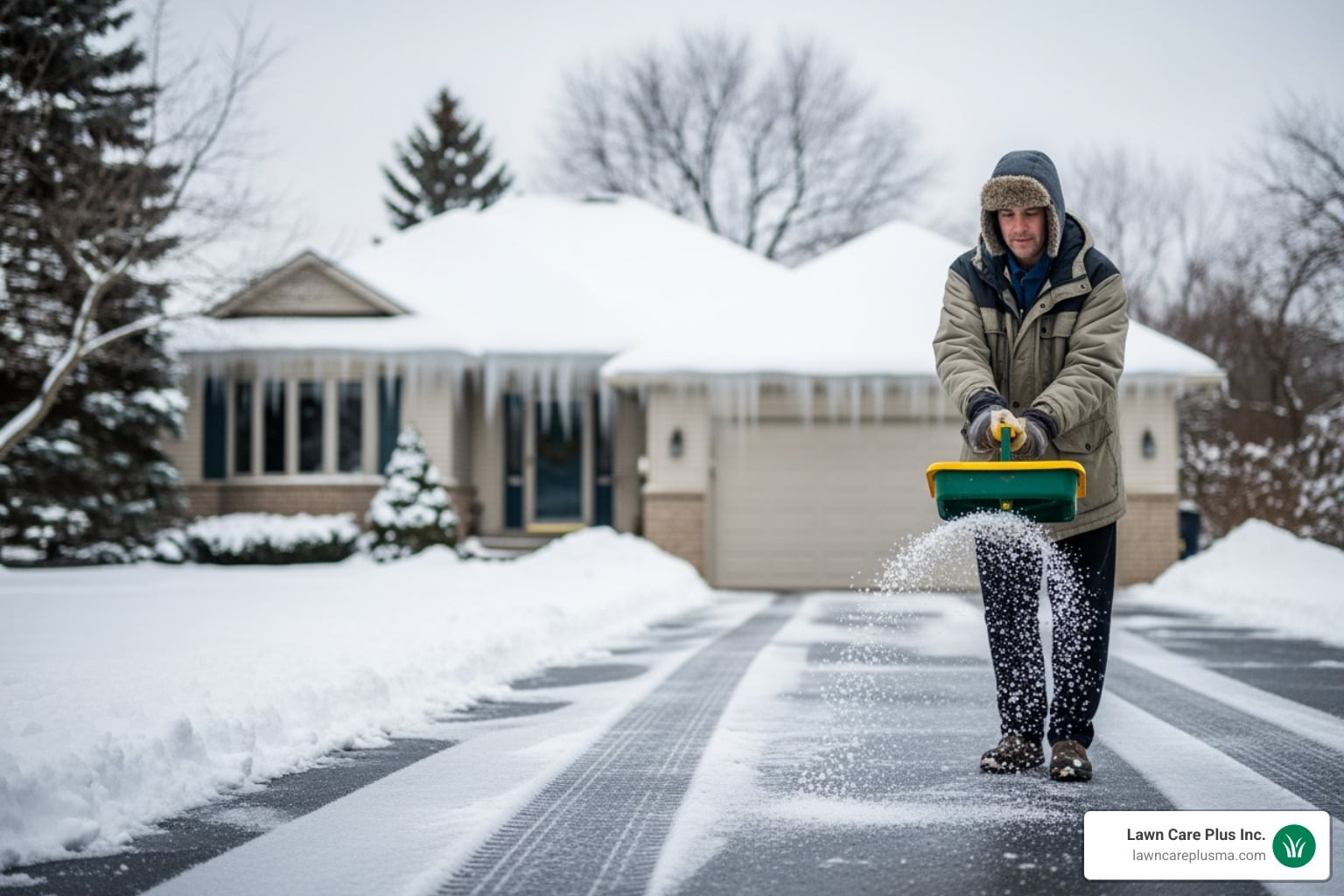
Why Finding the Right Salting Service Matters This Winter
Salting near me is one of the most searched winter service terms for good reason—nobody wants to deal with icy driveways, slippery walkways, or the risk of a serious fall. When winter weather hits the Boston Metro-West area, finding a professional salting service quickly becomes a priority for homeowners and property managers alike.
If you’re looking for salting services in your area, here’s what you need to know:
- Professional salting services apply salt, sand, or specialized de-icing materials to driveways, walkways, and parking areas
- Most services monitor weather conditions and can treat your property before, during, and after winter storms
- You can typically get a free quote by providing your property size, location, and any specific requirements
- Look for providers who are insured, use proper application rates, and offer environmentally responsible options
- Salt Wise-trained professionals follow best practices to protect both safety and local water quality
Winter ice isn’t just inconvenient—it’s dangerous. According to research from cities like Madison, WI, winter salt is essential for maintaining safe conditions on high-traffic streets, bus routes, and areas near schools and hospitals. The same principle applies to your property. When temperatures drop and precipitation arrives, untreated surfaces quickly become hazards for your family, visitors, delivery drivers, and anyone else who needs to access your home or business.
Professional salting services take the guesswork out of winter safety. They know when to apply treatments, how much to use, and which materials work best at different temperatures. Instead of struggling with heavy bags of salt in freezing conditions, you get peace of mind knowing your property is safe and accessible.
Salting near me terms explained:
- commercial snow removal services
- commercial snow removal companies near me
- commercial snow removal contract
Why Professional Salting is a Smart Winter Investment
Winter brings a lot of beauty to Massachusetts—until you realize you need to leave the house. While shoveling snow might give you a decent workout, dealing with ice is a completely different challenge. That’s where professional salting becomes one of the smartest investments you can make for your property. We know that keeping your home or business safe and accessible matters deeply to you, and that’s precisely what professional salting delivers.

Picture this: an overnight freeze transforms your driveway and walkways into an ice rink. Suddenly, every step becomes risky—not just for you and your family, but for anyone who needs to reach your door. The mail carrier, delivery drivers, elderly neighbors, kids heading to the bus stop—they’re all vulnerable to slip-and-fall accidents on untreated surfaces. These incidents can lead to serious injuries, emergency room visits, and for property owners, potential legal liability that nobody wants to face.
Professional salting services act as your first line of defense against these dangers. Rather than reacting to icy conditions after someone gets hurt, you’re taking proactive steps to prevent accidents before they happen. This peace of mind alone makes professional services worthwhile.
Let’s talk about convenience and time-saving, because let’s be honest—nobody wants to haul heavy bags of salt in sub-freezing temperatures at six in the morning. When you hire professionals, you get experienced teams who monitor weather conditions around the clock. They often treat your property before a storm even arrives, using proactive ice prevention strategies that mean you wake up to safer conditions instead of a skating rink.
Professional services bring something else to the table that’s hard to replicate on your own: professional-grade equipment and expertise in correct application rates. Too little salt, and you’re still dealing with ice. Too much, and you’re wasting money while potentially harming your landscaping and the environment. Our teams know exactly how much to apply for effective results, which actually saves you money in the long run while protecting your property. For a complete picture of what professional winter services include, check out our Snow Management Services.
How Salting Improves Safety
Here’s where things get interesting—and a bit scientific, but we promise to keep it simple. The reason salt works so well on ice comes down to basic chemistry that feels almost magical when you see it in action.
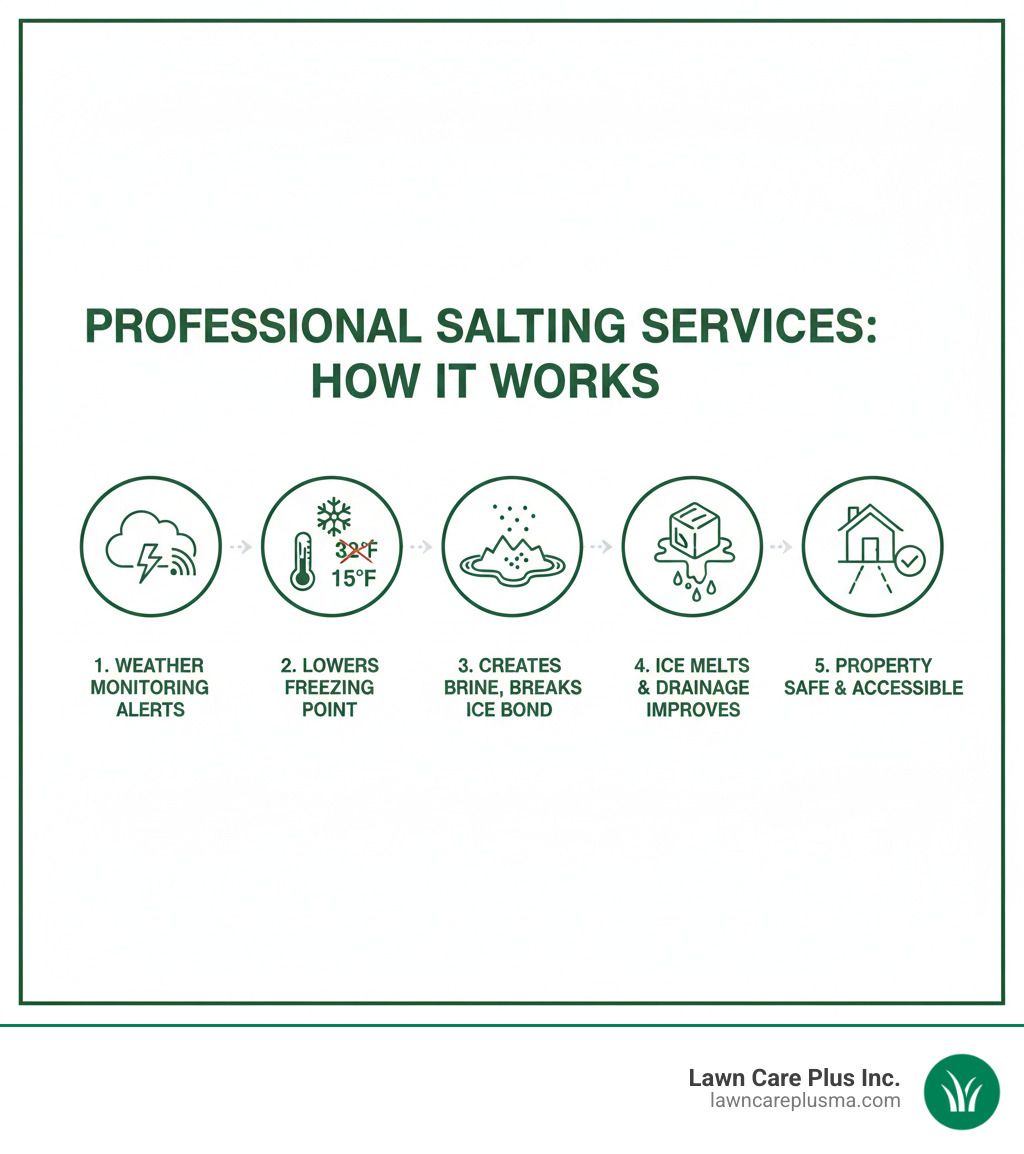
Water normally freezes at 32°F. Salt’s superpower is lowering that freezing point significantly. When salt hits ice, it dissolves in the thin layer of liquid water that exists on the ice surface (yes, even frozen ice has this microscopic liquid layer). This creates a brine solution with a much lower freezing point—often down to around 15°F or even lower depending on the concentration.
This brine doesn’t just sit on top of the ice. It works its way underneath, breaking the bond between the ice and your pavement. Once that bond breaks, the ice loses its grip and either melts away or becomes easy to remove. Think of it like sliding a credit card between two stuck pieces of paper—the salt solution gets in there and separates what was previously stuck together.
The real beauty of salting is that it prevents refreezing. Even when temperatures bounce around—which they love to do in New England—treated surfaces resist forming new ice. This means you get longer-lasting protection from a single application, keeping your property safer through those tricky freeze-thaw cycles we know all too well.
Benefits Beyond Your Driveway
When you search for “salting near me” and hire a professional service, you’re doing more than just protecting your own driveway. The benefits ripple outward, creating safety and convenience for everyone who interacts with your property.
Think about your family and visitors first. Holiday guests, children running outside to play, elderly relatives coming for dinner—everyone deserves a safe path to your door. A properly salted walkway means you can welcome people without worrying whether they’ll make it inside without falling. That’s worth a lot.
Then consider the people who keep your daily life running smoothly. Your mail carrier walks up to dozens of homes every day. Package delivery drivers are constantly hopping in and out of trucks. Even emergency responders might need quick, safe access to your property someday. When you maintain clear, ice-free surfaces, you’re protecting these essential workers while ensuring your services aren’t delayed or interrupted.
For property owners—especially those managing commercial spaces—professional salting significantly reduces legal liability. Slip-and-fall accidents on icy surfaces are among the most common premises liability claims. Courts and insurance companies look at whether you took reasonable steps to maintain safe conditions. Regular professional salting demonstrates that you’re meeting your duty of care, which can protect you from expensive lawsuits and claims. If you want to understand more about your legal responsibilities in Massachusetts, our guide on Massachusetts Snow Removal Law covers what property owners need to know.
Finally, professional salting maintains your property’s accessibility throughout winter. Whether you’re running a retail business that needs customers to feel confident walking in, managing an apartment complex where residents need safe passage, or simply want to use your own driveway without anxiety, clear paths make everything work better. Your property stays functional and welcoming instead of becoming a hazardous obstacle course every time the temperature drops.
How to Find a Reliable Salting Service Near Me
When winter weather hits and you find yourself searching for “salting near me” at 6 AM with an icy driveway staring back at you, you need answers fast. But finding a reliable salting service shouldn’t be a rushed decision—the right provider can make the difference between a safe, stress-free winter and a season of worry.
Your search should start online, but it definitely shouldn’t end there. Yes, a quick Google search will give you a list of local providers, but that’s just the beginning. Take time to explore their websites. What services do they actually offer? Do they seem professional and established? Are they specific about their service areas?
Here’s where the real insight comes in: tap into your local community. Your neighbors have already been through a few winters, and they know which companies show up reliably at 4 AM and which ones leave you waiting. Local Facebook groups, Nextdoor communities, and even conversations at the coffee shop can reveal honest experiences you won’t find in any online ad. Ask friends, colleagues, and other business owners in your area who they trust with their winter safety.
Online reviews deserve careful attention, but read them with a critical eye. Look for patterns rather than individual complaints. Do multiple reviewers praise the company’s responsiveness during storms? Are there consistent mentions of professional communication or fair pricing? On the flip side, if you see recurring complaints about missed appointments or property damage, take those seriously. A few negative reviews among hundreds of positive ones are normal, but patterns tell the real story.
Before you sign anything, verify insurance and licensing. This isn’t just bureaucratic box-checking—it protects you if something goes wrong. A truck accidentally damages your mailbox, someone slips despite treatment, equipment malfunctions—proper insurance means these situations don’t become your financial burden. Any reputable company will gladly provide proof of insurance and appropriate licensing. If they hesitate or make excuses, that’s your signal to keep looking.
For business owners searching for commercial solutions, the stakes are even higher. Your customers, employees, and liability exposure all depend on reliable ice management. Our guide to Commercial Snow Removal Companies Near Me offers additional insights custom specifically to commercial property needs.
Signs of a Quality Salting Service
Once you’ve narrowed down your options, how do you separate the truly excellent providers from the merely adequate? Here are the hallmarks of a quality salting service that takes winter safety seriously.
Proactive weather monitoring is perhaps the most telling sign of a professional operation. The best services don’t wait for ice to form—they’re watching forecasts days in advance and planning treatments before the first snowflake falls. Pre-treating with liquid brine before a storm can prevent ice from bonding to pavement in the first place, which is far more effective than trying to break up ice after it forms. If a company talks about their weather monitoring systems and pre-storm protocols, you’re on the right track.
Clear communication might sound basic, but it’s surprisingly rare. Quality providers keep you informed every step of the way. You should know when they’re scheduled to arrive, when treatments are complete, and what to expect next. Whether through text updates, email notifications, or a customer portal, you shouldn’t be left guessing. And when you have questions or concerns, you should be able to reach a real person who can help.
Well-maintained equipment signals a company that invests in doing the job right. Modern, calibrated spreaders apply salt at precise rates—enough to be effective without wasting material or harming the environment. Reliable trucks mean fewer breakdowns during critical storm events. If you can, take a look at their equipment. Does it look professional and well-cared-for?
When it comes to contracts and pricing, transparency is everything. You should understand exactly what you’re paying for and when. Are you billed per application, or is it a seasonal flat rate? What triggers a treatment—any snowfall, or only events over a certain threshold? Are there different rates for different materials? A quality provider explains all this upfront with no hidden fees or surprise charges buried in fine print.
Timeliness and reliability become crystal clear during your first winter storm. Does the company show up when they say they will? Do they prioritize your property appropriately? Check references specifically about reliability during peak demand—anyone can provide good service on a quiet Tuesday, but the real test comes during a major storm when everyone needs service simultaneously.
Look for providers who demonstrate knowledge about different de-icing materials. They should be able to explain why they use certain products, how different materials perform at various temperatures, and what options might work best for your specific situation. This expertise ensures you’re getting the right treatment for the conditions, not just a one-size-fits-all approach.
Environmentally responsible practices matter more than ever. Quality services understand that over-application doesn’t just waste money—it harms local waterways, vegetation, and wildlife. Ask if their technicians are trained in smart salting practices. Do they use calibrated equipment to prevent over-application? Are they familiar with programs like Salt Wise? A good provider will appreciate these questions and have solid answers.
Finally, beyond just having insurance, ask about safety training for their crews. Well-trained employees work more safely and effectively, reducing risks to themselves, your property, and anyone on-site during treatments.
Don’t be shy about asking direct questions. When you contact potential providers, inquire about their Salt Wise training, their weather monitoring systems, and their typical response times. The companies worth hiring will welcome your questions and provide thorough, confident answers.
Special Considerations for Commercial vs. Residential Properties
While every property deserves safe, ice-free surfaces, the approach for commercial properties looks quite different from residential service—and for good reason.
Commercial properties face unique challenges that demand a different level of service. Parking lots, loading docks, sidewalks, and entryways see constant traffic from employees, customers, and delivery vehicles. A slip-and-fall incident at a business can result in serious injuries, costly lawsuits, and damaged reputation. For commercial clients, ice management isn’t just about convenience—it’s about protecting people, maintaining business operations, and managing substantial liability risk.
Many businesses require zero-tolerance policies, meaning surfaces must be completely clear of ice and snow at all times. A retail store needs its parking lot treated before opening hours so customers can shop safely. A medical office can’t have icy walkways when elderly patients arrive for early appointments. A distribution center needs loading areas clear for trucks that arrive around the clock. This level of service demands careful planning, reliable execution, and often 24/7 availability.
ADA compliance adds another critical layer for commercial properties. Accessible routes from parking areas to building entrances must be kept clear and safe, ensuring people with disabilities can steer the property without barriers. This isn’t optional—it’s a legal requirement that professional services understand and prioritize.
Think about how cities like Madison, Wisconsin prioritize their “salt routes”—focusing first on high-traffic arterial streets, bus routes, and areas near schools and hospitals where safety impacts the most people. Commercial snow management follows this same strategic thinking, identifying high-priority areas and ensuring they receive prompt, thorough treatment. Our Commercial Snow Removal services are designed specifically around these complex commercial needs.
Residential properties, while equally important for safety, typically operate on a different scale. Homeowners need their driveways clear to get to work, their walkways safe for mail delivery, and their steps ice-free so family and visitors don’t fall. The focus is usually on smaller areas—a driveway, front walk, maybe some back steps or a patio.
For residential clients, convenience and peace of mind are often the driving factors. You want to wake up to a safe, accessible property without having to bundle up and spread salt yourself in freezing temperatures. The volume of traffic is lower than commercial properties, but the safety of your loved ones is priceless.
Residential services also consider factors like pet and plant safety more heavily. Rock salt can irritate dogs’ paws and damage grass and shrubs along walkways. Many homeowners prefer gentler alternatives like magnesium chloride or calcium chloride that are less harsh on landscaping and safer for pets. A good residential provider will discuss these options and help you choose materials that protect both your family and your property’s living elements.
The bottom line: whether you own a home or manage a business, professional salting services should be custom to your specific needs, traffic patterns, and priorities. The right provider understands these distinctions and adjusts their approach accordingly.
Understanding Your De-Icing Options: Salt, Sand, and More
When you’re searching for “salting near me,” you might be surprised to learn that not all de-icing solutions are created equal. The term “salt” has become shorthand for winter ice treatment, but there’s actually a whole toolkit of materials available, each with unique strengths and limitations. Understanding these options helps you have informed conversations with service providers and ensures your property gets the treatment that’s right for your specific situation.
Before we dive into specific materials, let’s clarify an important distinction: de-icing versus anti-icing. De-icing is what most people picture—applying materials to melt existing snow and ice. Anti-icing takes a more proactive approach, treating surfaces before winter weather arrives to prevent ice from bonding to the pavement in the first place. Think of it like the difference between treating an illness and preventing it.
Professional services often use proactive liquid brine treatments as part of their anti-icing strategy. By monitoring weather forecasts and applying treatments strategically before temperatures drop, they can prevent ice formation altogether. This approach often uses less material overall and provides better results than trying to melt thick ice after it’s already formed. The key is timing—applying the right material at the right time to the right surfaces.
Common De-Icing Materials
Let’s break down the most common de-icing materials you’ll encounter. Each has its place in a comprehensive winter management plan.
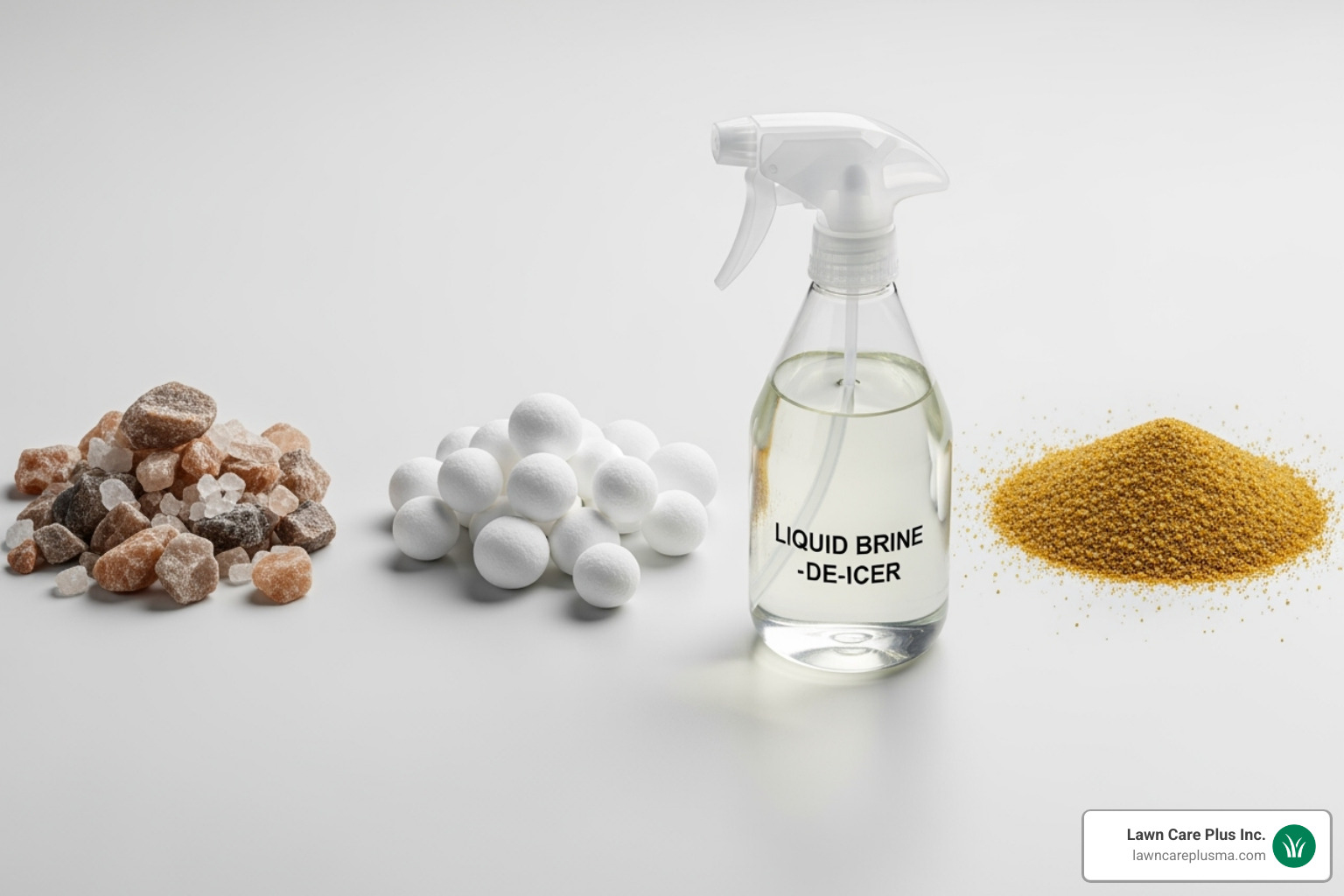
Rock salt (sodium chloride) is the workhorse of the de-icing world. It’s the most common and cost-effective option, which is why it’s so widely used. Rock salt works effectively down to about 15°F, creating a brine solution that breaks the bond between ice and pavement. However, it comes with trade-offs—it can be corrosive to concrete and metal, harmful to plants, and damaging to freshwater ecosystems when it washes into storm drains and waterways.
Calcium chloride is the overachiever of de-icers. It works much faster than rock salt and remains effective in much colder temperatures—down to about -25°F. This makes it ideal for extreme cold snaps or situations where you need rapid ice melting. The downside? It costs more and can be even more corrosive to concrete and metal surfaces than rock salt. It also releases heat when it dissolves, which speeds up melting but can be harder on surfaces.
Magnesium chloride strikes a middle ground. It’s effective down to about 5°F and is generally considered less harmful to concrete, vegetation, and pets than sodium chloride or calcium chloride. Many environmentally conscious property owners prefer it for this reason. It works faster than rock salt but not quite as quickly as calcium chloride, and it falls in the middle range for cost.
Sand deserves special mention because it works completely differently. Sand doesn’t melt ice at all—instead, it provides traction on icy surfaces. It’s often mixed with salt to give you the best of both worlds: melting action from the salt and immediate traction from the sand. Sand is inexpensive and won’t damage plants or concrete, but it requires cleanup in the spring and can clog storm drains if overused. It’s most useful on sloped areas where traction is critical.
Here’s a quick comparison of how these materials stack up:
| Material | Effective Temperature | Speed of Action | Cost | Environmental/Surface Impact |
|---|---|---|---|---|
| Rock Salt (Sodium Chloride) | Down to 15°F | Moderate | Low | Corrosive to concrete and metal; harmful to plants and freshwater; most commonly used |
| Calcium Chloride | Down to -25°F | Fast | High | Very effective but more corrosive; releases heat; harder on surfaces |
| Magnesium Chloride | Down to 5°F | Moderate-Fast | Moderate | Less harmful to concrete, plants, and pets; better environmental profile |
| Sand | All temperatures | Immediate (traction only) | Low | No melting action; provides traction; requires spring cleanup; no chemical damage |
Choosing an Environmentally Responsible Salting Service Near Me
As awareness of environmental impacts grows, choosing a service that practices responsible salting becomes increasingly important. The reality is that chlorides from all salt-based de-icers can impact freshwater streams and lakes. Once chloride enters our water systems, it’s nearly impossible to remove. Over time, liftd chloride levels harm aquatic life and can even affect drinking water quality.
This doesn’t mean we should stop using salt altogether—winter safety is too important. Instead, it means using it smartly. Calibrated salt spreaders are a game-changer here. These professional-grade tools apply precise amounts of material, preventing the over-application that happens when salt is spread by hand or with uncalibrated equipment. More salt doesn’t mean more safety; in fact, using too much is wasteful, costly, and unnecessarily harmful to the environment.
When interviewing potential salting services, ask about their environmental practices. Are they trained in “smart salting” techniques? Do they use calibrated equipment? Programs like Salt Wise from Wisconsin have developed best practices for winter salt application that protect water quality while maintaining safety. Services familiar with these principles demonstrate a commitment to responsible practices.
Liquid brine deserves special mention as a greener alternative. When applied before a storm, liquid brine can prevent ice from forming using less total chloride than traditional rock salt. It sticks to pavement better than dry salt and won’t bounce or scatter. Many professional services now offer brine pre-treatment as part of their winter management packages.
Beyond salt alternatives, consider protecting your plants and soil. Ask your service provider about pet-safe de-icing options, especially for areas where dogs or cats walk regularly. Some products are specifically formulated to be gentler on paws while still providing effective ice melting. For areas near sensitive landscaping, your provider might recommend targeted application—using less aggressive materials near plants and reserving stronger de-icers for high-traffic safety zones.
The goal is balance: maintaining safe surfaces while minimizing environmental impact. A quality salting service near me will understand this balance and work with you to develop a plan that protects both people and the environment.