
Why Tree Landscaping Transforms Your Property Investment
Tree landscaping is the strategic placement and care of trees to improve your property’s beauty, functionality, and value. Whether you’re looking to create shade, boost curb appeal, or increase your home’s worth, the right trees in the right spots deliver measurable returns.
Key Tree Landscaping Benefits:
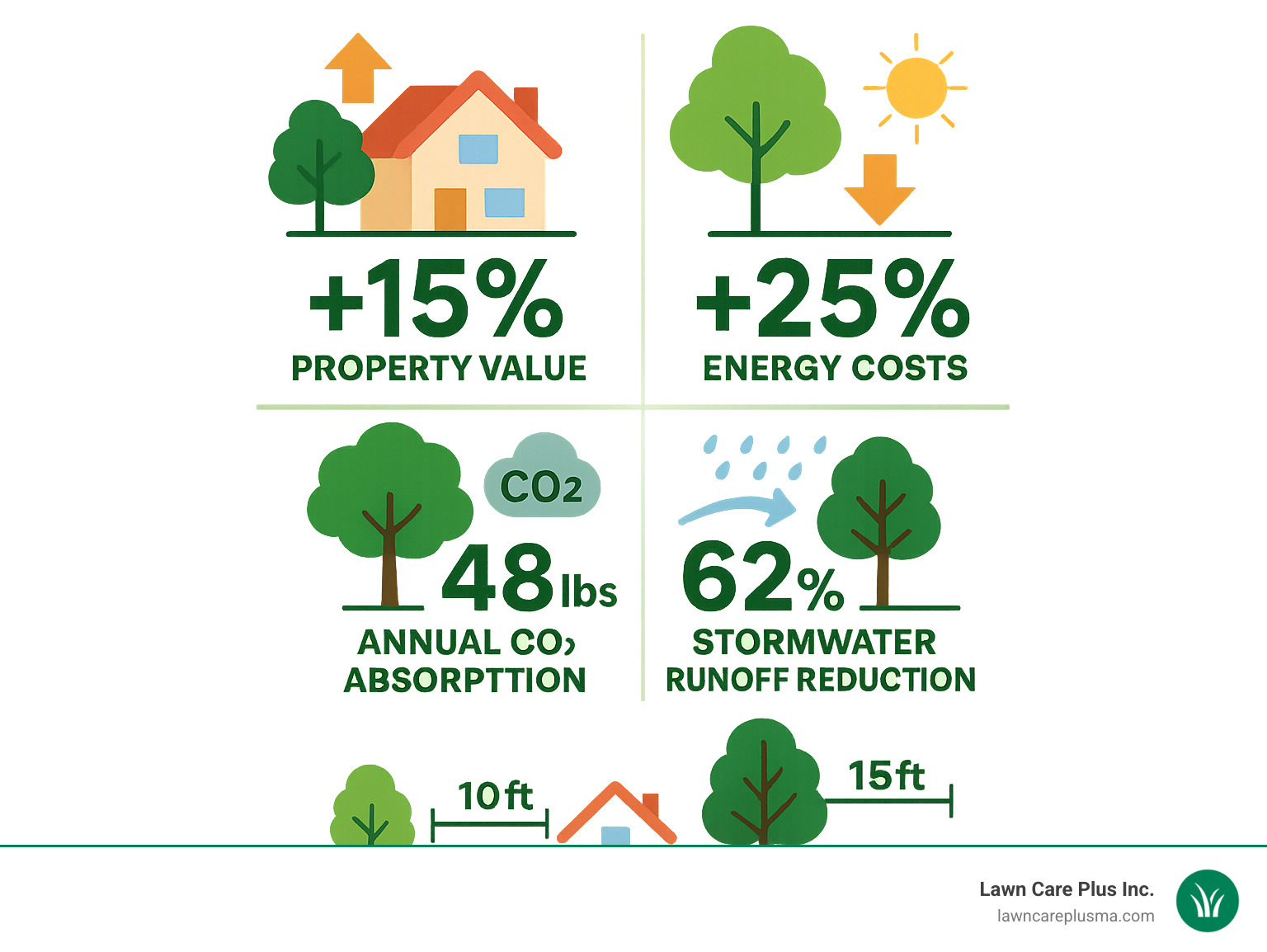
– Property Value: Increases home value by up to 15%
– Energy Savings: Reduces household energy costs by up to 25% through strategic shade and windbreaks
– Environmental Impact: One mature tree absorbs 48 pounds of CO2 annually
– Storm Management: Trees reduce stormwater runoff by up to 62%
– Privacy & Beauty: Creates natural screens while adding four-season interest
Trees aren’t just plants—they’re living investments that pay dividends for decades. A properly placed shade tree can slash your summer cooling bills, while a privacy screen of evergreens eliminates the need for expensive fencing.
The secret lies in planning first, planting second. Consider your goals, soil conditions, and mature tree size before breaking ground. Small trees under 30 feet need at least 10 feet of clearance from structures, while larger specimens require 15+ feet.
From choosing the right species for Massachusetts weather to avoiding common mistakes like “volcano mulching,” smart tree landscaping requires both vision and expertise.
Tree landscaping further reading:
– landscape design norwood ma
– landscaping and masonry
– residential landscape architect near me
Choosing & Placing the Right Trees for Your Yard
Think of choosing the right tree like matchmaking—you want a perfect partnership between your specific yard conditions and a tree that will thrive there for decades. Too many homeowners fall in love with a gorgeous specimen at the nursery, only to watch it struggle or fail because it wasn’t suited to their particular spot.
Massachusetts spans hardiness zones 5a through 7a, which means what survives a winter in Pittsfield might not make it through a cold snap in the Berkshires. Your soil type matters just as much—clay soil holds moisture but can suffocate roots, while sandy soil drains quickly but may leave trees thirsty.
Here’s where growth rate becomes crucial. Fast-growing trees (shooting up 2+ feet per year) give you quick results but often have weaker wood and shorter lifespans. Slow growers (under 12 inches annually) test your patience but typically reward you with stronger, longer-lived trees.
We always steer clients toward native species when possible. Trees like Red Maple, White Oak, and Eastern Redbud have spent thousands of years adapting to our New England weather. They support local wildlife, resist regional pests, and generally require less fussing once established.
Watch out for invasive species that can escape your yard and crowd out native plants in our forests. The right-tree-right-place principle emphasizes working with nature rather than against it.
Define Your Goal Before You Dig
Every tree should earn its keep in your landscape. We’ve learned that homeowners who start with a clear purpose create outdoor spaces that actually work for their lifestyle.
Need shade? Plant deciduous trees on your home’s south and west sides. Sugar Maples and Red Oaks are champions at this—they’ll block scorching summer sun but let warming winter light through their bare branches.
Want privacy? Evergreens like Eastern White Pine or Arborvitae create year-round screens. Plant them closer together than their mature spread suggests for faster coverage.
Tired of winter wind? A windbreak of evergreens planted 50 to 100 feet away can significantly cut your heating bills.
Love watching birds? Native fruit trees like Serviceberry and American Holly turn your yard into a wildlife café while adding gorgeous seasonal color.
Boosting curb appeal? Ornamental trees like Flowering Dogwood or Japanese Maple create stunning focal points that neighbors will admire.
Applying the Half-Spread Rule in Tree Landscaping
The half-spread rule might be the most important concept you’ll learn about tree landscaping. This simple math prevents expensive headaches down the road and gives your trees room to reach their full potential.
Here’s how it works: find your tree’s mature canopy width (usually noted on the plant tag), cut that number in half, and plant at least that distance from structures, property lines, or other trees. So if you’re eyeing a Red Oak that’ll eventually spread 50 feet wide, plant it at least 25 feet from your house, fence, or neighboring trees.
This spacing prevents root systems from damaging foundations and driveways, ensures each tree gets adequate sunlight and air circulation, and gives you room to maintain your trees properly as they mature.
Don’t forget about the root flare—that’s where the trunk widens as it meets the soil. This area should be visible after planting, not buried under dirt or mulch.
How Far Should Trees Be From Structures in Tree Landscaping?
Getting tree placement distances right the first time saves you from the heartbreak (and expense) of removing a beloved tree that’s threatening your foundation or tangling with power lines.
Small trees under 30 feet need 10 to 15 feet from your house and foundation, at least 10 feet from power lines, and 8 to 10 feet from driveways and walkways. Even compact trees deserve 5 to 8 feet of space from property lines.
Large trees over 30 feet need serious respect. Plant them 20 to 30 feet minimum from houses and foundations, 25+ feet from power lines (or skip planting near them entirely), 15 to 20 feet from driveways, and 15 to 25 feet from property lines.
Special situations require extra caution. Keep all trees at least 25 feet from septic systems—roots and sewage don’t mix well. Swimming pools need 15+ feet of clearance to prevent constant leaf cleanup. And always call 811 before digging to locate underground utilities.
These distances are minimums, not maximums. When you’re unsure, plant farther away. For complex situations where you’re considering large trees near structures, professional guidance can save you years of worry and potentially thousands in future tree removal projects.
Planting & Caring for New Trees
Getting your new tree off to a strong start isn’t rocket science, but it does require attention to detail. After years of planting trees across Massachusetts, we’ve learned that the first year makes all the difference between a tree that thrives and one that merely survives.
The foundation of successful tree planting starts with the hole. Dig it twice as wide as the root ball but never deeper. Trees need their roots to spread horizontally, not dive deep. A wide, shallow hole encourages the kind of lateral root growth that keeps your tree anchored during those notorious New England storms.
Here’s where many people go wrong: they think they’re helping by digging deeper and adding lots of fancy soil amendments. Keep the backfill simple—use the original soil mixed with about 20-30% organic compost. Heavy amendments can create what we call a “pot effect,” where roots get comfortable in their amended soil and never venture out to establish properly.
Staking is another area where less is often more. Only stake your tree if it’s in a particularly windy spot or has a weak root system. Even then, remove those stakes after one growing season. Trees need to move a little in the wind—it’s how they build trunk strength.
Now let’s talk about watering, because this is where we see the most confusion. Your new tree needs consistent moisture, not occasional flooding. Start with daily deep watering for the first two weeks, then switch to every other day for the next few months. By month four, weekly watering during dry spells should be enough. After the first year, only water during genuine drought conditions.
Mulching is like giving your tree a security blanket. Apply 2-3 inches of organic mulch in a ring extending out to the drip line, but—and this is crucial—keep that mulch at least 6 inches away from the trunk. Mulch touching the trunk invites rot and pest problems you definitely don’t want to deal with later.
Here’s something that surprises many homeowners: skip the fertilizer that first year. Your newly planted tree is focused on establishing roots, not putting on new growth. Fertilizer can actually stress a tree that’s already working hard to settle into its new home.
Based on internet research, tree planting costs typically range from $300-$1,200 per tree, though prices can vary dramatically—sometimes up to three times these amounts—depending on the tree size, species, and how challenging your site conditions are.
Best Planting Day Checklist
We’ve learned that a little preparation goes a long way toward planting success. Here’s what we always do before breaking ground:
Before you even think about digging, call 811. It’s the law in Massachusetts, and hitting a utility line can turn your tree planting project into an expensive nightmare. Give them a few days to mark your utilities—it’s free and could save you thousands.
Check the weather forecast and aim for an overcast day if possible. Your tree will thank you for avoiding the stress of blazing sun during its most vulnerable moment.
Gather your tools ahead of time: a sharp spade (dull tools make the job harder and can damage roots), pruning shears for any damaged branches, your hose or watering system, organic compost, and mulch. Don’t forget proper safety gear—work gloves, safety glasses, and sturdy boots.
Plan your watering schedule for the next month before you plant. Consistency is key, and it’s easier to stick to a schedule when you’ve thought it through in advance.
Mulch vs. Landscape Fabric – What Works Best?
This question comes up in almost every tree landscaping conversation we have with homeowners. Both materials have their place, but they work very differently.
Organic mulch is usually our go-to recommendation because it does double duty—suppressing weeds while actually improving your soil as it breaks down. Shredded bark or wood chips create the forest floor conditions that trees naturally love. They retain moisture beautifully, and as they decompose, they feed beneficial soil organisms that help your tree thrive.
The downside? Organic mulch needs refreshing every year or two as it breaks down. Some homeowners see this as maintenance; we see it as an opportunity to keep improving your soil.
Landscape fabric excels at weed control, especially in the first few years. It’s particularly useful on slopes where mulch might wash away or in high-traffic areas where mulch gets kicked around. The initial cost is higher than mulch, but it can last 3-5 years if maintained properly.
Here’s the catch: fabric can work against you over time. It can restrict air and water flow to roots, and as it degrades, pieces can work their way to the surface. When fabric gets clogged with debris (and it will), it actually prevents water from reaching your tree’s roots.
Our recommendation? For most residential tree landscaping situations, stick with organic mulch. It’s better for tree health, looks more natural, and supports the soil ecosystem your tree depends on.
Consider fabric only for specific challenges—steep slopes, commercial installations requiring minimal maintenance, or areas where mulch consistently gets displaced. If you do choose fabric, invest in high-quality, permeable versions and plan to replace them every few years.
For ongoing care of your established trees and landscapes, our landscape maintenance services are designed specifically for Massachusetts growing conditions.
Designing Around Trees & Solving Tree Landscaping Challenges
Working with existing trees often presents more interesting design opportunities than starting from scratch. Over the years, we’ve found that the biggest tree landscaping challenges usually become the most beautiful solutions once you learn to work with nature instead of against it.
Take exposed roots, for example. Many homeowners panic when they see tree roots popping up above the soil line. The temptation is to dump dirt on them or hack them away, but both approaches can seriously harm your tree. Instead, we’ve learned to celebrate these natural sculptures by creating attractive groundcover plantings around them or designing beautiful mulch rings that highlight the tree’s character.
Poor drainage under trees doesn’t have to mean muddy messes. Trees like Red Maple and River Birch actually love wet feet, turning boggy problem areas into stunning rain gardens that manage stormwater naturally while looking gorgeous.
When dealing with limited light under dense canopies, think forest floor rather than sunny meadow. These naturally cool, shaded areas stay comfortable all summer long and require much less watering than sun-baked spaces.
Creative design elements can turn ordinary tree areas into outdoor living spaces. Landscape lighting transforms trees into evening sculptures while providing security. We’ve installed everything from simple uplighting to dramatic hammock posts between sturdy trees, creating instant backyard retreats.
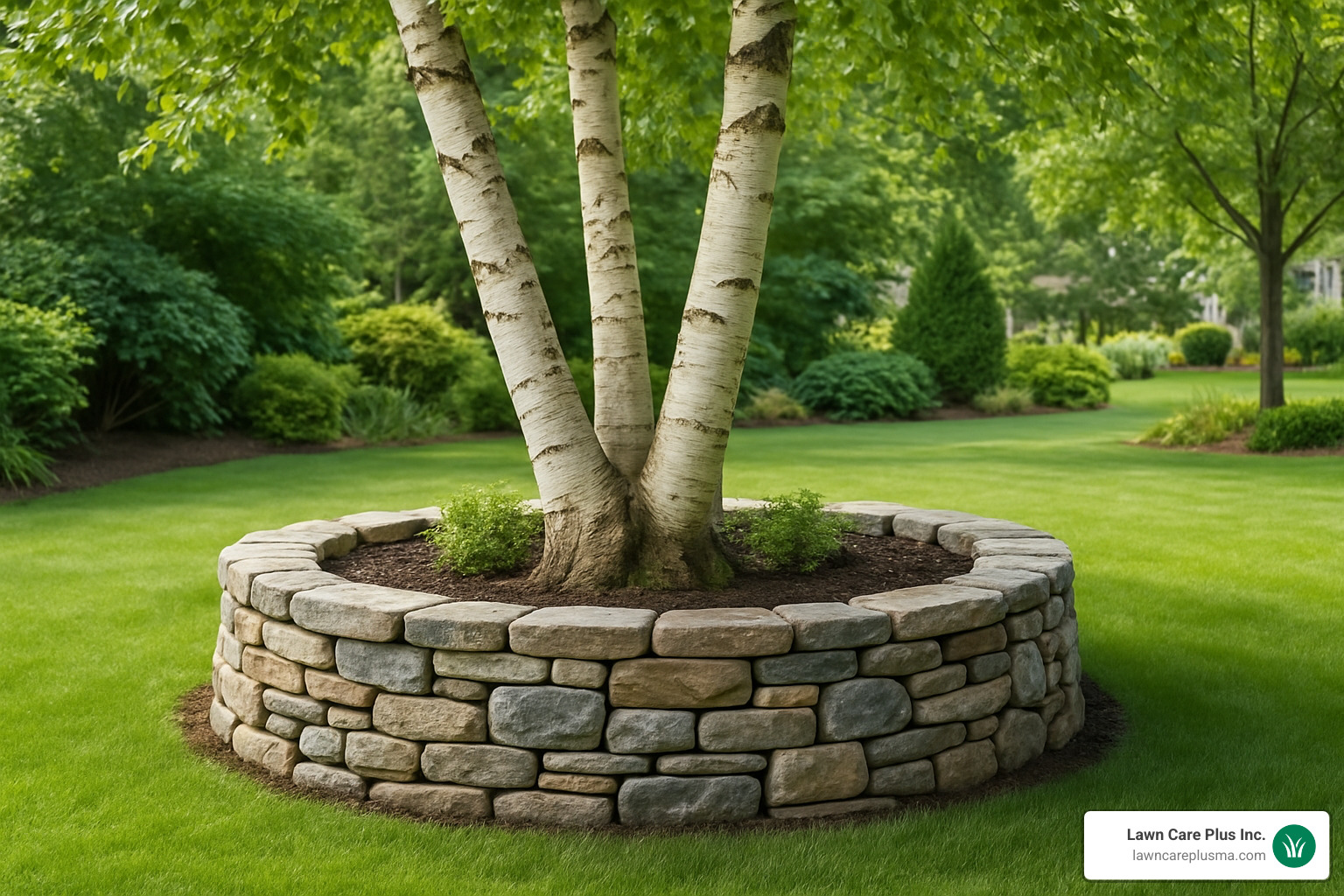
Retaining walls solve multiple problems at once, especially on sloped terrain. A well-built stone wall can prevent erosion, create level planting areas, and provide stunning visual contrast against tree bark and foliage.

Small-Space Superstars for Front Yards
Small properties don’t mean you have to skip trees entirely. Some of our favorite tree landscaping projects involve compact trees that pack maximum punch into minimal space.
Serviceberry stands out as our top recommendation for Massachusetts front yards. This native beauty reaches a manageable 15-20 feet at maturity while delivering something special in every season. Spring brings clouds of white flowers, summer offers sweet berries that birds love, fall explodes in brilliant color, and winter showcases attractive bark patterns.
Eastern Redbud creates unforgettable spring drama when its bare branches burst into purple-pink blooms before a single leaf appears. The heart-shaped leaves that follow turn golden-yellow in fall, and the tree’s graceful spreading form makes it perfect as a specimen planting or driveway marker.
For truly tight spaces, dwarf crabapples deliver spectacular spring flower shows followed by colorful fruit that persists into winter. Modern disease-resistant varieties have solved the old problems with these trees, making them reliable performers that stay compact at 8-15 feet tall.
Paperbark Maple might be our best-kept secret for adding four-season interest to front yards. Yes, it grows slowly, but the exfoliating bark provides incredible winter drama, and the fall color rivals any tree we’ve planted.
For more ideas about incorporating native species into your front yard design, check out our guide to native plants Massachusetts.
Under-Tree Garden Combos
Creating thriving gardens beneath trees requires understanding what makes these spaces special. The dappled shade, root competition, and often drier soil conditions aren’t problems to solve—they’re opportunities to create something uniquely beautiful.
Hostas and ferns form the backbone of most successful under-tree plantings, and for good reason. Hostas come in dozens of sizes and leaf patterns, from tiny miniatures to giants with leaves the size of dinner plates. Pair them with Christmas ferns for evergreen structure that looks good even in winter.
Spring bulbs add early-season magic to tree gardens. Plant them in fall, and you’ll have waves of color in March and April before the tree canopy fills in and blocks the light. Daffodils, crocuses, and grape hyacinths naturalize beautifully under trees, coming back stronger each year.
For something more adventurous, try native woodland plants like Wild Ginger, which spreads to form dense groundcover, or the architectural umbrella leaves of Mayapple.
Epimedium deserves special mention as one of the toughest groundcovers for dry shade. Once established, it tolerates drought, dense shade, and root competition while producing delicate flowers in spring and attractive foliage all season long.
The secret to success is thinking in layers and drifts rather than single plants scattered around. Plant groups of the same species together for impact, and layer different heights from groundcovers up to small shrubs.
Common Tree Landscaping Mistakes & How to Avoid Them
After decades of fixing other people’s tree problems, we’ve seen the same mistakes over and over. The good news? They’re all completely preventable with a little knowledge.
Volcano mulching tops our list of tree-killing mistakes. We see it everywhere—mulch piled up against tree trunks like little volcanoes. This creates the perfect environment for rot, insects, and disease. Think “donut, not volcano.” Keep mulch at least 6 inches away from trunks and never deeper than 3 inches.
Ignoring mature size causes expensive headaches down the road. That cute little tree at the nursery might grow 60 feet tall and 40 feet wide. We’ve removed countless beautiful, healthy trees simply because they were planted too close to houses, driveways, or property lines.
Planting too deep kills more trees than drought. The root flare—where the trunk widens at the base—should be visible at soil level. Trees planted too deep can’t get enough oxygen to their roots and often develop trunk rot.
Topping trees by cutting main branches back to stubs ruins the tree’s natural structure and creates weak, dangerous growth. Proper pruning maintains the tree’s natural form while removing only what’s necessary for health and safety.
Don’t forget about pruning permits—many Massachusetts communities require permits for major tree work, especially on larger trees or in historic districts.
The biggest mistake of all? Impulse planting based solely on how a tree looks at the garden center. Consider your site conditions, maintenance requirements, and long-term goals first.
Frequently Asked Questions about Tree Landscaping
When it comes to tree landscaping, we hear the same questions over and over from homeowners across the Boston Metro-West area. These three topics come up in nearly every consultation, so let’s address them head-on.
What’s the safest way to trim high branches myself?
Here’s the honest truth: if you can’t reach it safely from the ground, you probably shouldn’t be doing it yourself. For branches within reach using a pole saw or pruner, always use the proper three-cut technique—make an undercut first, then a top cut, and finish with a clean cut at the branch collar.
But here’s where we draw the line: anything above 10 feet or anywhere near power lines should be left to certified arborists. We’ve seen too many weekend warriors end up in the emergency room because they underestimated the risks. Ladders around trees are notoriously unstable, falling branches are unpredictable, and electrical hazards can be deadly.
Professional arborists have specialized equipment, years of training, and insurance for a reason. The few hundred dollars you might save on DIY tree work isn’t worth risking your life or your property.
Can I plant over existing exposed roots?
This is one of those questions where the simple answer saves you a lot of heartache later: don’t do it. Adding soil over tree roots might seem like an easy fix for those gnarly surface roots, but you’re essentially suffocating your tree.
Trees need oxygen at their root zone, and piling soil on top cuts off that vital air supply. Instead, work with those exposed roots rather than against them. Plant shallow-rooted groundcovers around them, create attractive mulch rings, or accept those roots as natural garden features.
If you absolutely must add some soil for planting purposes, limit it to 2-3 inches maximum and use a sandy, well-draining mix that won’t compact. Better yet, consider container plantings or raised beds that don’t actually contact the root zone. Sometimes the best tree landscaping solution is the one that works with nature instead of fighting it.
When should I hire a professional arborist instead of DIY?
The short answer? When safety, complexity, or local regulations are involved. Call in the professionals for any work involving power lines, trees over 30 feet tall, or trees that are diseased, damaged, or dead. These situations require expertise that comes from years of training and specialized equipment.
You should also consider professional help for complex pruning, complete tree removal, stump grinding, or when your municipality requires permits for tree work. Many towns in Massachusetts have strict regulations about tree removal, especially for larger specimens or trees in protected areas.
DIY is perfectly fine for small tree planting, basic mulching, regular watering, and light pruning of young trees. These tasks are straightforward and don’t involve significant safety risks.
When you’re genuinely unsure about your tree’s health or the scope of work needed, a consultation with a certified arborist can help you determine what’s safe to tackle yourself versus what requires professional expertise. Think of it as an investment in both your safety and your trees’ long-term health.

Conclusion
Tree landscaping is one of the smartest investments you can make in your property. We’ve covered everything from selecting the perfect species for Massachusetts weather to mastering proper planting techniques, and there’s one truth that stands out: the trees you plant today will reward you for decades to come.
Think about it—while other home improvements depreciate, trees actually increase in value over time. That shade tree you plant this spring will be cooling your home, cleaning your air, and boosting your property value long after you’ve forgotten what you paid for it.
The secret sauce isn’t complicated. Start with your goals, whether that’s creating a private backyard oasis or adding stunning curb appeal. Apply the half-spread rule to avoid costly placement mistakes. Focus on soil health and consistent watering during that crucial first year. These fundamentals will set your trees up for a lifetime of success.
We know every yard in the Boston Metro-West area has its own personality—sandy soil here, clay there, that perfect sunny spot or that challenging shady corner. What works in Wellesley might need tweaking in Waltham. That’s where experience makes all the difference.
At Lawn Care Plus Inc., we’ve spent years learning what thrives in our unique New England conditions. We understand which native species will flourish in your specific microclimate and how to give them the best possible start. From tree landscaping design through installation and ongoing care, we’re here to turn your outdoor vision into reality.
Ready to plant your property’s future? Our comprehensive landscaping services cover everything you need to create that shady, stunning landscape you’ve been dreaming about. Let’s work together to choose the right trees, put them in the right places, and watch your investment grow—literally.
Your perfect landscape is just a phone call away. Let’s get started!
