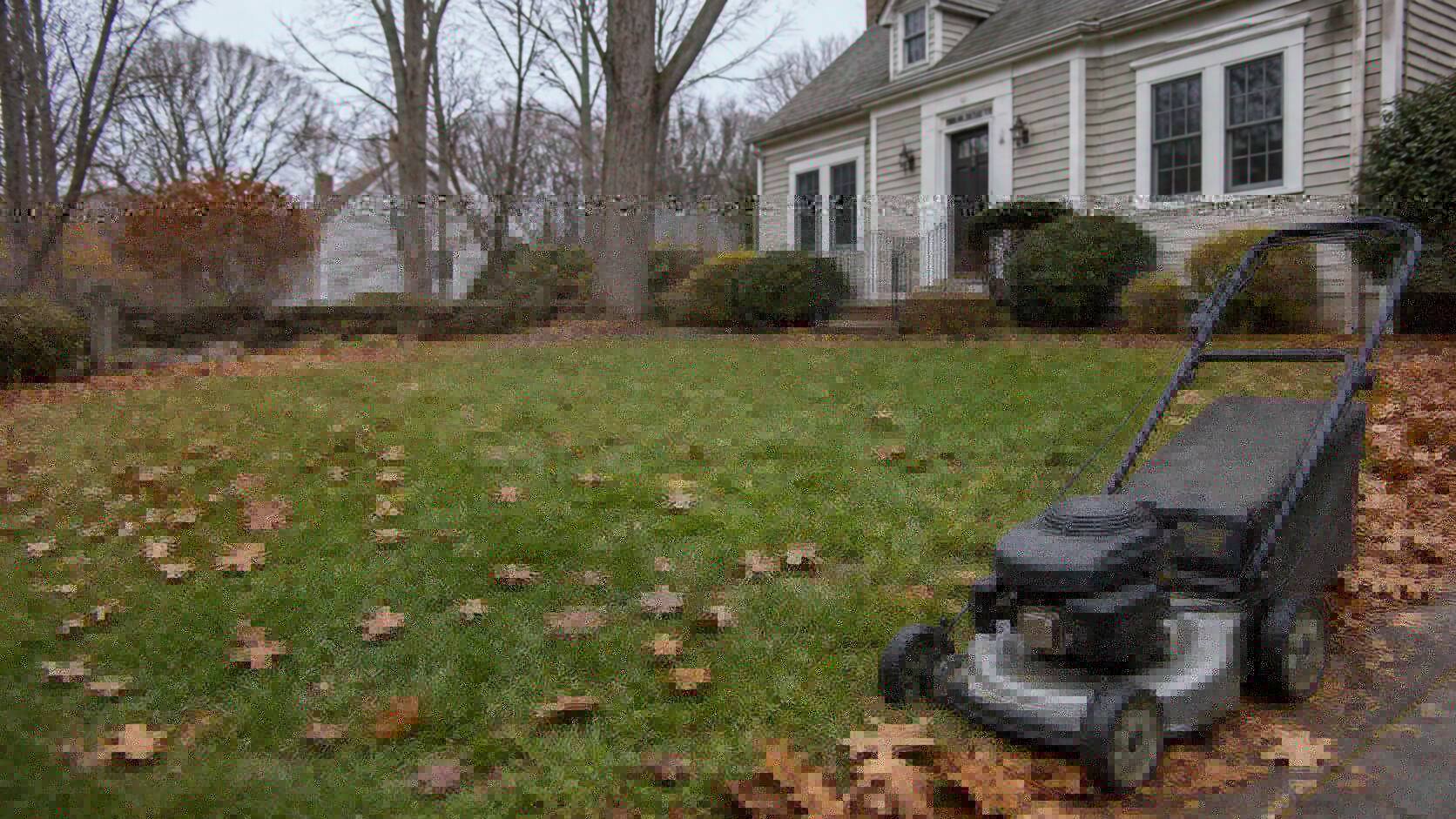
If you are deciding when to stop mowing your lawn in Massachusetts, watch the grass rather than the calendar. Continue mowing in fall while the turf is still adding noticeable height, then stop when growth has effectively ended and another cut would not improve the lawn. A warm stretch may create one more mowing window; cold, saturated, or frozen conditions may close it.
The goal of the last cut is not to make the lawn unusually short. It is to leave cool-season turf evenly cut, free of heavy leaf mats, and undamaged by a mower used in poor conditions.
Why a fixed “last mowing date” does not work
Massachusetts lawns do not all enter winter on the same weekend. Coastal influence, elevation, shade, soil moisture, and short warm periods can change how long turf continues to grow. Even different areas of the same property may slow down at different times.
A calendar date can remind you to start checking, but it should not make the final decision. The better test is whether the lawn has produced enough new growth since the previous cut to need mowing again.
Use a three-question decision check
Quick decision: Mow if the grass has grown and the surface is firm and dry enough for a clean cut. Wait if turf is frosted or soil is saturated. Stop when growth has ended and the lawn is already within its normal mowing range.
Before bringing the mower out in late fall, answer these questions in order:
- Has the grass grown? Compare the turf with its height after the previous cut. If there is no meaningful increase, mowing again provides little value.
- Can the surface support a clean cut? Soil should be firm enough to avoid ruts, and grass blades should not be frosted, frozen, or coated with heavy moisture.
- Can leaves be managed first? Remove or mulch a light leaf layer before it interferes with cutting. Do not mow blindly through a deep, wet mat.
If the answer is yes to all three, another mow may be appropriate. If the grass has grown but conditions are wet or frosty, wait for a better window. If growth has stopped, put the mower away rather than cutting simply because the date feels late.
Keep the final cut within a normal mowing range
Late fall is not the time for a drastic height change. Cutting much shorter than usual removes photosynthetic leaf area and can scalp uneven ground. Leaving excessive growth can make the lawn harder to manage under leaves and winter moisture.
UMass Extension recommends mowing cool-season lawn grasses at roughly 2.5 to 3.5 inches and continuing into fall until the turf stops growing. Its mowing guidance also applies the one-third rule: do not remove more than one-third of the grass blade in a single cut.
That rule is more useful than chasing a special “winter height.” If the lawn has become overgrown, reduce it gradually across separate mowing opportunities rather than making one severe final cut. Use the higher end of the appropriate range where shade, stress, or turf type calls for it.
Before the last expected cut, confirm the mower’s actual deck setting instead of relying only on the lever label. Uneven wheels, a bent blade, or a deck set lower than intended can turn a routine late-fall pass into an accidental scalp.
Know the difference between “wait” and “stop”
Some late-fall conditions mean postpone the work, not end the season:
- Wait after frost. Give frozen or frosted blades time to thaw and dry so mower traffic does not bruise the turf.
- Wait on saturated soil. If tires or shoes leave depressions, mowing can create ruts and compaction.
- Wait when leaves hide the surface. Clear enough debris to see obstacles and evaluate the grass height.
By contrast, stop for the season when grass height is no longer increasing, the lawn is already within its normal mowing range, and colder conditions are becoming persistent. A few mild afternoons do not automatically mean the lawn needs another cut.
Handle leaves without turning the article into a fall-cleanup plan
Leaves matter to the mowing decision because they can block light, hold moisture, hide hazards, and prevent an even cut. A thin, dry layer may be mulched finely if the mower can process it without leaving clumps. A heavy or wet layer should be removed before mowing.
Do not use the mower to force wet leaves and long grass into one pass. Separate the tasks: clear the surface, reassess actual turf height, and mow only if the grass itself still needs it. That produces a cleaner cut and avoids treating leaf removal as proof that mowing is required.
Complete a short winter-ready check
Once active growth has stopped, walk the lawn once more and confirm that:
- the turf is at an even, normal height rather than scalped or matted;
- thick leaf piles are not covering grass or blocking drainage;
- sticks, toys, hoses, and other objects are removed before snow cover;
- soft or damaged areas are noted so they are not driven over; and
- the mower is cleaned and stored according to its manufacturer’s instructions.
If grass resumes measurable growth during an extended mild spell and the soil is firm, repeat the three-question check. Otherwise, leave the lawn alone until spring conditions support mowing again.
Base the last mow on conditions, not pressure to pick a date
For most Massachusetts properties, the right stopping point is a field decision: growth has ended, height is appropriate, leaves are under control, and mowing conditions are no longer consistently suitable. That approach avoids both an unnecessary late cut and an overgrown lawn left under winter debris.
Lawn Care Plus offers lawn care services in Greater Boston for properties that need ongoing seasonal maintenance. A condition-based mowing decision is a small but useful part of preparing the lawn for winter.