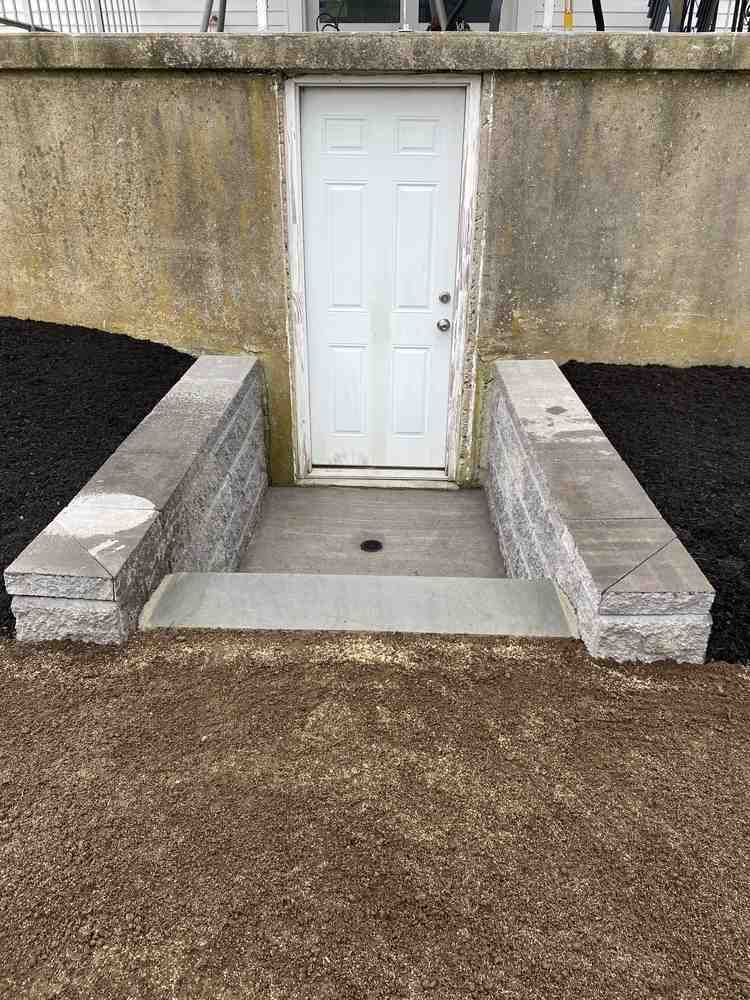
More Than Just a Wall: Open uping Your Property’s Potential
A Retaining Wall Builder is a professional contractor who specializes in designing, engineering, and constructing retaining walls to manage soil, prevent erosion, and create usable space on sloped terrain. Here’s what a qualified retaining wall builder does:
- Site Assessment – Evaluates soil type, drainage patterns, and slope conditions
- Design & Planning – Determines appropriate wall height, materials, and reinforcement needs
- Proper Installation – Excavates, prepares foundations, installs drainage systems, and builds the wall to engineering standards
- Permits & Engineering – Secures necessary permits and works with engineers for walls over 4 feet tall
- Long-Term Stability – Ensures proper compaction, backfill, and water management to prevent failure
If you’re dealing with a sloped yard, you know the frustration. Rain washes away soil. Your lawn becomes unusable space. Water pools where you don’t want it. A retaining wall solves these problems while adding beauty and value to your property.
Retaining walls are feats of engineering designed to redistribute the pressure and forces of sloping ground. They stabilize soil around foundations and driveways, manage water runoff, and create flat, usable areas from previously wasted space. But here’s the truth: a poorly designed or installed retaining wall can lean, crack, or completely collapse—sometimes causing catastrophic damage to your landscape or even your home.
The stakes are high. Soil weighs over 100 pounds per cubic foot, and when water saturates that soil, the pressure becomes immense. That’s why proper drainage, compaction, and construction techniques aren’t optional—they’re essential.
I’m Tim DiAngelis, owner of Lawn Care Plus, Inc., and I’ve spent over a decade helping homeowners and commercial clients throughout Greater Boston and Metro-West transform challenging slopes into beautiful, functional outdoor spaces. As a Retaining Wall Builder, I’ve seen how the right design and installation can protect your property investment for generations.
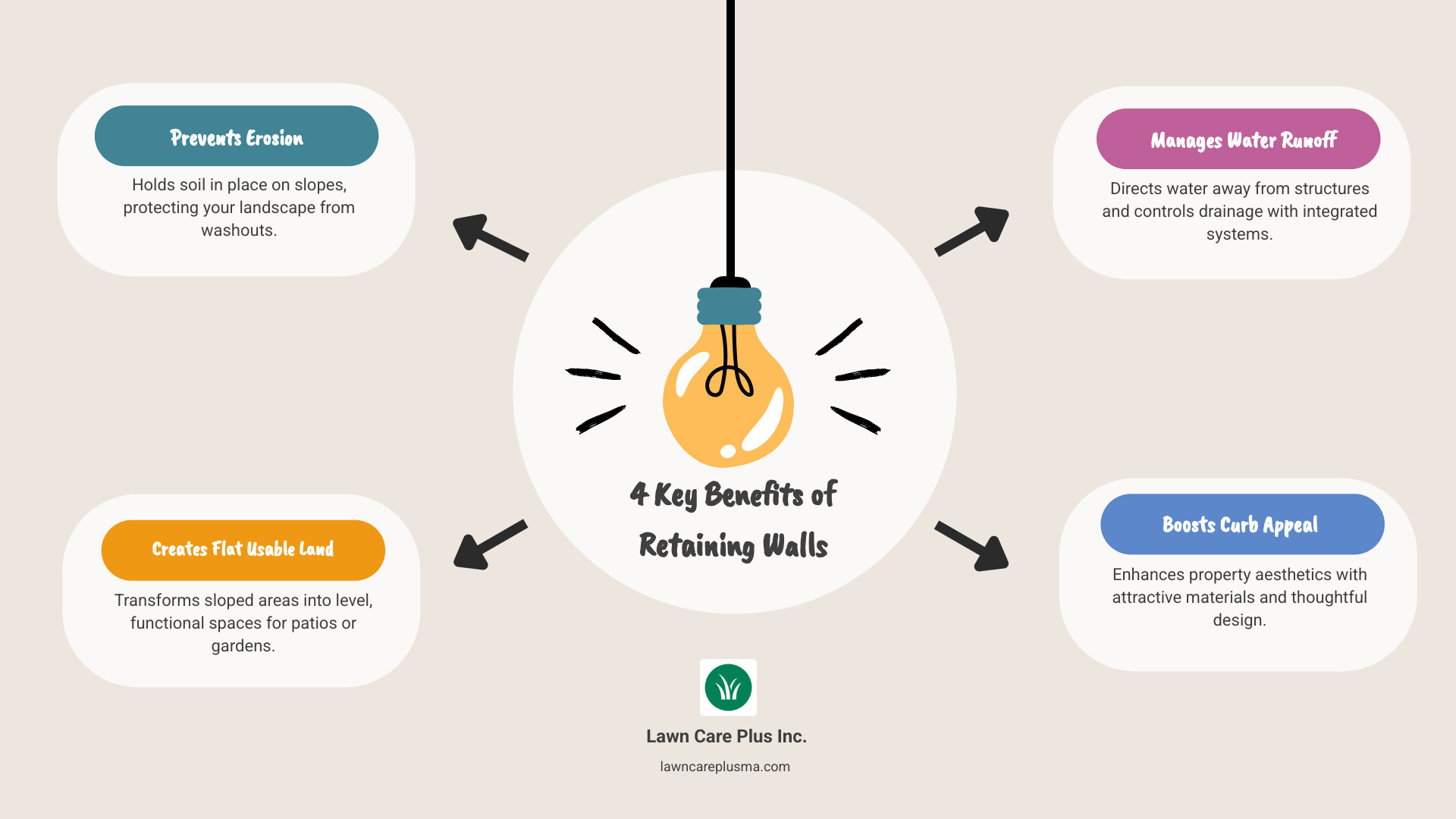
Retaining Wall Builder terms to learn:
More Than Just a Wall: Opening up Your Property’s Potential
For many property owners in Massachusetts, especially in areas like Belmont, Newton, or Brookline, sloped terrain is a common challenge. These slopes can lead to several headaches:
- Erosion Control: The most fundamental function of a retaining wall is to control erosion. Sloping ground is highly susceptible to wind and water erosion, which can wash away precious topsoil, damage landscaping, and even undermine the foundations of structures. Our retaining walls help to prevent or control this, maintaining the shape and integrity of your property.
- Creating Usable Space: Imagine changing a steep, unused incline into a vibrant tiered garden, a level patio for entertaining, or a safe play area for children. Retaining walls make this possible by restraining soil to a more desirable, often flatter, grade. This effectively expands your usable outdoor living space.
- Increasing Property Value: A well-designed and professionally installed retaining wall system can significantly improve your home’s curb appeal and functionality. This, in turn, boosts its market value. It shows potential buyers that the property is well-maintained and thoughtfully designed.
- Redirecting Water Problems: Beyond preventing erosion, retaining walls can be strategically designed to manage water runoff. By channeling water away from critical areas like your home’s foundation or driveways, they protect against water damage.
- Structural Support and Safety: Retaining walls stabilize the sloping ground, preventing it from crumbling. This is especially important for properties on challenging soil types, like clay, or land prone to water damage. By holding back the soil, they prevent catastrophic damage to landscapes and even homes.
Retaining walls are not merely functional structures; they are also major site features that contribute significantly to your landscape’s visual aesthetic. We believe in an emphasized focus on great design that will not only increase the longevity of your wall but will also add to the beauty of your yard.
Designing Your Wall: From Foundation to Finishing Touches
Designing a retaining wall is a blend of art and science. It requires careful consideration of the site’s unique characteristics, the desired function of the wall, and the aesthetic you wish to achieve. Whether it’s a small garden wall in Canton or a larger structural wall in Dedham, each project demands a custom approach.
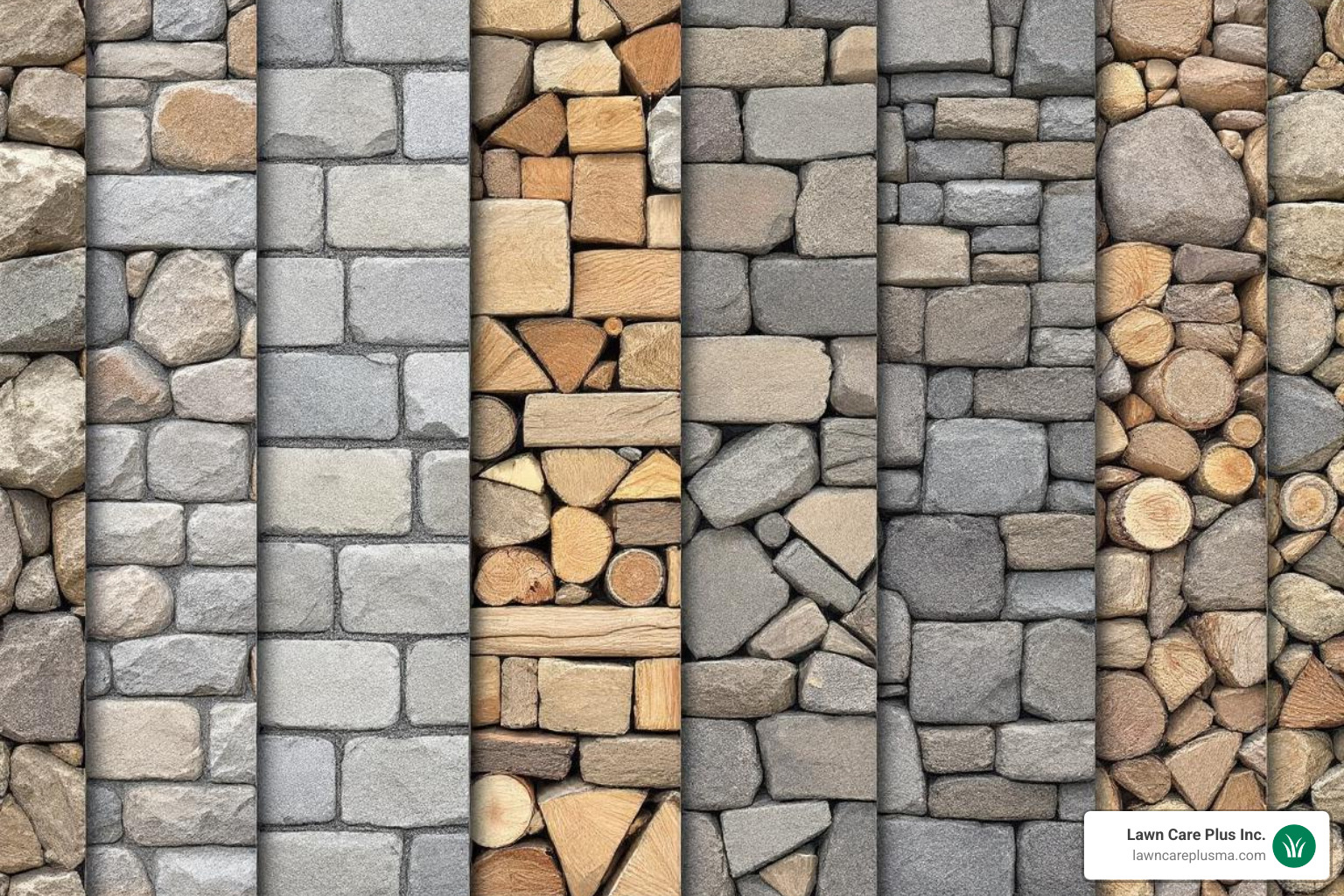
A collage showing different retaining wall materials like natural stone, interlocking blocks, and boulders.
Key Design Considerations
When we work with you on your retaining wall project, we discuss several key elements:
- Size and Location Planning: The purpose of your wall dictates its size. A wall built to hold back a large amount of soil for a new driveway in Needham will generally be larger and more robust than a decorative garden wall in Milton. Its location is crucial for properly redistributing the pressure of sloping ground.
- Material Selection: The material you choose impacts not only the look but also the structural integrity and lifespan of your wall. We consider the surrounding landscape, your home’s architectural style, and the amount of pressure the wall needs to withstand.
- Aesthetic Possibilities: Retaining walls can be visually stunning structures. We can integrate them into your landscape design, adorned with climbing vines, built-in seating, or neat lighting, creating a personalized outdoor living space. Our hardscaping and masonry services offer a wide range of options to achieve your vision.
Choosing the Right Materials
The material choice for your retaining wall is paramount. It affects the weight it can support, its durability, and the overall aesthetic. Here’s a comparison of common retaining wall materials we work with:
| Material | Pros | Cons | ||
|---|---|---|---|---|
| Concrete Blocks | Versatile, many styles, good for various applications. Durable, strong, often more cost-effective than natural stone. | Can be heavy. Mortared walls require more skill. Permeable, needs good drainage. | 50-100+ years | General landscape retaining, garden walls, structural support. |
| Poured Concrete | Extremely strong, monolithic structure, highly durable. Can be formed into various shapes. | Requires extensive formwork, professional expertise, and longer curing times. Less natural aesthetic. | 50-100+ years | Heavy-duty applications, commercial projects, high load-bearing requirements. |
| Natural Stone | Best aesthetic appeal, classic and timeless look, very durable. | Expensive, labor-intensive installation, requires skilled masonry. Weight-bearing capacity depends on stone type and construction. | 100+ years (often much longer) | Decorative walls, high-end landscaping, historical properties. |
| Timber (Railroad Ties) | Affordable, relatively easy to install for DIYers. Natural, rustic look. | Limited weight support. Prone to rot, decay, and insect damage. Shorter lifespan. SPO H1: Retaining Wall Builder |
Segmental Retaining Walls (SRW), also known as modular block walls, are a popular choice due to their versatility and ease of installation. They are composed of manufactured concrete blocks that interlock, often without mortar. The design allows for flexibility, including curves and various finishes. While they are a type of gravity wall, their system-based design allows for more engineered solutions, especially with the integration of geogrid reinforcement.
Poured Concrete Retaining Walls
Poured concrete walls are built by erecting forms and then pouring concrete into them, often with steel rebar reinforcement. This creates a monolithic, exceptionally strong, and durable structure. They are ideal for heavy-duty applications and situations requiring a very long lifespan. The main drawback is the extensive labor for formwork and longer curing times.
Natural Stone Retaining Walls
For a truly classic and timeless aesthetic, natural stone retaining walls are unparalleled. These can range from dry-stacked fieldstone walls to mortared walls using cut bluestone or granite. While beautiful and incredibly durable, they are often the most expensive option due to the cost of materials and the specialized masonry skills required for installation.
Timber Retaining Walls
Timber retaining walls, often constructed from treated lumber or railroad ties, are generally the most affordable option. They offer a rustic aesthetic and can be relatively easy to install for smaller, less critical applications. However, timber has significant limitations: it is prone to rot, decay, and insect damage, and has a shorter lifespan compared to other materials. It also has limitations on the amount of weight it can support.
The Unseen Hero: Proper Drainage Design
No matter how robust your chosen material, a retaining wall is only as strong as its drainage system. Water is the archenemy of retaining walls, and if not managed properly, it will lead to failure. Here’s why and what we do about it:
- Hydrostatic Pressure Explained: When soil behind a wall becomes saturated with water, it significantly increases the pressure exerted on the wall. This is called hydrostatic pressure. Soil can weigh over 100 lbs per cubic foot, but when wet, it expands and becomes much heavier and more fluid, pushing outwards with immense force. This is a primary cause of walls leaning, bulging, or toppling.
- Importance of Gravel Backfill: We always install a layer of clean, angular crushed stone (wall rock) immediately behind the retaining wall blocks. This permeable layer allows water to quickly drain down to the base of the wall, preventing saturation of the soil directly against the structure.
- Filter Fabric Function: To prevent fine soil particles from migrating into the gravel layer and clogging the drainage system, we use a porous filter fabric. This fabric separates the drainage aggregate from the infill soil, maintaining the long-term efficiency of your wall’s drainage.
- Weep Holes and Drainage Pipes: At the base of the wall, behind the gravel backfill, we install perforated drain pipes. These pipes collect the water that filters through the gravel and direct it away from the wall’s foundation. We ensure these pipes are vented to daylight (exit spouts) every 50 feet or so, allowing the water to exit freely. This system is critical for any reinforced wall, gravity wall over 4 feet tall, or sites with poor drainage.
- Preventing Wall Failure: Proper drainage is not just a good idea; it’s essential for a retaining wall that will last a lifetime. Without it, even the strongest materials will succumb to the relentless forces of water. As experts, we understand that how to build a retaining wall that will last a lifetime hinges on meticulous attention to drainage.
The Critical Role of a Professional Retaining Wall Builder
When it comes to something as structurally vital as a retaining wall, trusting its construction to anyone less than a professional Retaining Wall Builder is a gamble. We’ve seen the headaches and expenses that arise from poorly designed or installed walls.

A professional crew excavating a trench for a retaining wall foundation.
Importance of Proper Installation
A retaining wall is a feat of engineering, and its longevity directly correlates with the quality of its installation. Here’s what we prioritize:
- Soil Type Analysis: Different soil types behave differently under pressure and with moisture. Clay soils, common in many Massachusetts towns like Roslindale or Watertown, can expand when wet, exerting significant force. Our team understands these nuances and plans the wall’s design and drainage accordingly.
- Compaction Techniques: A solid, well-compacted base and backfill are fundamental. We use professional-grade vibrating plate compactors to compact the base trench and backfill materials in 3-4 inch lifts. This increases the soil’s internal friction and directs pressure downwards, not outwards against the wall. We know that poorly compacted soil adds immense pressure to walls and can lead to instability.
- Foundation and Footing Requirements: The foundation is where your wall’s strength begins. Depending on the wall’s height and location, we may use a stone or concrete footing. For example, walls over 4 feet tall require a substantial base that can be several feet deep. We ensure the first course of blocks is buried and perfectly level, as this sets the stage for the entire structure’s stability.
- The Risks of Poor Construction: A retaining wall that isn’t built correctly is a ticking time bomb. It can lead to property damage or even disaster. We understand the physics of how soil “pushes” and how to build a wall that “pushes back.” Our expertise ensures that your investment is secure. For specific guidance on local requirements, explore our services for retaining walls in Brookline, MA.
What to Expect from Your Retaining Wall Builder During Installation
When you choose Lawn Care Plus Inc. as your Retaining Wall Builder, you’re partnering with a team committed to precision and durability. Here’s a typical seven-step process we follow:
- Site Assessment & Excavation: We begin with a thorough site assessment, marking out the wall’s layout and excavating the area. This includes removing any existing structures and ensuring the site is clear.
- Base Trench Preparation & Compaction: A critical step often underestimated in DIY projects. We excavate a trench wide enough for the wall and adequate space for drainage material. The trench bottom is then carefully compacted to create a stable foundation.
- Laying the Gravel Foundation: A layer of compacted wall rock (crushed stone) is laid in the base trench. This forms a strong, level, and permeable foundation upon which the first course of blocks will rest.
- Setting the First Course: This is arguably the most crucial step. The first course of blocks is placed, ensuring each block is perfectly level, both front-to-back and side-to-side. This establishes the structural integrity for the entire wall. For walls on slopes, we carefully step up the courses to follow the grade.
- Building Subsequent Courses & Adding Reinforcement: We stack subsequent courses, offsetting vertical seams for increased strength. For taller walls or those retaining significant loads, we incorporate geogrid reinforcement at specified intervals, extending it into the compacted backfill to tie the wall into the soil mass.
- Installing Drainage System & Backfilling: As the wall goes up, we simultaneously install the drainage system. This involves filling the hollow cores of blocks and the area immediately behind the wall with wall rock, placing perforated drain pipes at the base, and ensuring exit spouts are properly located. Backfill soil is then added in thin layers (lifts) and compacted thoroughly.
- Final Grading & Cleanup: Once the wall is complete, we ensure the area is properly graded to direct surface water away from the wall. We then perform a comprehensive cleanup, leaving your property immaculate.
Why a DIY Retaining Wall Builder Can’t Match Professional Results
While tempting, tackling a retaining wall project yourself often leads to costly mistakes and short-lived results. Here’s why a professional Retaining Wall Builder is invaluable:
- Potential Failures: Without proper engineering knowledge and experience, DIY walls are susceptible to:
- Bulging or Leaning Walls: Often a sign of inadequate drainage, poor compaction, or insufficient base.
- Cracking and Separation: Can indicate uneven settlement, lack of reinforcement, or improper material choice for the soil pressure.
- Complete Collapse: The most catastrophic failure, usually due to a combination of design flaws, water pressure, and poor construction.
- Hidden Costs of DIY Mistakes: Fixing a failed retaining wall is almost always more expensive than building it correctly the first time. This can involve re-excavation, material replacement, and potential damage to surrounding property.
- The Value of Experience and Proper Equipment: We have the specialized tools (e.g., plate compactors, laser levels, block splitters), the trained crew, and the accumulated knowledge to execute complex projects safely and efficiently. We adhere to industry best practices, including those outlined in Allan Block best practices for retaining wall construction, to ensure your wall’s structural integrity and longevity.
Advanced Walls: When to Bring in an Engineer
Not all retaining walls are created equal. As walls get taller, the forces acting upon them increase exponentially, demanding a higher level of technical expertise and often, professional engineering.
A large, complex tiered retaining wall on a steep commercial property.
- Height Considerations: The general rule of thumb across many municipalities, including those in Massachusetts, is that walls over 4 feet tall will likely require a building permit and a plan made by a licensed engineer. This threshold is critical because beyond this height, the potential for failure and the associated risks rise significantly.
- Tiered Wall Design Rules: For tall slopes, a series of tiered walls is often a more stable and aesthetically pleasing substitute for a single, monolithic wall. However, these tiers must be carefully designed. An upper tier can apply immense pressure to a lower tier unless it’s spaced the proper distance. The rule of thumb is to set back the upper wall at least twice the height of the lower wall. This spacing ensures that the upper wall is behind the “failure plane” of the lower wall, preventing additional pressure.
- Surcharges (Slopes, Driveways): Any additional weight or slope above a retaining wall is considered a surcharge. This could be a driveway, a building, or even a natural slope. Surcharges significantly increase the pressure on the wall, and an engineer is crucial to calculate these forces and design appropriate reinforcement, such as geogrid, to ensure stability.
- Poor Soil Conditions: If your property has unstable or poor soil conditions (e.g., highly expansive clay, saturated silts, or uncontrolled fill), an engineer’s assessment is vital. They can recommend specific foundation designs, soil stabilization techniques, or additional reinforcement to ensure the wall’s long-term performance.
- Residential vs. Commercial Requirements: While residential walls under 4 feet may sometimes be built without an engineer’s stamp, commercial retaining walls, due to their larger scale, higher loads, and public safety implications, almost always require detailed engineering plans and permits. We have extensive experience with both residential and commercial projects across our service areas, including Newton, Wellesley, and Westwood.
- Building Permits: We handle the necessary paperwork and coordination with local building departments in your community to ensure all permits are secured before construction begins. This is a critical step to avoid legal issues and ensure your wall meets all safety standards.
Frequently Asked Questions about Retaining Walls
We often get asked similar questions from homeowners and commercial property managers considering a retaining wall project. Here are some of the most common:
How much does a retaining wall cost?
The cost of a retaining wall can vary significantly based on several factors, including materials, height, length, site access, and whether engineering is required. As a general guide, based on average internet data, here are some typical price ranges per square foot (facing area):
- Timber: $25-$75+ per square foot
- Concrete Blocks (Segmental): $45-$135+ per square foot
- Poured Concrete: $60-$180+ per square foot
- Natural Stone: $75-$600+ per square foot
Please note that these are average costs and do not reflect the actual pricing for Lawn Care Plus Inc. We provide detailed, customized quotes after a thorough site assessment.
How long will my retaining wall last?
The lifespan of a retaining wall largely depends on the material chosen, the quality of installation, and proper drainage.
- Timber: Typically 15-20 years, though treated timber can last longer. Eventually, it will rot and need replacement.
- Interlocking Concrete Blocks (Segmental): 50-100+ years, often much longer with proper installation and maintenance.
- Poured Concrete: 50-100+ years, and can endure for centuries if well-maintained.
- Natural Stone: 100+ years, often outlasting the structures they support, becoming a permanent landscape feature.
The key to maximizing any wall’s lifespan is professional installation and an effective drainage system.
Can a retaining wall be repaired?
Yes, many retaining walls can be repaired, depending on the extent and nature of the damage.
- Assessing Damage: We start by assessing the cause of the damage. Is it a few loose blocks, a section that’s started to lean, or a complete structural failure?
- Common Repairs: Minor issues like replacing a few dislodged blocks, re-grouting mortar, or addressing drainage blockages are often repairable. We can also reinforce sections or upgrade drainage systems to prevent future problems.
- When Replacement is Necessary: If the wall has suffered significant structural damage, such as severe bulging, widespread cracking, or a foundation shift, a full replacement is often the safest and most cost-effective long-term solution. Attempting to repair a fundamentally compromised wall can be a temporary fix at best.
We’re proud of the projects we’ve completed and can offer expert advice on whether repair or replacement is the best path for your specific situation.
Trust the Experts for a Wall That Lasts a Lifetime
Choosing the right Retaining Wall Builder is one of the most critical decisions you’ll make for your property. It’s an investment in safety, functionality, and aesthetic appeal that will pay dividends for years to come.
We’ve covered the essential aspects, from the myriad benefits of a well-placed wall to the critical role of material selection, meticulous drainage, and professional installation. We’ve also highlighted why specialized expertise is non-negotiable for taller or more complex structures.
At Lawn Care Plus Inc., we don’t just build walls; we build confidence. Our team of certified professionals brings unparalleled experience, a deep understanding of local soil conditions, and a commitment to excellence to every project. For homeowners and commercial properties in the Boston Metro-West area, we are your trusted partner for a retaining wall that stands strong, looks beautiful, and adds lasting value.
Don’t let a sloped yard be a source of frustration. Let us transform it into a functional and stunning landscape feature. Contact us today for a consultation on your landscape retaining wall project.