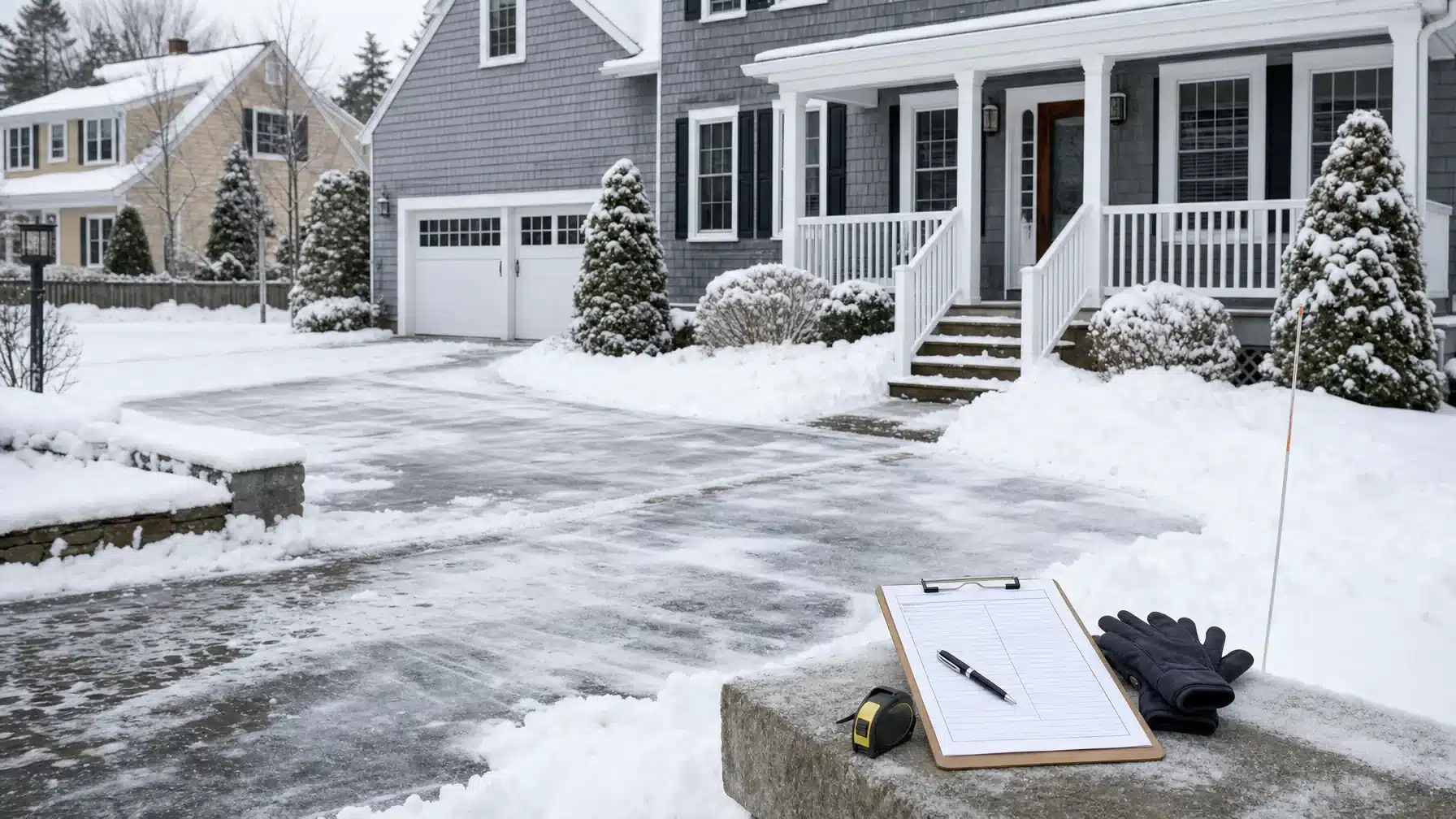
Before discussing residential snow removal with a provider, prepare a short property note: where you want clearing considered, what could restrict access, which features need attention, and what remains unresolved. Bring photos or a simple sketch so you can point to the same places during the conversation.
Lawn Care Plus is based in Roslindale, MA, and serves residential and commercial clients throughout Greater Boston and Metro-West. This checklist helps homeowners prepare for a provider discussion, whether it happens on the property or through shared notes and photos.
Start with a preparation note, not a service agreement
Your note describes your property and your requests. It does not establish what a provider will clear, when work will happen, or which tasks are included. Keep requested work separate from provider-confirmed agreements so an unanswered question does not become an assumption.
Note Leave the confirmed-agreement field blank until the provider responds. Ask for agreed scope and responsibilities to be reflected in the service documentation; your preparation note does not replace it.
If you are still sorting out service options, see the residential snow removal options guide. The checklist below focuses on the property information to prepare, rather than choosing a plan or comparing providers.
List each area you want discussed
Avoid describing the request only as “clear the driveway.” Name each area separately and identify where it begins and ends. This makes it easier to ask whether a path, landing, or entrance is included rather than assuming it belongs to a larger clearing area.
- Driveway: identify the street entrance, garage approach, parking spaces, and any shared portion.
- Paths: identify the routes between parking, household entrances, and the sidewalk.
- Steps and landings: list them separately from the adjoining walkway.
- Entrances: distinguish the door your household normally uses from other doors you want discussed.
- Other access areas: note any requested route to bins, deliveries, or household equipment.
Add why an area matters to your household, such as a route used by someone with limited mobility. Describe the access need without assuming a particular clearing method or arrival time. Flag uncertain property boundaries or shared areas for clarification.
Document parking, gates, and access constraints
Describe the property as it is normally used, not just as it looks when the driveway is empty. A provider discussion needs to account for parked vehicles, closed gates, and anything else that could limit access to a requested area.
- Parking arrangements: where vehicles usually sit, whether they can be moved, and who would move them.
- Gates: their location, how they open, and any access arrangements that need discussion.
- Restricted passages: narrow sections, tight turns, overhanging branches, or fixed obstructions to point out.
- Temporary obstacles: bins, trailers, stored materials, or other items that may occupy the requested clearing area.
- Household access needs: the entrances and routes that need discussion, including any constraints on moving vehicles or opening gates.
If you cannot reliably move a vehicle or provide gate access, say so before agreeing to arrangements that depend on it. Ask how an obstructed area would be handled. Share sensitive access details through a method agreed with the provider, rather than placing them in broadly shared photos or notes.
Photograph features before snow obscures them
Take overview photos that show how the requested areas connect, then closer photos of features you want to discuss. Label each image with a plain description that matches your note, such as the entrance name or driveway section.
- Pavement and walkway edges, including transitions to lawn or planting beds.
- Steps, low walls, raised edges, and fixed objects near requested clearing areas.
- Visible uneven surfaces or existing damage that you want the provider to see.
- Drainage features or places where you have observed water collecting.
Use photos to identify questions, not to prescribe equipment or guarantee property protection. If a surface condition is unclear, point it out and ask whether the provider needs to inspect it before confirming the work.
Confirm boundaries, snow storage, and marking responsibilities
Bring these topics as open questions. Do not choose a snow-storage location or install a marking system on the assumption that the provider will use it.
- Clearing boundaries: Where does the agreed work begin and end? Which requested areas are excluded?
- Snow-storage options: Which locations, if any, can the provider use after reviewing the property? What happens if available space becomes constrained?
- Features needing identification: Does the provider want any edges or obstacles marked? If so, who is responsible and what method should be used?
- Separate tasks: Are steps, paths, and any requested ice treatment part of the agreed scope, or do they need separate confirmation?
Agree on how access changes should be reported
Ask whom to contact and which communication method to use if a vehicle, gate, construction area, or other condition changes. Also ask how to raise a question about an area that appears outside the confirmed scope. Do not assume that sending a message changes the agreement or confirms that a crew has received it.
For broader questions about evaluating a provider, use the snow plow provider-selection guide. Keep your property note focused on the details the provider needs to understand your home.
Reusable homeowner walkthrough note
Copy these fields into a document and repeat the area-specific fields for each requested location. Keep unresolved items visible instead of filling them in with assumptions.
- Property address and discussion contact: ______
- Requested clearing area and boundaries: ______
- Household access need: ______
- Parking, gate, or other access constraint: ______
- Property feature and related photo label: ______
- Open question about scope, snow storage, or marking: ______
- Provider-confirmed agreement or exclusion: ______
- Service document where the agreement is recorded: ______
- Contact and agreed method for reporting access changes: ______
After the discussion, update the note to distinguish confirmed work, exclusions, and questions still awaiting an answer. That separation gives you a useful reference without turning your initial wish list into an assumed commitment.