The Grass is Greener with a Solid Landscape Maintenance Service Agreement
What You Need to Know About a Landscape Maintenance Service Agreement
A landscape maintenance service agreement is a written contract between a property owner and a landscaping company that clearly outlines the services to be performed, the schedule, payment terms, and the responsibilities of each party.
If you’re searching for a quick, no-nonsense answer on what a landscape maintenance service agreement is and why it matters, here’s what you need to know:
Landscape Maintenance Service Agreement in a Nutshell:
- What is it?
A signed, written agreement detailing exactly what landscaping tasks will be done, when, and for how long. - Why is it important?
Clarity. It takes the guesswork out of what’s included.
Protection. It gives legal protection for both you and the service provider.
Consistency. It locks in regular service, helping your property look great all season. - What are the must-haves?
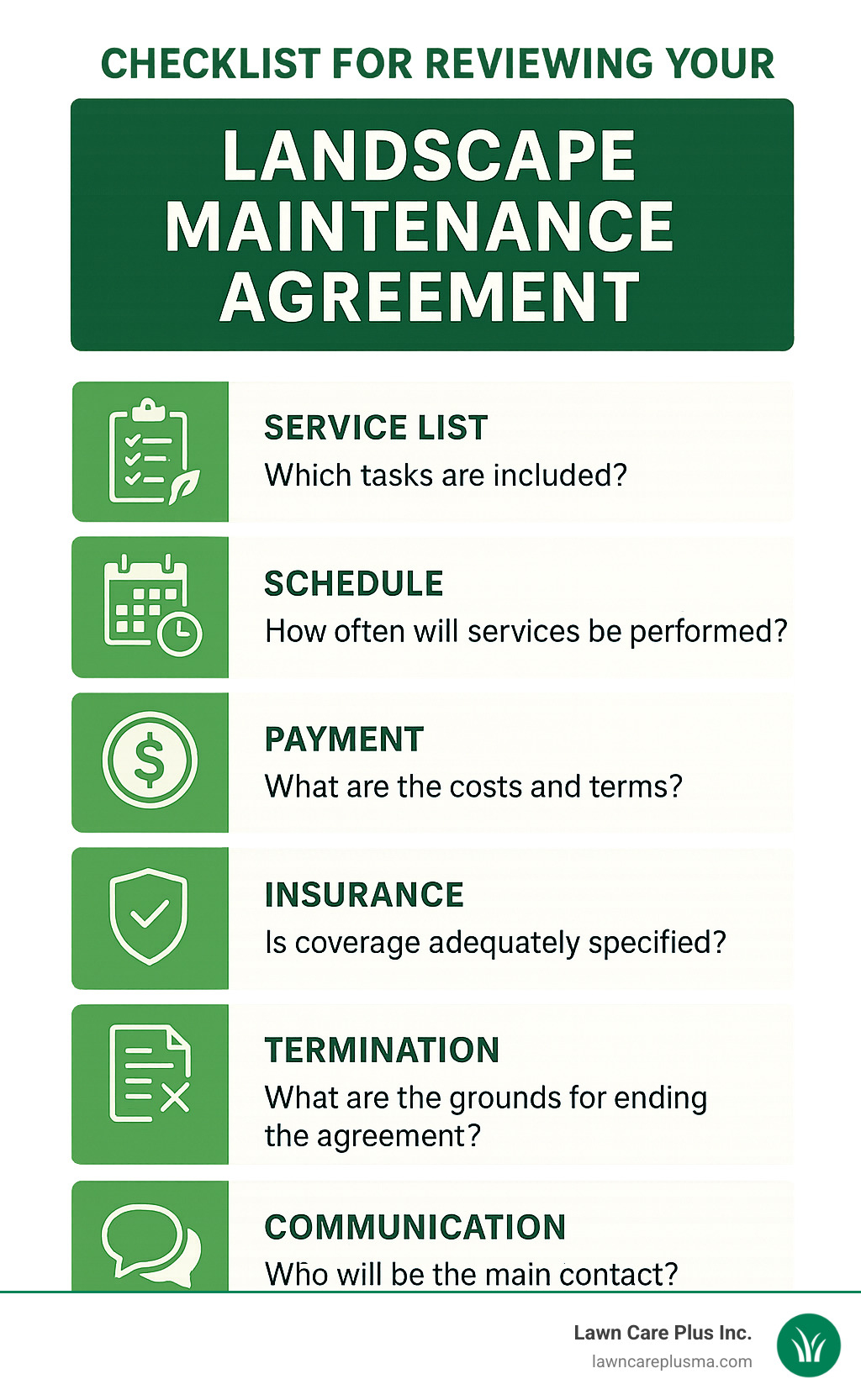
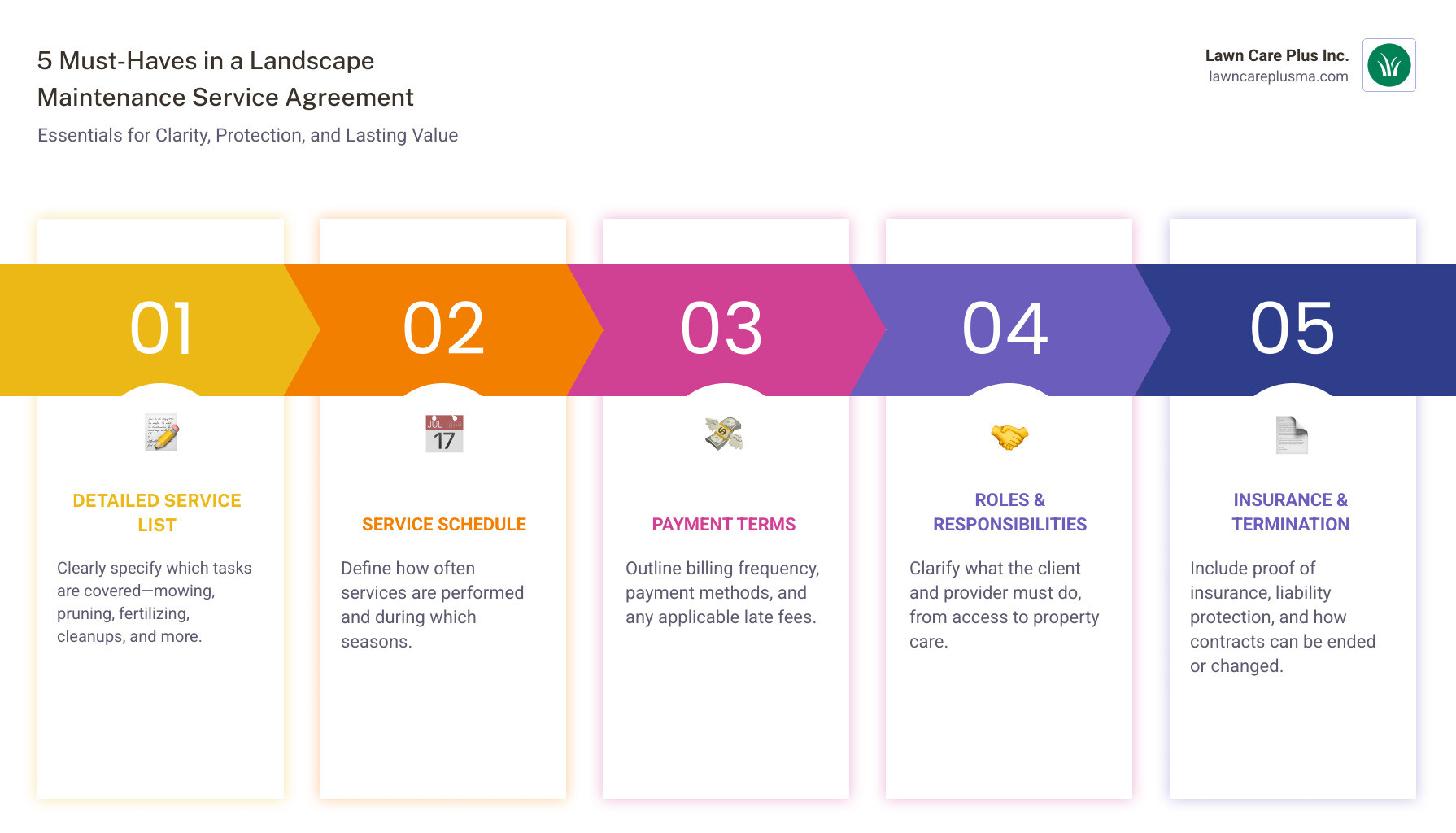
- List of specific services (mowing, pruning, cleanups, etc.)
- Schedule/frequency of visits
- Payment terms and invoicing details
- Roles and responsibilities
- Insurance and liability coverage
- How to handle changes or cancel the contract
“No two landscape maintenance contracts are the same — so how do you know yours is right for you?”
— Landscape industry insight
In short, a strong landscape maintenance service agreement brings peace of mind, protects property value, and sets the stage for a beautiful, worry-free yard or grounds—all year round.
Ready to dig into the details? This guide will walk you through everything you need to look for—and watch out for—before signing your next landscape maintenance service agreement.
What Is a Landscape Maintenance Service Agreement?
A landscape maintenance service agreement isn’t just paperwork—it’s the backbone of a smooth, stress-free relationship between you and your landscaping team. Think of it as your playbook for a thriving yard: it spells out exactly what will be done, how often, who’s handling what, and what happens if anything goes sideways. No crossed fingers, no guesswork.
At Lawn Care Plus Inc., we see every agreement as a handshake—just one that’s written down, so both sides know exactly what to expect. This agreement is a partnership combining your hopes for your property with our hard-earned expertise. It can cover everything from regular mowing and weeding to seasonal clean-ups, irrigation checkups, and even snow removal (a must-have in Massachusetts!).
“Taking the time to make sure that you fully understand any contract before you sign it is important.”
— Commercial landscape contract expert
Why a landscape maintenance service agreement matters
First and foremost, a landscape maintenance service agreement offers legal protection. If there’s ever a disagreement, the contract becomes the rulebook that settles things fairly. It also means steady results—your lawn or landscape gets the attention it deserves, right on schedule, because the crew plans ahead and nothing is rushed or forgotten. Maybe most importantly, the agreement brings real clarity for everyone. You’ll know just how often the hedges get trimmed, who’s supposed to flag the sprinkler heads, and what’s included with each visit.
Curious what a real contract looks like? You can see a Landscaping Services Contract Template to get a feel for what’s included.
Top benefits of a landscape maintenance service agreement for both parties
When you sign a landscape maintenance service agreement, you open up quite a few benefits. You get budget control—knowing exactly what you’ll pay, with no shock charges lurking around the corner. You set quality standards up front, so you and your landscaper agree on how things should look and what “good enough” actually means. Plus, if anything ever goes wrong, the agreement guides you both toward quick, fair solutions and keeps misunderstandings from turning into headaches.
Above all, such an agreement gives you genuine peace of mind. You can sit back and enjoy your yard, confident that the weeds are under control and the grass won’t take over your walkways.
A detailed, written contract isn’t just a formality—it’s your ticket to a beautiful yard and a worry-free experience, all season long.
Must-Have Clauses & Red Flags
A strong landscape maintenance service agreement is more than just a nice-to-have—it’s your safety net. Before you sign, make sure your contract covers all the crucial details, and keep your eyes peeled for anything that seems too vague or one-sided. If something reads more like “wishful thinking” than a real plan, that’s a red flag worth waving!
Let’s dig into what matters most.
Service & scope clause essentials
First up: the actual work to be done! Your agreement should clearly spell out everything included—not just “general maintenance” (which could mean almost anything). Look for specific language about lawn mowing (including how often, and whether edging and blowing are part of the deal), shrub and hedge pruning, and spring/fall cleanups. Make sure it also mentions key tasks like fertilization, weed control, and irrigation system checks. If your property needs leaf removal, debris haul-away, or snow removal, those should be on the list, too.
Why does this matter? Well, the last thing you want is a “surprise” when your landscaper says, “Sorry, that wasn’t included!” For a deeper dive into what good commercial maintenance covers, check out our commercial property maintenance guide.
Pro tip: The more itemized your service list, the fewer misunderstandings down the road.
Term, renewal & termination pitfalls
Next, let’s talk about how long the agreement lasts and how (or if) it renews. A typical landscape maintenance service agreement runs during the growing season—which, here in Massachusetts, often means April through November. If you need snow and ice management, make sure your contract says so.
Watch out for automatic renewal clauses. These keep your service rolling unless you give written notice (usually 30 days), so mark your calendar if you might want to make a change.
Don’t forget about termination terms. Standard contracts allow either party to cancel with 30 days’ written notice. Look for “termination for cause” language, too—this means you can end things early if the company doesn’t deliver what was promised, or if you run into other problems.
Liability & indemnification checkpoints
Now, who’s responsible if something goes wrong? This part matters—a lot. Your contract should include a hold-harmless clause, explaining which party is on the hook if there’s damage or an accident. Generally, if a landscaper damages your property, their insurance needs to cover it.
Pay attention to warranty limits: Plant material warranties are common (often one year), but only if you follow the provider’s care tips and keep up with payments. Make sure the landscaper is required to carry proper liability and worker’s comp insurance as well.
If you spot a contract that seems to protect only the landscaping company—while leaving you out in the weeds—ask for clarification or changes before you sign.
Looking to compare what’s standard? Take a look at this free lawn care contract template.
A well-written landscape maintenance service agreement keeps everyone on the same page, builds trust, and helps you avoid headaches later on. When in doubt, ask questions. At Lawn Care Plus Inc., we believe your contract should bring peace of mind—not fresh worries!
Scope, Schedule & Property Boundaries Explained
When it comes to a landscape maintenance service agreement, few things cause more headaches than fuzzy boundaries or unclear schedules. A solid agreement doesn’t leave any room for guesswork—it spells out exactly where work will happen, how often, and what’s included.
Defining exact service areas
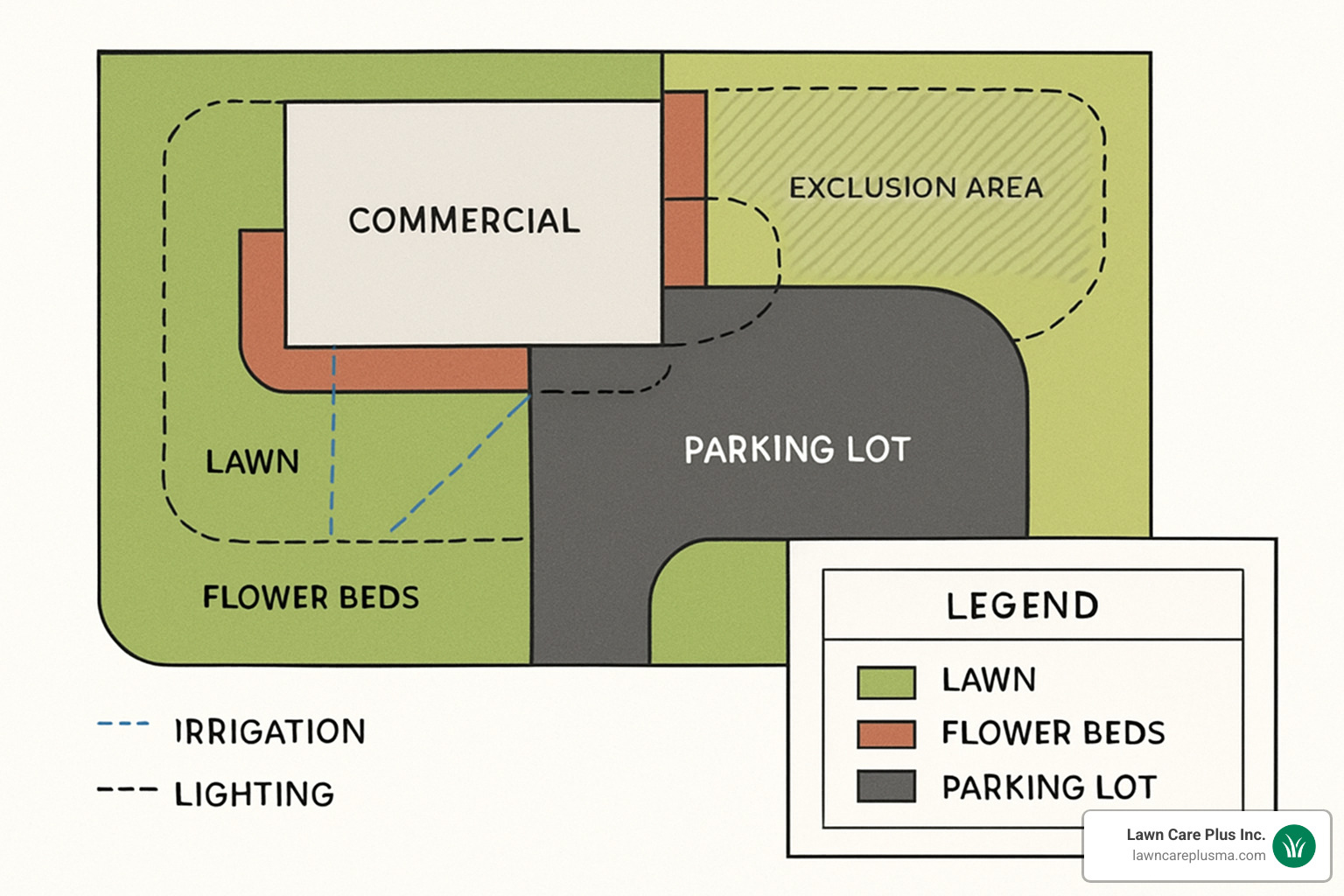
Clear communication starts with the lay of the land. Every good contract should reference a site map or drawing that marks the service areas—think front yard, backyard, parking lots, or shared spaces if you’re part of an HOA. If there are spots that should be left alone, like a veggie patch, a section under construction, or protected wetlands, those exclusion zones should be clearly listed in writing.
Another must? Utility locate. Before any mower or shovel hits the ground, all underground utilities—like irrigation lines or lighting wires—should be flagged. This keeps both your property and the landscaping crew safe (and avoids surprise fountains in the backyard).
Building a flexible seasonal schedule
Massachusetts weather keeps us all on our toes, and a smart landscape maintenance service agreement rolls with the seasons. During the growing season, your agreement should spell out regular visits for mowing, garden upkeep, and those essential spring and fall cleanups. When the grass slows down for winter, the schedule might shift to fewer visits, winter pruning, or snow removal if needed.
Some agreements are performance-based—they adjust service frequency depending on weather and how fast things grow. That way, your property always looks its best, even if Mother Nature has other plans. And if rain or emergencies prevent scheduled service, your contract should make it clear whether you’ll get a reschedule, a credit, or another solution, so there are no surprises.
If you’re curious how schedules adapt in our famously unpredictable New England climate, check out more info about landscaping maintenance services near you.
In the end, a well-written landscape maintenance service agreement maps out not just the property, but the path to a worry-free, beautiful landscape—rain or shine, summer or snow. All you have to do is enjoy the view!
Show Me the Money: Payments, Price Adjustments & Hidden Costs
When it comes to a landscape maintenance service agreement, payment terms can either make things smooth as fresh-cut grass—or leave you tangled like weeds in July. Let’s dig into what you should expect, so your budget stays happy and there are no surprises sprouting up along the way.
Let’s clear up one big question: How will you be billed?
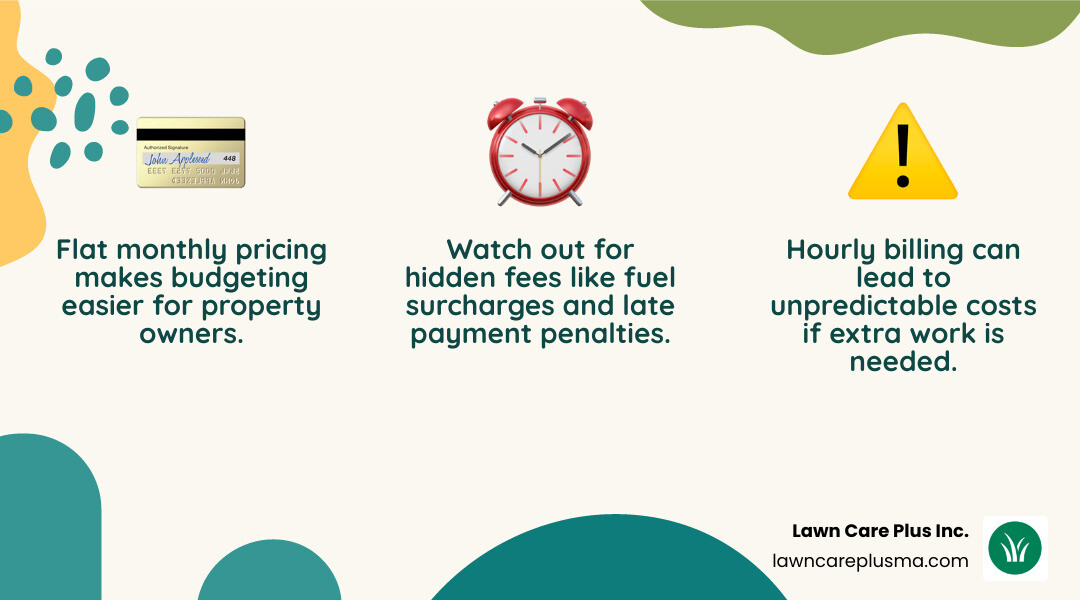
In landscaping agreements, you’ll usually see two main models—hourly pricing and flat monthly (or seasonal) pricing. With hourly pricing, you pay for the time the crew spends on your property. This can seem fair, but can also lead to surprise costs if extra work pops up. Meanwhile, monthly or seasonal pricing keeps things predictable—perfect for those who like to know what’s coming out of their wallet each month. However, just remember, even if the grass isn’t growing as fast some weeks, the bill likely stays the same.
Here’s a quick comparison:
| Feature | Hourly Pricing | Monthly/Seasonal Pricing |
|---|---|---|
| How You’re Billed | Per hour or per job | Flat fee for all-included services |
| Pros | Pay for what you use | Predictable budgeting, steady cash flow |
| Cons | Surprises if extra work | May pay same in slow months |
| Common Pitfalls | Hidden fees for materials | Exclusions not clearly listed |
Source: Industry research and contract templates
It’s important to note that average lawn mowing costs you find online can range from $32 all the way up to $250 per visit—sometimes even higher for large or complex properties. Of course, these are just ballpark figures based on internet data, not actual pricing from Lawn Care Plus Inc. Your exact cost depends on your property and the services you need.
Payment terms that keep cash flowing
Most landscape maintenance service agreements stick with friendly, familiar payment terms. For commercial clients, “net-30” is common—meaning you’ve got 30 days to pay after each invoice. Many residential customers prefer using credit cards or setting up autopay, which makes things almost as easy as watching the grass grow.
But don’t forget about late fees! If a payment slips through the cracks, most agreements will add a late charge—often about 10% of the invoice, or sometimes a monthly percentage until the bill is paid. And with fuel prices on a wild ride these days, some contracts include a fuel surcharge if prices spike. Make sure your agreement spells all this out clearly, so nothing catches you by surprise.
Avoiding surprise charges & hidden fees
Nobody likes hidden costs lurking in the fine print. In a solid landscape maintenance service agreement, you’ll want to look for transparency on:
- Extra visits: Sometimes storms or fast-growing grass mean extra service days. Find out how those are billed, so you’re not left guessing.
- Specialty equipment: Need tree removal or heavy machinery? Make sure those extra charges are explained in advance, not snuck onto your invoice.
- Materials markup: If your service includes mulch, plants, or other materials, see if there’s an added markup—ask for these costs to be listed upfront whenever possible.
A well-written contract should lay all this out, so you can budget confidently and avoid the headache of surprise charges.
Curious about different pricing setups and what works best for your property? Head over to professional landscaping services near me for more info.
With the right contract, your landscape maintenance payments should be as simple and stress-free as a sunny Saturday morning. And if you ever have a question, just ask—at Lawn Care Plus Inc., we believe clear, honest communication keeps your yard (and your budget) looking their best.
Risk Management: Insurance, Liability & Termination

When it comes to a landscape maintenance service agreement, protecting you and your property isn’t just a nice bonus—it’s absolutely essential. At Lawn Care Plus Inc., we believe every good contract should give you peace of mind, not headaches.
Let’s talk insurance first. Before you sign anything, make sure your landscaper carries general liability insurance (at least $1 million per occurrence is the industry standard). This means if something gets damaged or someone gets hurt while we’re on the job, you’re not left footing the bill. Equally important, a reputable company should always have active worker’s compensation insurance to cover their crew in case of on-site accidents.
Licensing is more than just paperwork—it’s your assurance that the team caring for your yard is trained, vetted, and follows all Massachusetts and local rules. And if your property is commercial or part of an HOA, you’ll want to make sure you’re added as an additional insured on the landscaper’s policy. This is a common request and gives you an extra layer of protection.
Now, what happens if things go sideways? The best landscape maintenance service agreements spell this out clearly, so you’re never left wondering. If there’s an issue—like a missed payment or service that misses the mark—there’s usually a structured process. For example, non-payment might result in a pause or end to services after a certain period. If the work isn’t up to the agreed standards, most contracts give the provider a “right to cure”—typically 30 days to make it right before termination is allowed.
In plain English: both sides usually get 30 days to resolve any big issues before the agreement can be ended. This gives everyone a fair chance to fix problems, rather than rushing to part ways.
For more details on how a full-service landscaping company handles risk management, check out our full service landscaping company info.
A strong landscape maintenance service agreement isn’t just about mowing and cleanups. It’s about trust, clear expectations, and making sure you’re covered—rain or shine.
Customizing for Residential, HOA & Commercial Needs
Not all properties are the same—and neither are their contracts! The best landscape maintenance service agreement is one that’s custom to your property type, your needs, and your peace of mind. Whether you’re a homeowner, a property manager, or running an HOA, your agreement should fit just right (like your favorite gardening gloves).
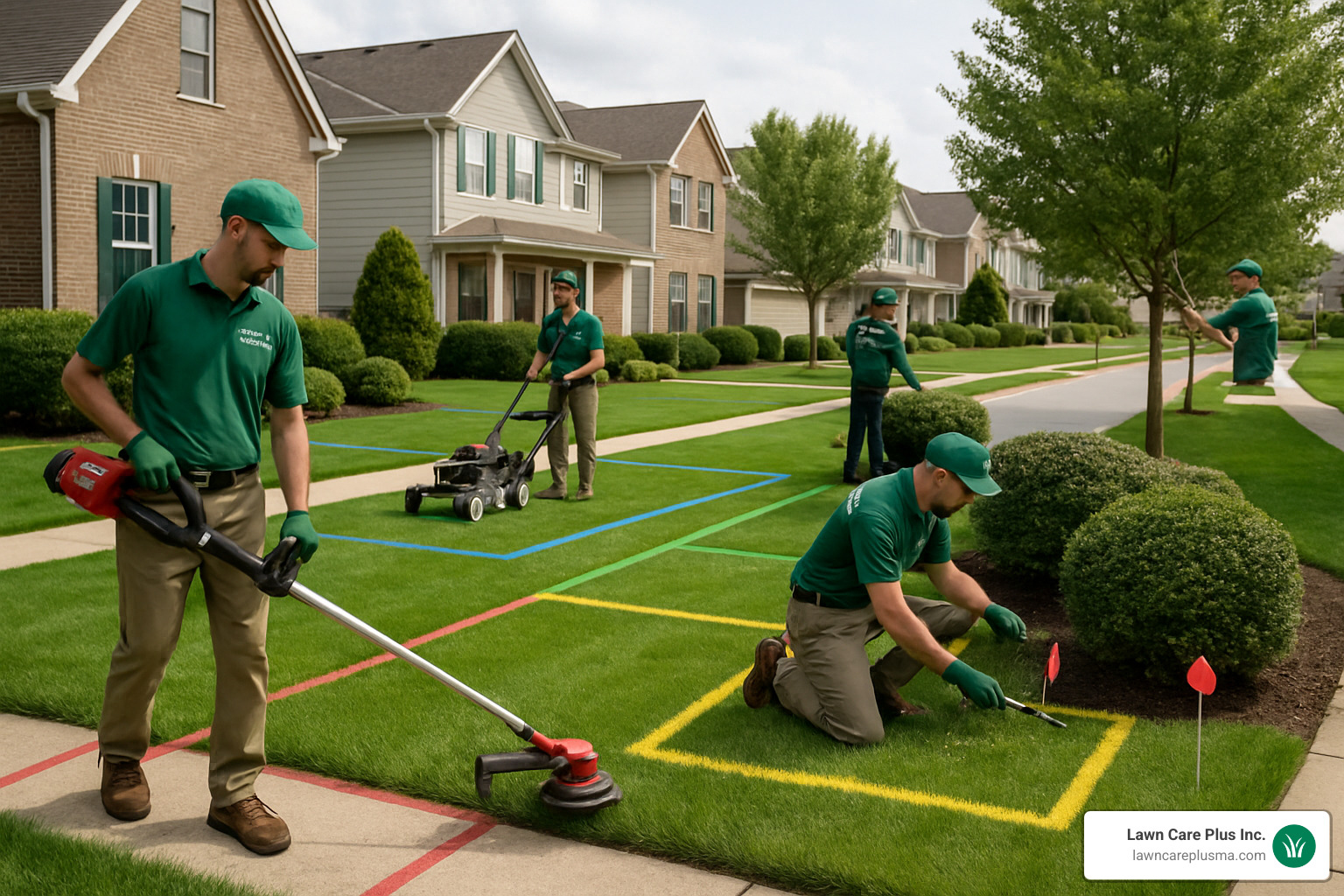
Let’s walk through how the details can change, depending on your type of property.
For residential properties, a little customization goes a long way. If you have pets, your agreement should spell out how to keep them safe during service—nobody wants Fluffy making a dash for it while we’re mowing the backyard! If you have locked gates, alarm codes, or tricky driveway access, your agreement should let your landscaper know in advance, so there are no hiccups (or accidental alarms). Some neighborhoods also have quiet hours, so it’s smart to address any weekend or early-morning restrictions right in your contract. This way, your property gets the attention it needs, without waking up the neighbors.
When it comes to HOAs and commercial properties, things can get a little more complex—but a solid landscape maintenance service agreement keeps everything running smoothly. For example, having a detailed community map included in your agreement means everyone knows exactly which areas are covered (and which aren’t—no more guessing about the back lot or side path). With multiple decision-makers, the contract should clearly define who has the authority to request extra work or approve changes. This helps prevent crossed wires, last-minute surprises, and the classic “too many cooks in the kitchen” situation. If you manage several properties, don’t forget to ask about multi-property discounts—many companies, including us at Lawn Care Plus Inc., offer savings for bundled service agreements.
The bottom line? Whether it’s a backyard, a condo complex, or a sprawling office park, your landscape maintenance service agreement should spell out the details that make your property unique. We believe the right agreement is about more than just grass—it’s about keeping things simple, smooth, and just how you like it.
Want more details on what to include for your HOA or commercial property? Check out our Commercial Landscape Maintenance Services page for tips and guidance.
Frequently Asked Questions about Landscape Maintenance Service Agreements
Let’s tackle some of the most common questions we hear from folks considering a landscape maintenance service agreement. We know contracts can sound dry, but having clear answers will make your life a whole lot easier—and your lawn a whole lot greener.
How long should a landscape maintenance service agreement last?
Most agreements in the Boston Metro-West area run for the active growing season, which is usually April through November. That means you get steady care while your yard is at its busiest. If you’re a commercial client, or need snow removal in winter, agreements often extend year-round—just one less thing to juggle when the snow starts flying.
A big bonus: many contracts, including ours here at Lawn Care Plus Inc., renew automatically. So unless you send written notice (typically with 30 days’ heads up), your lawn stays in good hands without you lifting a finger.
What happens if service quality drops?
Great question—it’s your property, and you deserve top-notch care! If you notice the quality slipping, the first step is to notify your provider in writing. Most solid agreements (ours included) have a 30-day “right to correct” period. This means the landscaper gets a fair shot at fixing the issue. If things still don’t improve after that window, you can usually terminate the contract—no penalties, no fuss.
A well-written landscape maintenance service agreement lays this all out, taking the stress out of tricky situations.
Who supplies materials and equipment?
In nearly all cases, the landscaping company brings their own equipment and all necessary supplies—from mowers to mulch. This keeps things simple for you and ensures that everything is up to professional standards.
If you have special requests (maybe you want to use your own fertilizer or pick out specific plants), just mention it before signing. Make sure the agreement spells it out clearly so there’s no confusion later.
Pro tip: Don’t hesitate to ask for proof of insurance and any relevant certifications. Open communication is the root of a strong partnership—and helps protect everyone involved!
Still have questions about landscape maintenance service agreements? Just reach out to Lawn Care Plus Inc.—we’re here to help make your contract (and your lawn) as worry-free as possible. For more details on our services, visit our landscaping services page.
Conclusion
Let’s be honest—a lush, tidy yard is never just a stroke of luck. It’s the result of teamwork, planning, and a solid landscape maintenance service agreement that spells out every detail before the grass even needs cutting.
A clear agreement is more than just paperwork. It’s your guarantee that your property will be cared for the way you want, every single visit. Instead of worrying about missed mowings or surprise fees, you get to relax and enjoy your outdoor space—while your landscaper knows exactly what you expect.
At Lawn Care Plus Inc., we believe that great landscaping starts with trust and good communication. Our agreements are flexible and transparent, so whether you’re managing a cozy backyard, a busy HOA, or a sprawling commercial space, you get exactly the services you need—no more, no less. We’re big on making things easy: clear schedules, reliable service, and straight answers to your questions.
If you’re ready for fewer headaches, more curb appeal, and true peace of mind, we’re here to help. Learn more about our landscaping services, or reach out today for a custom proposal. You’ll see what it feels like to have a local partner who actually listens—and delivers.
Because in the end, your yard deserves to look its best—and so do you! With a strong landscape maintenance service agreement and a team you trust, that “just mowed” feeling can last all year long.