The Business Case for Professional Lawn Care
Lawn care is more than just aesthetic maintenance—it’s a critical investment for commercial property owners and managers. Here’s what you need to know when searching for commercial lawn services:
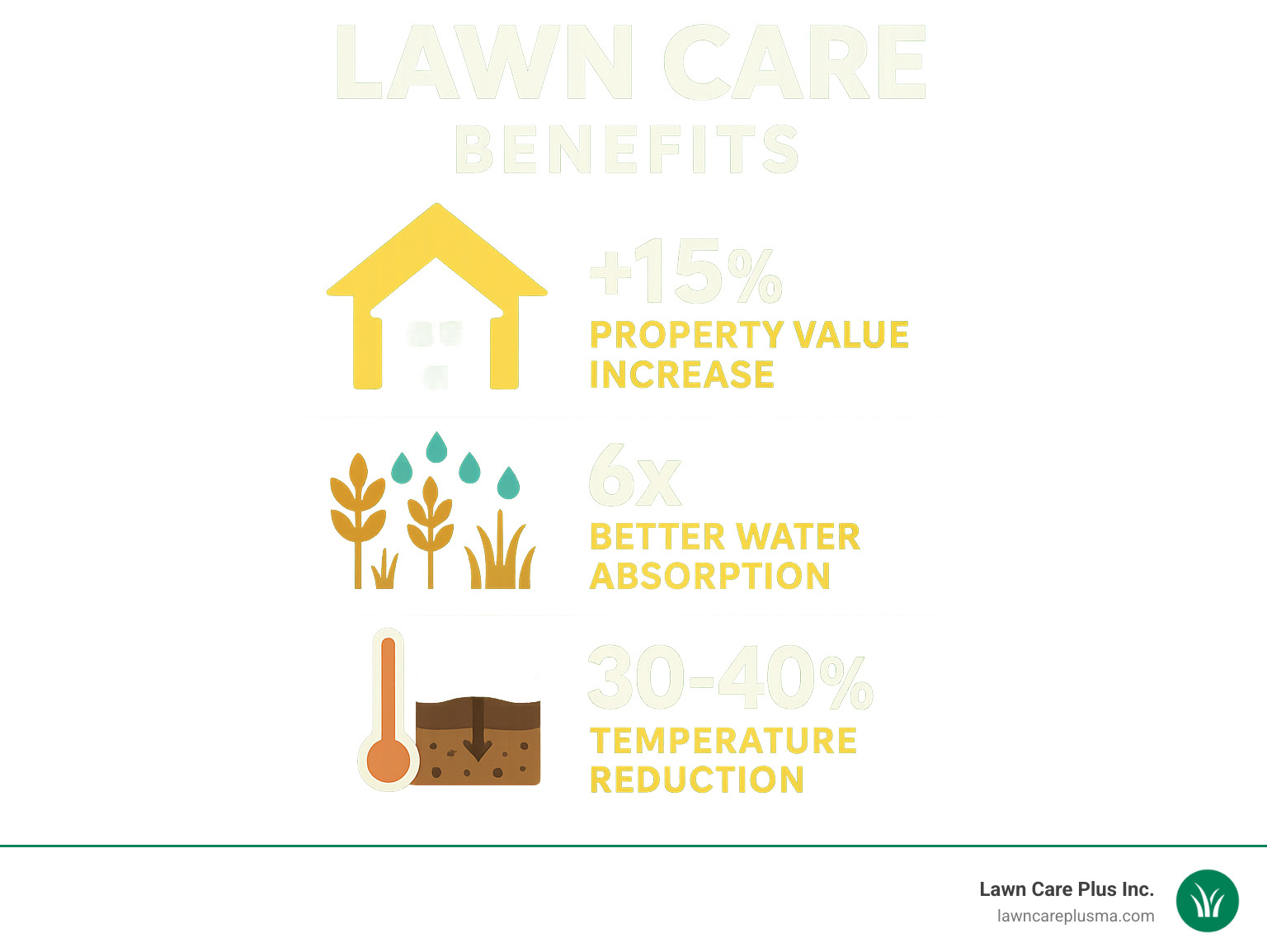
- Property Value Boost: A well-maintained lawn can increase property values by up to 15%
- Environmental Benefits: Healthy turfgrass absorbs 6x more rainfall than wheat fields, preventing runoff
- Temperature Control: Lawns can lower surface temperatures by 30-40°F compared to asphalt
- First Impressions: Professionally maintained grounds create positive impressions for clients and visitors
Finding the right commercial lawn care provider can make all the difference between a mediocre outdoor space and one that improves your property’s value, sustainability, and appearance. In the Boston Metro-West area, commercial properties face unique challenges—from harsh New England winters to summer drought periods—requiring specialized knowledge and consistent maintenance.
The U.S. has approximately 40 million acres of turfgrass, making it the single largest irrigated crop in the country. For commercial property managers, this translates to significant responsibility and opportunity. A professional lawn care service doesn’t just cut grass—they implement science-based approaches to soil health, water conservation, and plant selection that save you time and resources while maximizing curb appeal.
As one lawn care professional noted in our research: “The best landscapes go beyond aesthetics—they must adapt, endure, and add long-term value.” This guide will help you understand what to look for in a commercial lawn care partner that can deliver that value.
Key Lawn Care vocabulary:
– boston lawn mowing
– landscaping westfield ma
– lawn service quincy ma
Choosing the Right Grass for Your Site
Selecting the appropriate grass type is the foundation of successful Lawn Care. In the Boston Metro-West area, we primarily work with cool-season grasses that thrive in our New England climate. Understanding the basics of grass selection will help you communicate effectively with your lawn care provider and make informed decisions about your commercial property.
Cool-Season vs. Warm-Season Grasses
For commercial properties in Massachusetts, cool-season grasses are the standard choice. These varieties grow best when temperatures are between 60-75°F and include:
Kentucky Bluegrass creates a lush, dense turf that recovers well from heavy foot traffic—perfect for commercial entrances and gathering spaces. Fine Fescues offer excellent shade tolerance with lower maintenance needs, ideal for areas around buildings or under trees. Perennial Ryegrass establishes quickly and stands up well to wear, making it a great choice for high-traffic commercial areas.
Warm-season grasses like Bermudagrass, Bahiagrass, St. Augustinegrass, Centipedegrass, and Zoysiagrass are better suited for southern regions. They thrive in temperatures between 80-95°F and typically go dormant (turn brown) during our New England winters.

The key factors that influence grass selection include soil pH (most turfgrasses prefer 6.0-7.0), shade tolerance (Fine fescues perform best in shade, while Kentucky bluegrass needs more sun), drought resistance (crucial for reducing water bills), traffic wear (high-traffic commercial areas need resilient grass types), and maintenance requirements (matching your budget and resources).
Lawn Care Match-Up: Soil, Shade & Use
For commercial properties, matching the right grass to your specific site conditions is crucial for long-term success. At Lawn Care Plus Inc., we recommend starting with a comprehensive soil test before making any grass selection decisions.
A professional soil analysis reveals pH levels, nutrient deficiencies, organic matter content, and compaction issues. This information is gold—it helps us determine what amendments might be needed before establishment and guides our fertilization program moving forward.
Next, we evaluate sun exposure across your property. Commercial sites often have varying degrees of shade due to buildings, trees, and other structures. We map these areas to determine which grass varieties will perform best in each zone.
Finally, we consider how different areas of your property will be used. That pristine entrance needs to look great while handling constant foot traffic. Event spaces need resilience. Pet-friendly areas require grasses that can handle, well, pet business. This comprehensive assessment ensures we select grass varieties that will thrive in your specific conditions, saving you money on replacements and reducing water and fertilizer needs.
Establishing a New Lawn the Right Way
When establishing a new lawn for commercial properties, several methods offer different balances of cost, speed, and results.
Seeding is the most economical approach but takes longer to establish. Internet averages suggest costs between $0.10-$0.30 per square foot for materials, making it ideal for large areas where immediate results aren’t critical.
Hydroseeding applies a slurry of seed, mulch, fertilizer, and binding agents that promotes faster germination than traditional seeding. Internet averages suggest costs between $0.15-$0.50 per square foot.
Sodding gives you an instant lawn but at a higher cost. Internet averages suggest costs between $0.50-$1.50 per square foot. It’s ideal for high-visibility areas requiring immediate impact.
Plugging involves planting individual plugs of grass at intervals. Internet averages suggest costs between $0.25-$0.75 per square foot. This method works well for specific varieties that don’t establish well from seed.
Sprigging plants small pieces of runners or stolons. Internet averages suggest costs between $0.20-$0.60 per square foot. It’s used primarily for warm-season grasses.
For commercial properties in the Boston Metro-West area, we typically recommend a combination approach: sod for high-visibility areas and seeding or hydroseeding for larger, less visible spaces. This balances immediate visual impact with cost-effectiveness.
Proper irrigation startup is critical during establishment. New lawns require consistent moisture until roots are established. At Lawn Care Plus Inc., we can design and install irrigation systems specifically calibrated for your new lawn’s needs, ensuring water is delivered efficiently exactly where it’s needed.
More info about choosing grass
Lawn Care Maintenance Essentials for Year-Round Success
Maintaining a healthy commercial lawn isn’t just about looking good—it’s about creating a resilient outdoor space that performs season after season. Here in New England, your lawn faces everything from summer heat waves to winter freezes, and each season brings its own lawn care challenges and opportunities.
Smart Mowing & Watering for Optimal Lawn Care
Ever notice how a freshly mowed lawn just feels right? That’s because proper mowing is both an art and a science. One of the biggest mistakes we see on commercial properties is cutting grass too short—it’s actually harmful! At Lawn Care Plus, we follow the “one-third rule,” never removing more than one-third of the grass blade in a single mowing.
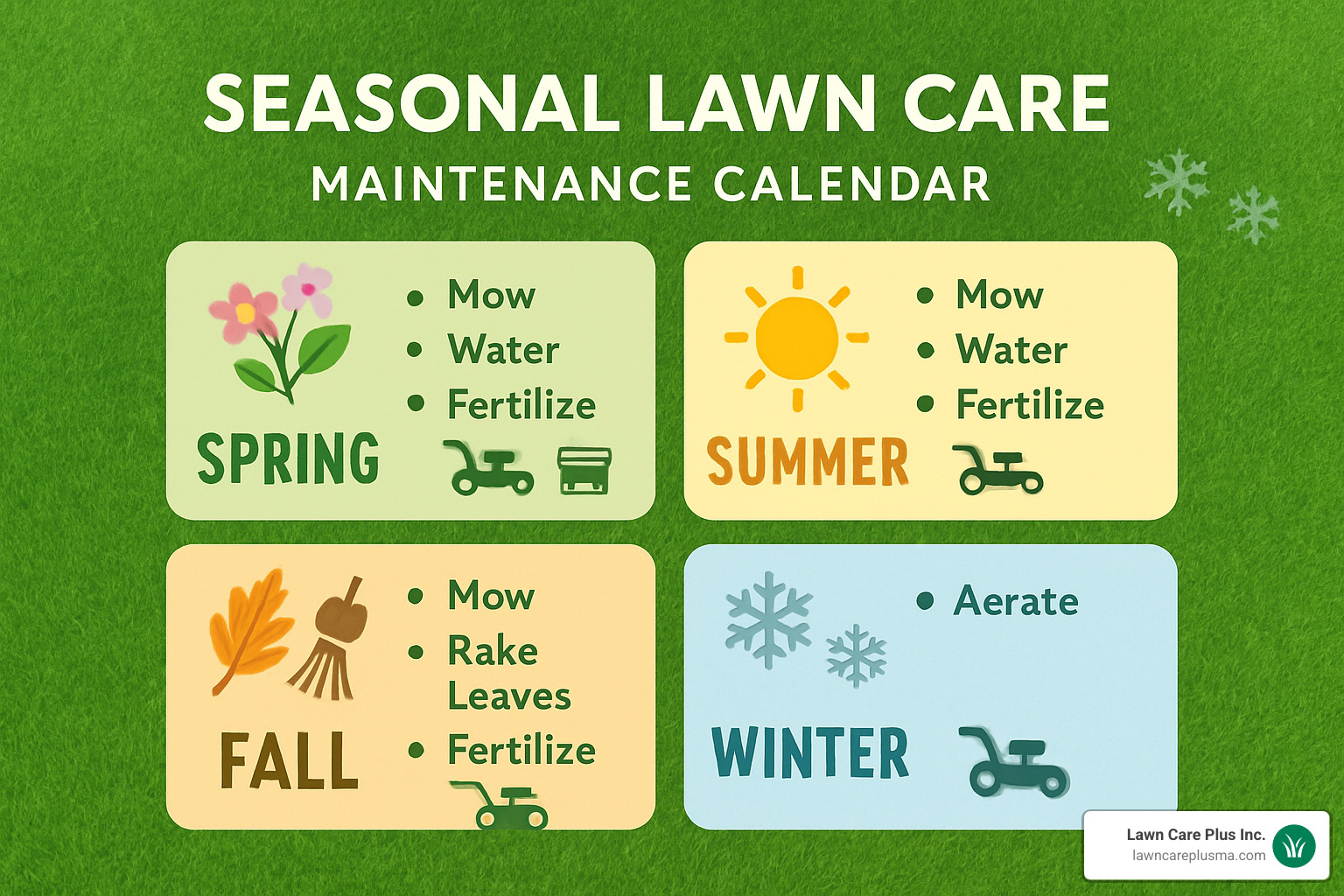
For our Massachusetts cool-season grasses, we adjust heights seasonally: 2-2.5 inches in spring, raising to 3-3.5 inches during summer heat (protecting those precious roots), then gradually lowering back to 2-2.5 inches in fall, with a final 2-inch cut before winter. This simple practice encourages deeper roots, improves drought tolerance, and naturally crowds out weeds.
Watering wisdom is equally important. Think of it like this: shallow, frequent watering creates lazy grass with shallow roots, while deep, infrequent watering (about 1″ per week) encourages roots to grow downward seeking moisture. Early morning irrigation (4-9 AM) is ideal—the grass drinks deeply before the sun causes evaporation, and leaves dry quickly, preventing disease.
Your lawn will tell you when it’s thirsty. Look for footprints that remain visible after walking across it, grass blades folding lengthwise, or a blue-gray color replacing vibrant green. For busy property managers, smart irrigation controllers are game-changers—they automatically adjust to weather conditions, saving water and reducing your utility bills while maintaining that professional appearance.
Fertilization & Soil Health Basics
Think of fertilization as your lawn’s nutrition plan—and just like human nutrition, it’s not one-size-fits-all. Professional lawn care requires understanding what your specific soil needs, which is why we recommend annual soil testing for commercial properties. These tests reveal exactly what nutrients are lacking, allowing for precise, targeted fertilization.
Understanding those N-P-K numbers on fertilizer bags helps you make informed decisions:
Nitrogen (N) fuels leaf growth and gives that lush green color everyone wants. Phosphorus (P) supports strong root development (especially important for new lawns). Potassium (K) works behind the scenes, improving disease resistance and helping your lawn handle stress.
For established commercial lawns in our region, timing matters: balanced fertilizer with light nitrogen in spring, minimal feeding during summer stress periods, and higher nitrogen in fall to build strong roots before winter dormancy.
The organic versus synthetic fertilizer debate isn’t black and white. Organic options release nutrients slowly as they decompose, improve soil structure, and boost beneficial microbial activity. Synthetic fertilizers provide precise nutrient ratios, show faster results, and can be more economical for large commercial areas. Many of our clients enjoy the benefits of our hybrid approach—primarily slow-release products supplemented with quick-release fertilizers for specific situations.
Compost top-dressing is another valuable soil health practice we offer. This thin layer of high-quality compost adds organic matter to soil, improving its structure, water retention, and ability to hold nutrients—think of it as a multivitamin for your soil.
Safe Weed, Pest & Disease Control
No one wants their commercial property overrun with weeds or damaged by pests, but heavy-handed chemical approaches aren’t the answer either. Our integrated pest management (IPM) approach to lawn care minimizes chemical use while maintaining the professional appearance your business deserves.
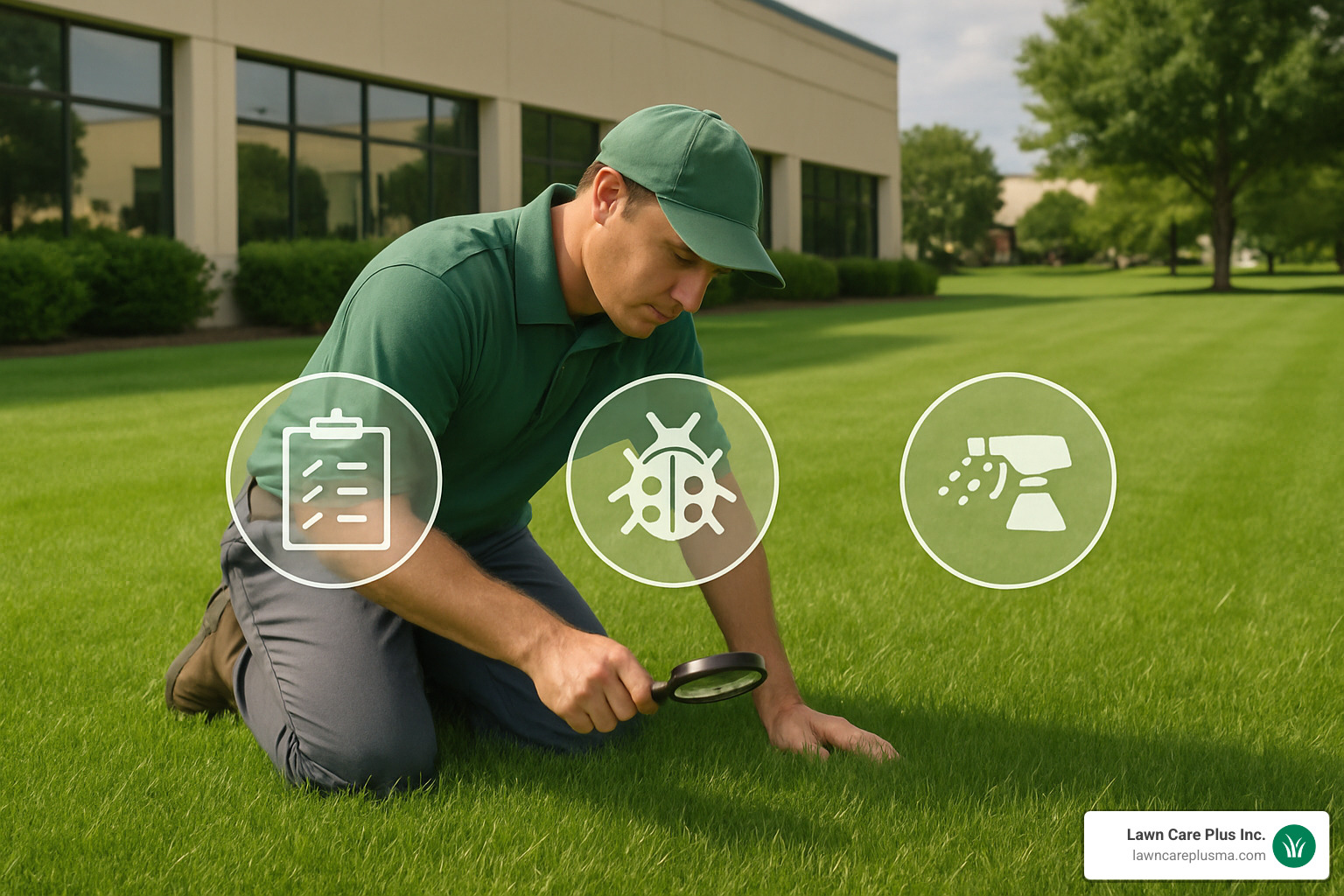
Timing is everything with weed control. Pre-emergent applications create a barrier that prevents weed seeds from establishing, but must be applied before germination—typically when soil temperatures reach 55°F. For weeds that do appear, we use targeted spot treatments rather than blanket applications, focusing only on problem areas.
Massachusetts commercial properties commonly battle lawn pests like grubs (those Japanese beetle larvae love our grass roots), chinch bugs, and sod webworms. Rather than preventively treating for everything, we monitor pest populations and only treat when they reach damaging levels. When possible, we incorporate beneficial insects and select the least toxic effective treatments.
Our region’s humidity and temperature swings make disease prevention crucial. Snow mold, dollar spot, brown patch, and red thread are common culprits, but many lawn diseases can be prevented through cultural practices: proper mowing height, morning irrigation, improved air circulation, and thatch management.
For high-traffic commercial areas, we schedule treatments during off-hours and provide clear guidance on safe re-entry periods. Your customers’ and employees’ safety is always our priority.
Scientific research on turfgrass functions
Lawn Maintenance
Sustainable & Low-Input Strategies
Modern commercial lawn care isn’t just about creating beautiful green spaces—it’s about doing so responsibly. At Lawn Care Plus Inc., we help Boston Metro-West businesses find that sweet spot where sustainability meets curb appeal.
Water Conservation Approaches
Let’s face it—water isn’t getting any cheaper, and conservation matters now more than ever. Our commercial clients are finding that water-smart strategies don’t mean sacrificing appearance:
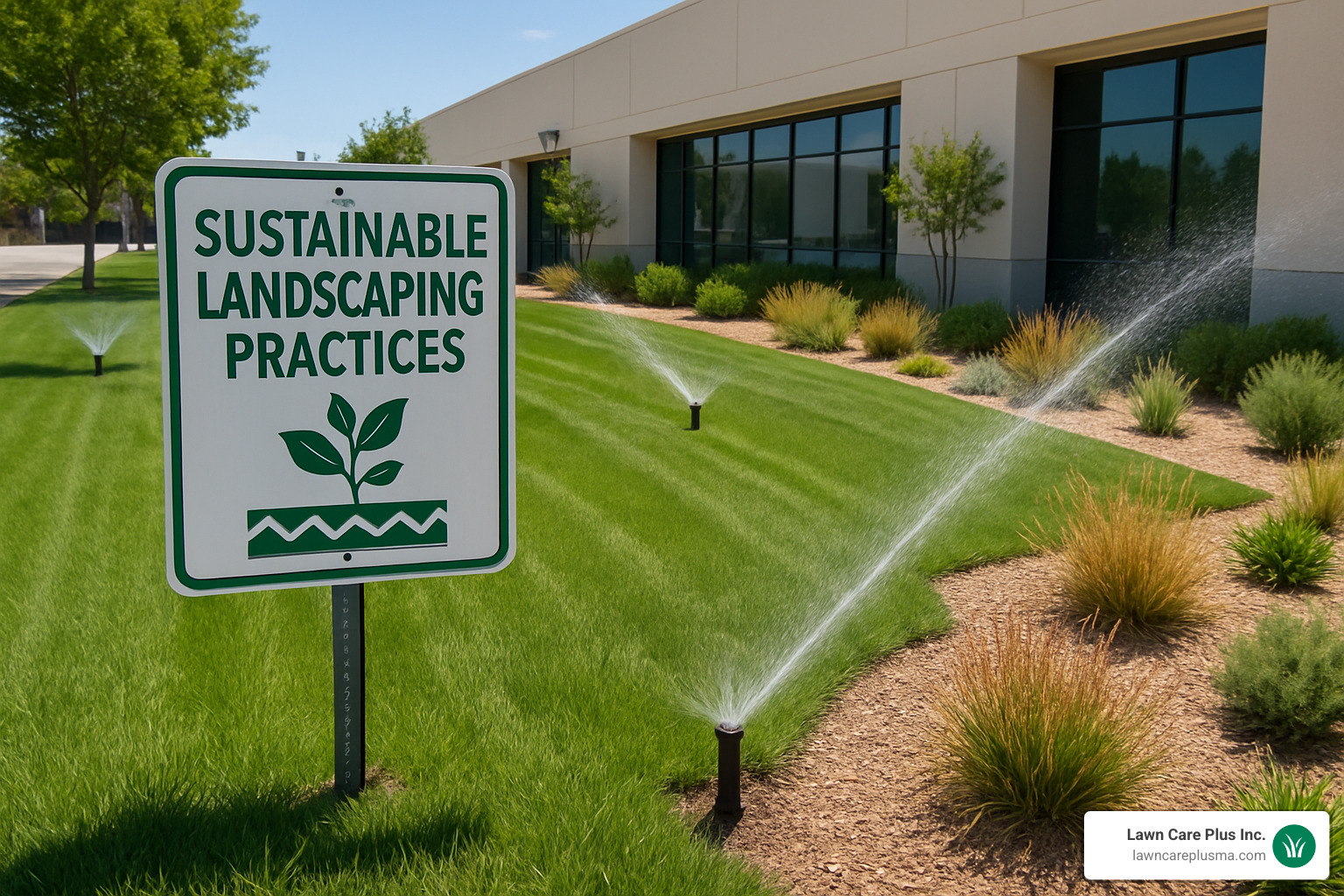
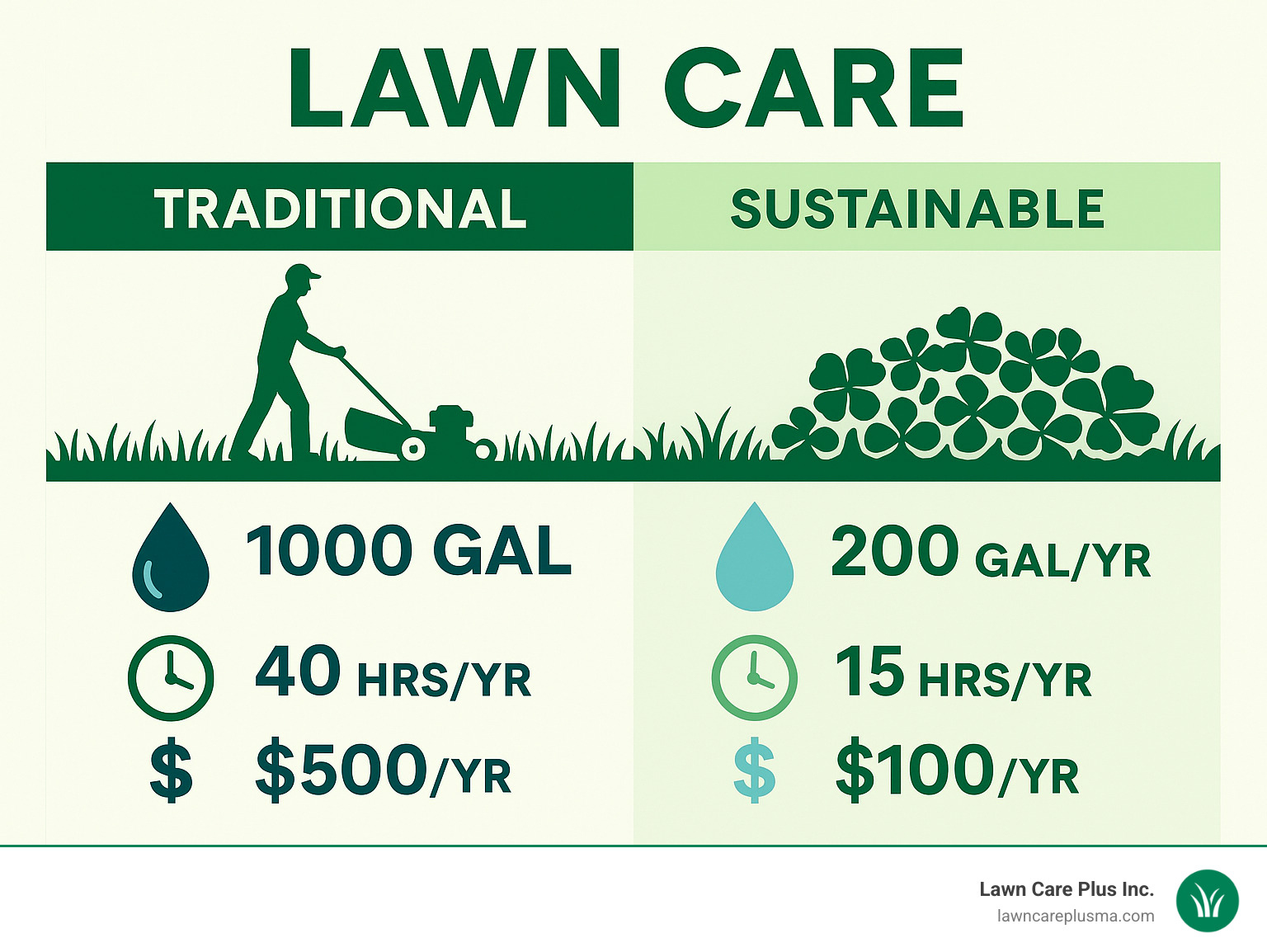
Xeriscape zones have become one of our most requested features. By designating specific areas for drought-tolerant plantings, we can slash irrigation needs by 50-75%. These zones don’t just save water—they create visual interest through varied textures and colors that break up monotonous turf expanses.
The technology behind irrigation has come a long way too. Smart controllers are like having a meteorologist dedicated to your sprinkler system. They adjust watering schedules based on weather data and soil moisture, typically reducing water usage by 15-30% compared to traditional timers. Pair these with simple rain sensors that prevent the embarrassment (and waste) of sprinklers running during a downpour, and you’ve got a system that practically manages itself.
We’re also seeing great results with upgraded sprinkler components. Low-angle nozzles minimize wind drift, while pressure-regulating heads prevent that fine mist that evaporates before it ever reaches your grass. Small changes, big savings.
Biodiversity and Native Plants
There’s something beautiful about plants that belong here naturally. Native grass blends have evolved alongside our New England climate for centuries, making them naturally adapted to our conditions. These grasses typically require less supplemental water and show greater resistance to regional pests and diseases.
Many of our commercial clients are embracing rewilding along property edges. These transitional areas—often awkward to mow anyway—become havens for beneficial insects and pollinators when planted with native species. One banking client reported that their rewilded areas not only reduced maintenance costs but also became conversation starters with environmentally-conscious customers.
Microclover blends are another game-changer. By integrating clover into traditional turf, we create lawns that naturally fix nitrogen from the air, reducing fertilizer needs by up to 25%. These blends stay green during moderate drought periods when traditional lawns would start to brown, and they require less frequent mowing—a win-win for busy property managers.
Reduced Input Maintenance
Sometimes the most sustainable practices are also the simplest. Mulching mowers that return clippings to the soil recycle nutrients naturally, reducing fertilizer needs while saving on disposal costs. One office park we service estimates they’ve cut their fertilizer budget by nearly a quarter since switching to mulching.
Proper mowing height remains one of the most overlooked yet effective water conservation strategies. Taller grass (3-3.5 inches for most cool-season varieties) develops deeper roots and shades the soil surface, significantly reducing evaporation. It’s like giving your lawn built-in drought insurance.
Regular core aeration might seem like just another maintenance task, but it’s actually a sustainability powerhouse. By improving water penetration and reducing runoff, aeration ensures that precious irrigation water reaches plant roots rather than flowing into storm drains. The improved soil structure also encourages deeper rooting, making lawns more resilient during dry periods.
For commercial properties throughout Massachusetts, these sustainable approaches deliver multiple benefits: lower water bills, reduced maintenance costs, and alignment with corporate environmental initiatives—all while maintaining the professional appearance your property deserves.
Scientific research on xeriscape
How to Hire a Commercial Lawn Care Partner
Finding the right commercial Lawn Care partner is a bit like dating – you need compatibility, trust, and shared goals. The right provider will improve your property’s appearance while respecting your budget and environmental values. Here’s how to find your perfect match in the Boston Metro-West area.
Evaluating Service Scope and Capabilities
When searching for a commercial lawn care partner, start by looking at the full picture. Does the company offer everything your property needs?
The best providers offer comprehensive service packages. Look for a company that handles regular mowing and edging, fertilization programs, seasonal aeration, irrigation management, and even snow removal services for those harsh Massachusetts winters. Having one partner for all these needs simplifies your property management and ensures consistent quality.
Equipment quality matters tremendously. Professional-grade mowers with regularly sharpened blades create cleaner cuts that help grass resist disease. Well-calibrated spreaders ensure even application of products, preventing streaking or missed spots. When you meet with potential providers, don’t hesitate to ask about their equipment maintenance schedules – it’s a telling indicator of their overall professionalism.
Certifications speak volumes about a company’s commitment to excellence. Ask about pesticide applicator licenses, industry certifications like Landscape Industry Certified credentials, and ongoing staff training programs. These credentials show that a company invests in keeping their knowledge current and their practices safe.
Finally, verify that any company you’re considering carries proper insurance. This includes general liability coverage, workers’ compensation, and vehicle insurance. Working with an uninsured contractor puts your business at significant risk. At Lawn Care Plus Inc., we maintain comprehensive insurance and all required certifications for commercial properties throughout the Boston Metro-West region.
Questions to Ask Prospective Lawn Care Providers
The interview process is your opportunity to find the right fit. Beyond the basics of pricing and scheduling, dig deeper with these revealing questions:
“How long have you been serving commercial properties in this area?” Experience with local conditions matters – New England’s climate presents unique challenges that require specific knowledge.
“Can you provide references from similar commercial clients?” A reputable company will happily connect you with satisfied clients managing properties similar to yours.
“What’s your approach to fertilization for commercial properties?” Listen for answers that mention soil testing, customized programs, and environmental considerations rather than one-size-fits-all solutions.
“How do you handle communication when weather affects the service schedule?” Weather disruptions are inevitable in Massachusetts – what matters is how proactively they communicate changes.
“What sustainability practices do you incorporate?” Forward-thinking companies will mention water conservation, reduced chemical usage, and other eco-friendly approaches.
“Who will be our day-to-day contact?” Knowing who’s responsible for your satisfaction helps establish clear lines of communication from day one.
At Lawn Care Plus Inc., we welcome these questions. We believe transparent communication builds stronger partnerships and sets clear expectations from the start.
Understanding Service Plans & Yard Care Kits
Today’s commercial Lawn Care often comes in the form of comprehensive service plans or “yard care kits” that bundle related services for better results and efficiency.
A truly valuable service plan starts with proper assessment. This includes professional soil testing to identify specific deficiencies, site evaluation to map sun and shade patterns, and irrigation system analysis to ensure water is delivered efficiently. This foundation of knowledge allows for truly customized care rather than generic treatments.
The best plans offer a customized seasonal schedule that aligns perfectly with your property’s needs and usage patterns. For example, if you host outdoor corporate events in summer, treatments can be scheduled around these activities for minimum disruption.
Look for providers that bundle applications intelligently. Combining fertilization with weed control when appropriate, integrating pest management throughout the season, and adding soil amendments based on testing results creates a comprehensive approach that produces better results than disconnected services.
Regular monitoring and adjustment set professional services apart from basic maintenance. Your provider should conduct regular inspections, make adjustments based on changing weather conditions, and provide detailed reporting on services performed.
The benefits of comprehensive plans go beyond convenience. They provide consistency through regular, scheduled care that prevents problems before they start. They deliver efficiency through bundled services that reduce overall costs. They offer expertise through professional oversight that ensures optimal timing of treatments. And perhaps most importantly for busy property managers, they provide simplicity through a single point of contact for all lawn needs.
For commercial properties in the Boston Metro-West area, we create custom plans that address the unique challenges of New England’s climate while meeting your specific property requirements and budget constraints.
Frequently Asked Questions about Professional Lawn Care
How often should a commercial property be fertilized?
Commercial properties in Massachusetts typically benefit from 3-5 fertilizer applications per year. It’s not a one-size-fits-all approach though – your property’s specific needs depend on soil conditions, grass type, and how the space is used.
For cool-season grasses that thrive in our New England climate, we’ve found this schedule works best:
In early spring (April), we start with a light fertilization combined with pre-emergent weed control to get ahead of those pesky weeds before they emerge. By late spring (May-June), we apply a balanced fertilizer to support active growth. During the summer months (July-August), we might add an optional light feeding if your lawn needs a boost during stress periods.
The most crucial application comes in early fall (September), when we provide the primary feeding with higher nitrogen content – this is when your grass is actively storing nutrients for winter survival. Finally, a late fall (November) winterizing application helps strengthen the root system during dormancy.
At Lawn Care Plus Inc., we don’t just blindly follow a calendar. We adjust this schedule based on soil test results and what we observe on your specific property. Professional applications ensure even coverage with precisely calibrated equipment, avoiding the streaking or burning that often happens with DIY approaches.
What’s the safest way to control weeds around kids & pets?
When it comes to commercial properties where employees, visitors, and their furry friends frequent, safety becomes just as important as weed control. We take a thoughtful approach that balances both priorities.
First, we focus on cultural practices that naturally discourage weeds. Maintaining proper mowing height creates shade that prevents weed seedlings from establishing. Regular overseeding creates dense turf that weeds struggle to penetrate. Core aeration reduces soil compaction that many weeds prefer.
When we do need to treat weeds directly, we use targeted applications rather than blanket spraying the entire property. We’ll spot-treat problem areas using the minimum effective concentration, and schedule applications when foot traffic is lowest.
Product selection is critical when safety is a concern. We can choose products with shorter environmental persistence, consider organic alternatives for sensitive areas, and use granular products that dry quickly on leaf surfaces, reducing contact risk.
Clear communication is also part of our safety protocol. We can post temporary signage after applications, provide advance notice of treatments, and clearly mark recently treated areas so everyone knows which spaces to avoid temporarily.
At Lawn Care Plus Inc., we’re happy to develop a customized weed control program that prioritizes safety while keeping your commercial property looking its best.
How can I reduce irrigation costs without sacrificing green spaces?
Water conservation isn’t just good for the environment – it’s also excellent for your bottom line. Many of our commercial clients in the Boston Metro-West area have significantly reduced their water bills while maintaining beautiful landscapes.
Irrigation system upgrades offer the most immediate impact. Converting to high-efficiency rotary nozzles can reduce water usage by up to 30%. Smart controllers that adjust watering schedules based on actual weather conditions prevent wasteful irrigation during or after rainfall. Soil moisture sensors take this a step further by measuring actual soil conditions rather than just following a timer. We can also implement zone-specific programming that delivers precisely the right amount of water to different areas based on plant needs.
Landscape modifications can dramatically reduce water requirements. We often recommend grouping plants with similar water needs (a practice called hydrozoning) and converting peripheral areas to drought-tolerant landscaping. Strategic hardscaping and proper mulching around plantings can further reduce irrigation needs while enhancing your property’s appearance.
Smart maintenance practices also contribute to water efficiency. Regular core aeration improves water penetration, reducing runoff and waste. Wetting agents help distribute moisture more evenly through the soil profile. Adjusting mowing height seasonally (taller in summer) reduces evaporation from the soil surface. And scheduling regular irrigation audits helps us catch inefficiencies before they waste thousands of gallons.
For forward-thinking properties, alternative water sources like rainwater harvesting systems, HVAC condensate recovery, or municipal reclaimed water (where available) can further reduce potable water consumption.
These approaches typically reduce irrigation water usage by 30-50% while maintaining attractive, functional green spaces. Even better, the initial investment in efficiency upgrades usually pays for itself through reduced water bills within just 1-3 years – making water conservation as good for your budget as it is for the environment.
Conclusion
Choosing the right commercial Lawn Care partner isn’t just about keeping your grass green—it’s a strategic decision that impacts your property’s curb appeal, environmental footprint, maintenance costs, and overall value. Throughout the Boston Metro-West area, businesses have come to trust Lawn Care Plus Inc. for our comprehensive, science-based approach that improves commercial properties while respecting budget constraints.
What truly sets us apart is our dedication to customization. We recognize that different commercial properties—whether medical facilities, retail centers, corporate campuses, or industrial parks—each face unique challenges and have distinct priorities. Our experienced team brings specialized knowledge of New England’s climate challenges, offering custom solutions that work specifically for commercial properties in Belmont, Boston, Brighton, Brookline, and throughout our service area.
As your full-service provider, we eliminate the hassle of juggling multiple vendors by offering convenient one-stop service for all your exterior maintenance needs. From comprehensive Lawn Care programs to landscape installations, irrigation systems, hardscaping projects, and winter snow management—we handle it all with the same attention to detail and commitment to excellence.
This integrated approach ensures all aspects of your property’s exterior work together seamlessly, giving you just one point of contact for all your outdoor maintenance needs. No more coordinating between multiple vendors or dealing with service gaps when responsibilities overlap.
Commercial property managers particularly appreciate our proactive communication style. We don’t wait for problems to develop—we anticipate needs, provide detailed service documentation, and commit to sustainable practices that protect both your property and the environment. We understand your landscape is a significant investment, and our goal is helping you maximize its return through expert care and thoughtful management.
We warmly invite you to experience the Lawn Care Plus Inc. difference for yourself. Contact us today to schedule a comprehensive site evaluation and receive a customized service proposal designed specifically to improve your property’s appearance, functionality, and overall value.
More info about lawn care services
Investing in professional Lawn Care goes far beyond maintaining green grass—it’s about creating safe, attractive, and sustainable outdoor spaces that benefit your business, welcome your visitors, and protect our shared environment. Let our team help you achieve that vision for your commercial property, changing your grounds from a maintenance concern into a valuable business asset.