
Why Concrete Masonry Repair Matters for Your Property
Concrete masonry repair is essential for maintaining the structural integrity, safety, and appearance of walls, foundations, and hardscaping elements on your property. Whether you’re dealing with cracks, spalling, efflorescence, or water damage, addressing these issues promptly prevents costly failures and extends the life of your concrete structures.
Quick Answer: Key Steps for Concrete Masonry Repair
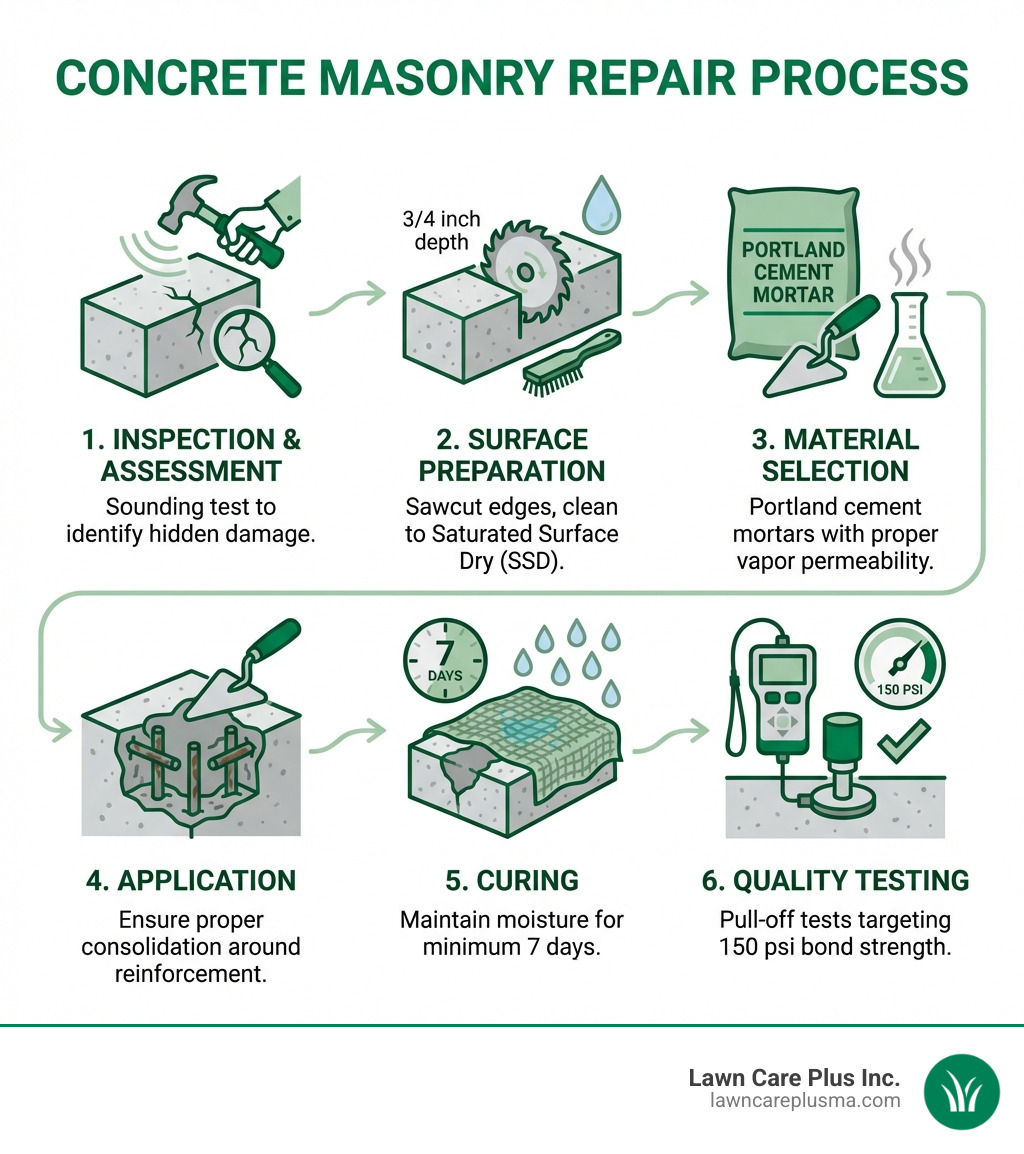
- Evaluate the damage – Use sounding tests and visual inspection to identify deterioration
- Prepare the surface – Remove unsound material, sawcut edges, and clean to achieve proper bond
- Select appropriate materials – Choose portland cement-based mortars or polymer repair products matched to your substrate
- Apply repair properly – Follow manufacturer guidelines for mixing, placement, and consolidation
- Cure correctly – Maintain moisture for at least 7 days to ensure strength development
- Prevent future damage – Manage water penetration, maintain control joints, and inspect annually
One of the most attractive features of concrete masonry is its low cost of maintenance—but only when paired with rigorous preventive care. Regular inspections and timely repairs can save thousands of dollars compared to emergency reconstruction.
Understanding the difference between repair and restoration is critical. Concrete repair addresses structural issues like rebar corrosion and load-bearing capacity, while restoration focuses on aesthetic resurfacing. Small exterior cracks often signal internal damage from moisture causing rebar to rust and expand, breaking concrete from the inside out.
The most common causes of concrete masonry damage include freeze-thaw cycles (especially relevant in New England winters), water infiltration through inadequate drainage or failed sealants, and natural shrinkage stresses that develop over time. Cracks larger than 0.02 inches cannot be sealed with clear water repellents alone and require more substantial intervention.
Surface preparation is often more critical than the repair material itself. Industry standards call for high-pressure water blasting at minimum 5000 psi to remove microcracking, sawcutting edges to prevent feathered repairs, and achieving a rough surface texture (CSP 6-10 profile) for proper mechanical bond. A good repair should achieve tensile strength exceeding 150 psi and typically fail in the substrate rather than at the bond line.
I’m Tim DiAngelis, owner of Lawn Care Plus Inc., and over the past decade I’ve overseen countless concrete masonry repair projects throughout the Boston Metro-West area, from residential foundation walls to commercial hardscaping installations. This hands-on experience with New England’s harsh freeze-thaw conditions has taught me that proper concrete masonry repair techniques make the difference between a patch that lasts one season and a permanent structural fix.
Common Concrete masonry repair vocab:
Evaluating and Diagnosing Concrete Masonry Damage
Before we grab the trowel, we have to play detective. At Lawn Care Plus Inc., we’ve seen homeowners try to patch a crack only to have it reappear three months later because they didn’t find the “why” behind the damage. Proper evaluation is the difference between a permanent fix and a temporary Band-Aid.
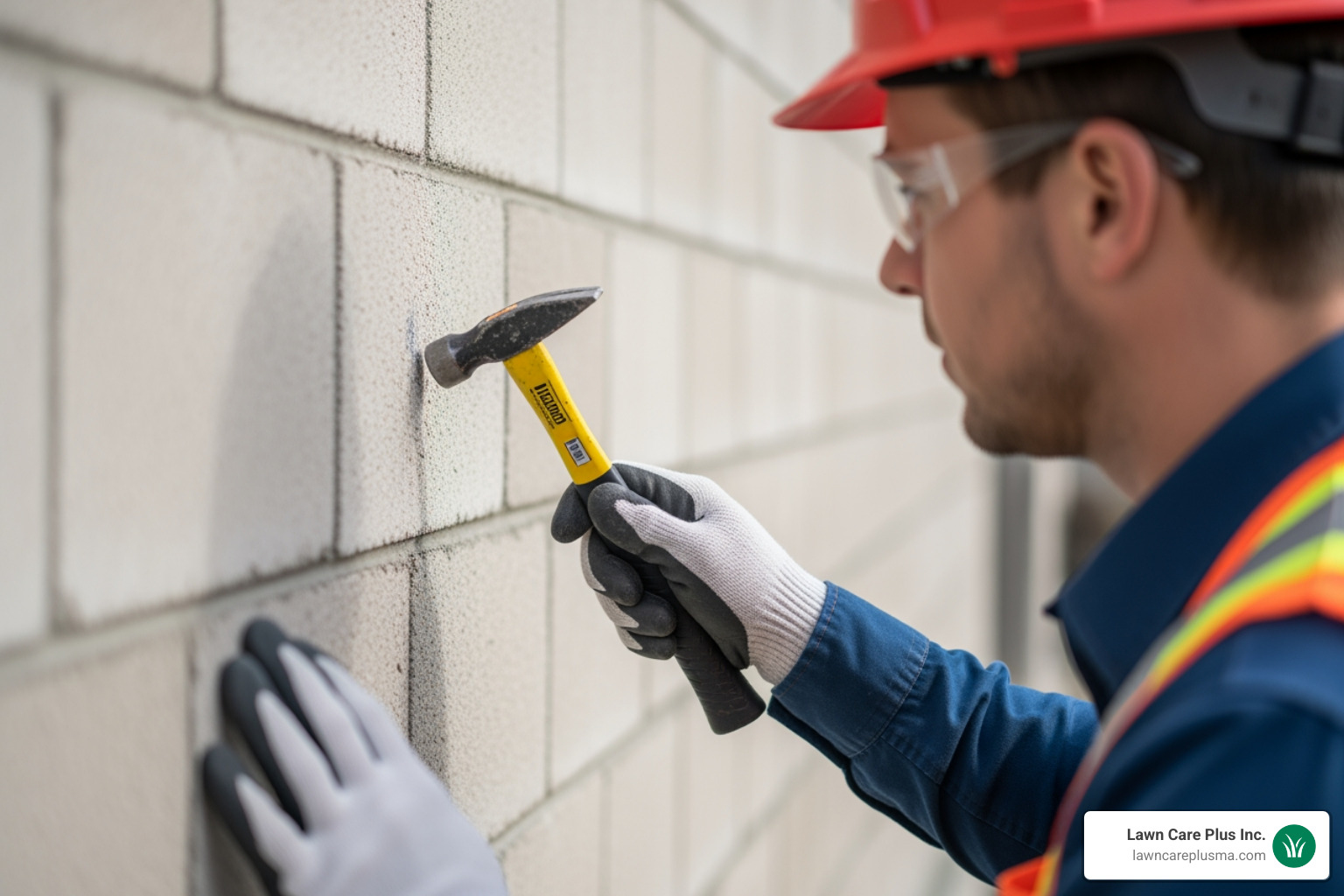
The first step is a thorough visual inspection. We look for signs of distress like cracking, spalling (where the surface chips or flakes off), and efflorescence (that white, powdery salt residue). One of our favorite “pro” tricks is the sounding test. By gently tapping the masonry with a small hammer, we listen for a “hollow” sound. A sharp “ping” means the material is solid; a dull “thud” indicates delamination, meaning the concrete has separated from the internal structure or reinforcement.
If you spot a crack, you need to know if it’s “active” or “dormant.” We recommend a simple gypsum plaster patch test. Apply a small dab of gypsum over the crack. If the plaster cracks over the next few days, the structure is still moving, and you likely have a structural settlement issue that requires a specialist. If it stays intact, it’s a dormant shrinkage crack that is safe to repair.
For those searching for Masonry Repair Near Me in areas like Newton or Wellesley, identifying the root cause—be it poor drainage, heavy tree roots, or simply the brutal Massachusetts freeze-thaw cycle—is the most important part of the job.
Understanding the Causes of Deterioration
Why do perfectly good walls go bad? In our experience serving the Boston area, moisture is the usual suspect.
- Moisture Ingress and Freeze-Thaw: Concrete is porous. Water enters the pores, freezes in January, expands, and creates micro-cracks. Repeat this for twenty winters, and you have a crumbling wall.
- Rebar Corrosion: If water reaches the internal steel reinforcement, the rebar rusts. Rust occupies more volume than steel, exerting “expansive pressure” that cracks the concrete from the inside out.
- Differential Settlement: The ground under your foundation in Brookline or Belmont might shift unevenly, causing structural cracks.
- Carbonation: Over time, CO2 from the air penetrates the concrete, lowering its pH and making the steel reinforcement vulnerable to rust.
For a deeper dive into these technical mechanics, we often refer to the Concrete Repair Guide ACI 546R-96, which is the industry bible for understanding why concrete fails.
Concrete Repair vs. Concrete Restoration
We often hear these terms used interchangeably, but they serve very different purposes. Knowing which one you need will save you time and money.
| Feature | Concrete Repair | Concrete Restoration |
|---|---|---|
| Primary Goal | Fix structural integrity and safety | Return to original aesthetic appearance |
| Scope | Addressing rebar rust, deep cracks, and load capacity | Resurfacing, cleaning, and cosmetic patches |
| Techniques | Chipping, rebar treatment, structural mortars | Power washing, thin overlays, staining |
| Appropriate for | Failing foundations or retaining walls | Faded patios or stained Block Walls |
Restoration is like a facelift; repair is like heart surgery. If your wall is leaning or has deep, wide cracks, restoration alone won’t save it. You must address the structural bones first.
Essential Techniques for Concrete masonry repair
Now that we know what we’re dealing with, let’s talk about the “how.” Successful concrete masonry repair lives and dies by surface preparation.
Surface Preparation: The Secret Sauce
If you just slap new mortar onto old, dirty concrete, it’s going to pop off. We follow a strict prep protocol:
- Sawcutting Edges: Never “feather edge” a repair. If you have a hole, use a masonry saw to cut the perimeter to a depth of at least 3/4 inch (20 mm). This creates a vertical shoulder that helps the repair material lock in.
- High-Pressure Blasting: We use high-pressure water blasting (minimum 5000 psi) or abrasive blasting to remove “bruised” concrete and micro-cracks. This creates what we call a CSP 6-10 profile—a surface as rough as coarse sandpaper.
- SSD Condition: Before applying any cement-based material, the substrate must be Saturated Surface-Dry (SSD). This means the concrete is soaked with water so it doesn’t “steal” moisture from your new mortar, but there is no standing water on the surface.
If you’re looking for Masonry Services Near Me, make sure your contractor doesn’t skip the sawcutting step!
Recommended Materials for Concrete masonry repair
Choosing the right “mud” is vital. For most DIY jobs, a high-quality acrylic compound like the Red Devil SKU: 0646 is excellent for sealing cracks in sidewalks and patios. It’s paintable, mildew-resistant, and won’t stain.
For larger structural fixes, we use:
- Portland Cement Mortars: The classic choice, often enhanced with polymers for better stickiness.
- Polymer-Modified Mortars: These are sag-resistant, making them perfect for vertical walls or overhead repairs.
- Vapor Permeable Coatings: In our climate, your masonry needs to “breathe.” If you seal it too tight, moisture gets trapped behind the coating and causes the face of the brick or block to pop off.
Whether you’re doing a Retaining Wall Repair Near Me or fixing a step, always match the strength of your repair material to the original concrete. If the patch is too hard, it will cause the surrounding old concrete to crack.
Proper Curing and Finishing
Curing isn’t just “drying.” It’s a chemical reaction called hydration. If concrete dries too fast, it loses strength and cracks. We recommend keeping your repair moist for at least 7 days. You can do this by covering it with wet burlap and a polyethylene sheet.
For professional-grade results, we use curing compounds that meet ASTM C309 standards. A properly cured repair should reach a tensile bond strength of at least 150 psi. If you can pull the patch off with a hammer, something went wrong with the curing!
Step-by-Step Guide to Fixing Cracks and Units
Ready to get your hands dirty? Here is how we handle the most common masonry headaches.
Tuckpointing and Crack Repair
- Clean it out: Use a hammer and chisel to remove loose mortar to a depth of about 1/2 inch.
- Match the mortar: This is an art form. We often mix trial batches and let them dry to ensure the color matches your existing wall in Jamaica Plain or Roslindale.
- Pack it in: Dampen the joint (SSD condition!) and pack the new mortar in layers.
- Tool the joint: Use a jointer tool to match the shape of the surrounding mortar.
Retrofitting Control Joints
Sometimes walls crack because they don’t have enough “room to move.” We can retrofit a control joint by sawcutting a vertical joint 3/8 inch wide through the wall. We then fill it with a backer rod and a flexible sealant. This gives the wall a “hinge” so it can expand and contract without cracking. For more on this, check out our Brick Masonry Near Me Guide.
Replacing Damaged Units
If a concrete block is completely shattered:
- Chisel out the old mortar around the unit.
- Remove the broken block.
- Clean the cavity thoroughly.
- Apply a thick bed of mortar to the bottom and sides of the new block.
- Slide the new unit in and “butter” the top joint.
Managing Water Penetration and Efflorescence
Efflorescence is that white “fuzz” on your walls. It’s not mold—it’s salt. When water moves through the wall, it dissolves salts and leaves them on the surface as it evaporates.
To fix it:
- Cleaning: Use non-aggressive methods first. Often, a stiff brush and plain water will do the trick. Always perform a cleaning test on a small area first.
- Site Grading: Ensure the ground slopes away from your Concrete Block Retaining Wall.
- Gutters: Keep those gutters clean! A waterfall from a clogged gutter is the #1 cause of basement wall failure.
Estimated Costs for Masonry Repairs
While we can’t give you a quote without seeing the job, we can share some average cost ranges based on internet data for the Massachusetts area. These are estimates, and actual costs for your specific project may vary significantly.
- Minor Crack Injection: $300 – $900
- Tuckpointing (per 100 sq. ft.): $500 – $2,500
- Retaining Wall Structural Repair: $2,000 – $12,000+
- Foundation Parging: $1,000 – $4,500
Note: These are average costs based on internet data and not actual costs for Lawn Care Plus. Large-scale structural projects can easily exceed the high end of these ranges by 3x or more depending on the complexity and equipment required.
Preventing Future Damage and Unit Degradation
The best concrete masonry repair is the one you never have to do. Maintenance is the name of the game.
The Ivy Debate
We know, it looks beautiful and “English,” but ivy is a masonry killer. Its rootlets find tiny voids in your mortar, expand, and eventually dislodge bricks or blocks. It also holds moisture against the wall, accelerating freeze-thaw damage.
- Tree Spacing: Keep large trees at least 10 to 15 feet away from basement walls to prevent root pressure.
- Shrub Placement: Smaller shrubs should be at least 2 to 3 feet away to allow for airflow.
Our Hardscaping Services team always recommends keeping vegetation clear of structural masonry to ensure longevity.
Professional Inspections for Concrete masonry repair
We recommend that building owners perform a visual inspection at least annually. Look for new cracks, peeling paint, or standing water. Every five years, you should have a more thorough inspection performed by a specialist.
Keep an Owner’s Manual for your property. Include:
- As-built drawings.
- Records of what sealants or coatings were used (so you don’t use an incompatible one later).
- Maintenance logs.
If you’re unsure about what you’re seeing, it’s always better to consult Mason Contractors Near Me before a small crack becomes a foundation failure.
Frequently Asked Questions about Concrete Masonry Repair
How do I know if a crack is structural?
Generally, if a crack is wider than 0.02 inches (about the thickness of a credit card), or if it runs diagonally across several units, it could be structural. If the gypsum patch test we mentioned earlier fails, call a pro immediately.
Can I paint over concrete masonry repairs?
Yes, but don’t rush it! Ensure the repair is fully cured (usually 28 days for standard mortar). Most importantly, use a “breathable” masonry paint with high vapor permeability. If you use standard latex or oil-based paint, you might trap moisture and cause the repair to fail.
Why is my concrete wall “sweating” or turning white?
That’s efflorescence. It means water is getting into the wall from somewhere—usually from the top (bad flashing) or the back (poor drainage). Cleaning the white powder is easy, but you have to stop the water source to keep it from coming back.
Conclusion
At Lawn Care Plus Inc., we take pride in helping our neighbors in Belmont, Dedham, Milton, and throughout the Boston Metro-West area protect their properties. Concrete masonry repair might seem intimidating, but with the right preparation and materials, you can tackle many of these issues yourself.
However, when the job involves structural stabilization, large-scale spalling, or complex water penetration issues, our team of experts is here to help. We provide residential and commercial solutions that stand up to the unique challenges of the Massachusetts climate.
Ready to restore your property’s strength and beauty? Explore our full range of Masonry Services or contact us today to discuss your project!
