
What Is a Stone Wall? A Quick Guide for Boston-Area Homeowners
Stone walls are one of the oldest and most durable hardscaping features you can add to a property. Here’s what you need to know at a glance:
| Type | Best For | Mortar Needed? |
|---|---|---|
| Dry-laid (dry stack) | Natural look, drainage, slight movement | No |
| Mortared | Formal appearance, structural rigidity | Yes |
| Wet/dry hybrid | Durability + dry-stack look | Partial |
Common uses:
- Retaining soil on slopes
- Defining garden beds or property lines
- Adding curb appeal and property value
- Creating seating walls or decorative borders
Most popular materials: Fieldstone, granite, bluestone, limestone, and concrete block.
In New England, stone walls are woven into the landscape itself. Farmers originally stacked fieldstones to clear land and mark boundaries. Today, that same tradition shows up in residential yards across Greater Boston — holding back hillsides, framing gardens, and giving properties a sense of permanence that manufactured materials simply can’t match.
But choosing the right type of stone wall — the right material, the right construction method, the right height — isn’t always straightforward. Get it wrong, and you’re looking at shifting stones, drainage failures, or walls that crack under New England’s brutal freeze-thaw cycles.
I’m Tim DiAngelis, owner of Lawn Care Plus, Inc., and after more than a decade building and restoring stone walls for homeowners across Greater Boston and Metro-West, I’ve seen what separates a wall that lasts generations from one that needs repairs within a few years. In this guide, I’ll walk you through everything you need to make a confident decision for your property.
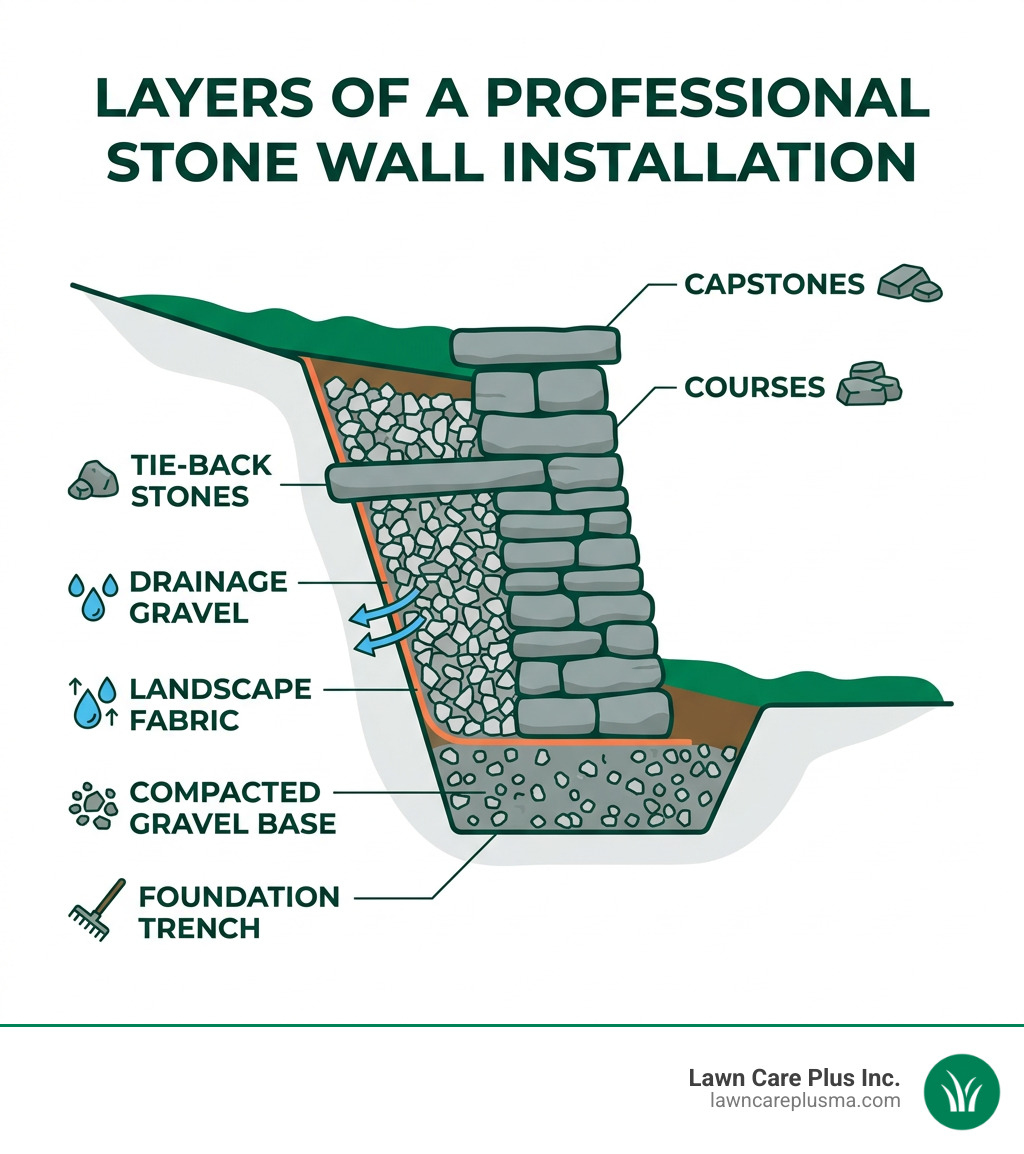
Stone wall vocab to learn:
Understanding the Different Types of Stone Wall Construction
When we talk about building a stone wall in the Boston area, we aren’t just talking about piling rocks. There is a deep-rooted science to how these structures stay upright, especially when they are fighting against the weight of a rain-soaked New England hillside. The method of construction you choose will dictate not just the look of your landscape, but how it performs over the next fifty years.
Dry Stone Technique
The dry stone technique, often called “dry stack,” is the gold standard for traditional New England aesthetics. This method relies entirely on gravity and friction. By carefully selecting and interlocking stones, we create a structure that is surprisingly flexible. In our region, where the ground expands and contracts during the winter, a dry-laid wall can “breathe.” If the ground shifts slightly, the stones move with it rather than cracking.
One of the biggest advantages of this method is that it is self-draining. Because there is no mortar blocking the gaps, water can seep through the wall naturally, preventing the buildup of hydrostatic pressure that often topples lesser structures. To do this right, you have to follow specific rules for how to build a stone wall, such as setting the length of the stone into the wall (to avoid “tracing”) and ensuring the “hearting” (the center fill) is packed tightly.
Mortared Masonry
Mortared walls, or “wet” walls, use a mix of Portland cement and sand to bind the stones together. This creates a much more rigid, formal look. While these walls are incredibly strong, they are also less forgiving. Because they cannot move with the frost, they require a deep, reinforced concrete foundation that extends below the frost line (usually 4 feet deep in Massachusetts). Without that foundation, the wall will crack as the ground heaves.
Wet/Dry Hybrid
For homeowners who want the structural security of concrete but love the rustic look of a dry stack, we often recommend a hybrid approach. We build the core of the wall with concrete and mortar for stability but leave the front face looking like a traditional dry-laid wall. This is a popular choice for retaining wall design ideas in suburban neighborhoods like Newton or Brookline, where structural integrity is a high priority.
Selecting the Right Stone Wall Material
The material you choose is the most visible part of your project. In the Boston Metro-West area, we are blessed with access to some of the finest natural stone in the country, but manufactured options have also come a long way.
- Fieldstone: These are the rounded or slightly flat stones found in New England fields. They offer a timeless, “old-world” look.
- Granite: Extremely durable and resistant to the freeze-thaw cycle. Granite is a favorite for steps and formal landscape retaining walls.
- Bluestone and Limestone: Often used for “cut stone” looks, providing flat surfaces that are easier to stack and very stable.
- Concrete Blocks: Modern blocks for retaining wall construction are engineered for strength. They are often the most cost-effective choice for large-scale erosion control and can be finished with a stone veneer to mimic natural materials.
The Functional Purpose of a Stone Wall
While we all love a beautiful stone wall, they are rarely just for show. In our service areas like Belmont and Watertown, many homes are built on variable terrain that requires smart retaining wall design.
- Erosion Control: This is the primary job of a retaining wall. By holding back soil on a slope, we prevent your backyard from washing away during a heavy spring downpour.
- Creating Usable Space: A well-placed wall can turn a steep, useless hill into a flat, beautiful patio or garden bed.
- Decorative Borders and Property Markers: Low-profile walls can define the edges of your driveway or mark the boundary between your yard and your neighbor’s, adding significant curb appeal.
Key Factors in Design and Engineering
Building a stone wall that stands the test of time requires more than just strong arms; it requires an understanding of physics. According to scientific research on retaining wall mechanics, a wall must be designed to resist the “lateral earth pressure” of the soil behind it.
The Foundation and Drainage
Every great wall starts underground. For a dry-stack wall, we typically dig a retaining wall foundation trench about 12 inches deep. We fill this with compacted gravel to provide a stable, non-shifting base.
Drainage is the single most important factor in wall longevity. When water gets trapped behind a wall and freezes, it expands with incredible force. This is why we use retaining wall drainage systems, including perforated pipes (weep holes) and a thick layer of free-draining gravel directly behind the stones. This ensures water moves down and away from the wall rather than pushing against it.
Planning Your Stone Wall Height and Slope
The height of your wall changes everything. “Gravity walls” rely on their own weight to stay put. As a rule of thumb, a gravity-type stone wall should be at least 50% to 60% as thick at the base as it is high.
If you are building a retaining wall on a slope, you also have to account for “surcharge”—the extra weight from things like cars or sheds sitting at the top of the hill. For walls over 3 feet tall, local safety codes in Massachusetts often require a structural engineer’s stamp to ensure the wall won’t fail.
Maintenance and Stone Wall Repair
Even the best-built walls need a little love over the decades.
- Settling: It’s normal for a natural stone wall to settle slightly over the first few years.
- Shifting Stones: In dry-stack walls, a stone might occasionally wiggle loose. These can usually be “pinned” back into place with smaller stones.
- Tuckpointing: For mortared walls, the mortar joints may eventually crack. This requires “tuckpointing,” where we scrape out the old mortar and replace it with fresh material to keep moisture out. If you notice a significant bulge or “leaning,” it’s time to search for retaining wall repair near me to address the underlying drainage or foundation issue before the wall collapses.
The Installation Process: DIY vs. Professional Builders
We often get asked if a stone wall is a good DIY project. The answer depends on the scale.
The DIY Path: If you are building a small retaining wall (under 2 feet) for a garden border, it can be a rewarding weekend project. You’ll need a shovel, a level, a string line, and a lot of patience. Sourcing your own fieldstone can save money, but be prepared for the physical toll—1 ton of stone only covers about 10 cubic feet of wall!
The Professional Path: For anything structural or over 3 feet high, the benefits of hiring a professional are clear. Professional retaining wall installers have the heavy machinery needed for deep excavation and the experienced “eye” to choose the right stones for maximum interlocking strength. We ensure the wall is “battered” (slanted back toward the hill) correctly, which is vital for long-term stability.
Estimating Your Project Costs
When planning your budget, you are investing in a structure that can last a century. Prices vary based on the stone type, the height of the wall, and the ease of access to your yard.
| Material Type | Estimated Cost Per Sq. Ft. (Installed) | Durability |
|---|---|---|
| Manufactured Concrete Block | $15 – $45 | High |
| Natural Fieldstone (Dry Stack) | $25 – $75 | Very High |
| Granite or Cut Stone (Mortared) | $60 – $165+ | Extreme |
Note: These are average costs based on internet data and not actual costs for Lawn Care Plus. Local labor rates in the Boston area and specific site challenges can push the high end of pricing to 3x or more of the national average.
Key Cost Factors:
- Labor: Skilled masonry is a craft that takes time.
- Excavation: Removing old soil and bringing in tons of gravel.
- Delivery: Stone is heavy! Shipping costs are calculated by weight and distance from the quarry.
- Site Prep: Sloped or hard-to-reach yards in places like Chestnut Hill or Brighton require more specialized equipment.
Frequently Asked Questions about Stone Walls
Do I need a permit for a stone wall?
In most Massachusetts towns, including Needham and Newton, you generally do not need a permit for a wall under 3 or 4 feet tall. However, if the wall is taller or if it is near a property line or wetlands, a permit and an engineered plan are almost always required. We always recommend checking with your local building department first.
How long does a natural stone wall last?
A well-constructed natural stone wall can last for decades, and in many cases, centuries. Dry-stack walls are particularly long-lived because they aren’t destroyed by the freeze-thaw cycle. You might need to adjust a stone here or there every 20 years, but the wall itself is essentially permanent.
What is the best stone for a retaining wall?
For structural strength and ease of installation, flat stones like flagstone or ashlar (cut stone) are excellent. For the classic “Boston” look, granite and New England fieldstone are the top choices. If you’re on a budget, high-quality concrete blocks designed specifically for landscape retaining walls provide the best bang for your buck.
Conclusion
Choosing the right stone wall is about finding the perfect balance between your home’s architecture, your landscape’s needs, and your personal style. Whether you are looking to reclaim a sloped backyard in Medfield or add a touch of historical elegance to a front walkway in Milton, a stone wall is an investment that truly grows more beautiful with age.
At Lawn Care Plus Inc., we take pride in building walls that are as sturdy as they are beautiful. From the initial landscape retaining walls design to the final capstone placement, our team brings the experience needed to handle the unique challenges of the Boston Metro-West climate.
If you’re ready to transform your property, we’re here to help you navigate the process. From Belmont to Walpole and everywhere in between, let us help you build something that lasts. Contact us today to start planning your next hardscaping project!
