Why Understanding Commercial Snow Removal Rates Matters for Your Business
Commercial snow removal rates are critical for property managers and business owners preparing for winter in the Boston Metro-West area. Understanding these rates helps you budget accurately, avoid unexpected costs, and ensure your property remains safe and accessible during snow events.
Quick Answer: What Are Commercial Snow Removal Rates?
Commercial snow removal rates typically fall into these ranges based on internet data:
- Small lots (10-20 spaces): $600-$1,000/month or $230-$575 per event
- Medium lots (20-60 spaces): $1,000-$2,500/month or $400-$750 per event
- Large lots (60+ spaces): $3,000-$8,000+/month or $1,000-$2,000+ per event
- Per-inch pricing: $3-$10+ per inch of snowfall
- Hourly rates: $50-$150+ per hour depending on equipment
- Seasonal contracts: $2,000-$10,000+ for the entire winter season
These are average costs based on internet research and vary widely based on property size, location, service level, and snowfall patterns. Actual costs may be higher for complex sites or premium services.
When winter hits New England, unprepared businesses face real consequences: customers unable to access your location, employees calling out due to unsafe conditions, and potential liability if someone slips on your property. The right snow removal contract protects your business continuity, reduces liability exposure, and ensures safety compliance—but only if you understand what you’re paying for and why.
The challenge most property managers face isn’t just finding a snow removal service—it’s determining whether they’re getting fair value. Are you overpaying for services you don’t need? Are hidden fees lurking in your contract? Will your provider actually show up during that 3 a.m. blizzard?
This guide breaks down the pricing factors, contract models, and cost-saving strategies you need to make informed decisions about your commercial snow removal budget.
I’m Tim DiAngelis, owner of Lawn Care Plus, Inc., and I’ve spent over a decade managing snow removal operations for commercial properties throughout Greater Boston and Metro-West. Understanding Commercial snow removal rates and how they’re structured has been essential to helping our clients budget effectively while maintaining safe, accessible properties all winter long.
Commercial snow removal rates terms to know:
The Anatomy of a Commercial Snow Removal Service
When we talk about commercial snow removal, we’re not just talking about pushing snow around. It’s a comprehensive service designed to keep your business operating smoothly and safely, even in the harshest New England winters. For our commercial clients in Belmont, Boston, Newton, Wellesley, and across the Metro-West area, this means a custom approach that goes far beyond what a residential service typically offers.
At its core, commercial snow removal includes:
- Plowing Parking Lots: Clearing main thoroughfares, parking spaces, and delivery zones to ensure vehicle access for customers, employees, and suppliers. This often involves large plow trucks capable of moving significant volumes of snow quickly.
- Clearing Walkways: Carefully removing snow from pedestrian paths, entrances, fire exits, and other foot traffic areas. This usually requires smaller equipment like snow blowers, or manual shoveling, to ensure every step is safe.
- De-icing Services: Applying salt, sand, or other ice-melting agents to prevent ice formation and melt existing ice. This is crucial for preventing slips and falls, which can lead to costly liability issues.
- Salting and Sanding: Strategic application of materials to provide traction and melt ice, particularly in high-traffic areas or on sloped surfaces.
The scale of commercial snow removal is vastly different from residential. Imagine the difference between clearing a single-car driveway and a 100,000 square foot big box store lot. Commercial properties demand heavier equipment, more personnel, specialized planning, and often, much faster response times. Our goal is to minimize disruption to your business operations.
Beyond the physical act of clearing, professional commercial snow removal is a critical investment in your business’s safety and legal compliance. Ignoring snow and ice can lead to serious consequences, including:
- Business Interruption: Inaccessible parking lots or walkways mean lost customers and revenue.
- Increased Liability: Slips and falls due to uncleared ice or snow can result in expensive lawsuits, medical costs, and reputational damage. Property owners have a legal obligation to maintain safe premises.
- Code Violations: Many local bylaws mandate specific timelines for snow and ice removal, and non-compliance can lead to fines.
While DIY snow clearing seems like a way to save money, it often costs more long-term due to equipment investment, time, and physical strain. With thousands of snow-shoveling injuries occurring annually, it’s a significant risk. Our professional, insured teams handle the job safely and efficiently, offering comprehensive property care to keep your commercial space looking its best year-round.
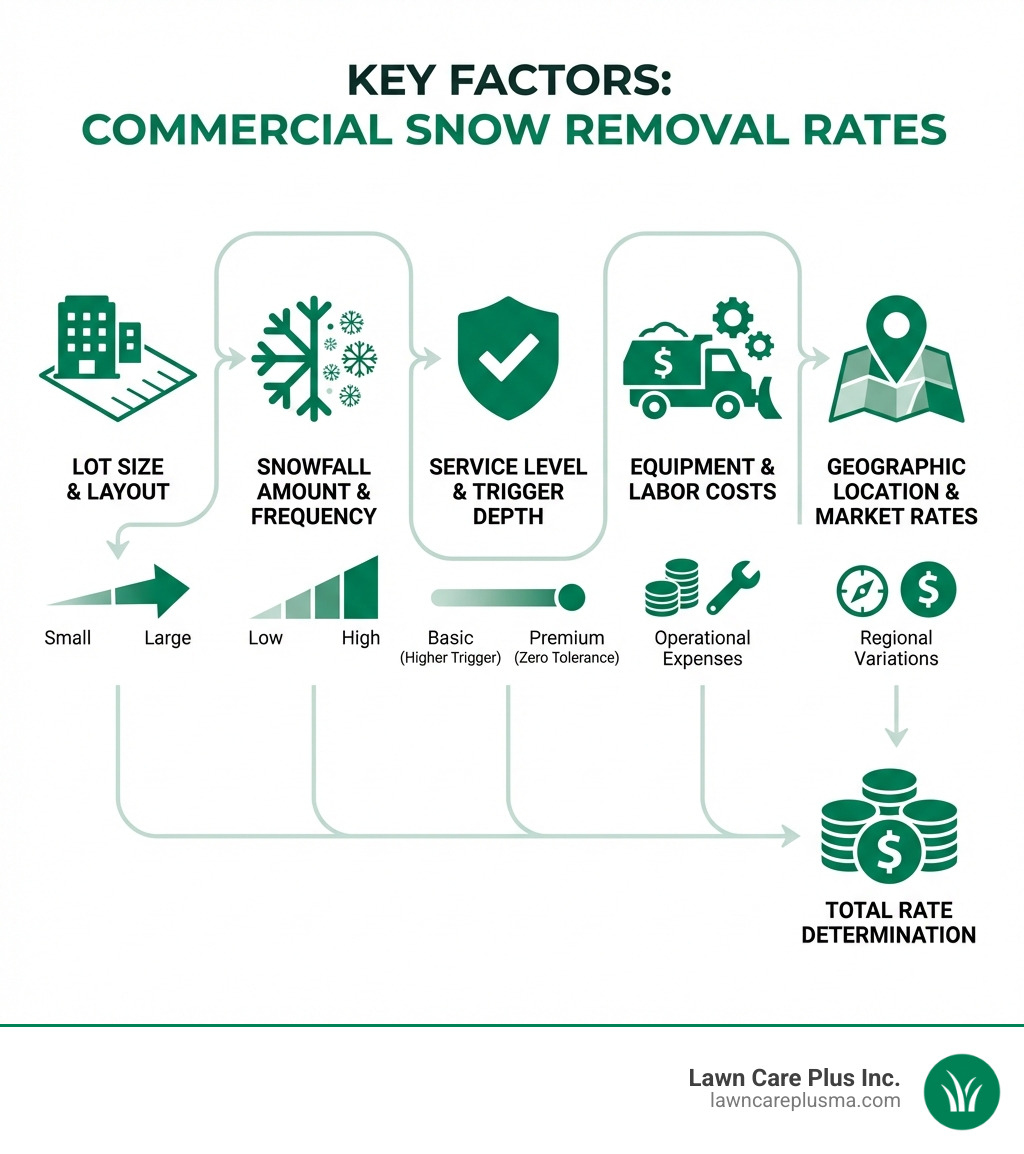
7 Key Factors That Drive Your Commercial Snow Removal Rates
Understanding what goes into commercial snow removal rates is crucial for our clients in the Boston Metro-West area. These factors directly influence the cost of keeping your property safe and functional all winter.
Please remember, the average costs mentioned below are general estimates based on internet data and not actual quotes from Lawn Care Plus. Actual pricing will always depend on a thorough assessment of your specific property and service needs.
1. Property Size and Layout
The most obvious factor is the size of the area needing clearing. A larger parking lot requires more time and equipment. However, the layout is also significant:
- Parking Spaces and Obstacles: More spaces, tight corners, islands, and light poles slow down plowing and may require manual clearing, increasing labor time.
- Entrances and Exits: Each access point needs careful clearing and often dedicated salting.
- Walkway Length and Width: Extensive or intricate pedestrian pathways demand detailed attention with smaller equipment or shoveling crews. We also offer expert walkway installation and care to ensure they’re prepared for winter.
A complex layout increases the time and resources required, leading to higher rates compared to a wide-open space.
2. Snowfall Volume and Geographic Location
The amount of snow we get in the Boston Metro-West area is a huge factor. Average annual snowfall can vary even within our service region.
- Average Annual Snowfall: Areas that historically receive more snow will have higher seasonal contract rates to account for more frequent service.
- Coastal Storms: Proximity to the coast can bring significant snowfall to our Massachusetts communities, impacting the frequency and intensity of snow events.
- Local Market Rates: Pricing is influenced by the going rates for skilled labor and equipment in specific towns like Canton, Dedham, Boston, or Newton.
3. Trigger Depth and Service Level
This is a key part of any snow removal contract.
- Service Trigger Depth: This is the pre-agreed snow accumulation (e.g., 1 or 2 inches) that activates service. A 1-inch trigger means more frequent dispatches and higher safety but also a higher seasonal cost. A 2-inch trigger is less frequent and less expensive but allows more accumulation before service.
- Zero-Tolerance Policies: Medical facilities or high-traffic retail often require “zero-tolerance” policies, where snow and ice are removed as soon as they appear. This premium service commands a higher rate.
- Guaranteed Response Times: Contracts can specify response times (e.g., within 2 hours of a trigger). Faster, more precise responses increase the cost.
- 24/7 Monitoring: For critical facilities, continuous weather monitoring and proactive deployment ensure your property is always clear.
4. Equipment and Labor
The machinery and the people operating it are major cost components.

- Plow Trucks: For clearing large parking lots and roadways.
- Loaders and Skid Steers: For moving and stacking large snow piles.
- Snow Blowers and Shoveling Crews: For detailed work on walkways and entrances.
- Operator Skill: Experienced, efficient operators are a valuable part of the cost.
- Insurance and Overhead: Professional companies carry extensive liability insurance. Other overhead costs like fuel, maintenance, and administrative support are factored into rates to ensure reliable service.
5. Type of Commercial Property
Different properties have different needs and commercial snow removal rates.
- Small Retail Lot: Requires quick turnaround for customer access.
- Large Shopping Plaza: Demands comprehensive service for extensive parking and high pedestrian traffic.
- Office Complex: Focuses on morning readiness for employees and visitors.
- Industrial Site: May have specific needs for clearing loading docks and large storage areas.
- HOA/Condo Association: Requires clearing shared roads, parking, and walkways for residents.
- Medical Facility: Has the most stringent requirements for immediate clearing to ensure emergency access.
Each property type’s unique challenges are reflected in the pricing.
6. Scope of Services and Add-Ons
Know what’s included in your base contract versus what’s an extra.
- Plowing Only: The most basic service for vehicular areas.
- Full-Service Packages: Typically include plowing, walkway clearing, and de-icing.
- Ice Management: Proactive application of de-icing agents to prevent ice bonding.
- Pre-Salting: Applying salt before a storm to make clearing easier.
- Post-Storm Monitoring: Checking for refreezing after a storm.
- Cost of Salt: De-icing agents are a significant expense. Contracts may include a set amount or bill it separately. Based on internet data, salt can cost $20 to over $150 per application or be billed per ton.
7. Snow Stacking and Hauling
Sometimes, there’s too much snow to push aside.
- On-Site Snow Relocation (Stacking): Pushing and stacking snow in designated areas is generally included in comprehensive services.
- Off-Site Snow Removal (Hauling): For properties with limited space, snow may need to be hauled off-site. This is almost always an additional service. Based on internet data, per-load fees for hauling can range from $500 to over $1,500.
A Guide to Snow Removal Pricing Models
Navigating the various pricing models for commercial snow removal can feel like deciphering a cryptic code. However, understanding these structures is key to effective budgeting and ensuring you get the right service for your property. We offer flexible options to our clients in the Boston Metro-West area, always aiming for transparency and value.
Here’s a breakdown of the common pricing models:
| Pricing Model | Cost Structure | Predictability | Best Use Case |
|---|---|---|---|
| Per-Event | Pay per snowfall | Low | Infrequent, light snow |
| Per-Inch | Pay based on snow depth | Medium | Variable snowfall |
| Hourly | Pay for time spent | Low | Complex, unpredictable jobs |
| Seasonal | Fixed fee for season | High | Consistent snow, budget certainty |
Understanding Per-Event and Per-Push Commercial Snow Removal Rates
The “per-event” or “per-push” model means you pay a set fee each time our crews are dispatched to clear your property after a snowfall that meets the agreed-upon trigger depth.
- Cost Structure: A flat rate is charged for each snow event or each time a crew “pushes” snow.
- Predictability: This model offers less budget predictability, as your total winter cost depends entirely on the number of snowfalls. In a mild winter, it could be cheaper; in a heavy winter, it could be significantly more expensive.
- Best Use Case: This model is often preferred by businesses in areas with infrequent or unpredictable snowfalls, or those who prefer to pay only when service is rendered. Based on internet data, average costs can range from $200 to over $600 per clearing event, depending on the property size and complexity.
Understanding Per-Inch Commercial Snow Removal Rates
This model ties the cost directly to the amount of snow that falls, making it a fair system when snowfall amounts vary widely.
- Cost Structure: You pay a rate based on the accumulated snow depth. This often involves tiered pricing, where, for example, there’s one rate for 1-3 inches of snow, a slightly higher rate for 4-6 inches, and so on. This accounts for the increased time and effort required for deeper snow.
- Predictability: Offers moderate predictability. While you know the rate per inch, your total bill still depends on the winter’s total snowfall.
- Best Use Case: Ideal for properties in regions with highly variable snowfall, ensuring you only pay for the snow that actually falls. Based on internet data, average costs for per-inch pricing can range from $3 to over $10 per inch.
Hourly Rates
An hourly rate means you’re billed for the actual time our crews spend on your property, including travel time to and from the site.
- Cost Structure: A set hourly rate is charged for labor and equipment.
- Predictability: This model offers low predictability, as the total cost depends on the duration and complexity of each snow event.
- Best Use Case: Hourly rates are often best suited for properties with highly complex layouts, unpredictable snow drifting patterns, or situations where the exact scope of work can’t be determined in advance (e.g., emergency clearings or unexpected heavy ice events). The rate can also vary significantly based on the specialized equipment required. Based on internet data, average hourly costs for commercial snow removal can range from $50 to over $150 per hour.
Seasonal and Monthly Contracts
A seasonal contract provides the ultimate in budget predictability, making it a popular choice for many commercial clients.
- Cost Structure: A fixed fee is agreed upon for the entire winter season (typically November through March), regardless of how much snow falls. This fee is often paid in monthly installments.
- Predictability: This model offers high predictability. You know your total cost upfront, simplifying budgeting.
- Best Use Case: Perfect for businesses that prioritize budget certainty and consistent, worry-free service throughout the winter. It often includes unlimited service for all snow events that meet the trigger depth. Based on internet data, average seasonal costs can range from $2,000 to over $10,000 for the entire winter season, depending on property size and service scope.
Smart Strategies for Your Snow Removal Budget
Choosing the right snow removal partner and contract is a crucial decision that impacts your operational budget, safety, and peace of mind. For property managers and business owners in the Boston Metro-West area, optimizing your commercial snow removal rates means more than just finding the lowest price—it means finding the best value.

Questions to Ask Before Signing a Contract
Before you commit, arm yourself with information. Asking the right questions upfront can save you headaches and unexpected costs down the line. We encourage all our clients to be thorough!
- What is the trigger depth for service? Clarify the exact snow accumulation (e.g., 1 inch, 2 inches) that will automatically dispatch crews.
- Is de-icing (salting/sanding) included in the base price, or is it an extra charge? If it’s extra, how is it billed (per application, per ton, hourly)?
- What is your guaranteed response time after a snowfall? Will crews arrive within a certain number of hours, or by a specific time (e.g., before business opening)?
- Can I see your certificate of insurance? Verify that the contractor carries adequate liability insurance and worker’s compensation to protect your business.
- How do you handle extreme blizzard events or heavy snowfalls (e.g., over 12 inches)? Are there additional charges or specific protocols for these situations?
- Are walkways, fire exits, and main entrances included in the service, or just the parking lot? Ensure all critical pedestrian areas are covered.
- What is the contract duration and cancellation policy?
- How do you communicate service updates or delays during a storm?
How to Spot and Avoid Hidden Fees
Hidden fees are the grinches of commercial snow removal. They can quickly inflate your winter budget if you’re not careful. Here are some common culprits to watch out for:
- Extra Charges for Major Snowfalls or Blizzards: Some contracts may have a cap on the number of visits or total snowfall, charging extra for anything exceeding that limit.
- Salting Billed Per Ton Instead of Flat Fee: If salting is billed per ton, a heavy ice event could mean a surprisingly large bill. Clarify if it’s included, billed per application, or per ton.
- Emergency Call-Out Fees: If you require service outside the agreed-upon trigger depth or response time, some contractors might charge a premium.
- Fuel Surcharges: With fluctuating fuel prices, some contracts include a clause for fuel surcharges, which can add to your bill.
- Pre-Season Site Visit Fees: While a good contractor will do a thorough site assessment, ensure this isn’t an unexpected charge.
- Snow Hauling Off-Site: As mentioned, if snow piles become too large, hauling it away is almost always an extra service, with costs ranging from $500 to over $1,500 per load. Make sure to discuss snow storage plans upfront.
Tips for Maximizing Value
Getting the most out of your snow removal budget involves strategic planning and clear communication.
- Bundle Services: Consider partnering with a company like Lawn Care Plus that offers year-round property maintenance. Bundling snow removal with other landscaping services can often lead to discounts and a more cohesive approach to your property’s care.
- Sign Contracts Early (September/October): Demand for snow removal services surges as winter approaches. Booking your contract in the late summer or early fall often secures better rates and ensures you have a reliable provider locked in before the first snowflake falls. Many companies offer early bird discounts.
- Consider a Multi-Year Agreement: If you’re happy with your contractor, a multi-year contract can sometimes lock in rates or provide preferential pricing.
- Adjust Trigger Depth Based on Tolerance: If your business can safely handle 2 or 3 inches of snow before clearing is absolutely critical, opting for a higher trigger depth can reduce the frequency of service and lower your overall seasonal cost.
- Establish Clear Communication Protocols: Ensure you know how and when your contractor will communicate, especially during prolonged storm events. A reliable contractor will keep you informed.
Frequently Asked Questions about Commercial Snow Removal Pricing
We hear a lot of questions about commercial snow removal rates from property managers and business owners throughout the Boston Metro-West region. Here are some of the most common inquiries we receive:
What are typical commercial snow removal rates for a small business in Massachusetts?
Costs for commercial snow removal in Massachusetts vary widely based on property specifics, location, and the level of service required. However, based on internet data from the Northeast, a small commercial lot (roughly 5,000–10,000 sq ft, or 10-20 parking spaces) might see estimated seasonal contract costs ranging from $1,200 to over $4,500 for plowing and walkways. Per-event charges for such a property could range from $75 to over $575 per clearing. These are general estimates, and an accurate price requires a detailed assessment of your specific site.
Is a seasonal contract cheaper than paying per event?
It depends on the winter. In a heavy-snow winter, a fixed-rate seasonal contract is almost always more cost-effective, providing budget certainty and priority service. In a very mild winter, paying per-event might be cheaper, but you sacrifice predictable costs and guaranteed response. For most businesses, the stability of a seasonal contract outweighs the potential savings of per-event pricing.
What is a “trigger depth” and how does it affect my bill?
A “trigger depth” is a pre-agreed amount of snow accumulation that, once reached, automatically initiates snow removal service at your commercial property. For example, a common trigger depth might be 1 inch or 2 inches. It directly affects your bill because:
- Lower Trigger Depth (e.g., 1 inch): This means our crews will be dispatched more frequently, even for lighter snowfalls. This ensures your property is cleared almost immediately, offering maximum safety and accessibility. However, this higher frequency of service will result in a higher overall seasonal or monthly cost.
- Higher Trigger Depth (e.g., 3 inches): This means crews are dispatched less often, as more snow must accumulate before service begins. This can reduce your overall costs, but it also means there will be more snow on your property for a longer period before it’s cleared. This might be acceptable for some businesses but not for others, especially those with high foot traffic or strict safety requirements.
Choosing the right trigger depth is a balancing act between cost, safety, and business operational needs.
Ensure Your Property is Safe and Accessible This Winter
Understanding commercial snow removal rates is an essential part of managing your commercial property in the Boston Metro-West area. As we’ve explored, factors from property size to the chosen pricing model and specific services all contribute to the final cost.
Investing in professional snow removal is about more than just clearing snow—it’s about ensuring safety, maintaining business continuity, and reducing liability. Our experienced team at Lawn Care Plus is dedicated to providing reliable, comprehensive commercial snow removal services, allowing you to focus on your business, not the weather.
Don’t let winter weather disrupt your operations or compromise safety. Get a reliable quote for your commercial snow management needs today, and let us help you prepare for a safe and accessible winter season.