
Why Choosing the Right Lawn Feed and Moss Killer Makes All the Difference
If you’re trying to decide which lawn feed and moss killer is worth buying, here’s a quick answer:
| Product Type | Best For | Key Action |
|---|---|---|
| 2-in-1 (feed + moss) | Light moss, no weeds | Feeds grass, kills moss |
| 3-in-1 (feed + weed + moss) | Moss and broadleaf weeds | Feeds, kills weeds and moss |
| 4-in-1 (feed + weed + moss + colour) | Heavy moss, tired lawns | Full revival in one pass |
The short version: Pick a 3-in-1 or 4-in-1 granular formula if your lawn has both moss and weeds. Apply in spring or early summer on moist soil. Rake out dead (blackened) moss after 7-14 days. Then focus on the root cause — shade, drainage, or acidic soil — so moss doesn’t come back.
A mossy lawn isn’t just an eyesore. Moss takes over when grass is weak — in shaded, damp, or nutrient-poor conditions. And once it spreads, it crowds out the healthy turf you’ve worked hard to maintain.
The good news? A quality lawn feed and moss killer tackles the problem from two angles at once: it kills existing moss and feeds your grass so it grows back thick enough to resist future invasion. The tricky part is knowing which product format fits your lawn, when to apply it, and how to get the results to last.
That’s exactly what this guide covers.
I’m Tim DiAngelis, owner of Lawn Care Plus, Inc., a full-service landscaping company serving Greater Boston and Metro-West — and I’ve seen how the right lawn feed and moss killer strategy can transform a patchy, moss-covered lawn into a dense, healthy turf that holds up through New England’s tough seasons. In the sections below, I’ll walk you through every product type, application method, and prevention step you need to get it right.
What Lawn Feed and Moss Killer Is and How It Works
Lawn feed and moss killer is a lawn treatment that combines fertilizer with an iron-based moss control ingredient. Some formulas only feed and kill moss. Others also include selective weed killers for broadleaf weeds like dandelion, clover, daisies, plantain, and chickweed.
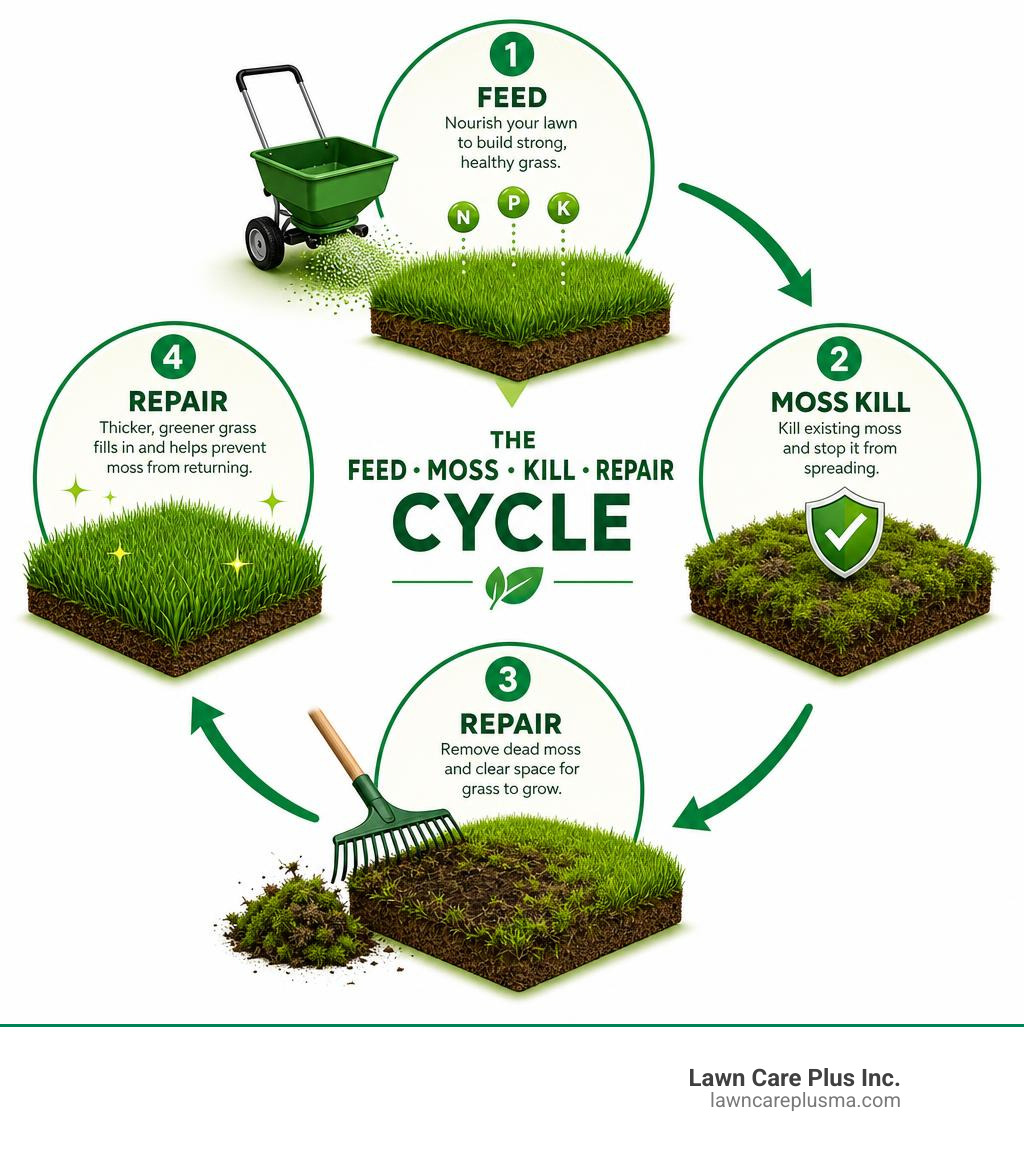
The goal is simple:
- Kill existing moss.
- Feed the grass.
- Thicken the turf.
- Make it harder for moss to return.
Moss usually shows up where grass is struggling. Around Belmont, Brookline, Newton, Needham, Dedham, Milton, Canton, and the rest of the Boston Metro-West area, we commonly see moss in lawns with:
- Too much shade
- Poor drainage
- Compacted soil
- Low fertility
- Acidic soil
- Thin turf
- Heavy thatch
- Wet spring conditions
Moss does not need the same conditions grass needs. It is perfectly happy in damp, shaded, compacted areas where turf roots are having a rough time. In other words, moss is not the main problem. It is the lawn waving a tiny green flag that says, “Something is off down here.”
How lawn feed and moss killer works
Most moss-killing lawn products use iron, often listed as iron sulphate, ferrous sulphate, or ferrous sulfate monohydrate. When applied correctly, the iron damages and dries out the moss. The moss then darkens, usually turning black or brown.
At the same time, the fertilizer portion feeds the turf:
- Nitrogen encourages green leaf growth.
- Phosphorus supports root development, depending on the formula and local product rules.
- Potassium helps turf tolerate stress, drought, disease, and seasonal swings.
- Iron can deepen turf color while also helping control moss.
Many products cause temporary darkening of grass blades too. That usually clears after mowing. The moss, however, stays blackened and should be raked or scarified out once it has died.
The feeding side matters just as much as the killing side. Healthy, dense turf shades the soil surface, competes for moisture and nutrients, and leaves less room for moss to creep back in.
Key ingredients to look for
When comparing products, read the label first. The front of the bag is the sales pitch. The back of the bag is where the truth lives.
Common ingredients and specs include:
- Ferrous sulphate or ferrous sulfate monohydrate: The main moss-control ingredient.
- Nitrogen: Drives green growth and recovery.
- Phosphorus: Helps roots, though some formulas contain little or none.
- Potassium: Improves stress tolerance.
- 8% iron: Common in many 10-2-2 + 8Fe style products.
- 10-2-2: A common feed, weed, and moss killer fertilizer analysis.
- 23-0-3: Seen in some feed plus moss control products.
- 2,4-D, dicamba, and mecoprop-P: Selective herbicides used in many 3-in-1 and 4-in-1 formulas for broadleaf weeds.
- Calcium oxide and sulphur trioxide: Found in some products to support soil balance, depending on the formulation.
For a typical high-iron granular example, see this product specification example for 10-2-2 + 8Fe formulas. We are not saying every lawn needs that exact product, but the label style is useful for comparing NPK, iron content, coverage, and application rate.
Best Lawn Feed and Moss Killer Types Compared for 2026
As of May 2026, the best choice depends less on the brand name and more on the type of problem you are solving. A lawn with light moss under one maple tree does not need the same treatment as a tired, weedy, compacted lawn that looks like it lost a wrestling match with March.
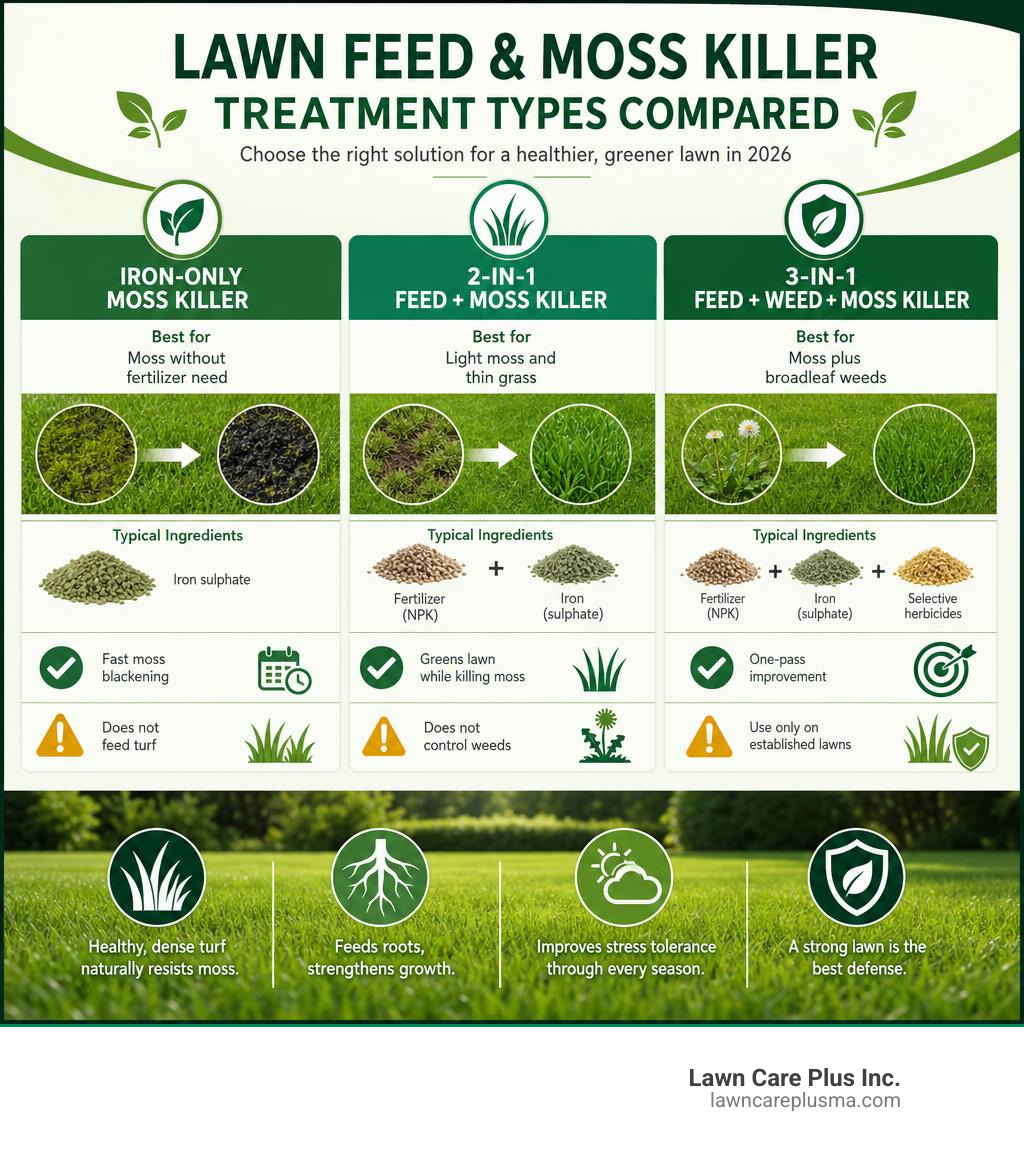
| Treatment Type | Best For | Typical Ingredients | Pros | Watch-Outs |
|---|---|---|---|---|
| Iron-only moss killer | Moss without fertilizer need | Iron sulphate | Fast moss blackening | Does not feed turf |
| 2-in-1 feed + moss killer | Light moss and thin grass | Fertilizer + iron | Greens lawn while killing moss | Does not control weeds |
| 3-in-1 feed + weed + moss killer | Moss plus broadleaf weeds | NPK + iron + selective herbicides | One-pass improvement | Use only on established lawns |
| 4-in-1 lawn treatment | Tired lawns needing color, feed, weed, and moss control | NPK + iron + herbicides, sometimes added color boost | Strong all-around revival | More restrictions and label precautions |
Best lawn feed and moss killer for light moss
For light moss with few or no weeds, a 2-in-1 feed plus moss control product is usually enough. These products are useful when the grass is mostly healthy but has moss in damp shade patches, north-facing areas, or compacted corners.
A known coverage example from research is Scotts Turf Builder with Moss Control, which covers 5,000 sq. ft. at the regular rate and 4,000 sq. ft. at the heavy rate. Its fertilizer analysis is listed as 23-0-3, with ferrous sulfate monohydrate as the active moss-control ingredient.
This type is best when:
- Weeds are not a major issue.
- You want spring greening and moss suppression.
- The lawn is established and actively growing.
- Moss is patchy rather than lawn-wide.
Online retail data from the research also showed Scotts Turf Builder Moss Killer Plus Lawn Fertilizer with a 4.3/5 rating from 136 reviews, while Scotts MossEx had a 3.6/5 rating from 921 reviews. Ratings can change, but they are useful reminders to look beyond the front label and compare actual user experience.
Best lawn feed and moss killer for moss plus weeds
If your lawn has moss and broadleaf weeds, choose a 3-in-1 product. These formulas feed the grass, kill moss, and target common lawn weeds. They are especially helpful for established lawns with dandelions, clover, daisies, plantains, chickweed, and similar invaders.
Some all-in-one products report control of up to 12 weed types and visible greening in about 7 days. Most use iron for moss and selective herbicides such as 2,4-D, dicamba, and mecoprop-P for weeds.
A product label example is this all-in-one weed, feed, and moss killer product details, which lists a common application rate of 32g/m2 and guidance around watering-in, pet safety, and seasonal use.
A 3-in-1 is best when:
- Moss and weeds are both active.
- The lawn is at least 6 months old.
- You want to reduce passes over the lawn.
- You can follow the reseeding and mowing restrictions.
Best professional-style 4-in-1 lawn treatment
A 4-in-1 granular treatment usually combines feeding, weed control, moss killing, and a color boost. These are often built around a 10-2-2 style NPK with added iron, commonly around 8% iron in many formulas.
Research examples show common coverage patterns:
- 5kg covering about 156m2
- 10kg covering about 312m2
- 20kg covering about 625m2
- 2.5kg covering up to about 78m2
- 10kg high-strength formulas covering around 280m2
Some Revival-style formulas also use nitrogen from two sources, providing feeding for up to 6 weeks. That is helpful when a lawn needs a stronger recovery period instead of a quick green-up followed by another slump.
Good reference labels include:
- Revival Feed, Weed & Moss Killer
- Pro-Kleen 4 in 1 Weed and Feed Lawn Treatment with Moss Killer 2.5kg
- Feed, Weed & Moss Killer Fertiliser 10-2-2
- Revival Weed, Feed and Moss Killer
A 4-in-1 is best for:
- Larger lawns
- Heavier moss pressure
- Moss plus weeds
- Tired turf needing color and vigor
- Established grass only
Best option for Massachusetts lawns
For Massachusetts lawns in our service area, we usually think beyond the bag. Cool-season grasses in Boston, Watertown, Wellesley, Newton, Norwood, Walpole, Medfield, and nearby communities respond well to spring and fall recovery work, but moss pressure is often tied to damp shade and compacted soil.
The best plan is usually:
- Treat active moss in spring or early summer.
- Rake out dead moss.
- Aerate compacted soil.
- Overseed thin areas at the right time.
- Correct pH if soil testing shows acidity.
- Improve drainage or sunlight where possible.
If you want help evaluating what your lawn actually needs, our Residential Lawn Care team can look at the turf, soil, shade, and drainage as a system.
How to Choose, Time, and Apply Lawn Feed and Moss Killer Correctly
Choosing the right product is half the job. Applying it correctly is the other half. The wrong timing or uneven spread can turn a good product into a patchy science experiment.
Choosing the right product for your lawn
Start with these questions:
- How old is the lawn?
- Is the moss light, moderate, or heavy?
- Are broadleaf weeds present?
- Is the lawn shaded or poorly drained?
- Do you need to seed soon?
- Is the grass actively growing?
- What is the lawn size?
Most feed, weed, and moss killer products are not recommended for brand-new lawns. Many labels say to wait until turf is at least 6 months old, or until it has been mowed 3-4 times and is well established. New sod and seedlings are more sensitive to herbicides and high-iron treatments.
If your lawn was recently installed, read our guide to Fertilizer for New Sod before applying any combination product.
Coverage matters too. Measure your lawn before buying. Many products list coverage in square feet or square metres. If a product applies at 32g/m2, overapplying does not make it work “extra good.” It increases burn risk, staining risk, runoff risk, and the chance your lawn sends you a strongly worded complaint.
When to apply lawn feed and moss killer
The best time is when moss, weeds, and grass are actively growing and the soil is moist. For Massachusetts lawns, that often means spring through early summer, with a possible early fall window depending on the product label and weather.
In May 2026, the practical timing guidance is:
- Apply in spring or early summer when soil is moist.
- Choose a calm day.
- Avoid frost.
- Avoid drought-stressed turf.
- Avoid heavy rain forecasts.
- Apply when grass is dry but soil is damp, unless the label says otherwise.
- Water in within 48 hours if rain does not arrive.
Many all-in-one weed, feed, and moss killer products list a May-August window. Some labels allow a wider spring-to-early-fall window. Always follow the product label for your exact product.
For seasonal timing and prep, see our Spring Lawn Care guide.
Step-by-step application for best results

Follow the label first, but this is the general process:
-
Check the weather.
- Pick a calm day with moist soil.
- Avoid drought, frost, wind, and heavy rain.
-
Measure the lawn.
- Calculate square feet or square metres.
- Buy enough product, but do not guess the rate.
-
Mow at the right time.
- Many labels recommend not mowing for 3 days before treatment.
- Do not scalp the lawn.
-
Put on protective gear.
- Wear gloves.
- Consider eye protection, especially when handling granules.
-
Calibrate the spreader.
- Use the recommended setting if available.
- Apply half in one direction and half at a right angle for even coverage.
-
Apply evenly.
- Avoid overlap.
- Do not dump extra product on mossy spots.
- More is not better. More is just more trouble.
-
Clean hard surfaces immediately.
- Iron can stain patios, walkways, driveways, and masonry with rust-colored marks.
-
Water in if needed.
- Many products should be watered in if rain does not fall within 48 hours.
-
Keep people and pets off the lawn.
- Wait until granules are watered in and the lawn has dried.
-
Delay mowing.
- Many labels recommend waiting at least 4 days after treatment.
-
Rake out dead moss.
- Once moss blackens and dies, usually 7-14 days, rake or scarify it out.
Results, Benefits, and Aftercare
The results come in stages. Do not panic if the lawn looks worse before it looks better. Dead moss is not glamorous. It is the awkward middle phase of lawn improvement, like wearing braces but for grass.
How long results take
Typical timelines:
- Moss darkening: Within hours to a few days, depending on product and conditions.
- Visible black or brown moss: Often within a few days to a week.
- Greener grass: Some products report greening in about 7 days.
- Color improvement: Often 1-2 weeks.
- Rake-out window: Usually 7-14 days after treatment.
- Weed wilting: A few days to a week.
- Complete weed control: Often 2-3 weeks.
- Feeding effect: Some professional-style formulas feed for up to 6 weeks.
Temporary turf darkening can happen, especially with iron. This is usually normal and fades after mowing.
Benefits of combined feed, weed, and moss killer products
Combined products are popular because they save time and simplify lawn care. One pass can handle several problems at once.
Benefits include:
- Fewer applications
- More even coverage when spread correctly
- Faster lawn greening
- Moss control
- Broadleaf weed suppression in 3-in-1 and 4-in-1 formulas
- Better turf density
- Improved root strength
- Fewer bare patches over time
- Less opportunity for moss and weeds to return
The biggest benefit is not just killing moss. It is helping the grass fill back in afterward. Bare soil invites moss, weeds, and erosion. Thick turf is the real long-term defense.
What to do after moss turns black
Once moss turns black, rake it out. If there is a lot of moss, scarifying may be needed. This can leave bare spots, which is normal.
Aftercare tips:
- Rake or scarify dead moss after 7-14 days.
- Do not reseed too soon if the product label restricts it.
- Many weed-and-moss products require waiting at least 6 weeks before reseeding or laying turf.
- Keep the lawn watered during recovery.
- Mow high enough to protect grass crowns.
- Avoid using the first few clippings as mulch if the label warns against it.
- Repair bare areas with seed only when the label allows.
For ongoing care after treatment, our Lawn Care and Maintenance services can help build the feeding, mowing, aeration, and overseeding plan around your property.
Safety, Soil Health, and Moss Prevention
A lawn product can be effective and still require care. Iron can stain. Herbicides can damage ornamentals. Some products are hazardous to aquatic life. Labels matter.
Safety precautions before and after treatment
Before applying:
- Read the full label.
- Wear gloves.
- Avoid breathing dust from granular products.
- Keep granules off skin and out of eyes.
- Do not apply near ponds, streams, or storm drains.
- Avoid windy conditions.
- Keep product away from flowers, shrubs, vegetables, and fruit plants.
- Sweep granules off patios, walkways, driveways, and stonework immediately.
After applying:
- Keep children and pets off treated areas until the product has been watered in and the grass is dry.
- Store leftover product sealed in a cool, dry place.
- Keep it away from children and pets.
- Do not allow runoff into drains or waterways.
- Follow all reseeding, mowing, and retreatment restrictions.
Iron staining is one of the most common homeowner frustrations. If iron granules sit on damp concrete, pavers, stone, or masonry, they can oxidize and leave rust-colored stains. Sweep first. Ask questions later.
How to stop moss coming back
Killing moss is easy compared with preventing it. Prevention means changing the conditions that invited moss in the first place.
Key prevention steps:
- Test soil pH.
- Aim for a turf-friendly pH, often around 6.2-7.0 for many cool-season grasses.
- Apply lime only if soil testing shows it is needed.
- Aerate compacted soil.
- Improve drainage in wet areas.
- Dethatch if thatch is excessive.
- Prune trees or shrubs where more sunlight is realistic.
- Mow at the correct height.
- Overseed thin turf.
- Feed on a seasonal schedule.
- Remove leaves quickly in fall.
- Fix low spots where water sits.
In our Massachusetts service area, compacted soil and shade are two of the biggest repeat offenders. If moss keeps returning after treatment, the lawn probably needs aeration, overseeding, drainage correction, or a broader Lawn Maintenance plan.
Common mistakes that reduce results
Avoid these:
- Applying too much product
- Spreading unevenly
- Treating during drought
- Treating frozen turf
- Applying before heavy rain
- Mowing too soon before or after treatment
- Reseeding too soon
- Letting granules sit on hard surfaces
- Ignoring shade and drainage
- Leaving dead moss in place
- Skipping soil testing
- Using weed-and-moss formulas on young lawns
The product is only one piece of the puzzle. If the soil is compacted, acidic, shaded, and wet, moss will happily RSVP to next year’s lawn party.
Frequently Asked Questions About Lawn Feed and Moss Killer
Can lawn feed and moss killer be used on new lawns?
Usually, no. Most combination products should only be used on established lawns. Many labels recommend waiting until the lawn is at least 6 months old or has been mowed 3-4 times.
New sod and new seed need gentler care. Their roots are still developing, and herbicide-plus-iron formulas can stress them. If you are planning a new lawn, start with the right turf type and establishment plan. Our guide on How to Choose the Best Type of Grass for Your New Lawn is a good place to begin.
Why does moss turn black after treatment?
Moss turns black because the iron ingredient damages and dries it out. That blackening is a sign the moss is dying. Grass may also darken temporarily, especially with high-iron formulas, but it usually recovers after mowing.
Once the moss is black and dead, rake it out. If you leave thick dead moss in place, it can block light, trap moisture, and slow turf recovery.
How often can you apply lawn feed and moss killer?
Follow the product label. Many products limit use to two applications per growing season. Some require 40 days between applications, while others recommend waiting 6-8 weeks.
Do not keep applying moss killer without fixing the cause. If moss returns quickly, look at soil pH, drainage, shade, compaction, mowing height, and turf density. Repeated chemical treatment without soil correction is like mopping the floor while the sink is still overflowing.
Conclusion
The best lawn feed and moss killer is the one that matches your lawn’s actual problem.
- Light moss and decent turf: Choose a 2-in-1 feed plus moss control.
- Moss plus weeds: Choose a 3-in-1 feed, weed, and moss killer.
- Tired, thin, mossy lawn: Consider a 4-in-1 treatment with feed, weed control, moss control, and color boost.
- Recurring moss: Focus on soil testing, aeration, drainage, overseeding, and shade management.
For Massachusetts lawns, timing and aftercare matter just as much as product choice. Apply during active growth, use the correct rate, water in as directed, rake out blackened moss, and repair the conditions that caused moss in the first place.
At Lawn Care Plus Inc., we help homeowners and commercial properties throughout Boston Metro-West build healthier lawns from the soil up. If your lawn needs more than a bag-and-spreader approach, our Lawn Care Services team can assess the turf, soil, drainage, and maintenance plan so your grass has the best chance to win the battle against moss for good.
