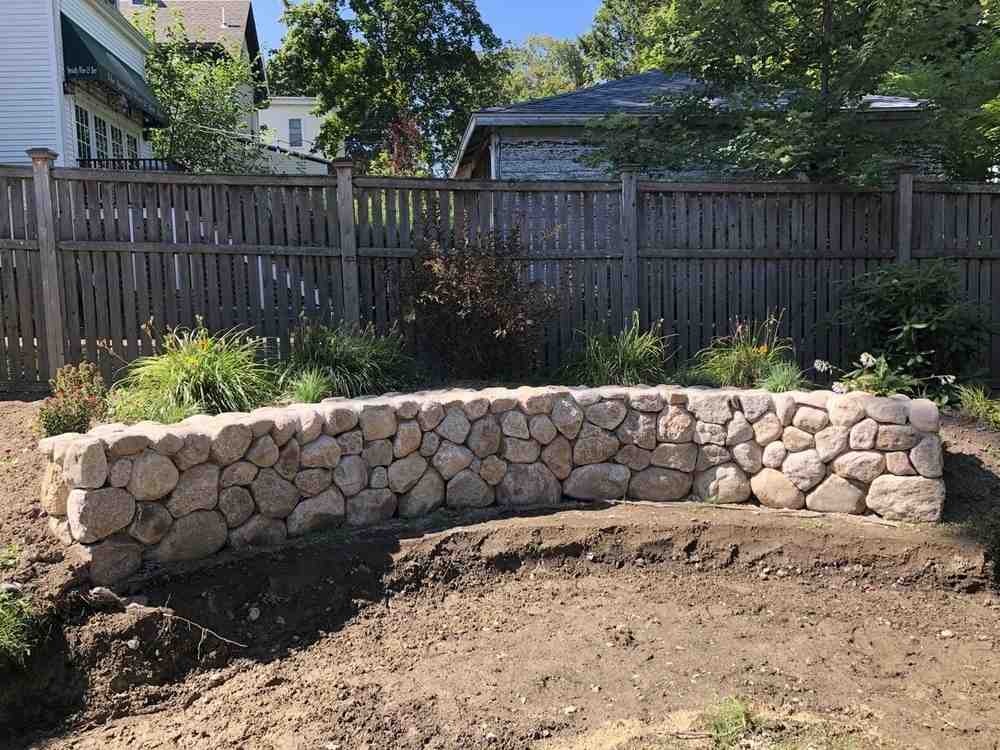
Why Landscape Block Walls Are Changing Boston Backyards
A landscape block wall is a structured outdoor feature built from interlocking or stacked blocks that serves both functional and aesthetic purposes in residential and commercial properties. Here’s what you need to know:
Key Functions:
- Retaining walls hold back soil on slopes and prevent erosion
- Freestanding walls create borders, privacy screens, and decorative elements
- Garden walls define planting beds and add visual interest
Common Materials:
- Interlocking concrete blocks (most popular for DIY and professional use)
- Natural stone blocks
- Manufactured segmental blocks with textured or smooth finishes
When Professional Help Is Needed:
- Walls over 2 feet tall typically require engineering review
- Sloped properties need proper drainage systems and reinforcement
- Building permits may be required depending on wall height and location
Whether you’re dealing with a sloped yard that’s losing soil after every rainstorm, or you want to create defined outdoor spaces with built-in seating, landscape block walls offer practical solutions that also boost your property’s curb appeal. The global retaining wall market is projected to reach $17.8 billion by 2030, reflecting how essential these structures have become for modern landscaping.
The challenge? Many homeowners don’t realize that a poorly built wall can lean, crack, or collapse within just a few years. Water management, proper base preparation, and understanding soil conditions make the difference between a wall that lasts decades and one that fails.
I’m Tim DiAngelis, owner of Lawn Care Plus, Inc., and I’ve been designing and installing landscape block walls throughout Greater Boston and Metro-West for over a decade. Our team has transformed countless sloped yards into functional outdoor living spaces using proven techniques for landscape block wall construction that stand up to New England’s harsh freeze-thaw cycles.
Relevant articles related to landscape block wall:
Understanding the Landscape Block Wall: Types and Functions
When we talk about a landscape block wall, we are usually referring to one of two main categories: garden walls or retaining walls. While they might look similar from a distance, their “jobs” are very different.
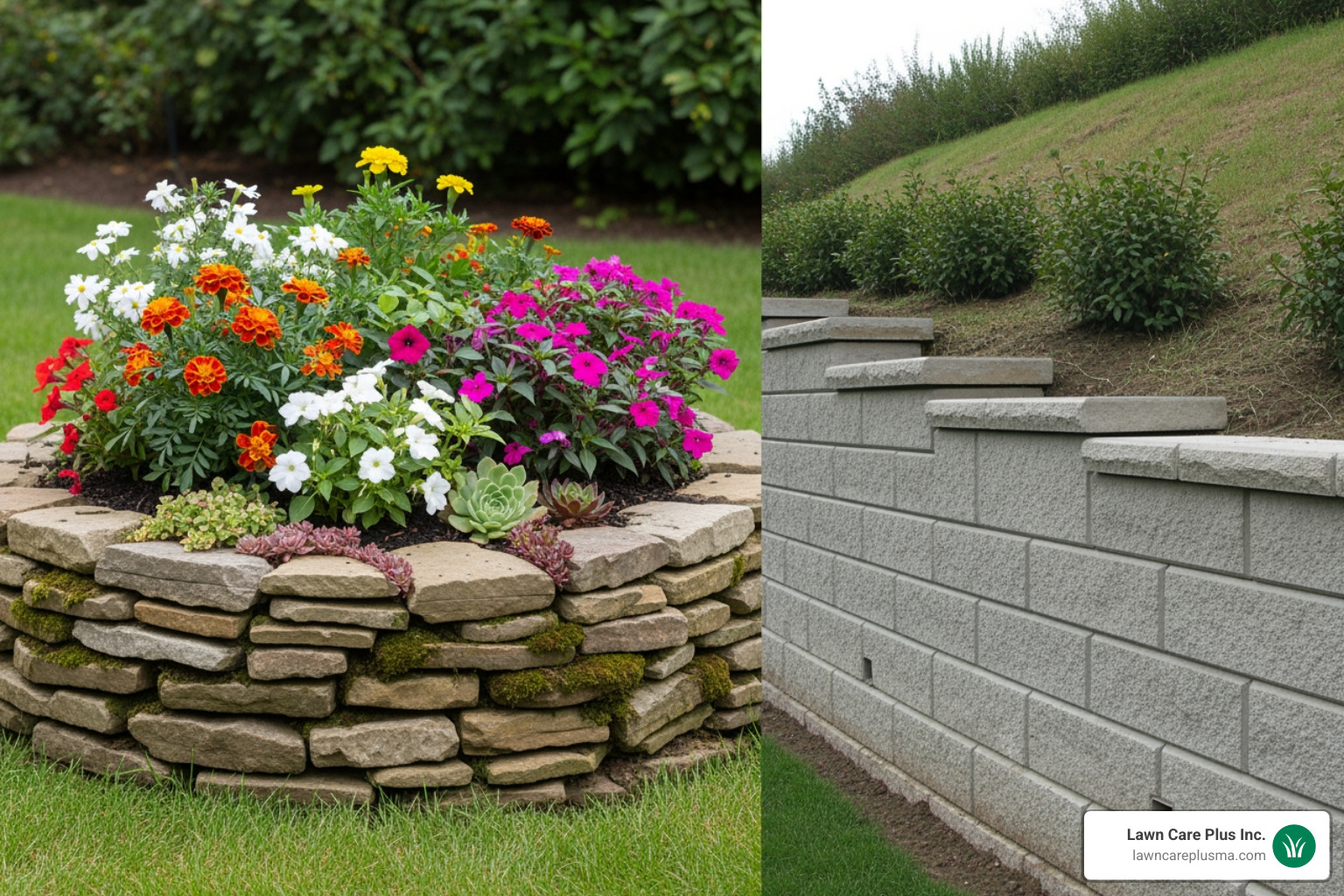
Garden Walls are typically shorter (usually under 2 feet) and are used primarily for decoration. They are great for highlighting flower beds, creating raised planters, or adding a bit of “pop” to a flat patio. Because they aren’t holding back a massive amount of earth, the engineering is simpler.
Retaining Walls, on the other hand, are the heavy lifters. Their primary function is structural support. They are designed to hold back soil, manage water runoff, and prevent soil erosion on sloped lots. These walls make “unusable” land usable. For more details on these heavy-duty structures, you can explore landscape retaining walls.
Another variety is the Freestanding Wall. Unlike a retaining wall, which has soil on one side and air on the other, a freestanding wall is visible from both sides. We often use these as privacy screens, property dividers, or decorative borders. You can find more technical details on building a landscape retaining wall through university extension guides, which highlight the importance of base preparation for all wall types.
Choosing the Right Landscape Block Wall for Your Slope
If your property in Newton or Brookline has a steep hill, you know the struggle of trying to mow grass on a 45-degree angle or watching your mulch wash away after a Nor’easter. This is where slope stabilization comes in.
By using a landscape block wall to create “terracing,” we turn one steep, useless hill into a series of flat, functional “steps.” This not only stops erosion but creates massive amounts of usable space for gardens, patios, or play areas. Many of these projects use concrete retaining wall block because of their weight and interlocking design, which are essential for fighting gravity.
Freestanding vs. Retaining Wall Systems
Choosing between a freestanding and a retaining system depends entirely on your site’s geometry. If the ground is flat and you just want to divide your outdoor kitchen from your fire pit area, a freestanding wall is your best friend. These often use dual-sided blocks so the wall looks finished from every angle.
We frequently design these as “seating walls” around patios. It’s a clever way to add extra spots for guests without cluttering the yard with more chairs.
| Feature | Freestanding Wall | Retaining Wall |
|---|---|---|
| Primary Purpose | Aesthetics / Privacy / Seating | Structural Support / Soil Retention |
| Visibility | Both sides finished | Front face finished |
| Foundation | Shallow trench | Deep, compacted trench |
| Reinforcement | Rarely needed | Often requires geogrid/anchors |
| Ground Condition | Flat surfaces | Slopes and hillsides |
Planning and Designing Your Wall Project
A successful landscape block wall doesn’t start with a shovel; it starts with a site analysis. In the Boston area, we have to deal with everything from heavy clay to rocky “fill” soils. Understanding your soil conditions is the first step in retaining wall design.
We also look at the architectural style of your home. A sleek, modern home in Wellesley might look best with smooth-faced, linear blocks, while a historic Colonial in Milton might call for a tumbled, natural stone look. You can find inspiration and technical limits in the Residential Installation Guide for Allan Block Retaining Walls.
Aesthetic Trends for a Modern Landscape Block Wall
The days of boring, grey “cinder block” looks are long gone. Modern trends favor:
- Textured Finishes: Blocks that mimic the look of hand-chiseled stone.
- Smooth Face: Sleek, minimalistic blocks for contemporary designs.
- Modular Patterns: Mixing different block sizes (like the “Ashlar” pattern) to avoid repetitive rows.
- Accent Banding: Using a row of a different color or texture to create a “stripe” of visual interest.
For a deeper dive into style, check out retaining wall design ideas for every style of home.
Material Selection: Concrete vs. Natural Stone
While natural stone has a “timeless” appeal, most of our clients in Dedham and Norwood opt for interlocking concrete blocks. Why?
- Compressive Strength: Manufactured blocks often exceed 5,000 PSI, making them incredibly strong.
- Freeze-Thaw Resistance: Concrete blocks are engineered to expand and contract without cracking during our brutal Massachusetts winters.
- Ease of Installation: The interlocking “tongue-and-groove” or “lip” systems make the build much faster and more precise.
If you are curious about the specific types of units available, read more about blocks for retaining wall.
Essential Steps for a Professional Installation
Building a landscape block wall is like building a house: if the foundation is off by an inch, the roof will be off by a foot.
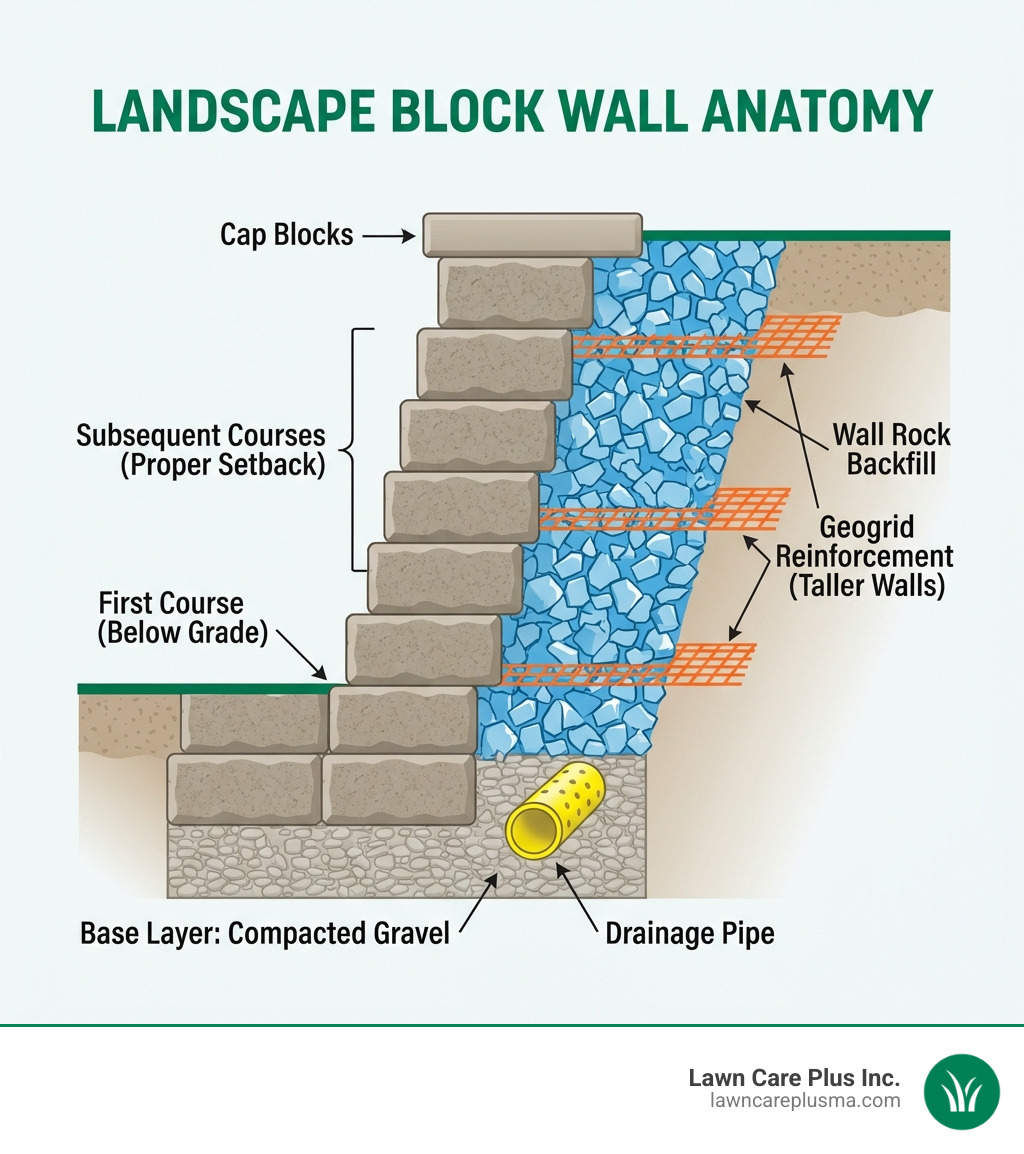
The process begins with excavation. You can’t just set blocks on top of the grass. We dig a trench that is deep enough to account for a gravel base and at least one “buried” course of block. This buried layer provides the “toe” that prevents the wall from sliding forward under the weight of the soil. Learn more about the start of the process at retaining wall foundation.
Mastering the Landscape Block Wall Installation Process
Once the trench is ready, we add 4 to 6 inches of angular, crushed gravel (not round pea gravel—round stones roll like ball bearings!). This base is then compacted until it’s rock hard.
- The First Course: This is the most critical step. Every block must be perfectly level from side-to-side and front-to-back. We use a rubber mallet to tap them into place.
- Interlocking Mechanisms: Most blocks have a built-in lip or pin system. This creates a “mortarless construction” that allows the wall to flex slightly with the ground’s movement.
- Staggering Joints: Just like a brick wall, you must stagger the vertical seams. Each block should “bridge” the two blocks below it.
For a detailed walkthrough, build a durable and attractive retaining wall with Allan Block offers a great visual guide. If you’re tackling a smaller DIY project, building a small retaining wall is a good place to start.
Backfilling and Drainage Requirements
Water is the #1 enemy of a landscape block wall. When soil gets wet, it becomes incredibly heavy (a cubic yard of wet soil can weigh 3,000 pounds!). This creates “hydrostatic pressure” that can push a wall over.
To prevent this, we use:
- Wall Rock: A 12-inch layer of clean, crushed stone directly behind the blocks.
- Perforated Pipe: A “drain tile” at the bottom of the wall that collects water and vents it away (to “daylight”).
- Geotextile Fabric: This keeps the fine soil from clogging up your drainage stone.
Understanding retaining wall drainage is non-negotiable for any wall taller than a couple of feet.
Structural Integrity: Engineering and Longevity
The taller the wall, the more complex the physics. For walls built on a slope, the soil isn’t just sitting there; it’s actively trying to push the wall downhill.
When walls get taller, we use Geogrid Reinforcement. This is a high-strength synthetic mesh that we “sandwich” between the layers of block and extend back into the soil. It essentially turns the soil itself into a giant, heavy block that helps hold the wall in place. This is vital when you build a retaining wall on a slope.
When to Consult a Professional Engineer
In many of the towns we serve, like Newton, Needham, and Watertown, local building codes are very specific. Generally, if a wall is over 4 feet tall, it must be designed by a civil engineer. However, even for walls over 2 feet, an engineering review is a smart move to prevent future collapse.
Improperly built walls can lead to “global stability” issues, where the entire hillside moves. This is one of the benefits of hiring a professional for your retaining wall installation—we handle the permits, the zoning, and the engineering. For more guidance, check out your guide to top retaining wall companies and contractors.
Cost Considerations and Maintenance
When planning your budget, it’s important to understand that a landscape block wall is a significant investment in your property’s infrastructure.
Note: These are average costs based on internet data and not actual costs for Lawn Care Plus.
- Basic Walls: For smaller garden or decorative walls, costs typically range from $10,000 to $30,000+.
- High-End Geogrid Walls: For large-scale structural retaining walls that require extensive excavation, engineering, and reinforcement, costs can range from $30,000 to $90,000+.
The wide range is due to factors like site access (can we get a bobcat back there?), soil type (is it solid ledge?), and the specific block you choose.
Maintenance Requirements: One of the best things about a concrete landscape block wall is that it is very low maintenance. You don’t need to paint or stain it.
- Cleaning: A simple power wash every few years will remove moss or dirt.
- Inspection: After a big storm, check your drainage outlets to make sure they aren’t blocked.
- Repair: If a block becomes loose, it can usually be re-glued with masonry adhesive. If you see leaning or bulging, you should search for retaining wall repair near me immediately.
Frequently Asked Questions about Landscape Walls
Do I need a permit for a landscape block wall?
In Massachusetts, regulations often require a permit for any wall over 4 feet tall. Some towns have even stricter rules (like 2 or 3 feet) if the wall is near a property line or a wetland. We always recommend checking with your local building department in places like Belmont or Canton before starting.
How long do interlocking concrete block walls last?
When installed correctly with a proper gravel base and drainage, a landscape block wall can easily last 50 to 100 years. Unlike wood (which rots) or poured concrete (which can crack due to the freeze-thaw cycle), segmental blocks are designed to move slightly without failing.
Can I build a landscape block wall myself?
If you’re building a 1-foot tall border around a rose bush, it’s a great DIY weekend project. However, if the wall is holding back a hill or is taller than 2 feet, the risk of failure is high. A cubic yard of soil is incredibly heavy, and a collapsing wall is a major safety hazard.
Conclusion
A landscape block wall is more than just a pile of stones; it’s a way to reclaim your yard, protect your home from erosion, and add a touch of elegance to your outdoor living space. Whether you’re in Brighton, Roslindale, or Walpole, the unique challenges of our New England geography make these walls a “must-have” for many properties.
At Lawn Care Plus Inc., we take pride in building walls that aren’t just beautiful, but are engineered to last a lifetime. From the first shovel in the ground to the final capstone, our team ensures every detail is handled with professional care.
Ready to transform your sloped yard into a masterpiece? We serve residential and commercial clients across the Boston Metro-West area, including West Roxbury, Jamaica Plain, and beyond. Let’s build something great together.
Explore more about landscape retaining walls and how they can improve your property today!