Why Paver Walkway Installation Near Me Matters for Your Property
Paver walkway installation near me is one of the most impactful upgrades you can make to your property. Whether you’re searching for a local contractor or exploring your options, here’s what you need to know:
Quick Guide to Finding Local Paver Walkway Installation:
- Verify credentials – Look for licensed, insured contractors with proven hardscape experience
- Review portfolios – Ask to see completed walkway projects similar to yours
- Get detailed estimates – Request written quotes that include materials, labor, and timeline
- Check references – Contact previous clients about quality and reliability
- Understand the process – Ensure contractors explain excavation depth, base preparation, and drainage
A professionally installed paver walkway does more than create a path from point A to point B. It enhances your home’s curb appeal, provides safe access during New England’s harsh winters, and can significantly boost your property value. According to industry data, paver installations are highly resilient to freeze-thaw cycles compared to poured concrete—a critical advantage in our climate.
The key to a walkway that lasts decades is proper base preparation. Research shows that contractors should excavate at least 6 inches and install multiple layers of crushed stone and sand for stability. Shortcuts during installation lead to settling, cracking, and costly repairs down the road.
I’m Tim DiAngelis, owner of Lawn Care Plus Inc., and I’ve spent over a decade helping homeowners throughout Greater Boston with paver walkway installation near me projects, from simple front paths to complex hardscape designs. Our team focuses on proper base preparation and quality materials to ensure your walkway withstands everything New England weather throws at it.
Relevant articles related to paver walkway installation near me:
Benefits and Design Options for Your Home
When we talk about paver walkway installation near me, we aren’t just talking about a place to walk. We are talking about the “red carpet” of your home. In towns like Newton and Brookline, curb appeal is everything. A winding paver path creates an immediate sense of elegance and permanence that poured concrete simply can’t match.
Beyond the looks, safety is a primary driver. Old, cracked asphalt or uneven stepping stones are tripping hazards, especially when the sun sets early in the winter. By choosing a segmented paving system, you’re investing in a surface that stays level. Unlike solid slabs, pavers are “pre-cracked,” meaning the joints between them allow the ground to breathe and shift slightly without the surface snapping. This is vital for the dos and don’ts of walkway design in Massachusetts, where the ground does a lot of moving between January and April.
Properly designed walkways also handle drainage better. Instead of water pooling and turning into a mini-ice rink on your front walk, a well-sloped paver path directs runoff away from your foundation. If you’re feeling adventurous, there are even creative walkway ideas that incorporate lighting or mixed materials to make your neighbors in Wellesley just a little bit jealous.
Popular Paver Patterns and Layouts
The pattern you choose says a lot about your home’s personality. We often help clients in Needham and Dedham choose layouts that complement their architecture. Here are the heavy hitters:
- Herringbone: The gold standard for durability. Because the pavers are set at 45 or 90-degree angles to each other, they lock together tightly, preventing shifting under foot traffic. It’s classic, sophisticated, and perfect for backyard walkway ideas.
- Running Bond: This is the most common pattern, where pavers are laid in parallel rows but offset (like a traditional brick wall). It’s great for making a narrow path look longer.
- Basketweave: This vintage style uses pairs of pavers laid at right angles to each other. It’s a decorative choice that brings a “Secret Garden” feel to your landscape.
- Stacked Bond: For a modern, clean look, pavers are aligned perfectly in both directions. It’s sleek but requires a very skilled hand to keep the lines perfectly straight.
- Serpentine Paths: Who says a walkway has to be a straight line? We love designing curved paths that meander through existing gardens, adding mystery and flow to your yard.
Choosing the Right Materials for Paver Walkway Installation Near Me
Selecting the right material is a balance of aesthetics, budget, and maintenance. In the Boston Metro-West area, we see three main contenders:
- Concrete Pavers: These are engineered for strength and come in a dizzying array of colors and textures. Brands like Belgard Cambridge Cobble Pavers offer a timeless look that mimics old-world European streets. Check out our best pavers walkway guide for a deeper dive.
- Natural Stone: If you want a high-end, organic feel, natural stone is the way to go. Bluestone walkway installation is incredibly popular in Milton and Canton because of its stunning blue-gray hues and natural slip resistance. Flagstone walkway installation offers more irregular, earthy shapes for a rustic vibe.
- Clay Brick: For that historic Boston feel, nothing beats clay brick. It’s incredibly durable and the color never fades because it’s baked into the material.
If you’re stuck, our guide on how to choose the right walkway material can help you narrow it down based on your home’s specific style.
The Professional Installation Process

A beautiful walkway is only as good as the dirt beneath it. We’ve seen too many DIY projects in Norwood and Walpole fail because the homeowner underestimated the “prep work.” Professional paver walkway installation near me starts with a rigorous site assessment. We look at the soil—is it heavy clay or sandy? Where does the water go when it rains?
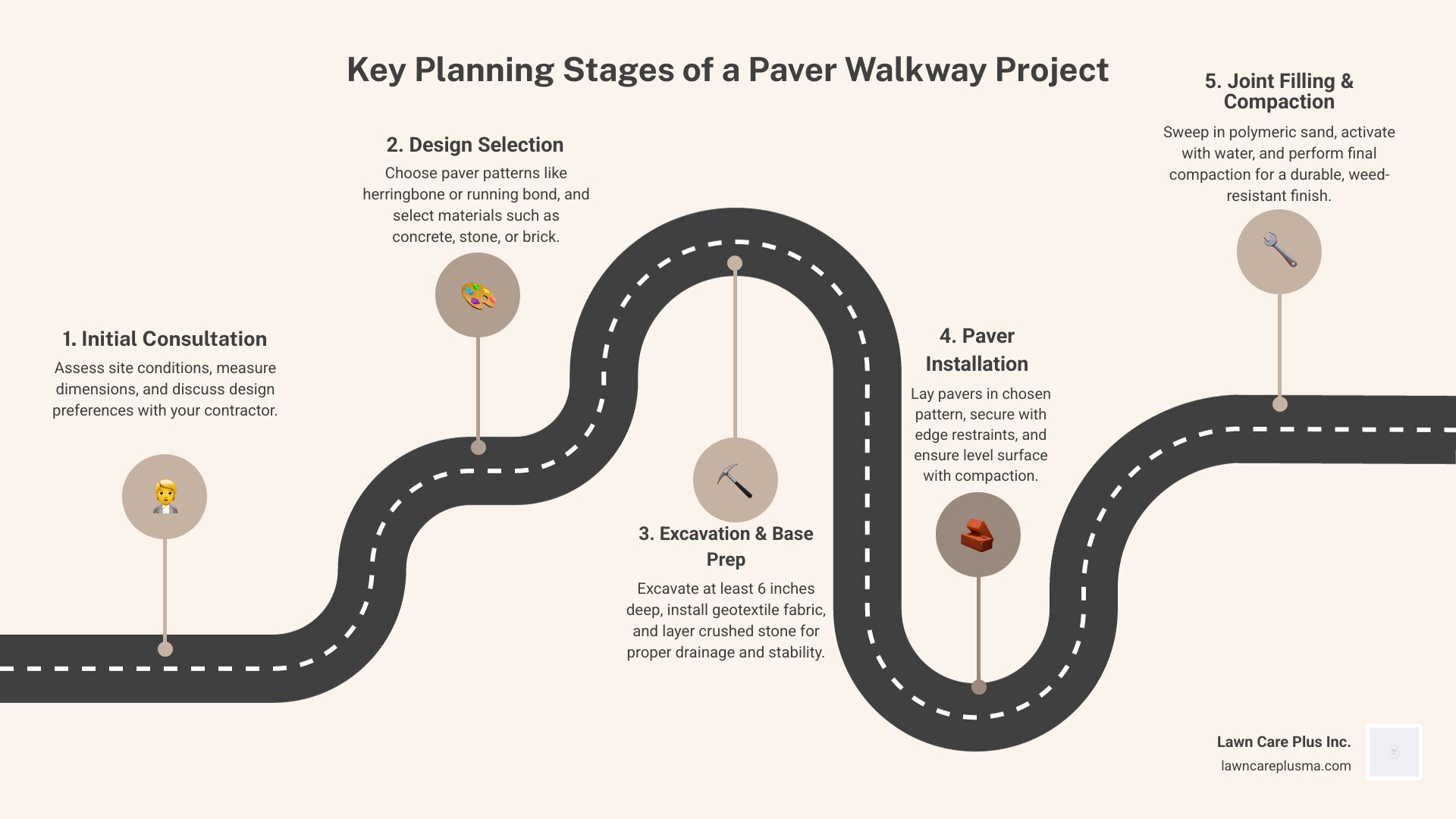
The process of how to install patio pavers and walkways is essentially a lesson in civil engineering. It starts with excavation. We don’t just scrape the grass off; we dig deep. For a standard walkway, we typically excavate 6 to 8 inches of soil to make room for the structural base.
Once the hole is dug, we focus on the base materials. This is the “skeleton” of your walkway. We use a combination of crushed stone and sand, compacted in layers. If you skip the compaction, your walkway will look like a roller coaster within two years. Installing a paver walkway correctly means using a power plate compactor to ensure the base is rock-solid.
Building a walkway with pavers is a meticulous job. Every paver must be set precisely to maintain the slope and the pattern. If you’re curious about the grit and grime of the work, our guide on how to install pavers walkway breaks down the manual labor involved.
Step-by-Step Walkway Construction
To give you a clear picture of what happens on your property, here is our standard walkway installation guide workflow:
- Subgrade Preparation: We clear the area and compact the raw soil to prevent future settling.
- Geotextile Fabric: We often lay down a heavy-duty fabric that keeps the stone base from sinking into the dirt while still allowing water to drain.
- Crushed Stone Base: We add 4 to 6 inches of 3/4-inch crushed stone. This provides the strength and the drainage.
- Sand Bedding: A 1-inch layer of fine sand is screeded perfectly level. This is what the pavers actually sit on.
- Setting the Pavers: We lay the pavers in your chosen pattern, working from the “clicked” edge outward.
- Edge Restraints: We install heavy-duty plastic or metal edging held by long spikes to keep the pavers from “creeping” outward over time.
- Polymeric Sand: This is the magic “glue.” We sweep this specialized sand into the joints and mist it with water. It hardens to keep weeds out and prevents the sand from washing away during heavy Watertown rainstorms.
Understanding the Cost of Paver Walkway Installation Near Me
Let’s talk numbers. When you search for paver walkway installation near me, you’ll see a wide variety of quotes. It’s important to remember that these are average costs based on internet data and not actual costs for Lawn Care Plus Inc. Every yard in the Boston area has its own quirks—from the rocky soil of Chestnut Hill to the tight access in Jamaica Plain.
The cost to install paver walkway projects usually includes three main buckets: materials, labor, and site preparation. For a standard 36-inch wide walkway, the cost of walkway pavers installed can vary wildly.
| Material Type | Avg. Material Cost (per sq ft) | Labor & Install (per sq ft) | Total Estimated Range |
|---|---|---|---|
| Basic Concrete Pavers | $4 – $8 | $12 – $25 | $16 – $45+ |
| High-End Concrete | $8 – $15 | $15 – $35 | $23 – $75+ |
| Natural Stone/Bluestone | $15 – $25 | $20 – $55 | $35 – $125+ |
Note: These are average costs based on internet data. High-end custom work or difficult site conditions can easily push these numbers 3x higher than the low-end averages.
Factors Influencing Your Final Estimate
Why is there such a huge range? It’s not just about the pavers. Several factors can swing your estimate:
- Soil Conditions: If we hit solid granite or “ledge” (common in some parts of Massachusetts), excavation takes much longer.
- Excavation Depth: A deeper base is required for areas with poor drainage or heavy clay to prevent frost heave.
- Site Access: Can we get a skid-steer into your backyard, or do we have to move 10 tons of stone by wheelbarrow?
- Material Scarcity: Supply chain shifts can impact the price of specific natural stones or imported bricks.
- Complexity: A straight path is simple; a serpentine path with multiple landings and steps requires significantly more labor.
Based on internet data, you might see quotes ranging from $15 to $125 per square foot. Always ask for a breakdown so you know exactly what you’re paying for.
How to Hire the Best Paver Walkway Installation Near Me
Choosing a contractor is the most important decision you’ll make. A bad installation looks great for six months and then starts to fall apart. Use our paver contractor near me ultimate guide to vet your options.
Start by reviewing their portfolio. Do they have photos of actual walkways they’ve built in towns like Newton or Belmont? Stock photos are a red flag. Check for licensing and insurance—this protects you if a worker is injured on your property.
When looking for landscape paver contractors near me, pay attention to their communication. Do they return calls? Do they show up on time for the estimate? If they are flaky before you sign the contract, they will be flaky when your yard is a giant hole in the ground. For more tips, check out our guide on walkway contractor selection.
Essential Questions for Your Hardscape Pro
Before you sign on the dotted line, ask these questions to any landscape paver contractors:
- How much experience do you have with Massachusetts frost cycles? You want someone who understands our local climate.
- What are your warranty terms? A good contractor should stand behind their work for at least a few years.
- What is the project timeline? Most walkways take 1-3 days, but weather can change that.
- Are you a specialized paver patio contractor or a generalist? Specialized hardscapers usually have better equipment for compaction and cutting.
Maintenance and Long-Term Care
One of the best things about pavers is that they are low maintenance, but they aren’t “no maintenance.” To keep your investment looking sharp, you need to understand paver walkways: everything you need to know.
The most important part of maintenance is joint stabilization. Over time, the sand between the pavers can settle or wash away. If you see gaps, it’s time to top off the polymeric sand. This prevents weeds from taking root and keeps the pavers from shifting.
We recommend a gentle power washing every year or two to remove moss and grime. However, be careful not to blast the sand out of the joints! After cleaning, you might consider sealing the pavers. Sealing enhances the color and provides an extra layer of protection against salt and oil stains.
In our area, freeze-thaw resilience is the name of the game. Because pavers are flexible, they handle the “heave” of the frozen ground better than concrete. If a single paver ever does crack (which is rare), you can simply pop it out and replace it without tearing up the whole path. This makes patios and walkways a much smarter long-term investment than asphalt.
Frequently Asked Questions
Do I need a permit for a paver walkway?
In many Massachusetts towns like Newton or Brookline, a simple walkway doesn’t require a building permit if it’s at grade (flat on the ground). however, if your project involves significant regrading, retaining walls over a certain height, or is near a wetland, you might need approval. If you live in a neighborhood with a Homeowners Association (HOA), you’ll definitely want to check their bylaws first. When in doubt, local building codes are the final word. You can also check the Thumbtack Help Center for general advice on hiring pros who handle permits.
How long does the installation typically take?
For a standard residential walkway, the installation usually takes 1 to 3 days.
- Day 1: Excavation and base preparation.
- Day 2: Laying the pavers and installing edge restraints.
- Day 3: Joint sanding, compaction, and site cleanup. Weather is the biggest variable. We can’t lay pavers in a torrential downpour or if the ground is frozen solid.
Can pavers be installed around existing trees or landscaping?
Absolutely! In fact, this is where pavers shine. We can design a serpentine (curved) path that meanders around your favorite oak tree or prize-winning rose bushes. We take great care to protect tree roots during excavation. If you’re looking for walkway installation near me that integrates seamlessly with your existing garden, a custom paver design is your best bet.
Conclusion
At Lawn Care Plus Inc., we take pride in being the Boston Metro-West experts in hardscaping. From the historic streets of Boston to the suburban charm of Medfield and Westwood, we understand the local soil, the local weather, and the local expectations for quality.
Whether you need a new front entrance in Newton or a garden path in Roslindale, our team has the experience and the equipment to do the job right the first time. We don’t just build walkways; we build lasting impressions.
Ready to transform your property? Contact us for a consultation today, and let’s start planning your perfect paver walkway!