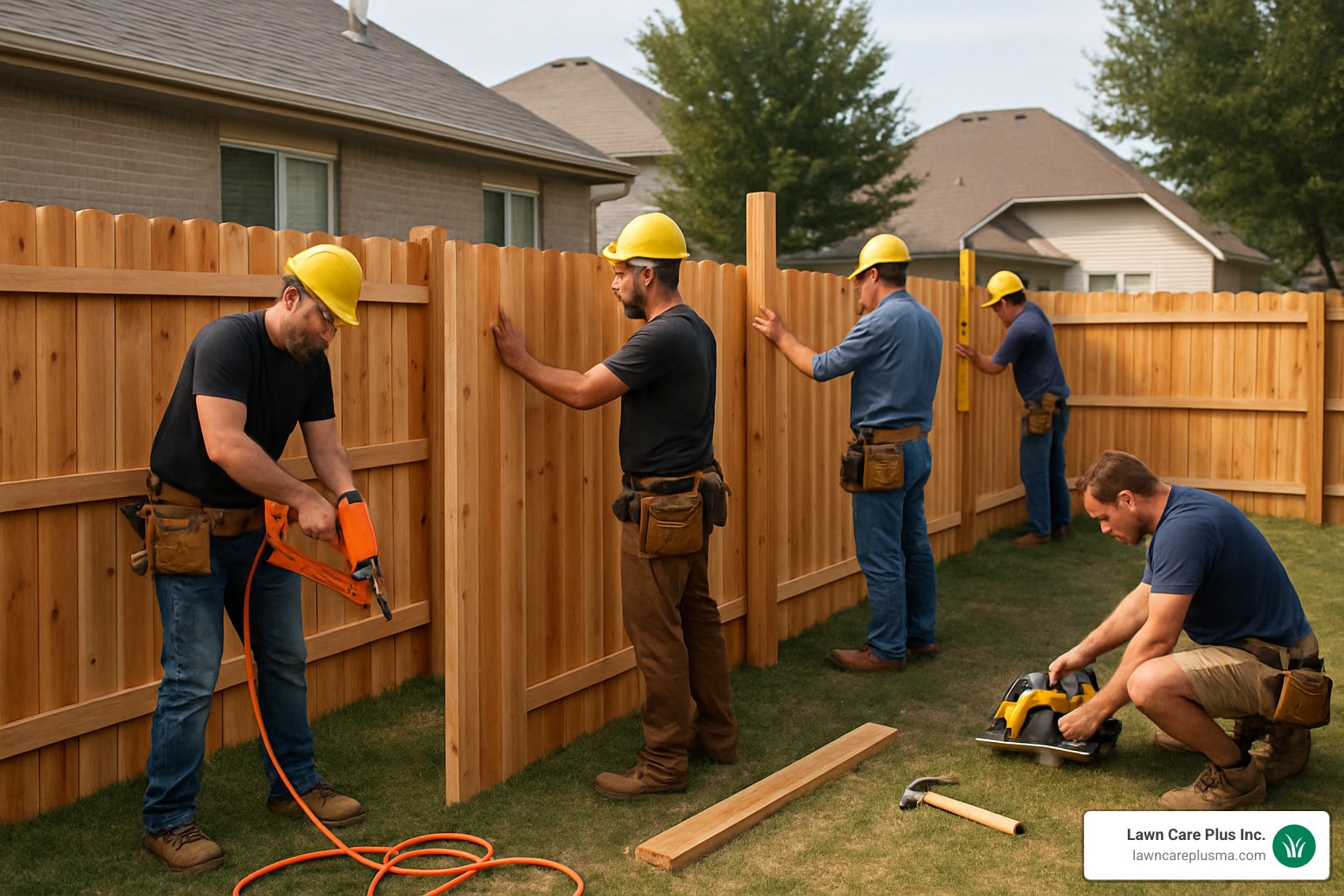
The Real Cost of Cedar Fence Installation
Thinking about adding a cedar fence to your property? Before you dive in, let’s talk about what you can really expect to pay. When researching the cost to install cedar fence options, here’s what most homeowners need to know right from the start:
Quick Cedar Fence Cost Summary:
* Average cost range: $15 to $30 per linear foot installed
* Typical backyard project (150 ft): $2,250 to $4,500 total
* Material costs: $5 to $15 per linear foot
* Labor costs: $10 to $20 per linear foot
* Lifespan: 15 to 30 years with proper maintenance
A cedar fence isn’t just a boundary marker—it’s an investment in your home’s personality and privacy. For Boston Metro-West homeowners looking to create a peaceful backyard sanctuary or define their property lines with style, understanding the true costs helps you budget realistically and avoid surprises.
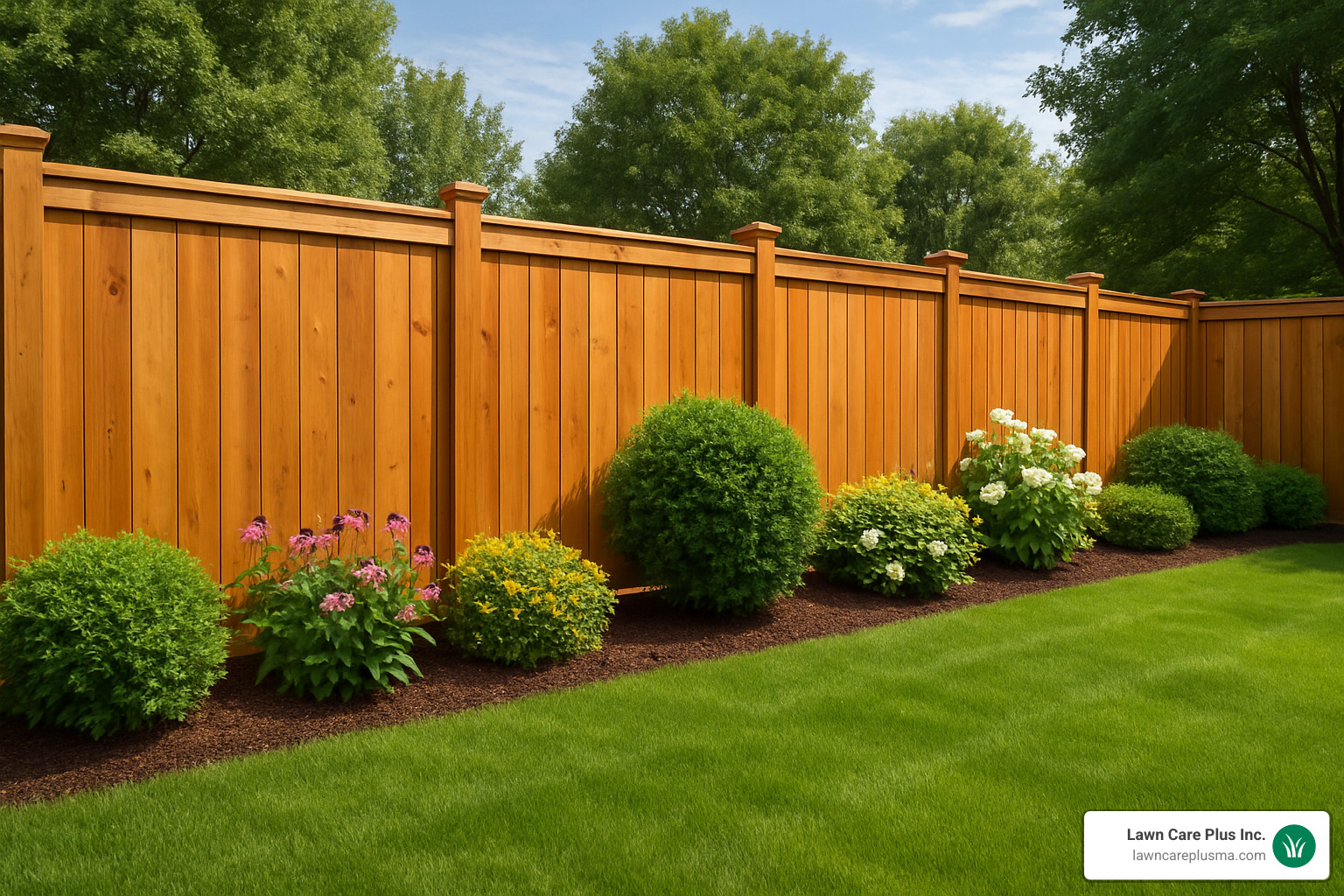
Cedar has earned its popularity for good reasons. Its warm, natural beauty immediately improves your property’s curb appeal. Plus, its natural oils make it naturally resistant to insects, decay, and moisture—something particularly valuable in our New England climate. While the initial price might make you pause, the long-term value often makes cedar the smarter financial choice.
As one local contractor told us, “My clients who choose cedar almost never regret it. They might wince at the upfront cost, but five years later, they’re thanking me while their neighbors are already replacing cheaper options.” That’s the cedar advantage in a nutshell.
The price range can be quite wide, though. A simple cedar picket fence might fall at the lower end of the spectrum, while a tall, board-on-board privacy fence with decorative post caps might push toward the higher end. Your specific property conditions, like slope challenges or rocky soil, can also influence the final price tag.
What many homeowners don’t initially consider is the long-term equation. While pine might seem more budget-friendly today, cedar’s extended lifespan and reduced maintenance needs often make it more economical when viewed across a decade or more of ownership. It’s not just about today’s installation—it’s about tomorrow’s maintenance schedule and eventual replacement costs.
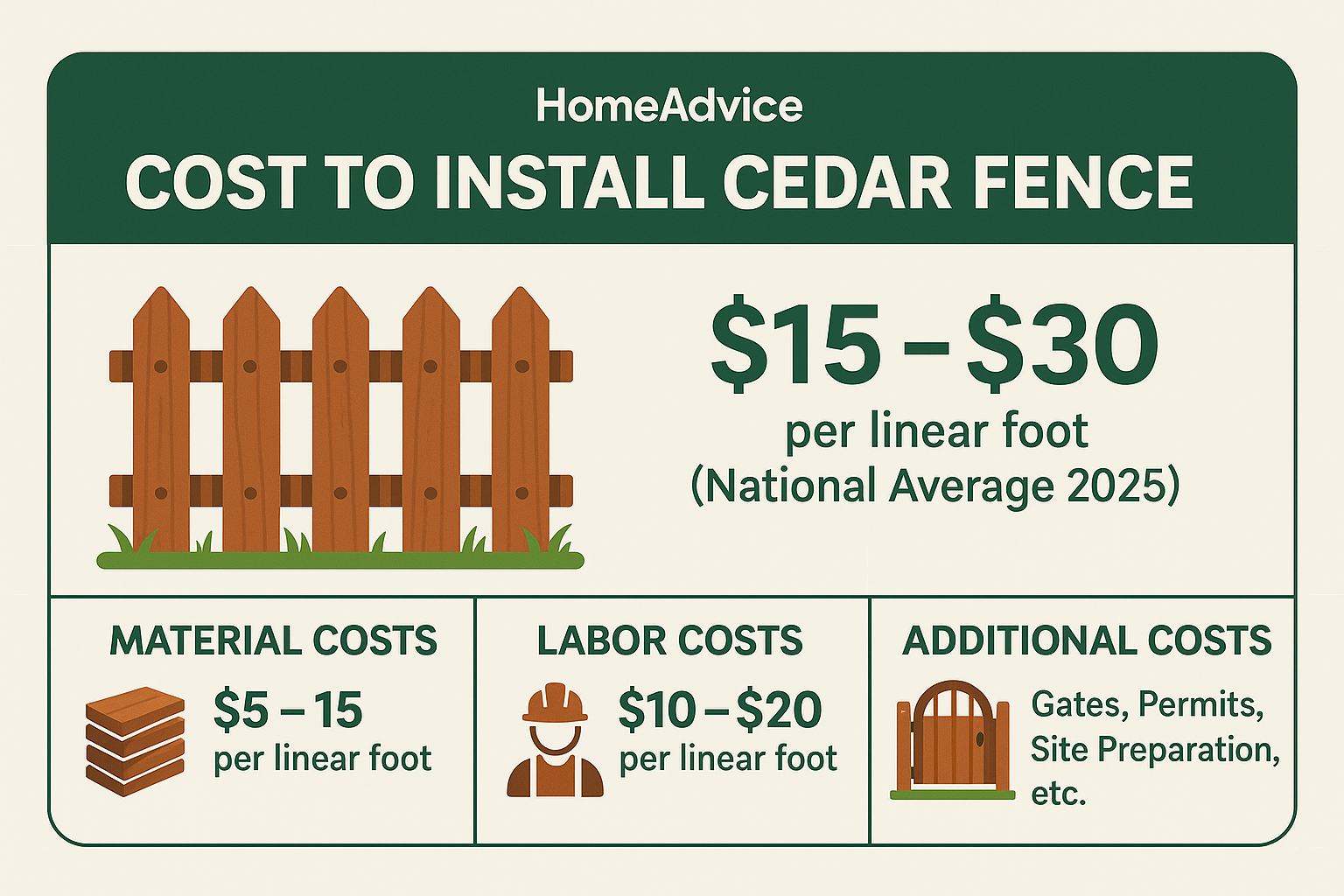
These figures represent national averages based on internet data, not actual costs from Lawn Care Plus Inc. Your specific project might vary based on your property’s unique features and your design preferences. For a personalized quote that accounts for your exact specifications, reaching out directly is always the best approach.
Understanding the Cost to Install Cedar Fence
When planning your cedar fence project, understanding the typical costs can help you set a realistic budget. While every property is unique, knowing the national averages gives you a solid starting point for your planning conversations.
Average cost to install cedar fence per linear foot
Most homeowners across the country pay between $15 and $30 per linear foot for a complete cedar fence installation. This figure includes both materials and professional installation for a standard project.
If you’re dreaming of that classic 6-foot privacy fence that keeps neighbors’ eyes away from your backyard oasis, the investment typically lands between $35 and $40 per linear foot installed. For those seeking the premium option, Western Red Cedar commands a higher price due to its exceptional durability, rich coloring, and natural resistance to decay. This premium wood can range significantly higher, especially for clear, knot-free boards that showcase cedar’s natural beauty.
Looking for something more decorative and less focused on privacy? Cedar picket fences offer charming curb appeal at a more modest price point, generally running $20 to $40 per linear foot installed for the typical 3 to 5-foot heights.
Typical project totals for 100-, 150- & 200-foot yards
To help visualize what your complete project might cost, here’s how the numbers typically break down for common yard sizes:
| Fence Length | Basic Cedar | Mid-Grade Cedar | Premium Western Red Cedar |
|---|---|---|---|
| 100 linear ft | $1,500-$3,000 | $2,500-$4,000 | $4,500-$9,000 |
| 150 linear ft | $2,250-$4,500 | $3,750-$6,000 | $6,750-$13,500 |
| 200 linear ft | $3,000-$6,000 | $5,000-$8,000 | $9,000-$18,000 |
These figures represent the base installation. Each gate you add typically costs $200 to $600 extra, depending on its size and design complexity. Need to remove an old fence first? That’ll add roughly $3 to $7 per linear foot for removal and disposal.
One of our Newton clients shared her experience: “We thought we had our budget all figured out for our backyard fence, but hadn’t considered the extra cost for the two gates we needed or how our rocky yard would make digging post holes more labor-intensive. Our final cost ended up about 20% higher than we initially planned.”
Material vs. labor breakdown
Understanding where your money goes helps identify potential savings without compromising quality:
About half your cost to install cedar fence typically goes toward materials. Cedar boards or pickets make up the largest portion at $5-$15 per linear foot. Your fence structure depends on sturdy posts (typically $20-$45 each) and horizontal rails ($10-$20 each) that provide the framework. Don’t forget concrete for setting posts ($6-$10 per bag) and hardware like screws and brackets (usually $50-$150 total).
The other half of your budget goes toward professional installation, typically running $10-$20 per linear foot in most areas. However, here in the Boston Metro-West area, our skilled tradespeople command rates that reflect our region’s higher cost of living and the expertise needed for proper installation that stands up to our challenging New England weather.
Site preparation costs vary dramatically based on your property’s unique characteristics. Level, easily-accessible yards with soft soil present minimal challenges, while slopes, rocky terrain, or limited access can significantly increase labor time and equipment needs.
For a typical 150-foot fence installation in our area, the material and labor costs reflect the quality and durability you’re investing in. While these costs represent national averages based on internet data and not actual costs for Lawn Care Plus, they provide a helpful framework for understanding the investment required for a beautiful cedar fence that improves your property for years to come.
What Makes Cedar Fence Pricing Go Up or Down
Several key factors can significantly impact the final cost to install cedar fence on your property. Understanding these variables helps you make informed decisions and potentially identify areas where you can manage costs without compromising quality.
Regional variations in the cost to install cedar fence
Location plays a major role in determining fence installation costs. In the Northeast, particularly the Boston Metro-West area where we serve communities like Newton, Brookline, and Watertown, prices tend to be higher than the national average due to several factors.
Labor rates in Massachusetts average 15-25% higher than the national median according to Bureau of Labor Statistics data. Plus, many Massachusetts communities have specific requirements for fence installations, including deeper post holes to account for frost lines, which increases labor time.
Cedar isn’t as readily available in the Northeast as in other regions, which can drive up material costs. And let’s not forget our famous New England weather! The shorter construction season means higher demand during prime weather months, often leading to premium pricing in spring and summer.
But here’s a little insider tip – if you’re flexible on timing, you might save a bundle. Many contractors, including our team at Lawn Care Plus Inc., offer discounted rates during the winter months when demand drops off. Some homeowners report saving 10-15% by scheduling their fence installation in late fall or early winter. That’s money you could put toward upgrading your materials or adding a decorative gate!
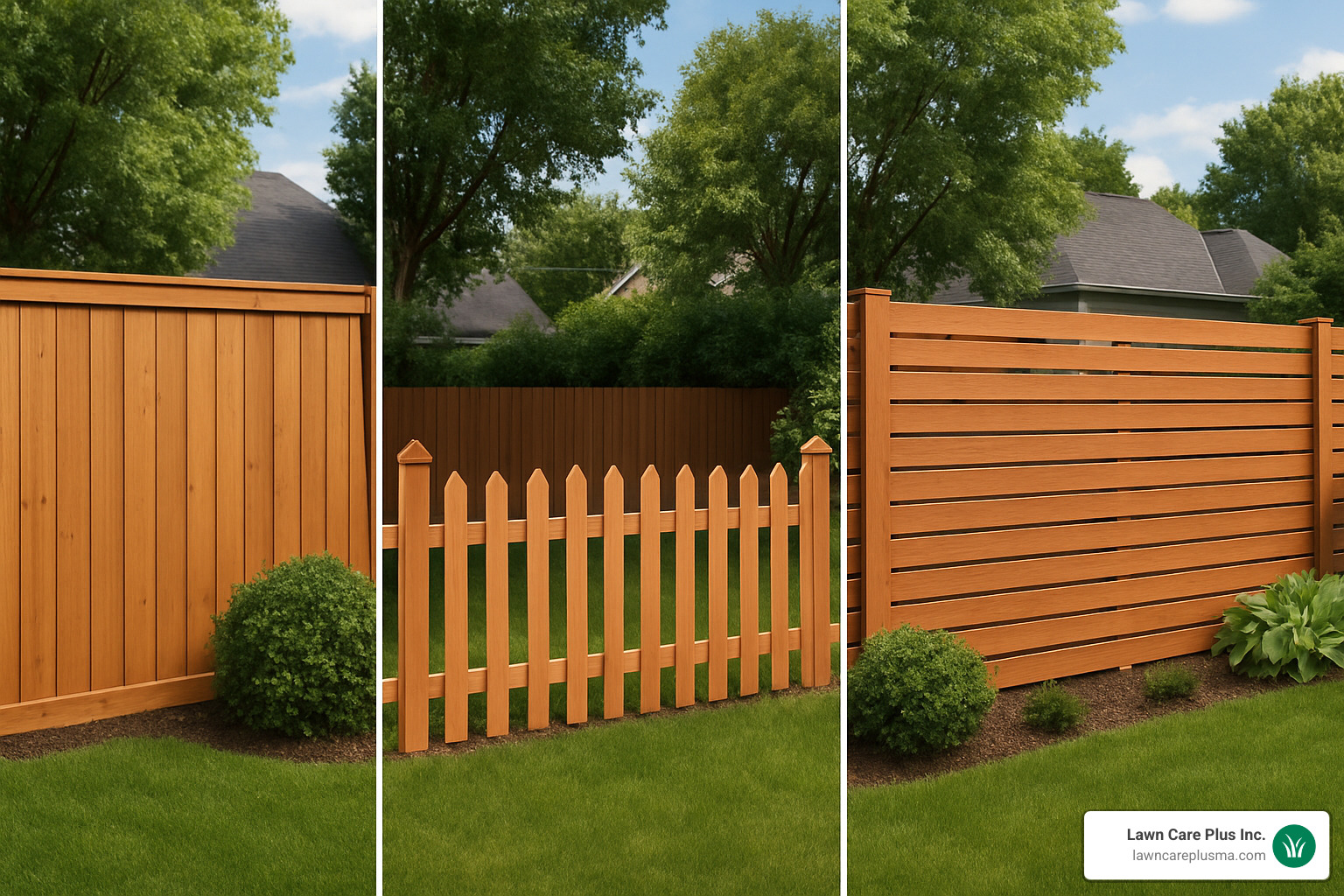
Style impact: privacy, picket, split-rail
The style of cedar fence you choose significantly impacts both material and labor costs. Privacy fences require the most material and typically stand 6-8 feet tall. They’re perfect if you want to create a secluded backyard oasis, but they’ll cost more than other styles. Options include standard privacy fences with minimal gaps, board-on-board designs with overlapping boards for complete privacy, or shadowbox fences that alternate boards on opposite sides for a more decorative look.
Picket fences use less material with spaces between pickets and usually stand 3-5 feet tall. They’re often more decorative with shaped picket tops and provide boundary definition without blocking views. These tend to fall in the middle of the price range.
Split-rail fences use the least material, typically standing 3-4 feet tall with just 2-3 horizontal rails. They offer a rustic appearance that’s popular for larger properties but provide minimal privacy or security. This style is generally the most budget-friendly option.
Hidden and add-on expenses
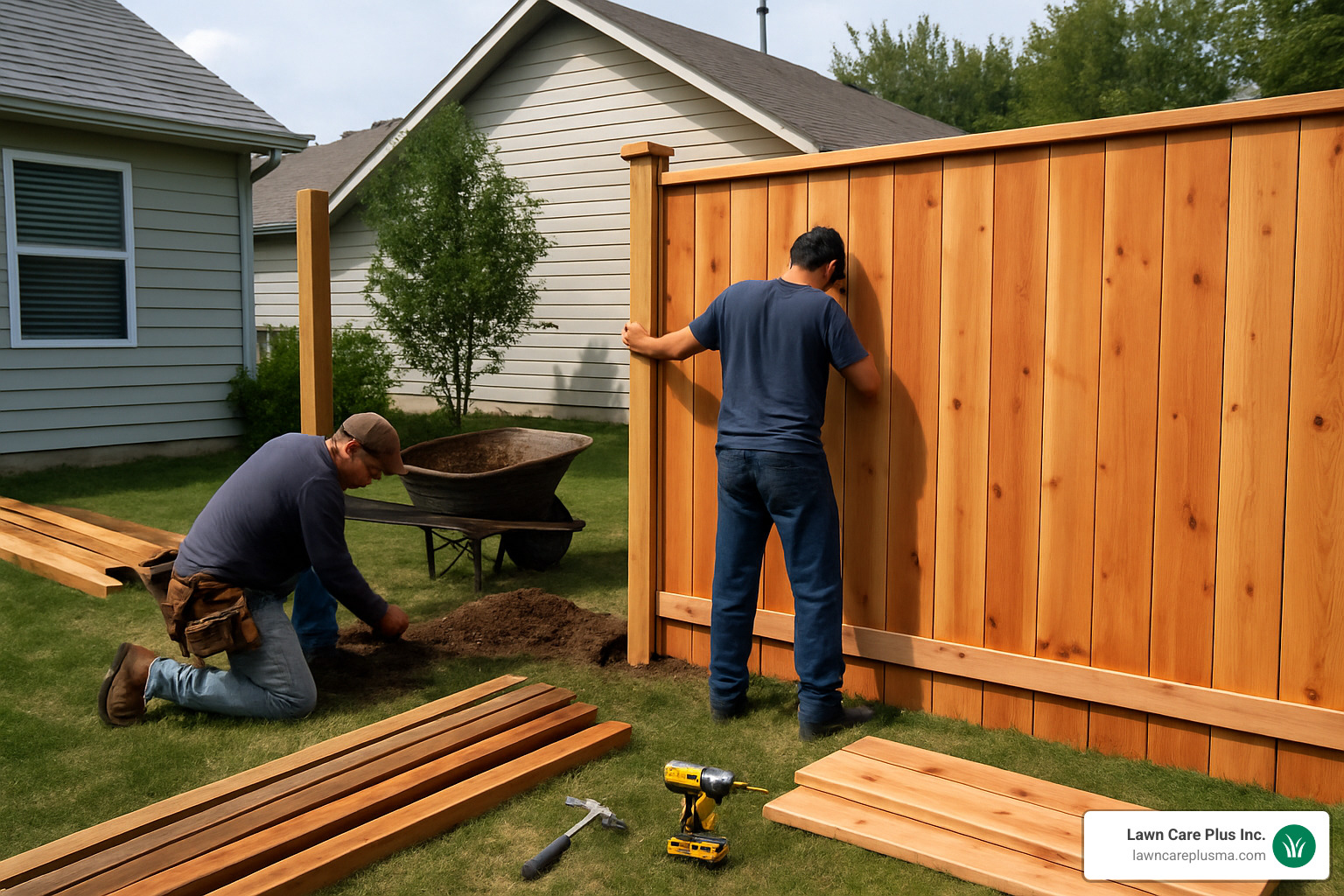
When budgeting for your cedar fence, be sure to account for these often-overlooked costs that can surprise unprepared homeowners.
Gates require additional materials and more complex construction. A standard walk-through gate typically costs more than regular fencing, while a double-wide driveway gate can run significantly higher. One Newton homeowner told us: “I budgeted for the fence itself but completely forgot about the two gates we needed. That was an unexpected add-on.”
If your property has significant slopes or uneven terrain, you may need land grading work before installation. Minor leveling might add a few hundred dollars, while extensive grading could add thousands to your project cost.
Removing an existing fence isn’t free either. The disposal of old materials adds to your total project cost, and many homeowners don’t factor this in when planning their budget.
Vegetation along your fence line may need to be cleared away. Tree or bush removal costs vary based on size and accessibility, but can quickly add up if you have several plants in the way.
Most municipalities in Massachusetts require permits for fence installation. Costs vary by location, but typically range from a hundred to several hundred dollars depending on your specific community and project scope.
While cedar naturally resists decay, applying a protective finish extends its life. Staining or sealing is an additional cost that many homeowners choose to invest in for longer-term protection.
As one Brookline homeowner shared with us: “We had no idea we’d need to apply for a permit and have a property survey done before installing our fence. Those two items alone added nearly $700 to our project that we hadn’t budgeted for.”
For more detailed information on the construction process itself, check out our guide on Building a Cedar Fence that walks through the steps involved.
The good news? When you work with an experienced contractor like Lawn Care Plus Inc., we’ll help you identify all these potential add-ons upfront so there are no surprises down the road. We believe in transparent pricing and helping you understand exactly what you’re paying for.
Cedar vs. Other Materials: Is It Worth It?
When considering the cost to install cedar fence, it’s natural to wonder if cedar truly delivers better value than other materials. While cedar often comes with a higher price tag upfront, understanding its long-term benefits helps you make a more informed decision about whether it’s the right investment for your property.
Durability & lifespan comparison
The true cost of fencing extends far beyond installation day. Cedar’s natural staying power makes it stand out in the crowd:
Cedar fences typically last 15-30 years when properly maintained, thanks to natural oils and tannins that act as built-in pest and rot resistance. Western Red Cedar, the premium option, can remain standing strong for 25+ years with minimal fuss.
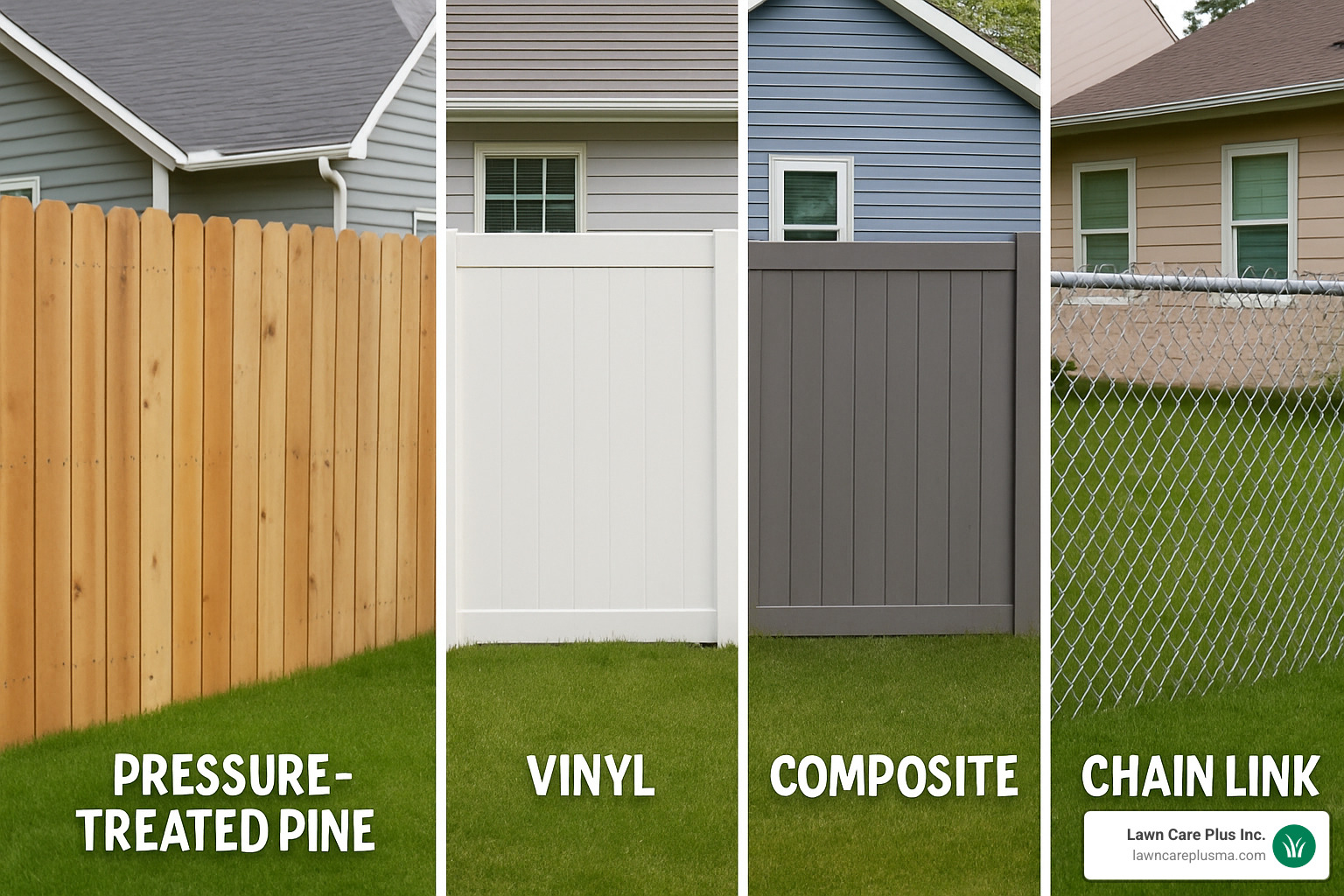
Compare this to pressure-treated pine, which might save you money initially but typically only lasts 10-15 years. Vinyl fencing offers impressive 25-30+ year durability with virtually no maintenance, though at the cost of that warm, natural wood aesthetic many homeowners prefer.
As one of our Newton clients recently told us: “After replacing our pine fence twice in 20 years, we finally invested in cedar. I wish we’d done it from the start—it would have actually been cheaper in the long run.”
Other options like composite (20-30+ years) offer good durability but at premium prices, while chain link (15-20 years) provides longevity at the expense of privacy and visual appeal.
Up-front price vs long-term value
Looking at the bigger picture reveals cedar’s true value proposition:
| Fence Type | Initial Cost Range (per linear ft) | Maintenance Requirements | Maintenance Cost (over 20 years) | Total 20-Year Cost |
|---|---|---|---|---|
| Cedar | $15-$30 | Moderate | $1,500-$3,000 | $3,750-$7,500 |
| Pressure-Treated Pine | $10-$25 | High | $2,500-$5,000 | $3,750-$8,750 |
| Vinyl | $20-$40 | Very Low | $250-$500 | $4,250-$8,500 |
| Composite | $25-$45 | Low | $500-$1,000 | $5,250-$10,000 |
| Chain Link | $8-$20 | Low | $250-$750 | $1,850-$4,750 |
What’s particularly interesting about cedar is how it hits the sweet spot of moderate initial investment with reasonable ongoing maintenance. While pressure-treated pine might seem like a bargain on day one, the constant staining, sealing and earlier replacement often makes it more expensive over time.
Cedar fences also boost your property’s curb appeal and market value. Real estate professionals typically estimate homeowners recoup around 60% of fence costs when selling—with cedar generally offering better returns than budget materials. As one Brookline realtor shared with us: “A well-maintained cedar fence is one of those upgrades that consistently helps homes sell faster and for better prices in our market.”
Environmental considerations
For environmentally-conscious homeowners, cedar stands head and shoulders above most alternatives:
Cedar comes from renewable forests and grows relatively quickly by hardwood standards. Unlike pressure-treated lumber, it needs minimal chemical treatment thanks to those natural protective compounds. When your cedar fence eventually reaches the end of its life, it biodegrades naturally without leaching harmful substances into your soil.
The manufacturing process for cedar fencing typically requires less energy and creates fewer emissions than vinyl or composite production. For Massachusetts homeowners looking to reduce their carbon footprint further, Eastern White Cedar can sometimes be sourced more locally than Western Red Cedar, cutting down on transportation impacts.
“We chose cedar partly because our children and pets play right next to the fence,” explained one Watertown family we worked with. “Knowing there aren’t harsh chemicals that could affect our vegetable garden or our kids’ health gave us real peace of mind.”
For the latest research on wood privacy fence costs and materials, you might want to check out this comprehensive guide from Homewyse, which provides regularly updated pricing information.
If you’re interested in learning more about the installation process itself, our guide on Building a Cedar Fence breaks down the steps involved and what to expect during the project.
DIY, Professional Labor, and Cost-Saving Strategies
When it comes to managing the cost to install cedar fence, homeowners face a crucial decision: roll up your sleeves for a DIY project or hire professionals? This choice significantly impacts both your budget and the final results.
DIY pros, cons, and true savings
If you’re handy and looking to save money, the DIY route can be tempting. The materials alone for a cedar fence typically run $5-$15 per linear foot, plus $150-$300 for tool rentals and another $200-$400 for concrete and hardware. For a standard 150-foot fence, your DIY materials might total $1,100-$2,950 – potentially saving 40-50% compared to professional installation.
But before you head to the lumber yard, consider what you’re really signing up for. A typical DIY fence project requires 30-50 hours of labor for someone without professional experience. That’s multiple weekends of physically demanding work – digging post holes (often in rocky Massachusetts soil), mixing concrete, lifting heavy panels, and ensuring everything stays perfectly level.
“I thought I’d save money installing my own fence,” shared one Newton homeowner we worked with after his DIY attempt. “But after renting equipment, making multiple trips to the hardware store for forgotten items, and spending two full weekends on the project, I’m not sure the savings were worth it. Plus, my fence isn’t quite as straight as a professional would have done.”
The hidden costs of DIY often include multiple supply runs for forgotten materials, potential mistakes requiring correction, and the value of your time. Many homeowners also underestimate the specialized tools needed – from power augers and post-hole diggers to levels, saws, and concrete mixing equipment.
Hiring a contractor: questions to ask
If you’re leaning toward professional installation (which many Boston Metro-West homeowners ultimately choose), knowing the right questions to ask can help you find a quality contractor at a fair price:
Licensing and credentials: “Are you licensed and insured to work in my town?” This is especially important in Massachusetts where requirements vary by municipality.
Experience with cedar: “How many cedar fence installations have you completed in the past year?” Cedar requires specific knowledge for proper installation and longevity.
Detailed estimates: “Can you provide a line-item estimate showing material and labor costs separately?” This transparency helps you understand exactly what you’re paying for.
Warranty coverage: “What warranty do you offer on both materials and workmanship?” Quality contractors stand behind their work.
Permit handling: “Will you obtain necessary permits?” Many homeowners don’t realize permits are required for fencing in most Boston suburbs.
At Lawn Care Plus Inc., we’re always happy to provide clear answers to these questions. We’ve found that transparent communication from the start leads to the best outcomes for our clients throughout the Metro-West area.
Money-saving tips without cutting corners
Even when hiring professionals, you can still make smart choices to manage your cost to install cedar fence without compromising quality:
Mix materials strategically. Using pressure-treated pine for below-ground posts while keeping cedar for the visible components can save 10-15% on materials while maintaining the cedar appearance you want.
Schedule during off-season. Late fall through early spring is our slower period, and many contractors (including us) offer discounted rates during these months to keep crews working. Winter installations in Massachusetts are entirely feasible when the ground isn’t frozen.
Optimize your fence layout. Do you really need fencing on all sides of your property? Strategic placement can significantly reduce your total linear footage while still providing the privacy or security you need.
Consider height variations. A 4-foot fence costs substantially less than a 6-foot fence. Some homeowners use taller fencing only where privacy is most needed.
Handle some tasks yourself. Even if you’re not building the entire fence, you might save by doing site preparation yourself – removing old fencing, clearing vegetation, or basic leveling. Similarly, applying stain after professional installation can reduce labor costs.
One of the most overlooked strategies is coordinating with neighbors if they also need fencing. This approach can secure volume discounts on both materials and labor while creating a more cohesive neighborhood appearance. We’ve helped several groups of neighboring homes in Watertown and Brookline with such projects, resulting in savings for everyone involved.
Whatever approach you choose, a well-installed cedar fence is an investment that improves your property value and enjoyment for decades. Balancing upfront costs with long-term quality will serve you best in the years to come.
Frequently Asked Questions about Cedar Fence Costs
How long will a cedar fence really last?
The lifespan of a cedar fence is a common concern for homeowners weighing the cost to install cedar fence against long-term value. With proper installation and maintenance, you can expect your cedar fence to beautify your property for 15 to 30 years.
Several factors influence just how many years you’ll get from your investment. Western Red Cedar tends to be the champion of longevity, often reaching the 25-year mark or beyond. Its natural oils and resins provide superior resistance to decay and insects compared to other cedar varieties.
Here in Massachusetts, our distinct seasons present unique challenges. The freeze-thaw cycles, snow loads, and occasional nor’easters all test your fence’s durability. That’s why proper installation is particularly crucial in our climate.
“The below-ground portion of cedar posts is most vulnerable to rot,” one of our installation experts often reminds clients. “Using concrete footings and ensuring proper drainage can add years to your fence’s life.”
For maximum longevity in our Boston Metro-West climate, we recommend setting posts at least 42 inches deep (below the frost line), using concrete footings, ensuring proper drainage, and applying a quality sealant within 1-2 months of installation. Annual visual inspections help catch small issues before they become major problems.
Your maintenance routine also plays a starring role in fence longevity. A simple cleaning every 1-2 years and resealing or staining every 2-3 years can significantly extend your fence’s useful life – and keep it looking beautiful throughout those years.
Do I need a permit, and what does it cost?
Navigating permit requirements can be one of the more confusing aspects of planning your fence project. Throughout the Boston Metro-West area, most towns do require permits for fence installation, though specific requirements vary by municipality.
Most communities have established some basic guidelines. Fence height is typically limited to 6 feet in backyards and 3-4 feet in front yards. If you live in a historic district, you might face additional style requirements to maintain the neighborhood’s character. Corner lots often have visibility requirements to ensure traffic safety. And contrary to what many assume, fences usually need to be set back slightly from property lines.
Permit costs in our service area typically range from $100 to $500, with historic districts sometimes requiring additional review fees. Some towns base their permit fees on linear footage or overall project value rather than charging a flat rate.
Beyond the basic permit, there may be other considerations. If your property boundaries are unclear, you might need a survey (typically $200-$1,200). Homeowners’ associations often require separate approval processes, which may include additional fees. And always remember to call 811 before digging – this free service marks utility lines to prevent costly and dangerous accidents.
At Lawn Care Plus Inc., we understand these regulations can be overwhelming. That’s why we handle permit applications for our clients throughout Belmont, Boston, Brighton, Brookline, Newton, Watertown, and surrounding communities. We’ve steerd these processes countless times and can help ensure your project meets all local requirements.
Will a cedar fence increase my home’s resale value?
If you’re wondering whether the cost to install cedar fence will pay off when selling your home, the answer is generally yes – though perhaps not dollar-for-dollar.
Real estate data suggests that well-maintained cedar fences typically allow homeowners to recoup about 50-70% of installation costs in increased home value. Privacy fences tend to add more value than purely decorative styles, and professionally installed fences yield better returns than DIY projects.
“In communities like Newton and Brookline, where outdoor space is at a premium,” shares a local real estate agent we work with, “a well-designed cedar fence that creates a private outdoor living area can be a significant selling point, especially for families with children or pets.”
The value extends beyond just the numbers on your home appraisal. Cedar fences dramatically improve curb appeal, creating that crucial positive first impression when potential buyers visit. They define outdoor living spaces, essentially adding “rooms” to your home. They increase both the actual and perceived security of your property. Many homeowners appreciate how fences reduce noise from busy streets, and families specifically look for fenced yards to provide safe spaces for children and pets.
For maximum value improvement, consider choosing a fence style that complements your home’s architecture and neighborhood aesthetic. A fence that looks like it was designed specifically for your property will always add more value than one that feels mismatched or generic.
While the financial return is important, don’t overlook the years of enjoyment, privacy, and functionality you’ll get from your cedar fence before you ever think about selling. That daily value is harder to quantify but just as real as the numbers on a home appraisal.
Conclusion
When considering the cost to install cedar fence on your property, the initial price tag tells only part of the story. Cedar fencing represents an investment that balances upfront expenses with long-term value, durability, and undeniable curb appeal.
Throughout the Boston Metro-West area, from the historic streets of Brookline to the family neighborhoods of Newton and Watertown, homeowners consistently choose cedar fencing for its natural beauty and excellent performance. While vinyl might require less maintenance and pressure-treated pine might cost less initially, few materials provide the same wonderful combination of warmth, character, and longevity that cedar delivers.
At Lawn Care Plus Inc., we understand that every property and homeowner has unique needs and budget considerations. That’s why we take the time to understand your specific situation before recommending solutions. Our experienced team works with clients across Massachusetts to design and install cedar fencing that improves property value while respecting your financial boundaries.
A cedar fence does more than just mark your property line – it creates private outdoor living spaces for family gatherings, provides security for children and pets, and adds a touch of natural elegance to your home’s exterior. By understanding the true costs involved and planning appropriately, you can enjoy all these benefits without budget surprises down the road.
The investment you make today in quality materials and professional installation will continue to pay dividends through years of enjoyment and reduced maintenance headaches. As one of our Newton clients recently told us, “Our cedar fence has become the backdrop for countless family barbecues and quiet morning coffees – it’s transformed how we use our outdoor space.”
For more information about cedar fence installation or to request a personalized estimate for your property, contact Lawn Care Plus Inc. today. Our team serves communities throughout the Boston Metro-West area with quality craftsmanship and attention to detail that ensures your fence will stand the test of time.
The true value of a cedar fence extends far beyond its initial cost—it’s an investment in your property’s beauty, functionality, and value for years to come. Visit our services page to learn more about how we can help transform your outdoor space.