
Why Artificial Grass Drainage Makes or Breaks Your Lawn
Artificial grass drainage is the system that moves rainwater through your synthetic turf, down through a base layer, and safely away from your property — keeping your lawn dry, clean, and usable in any weather.
Here’s how it works at a glance:
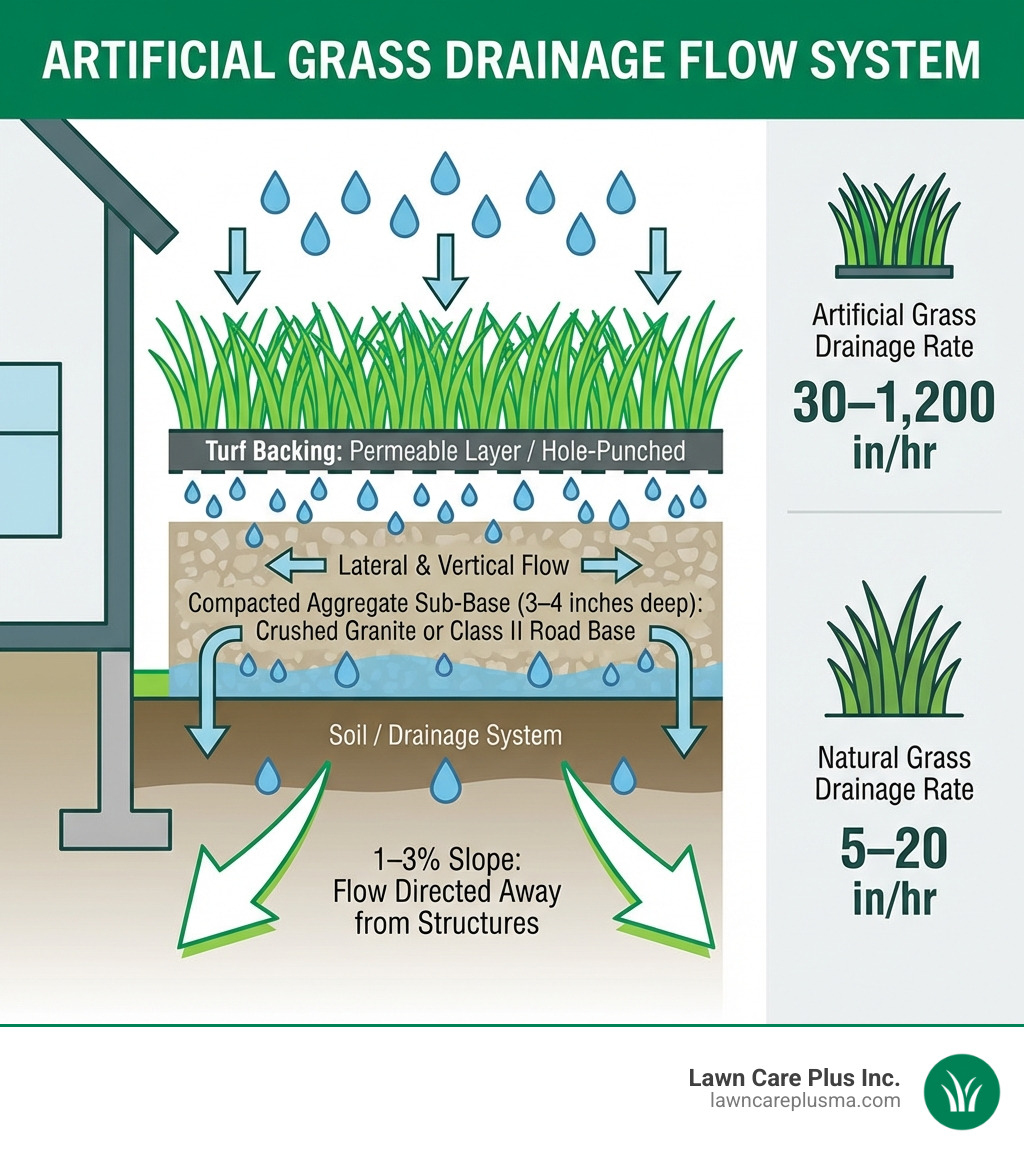
- Turf backing — water passes through small holes (or a fully permeable layer) in the backing material
- Sub-base layer — crushed aggregate beneath the turf absorbs and disperses water quickly
- Grading and slope — a 1–3% slope guides water away from buildings and prevents pooling
- Result — well-installed artificial grass can drain anywhere from 30 to 1,200 inches of water per hour, far faster than natural grass (typically 5–20 inches per hour)
Artificial grass looks low-maintenance — and it is, when it’s installed correctly. But many homeowners are surprised to find standing water, bad odors, or a spongy, uneven surface after heavy rain. In almost every case, the culprit is a drainage system that wasn’t properly planned or installed.
Poor drainage doesn’t just look bad. It can warp the turf fibers, erode the sub-base, encourage mold growth, and shorten the lifespan of an otherwise durable product. Getting drainage right from the start isn’t optional — it’s the foundation of everything.
I’m Tim DiAngelis, owner of Lawn Care Plus, Inc., a full-service landscaping company serving Greater Boston and Metro-West, with over a decade of hands-on experience designing and installing outdoor spaces — including projects where artificial grass drainage was the deciding factor between a lawn that lasts and one that fails. In the sections below, I’ll walk you through exactly how to get it right.
Artificial grass drainage vocab explained:
How Artificial Grass Drainage Works: The Multi-Layer System
When we install synthetic turf in towns like Newton or Needham, we aren’t just laying down a green carpet. We are engineering a vertical filtration system. Unlike natural grass, which relies on the uneven permeability of soil, artificial grass is designed to be a “flow-through” product.
The system starts at the surface. When rain hits the blades, it doesn’t just sit there. It travels down to the turf backing. This backing is the first gateway. From there, the water enters the sub-base, which acts like a giant sponge, holding and then slowly releasing the water into the ground or toward a land-drainage-system. This process is vital for water conservation and rain management, as it prevents the rapid runoff that often causes erosion in traditional yards.
Hole-Punched vs. Fully Permeable Backing
Not all turf is created equal when it comes to letting water through. There are two primary types of backing we work with:
- Hole-Punched Systems: This is the traditional choice. During manufacturing, small holes are punched into the backing every 4 to 6 inches. These systems typically drain at a rate of 50–300 inches per hour. While that sounds like a lot (and it is!), the holes can occasionally become clogged with fine infill or debris over many years.
- Fully Permeable (Flow-Through) Backing: This is the “gold standard” for drainage. Instead of specific holes, the entire backing is porous. These backings can handle massive amounts of water—often 900+ inches per hour. Some proprietary technologies, like Smart Flow, are designed specifically to handle heavy downpours without a single puddle forming.
The Role of the Sub-Base in Artificial Grass Drainage
If the turf is the skin, the sub-base is the skeleton. You can have the most permeable turf in the world, but if you lay it over a sheet of plastic or hard-packed clay, it won’t drain.
We typically recommend a minimum 3-inch depth of Class II Road Base or a similar crushed aggregate. For the top finishing layer, we use a 6mm granite dust or crushed granite to create a smooth surface that still allows water to pass through freely. In many Massachusetts installations, we also include a geotextile-for-french-drain to keep the stone layers from mixing with the native soil, which maintains the integrity of the drainage over time.
| Feature | Artificial Turf | Natural Grass |
|---|---|---|
| Drainage Rate | 30 – 1,200 inches/hr | 5 – 20 inches/hr |
| Reliability | Consistent (Engineered) | Variable (Soil-dependent) |
| Recovery Time | Minutes after rain | Hours or days (muddy) |
| Maintenance | Low (Keep debris clear) | High (Aeration required) |
Designing for Success: Slopes, Grading, and Soil Types
In the Boston Metro-West area, we deal with everything from sandy soils to the dreaded “New England clay.” Proper artificial grass drainage starts with a transit level and a shovel, not a roll of turf.
To ensure water doesn’t just sit under your lawn, we implement a 1–3% slope. For installations over organic surfaces like soil, a 2% minimum slope is our rule of thumb. This ensures that even if the ground becomes saturated, the excess water has a clear path to follow. Understanding six main types of soil and clay permeability is essential here; clay acts like a basin, so we have to be extra careful with our drainage-solutions-for-sloping-land.
Managing Heavy Clay and Excavation
If your backyard in Brookline or Milton feels like a swamp every spring, you likely have heavy clay. Standard installation calls for about 50-100mm of excavation, but for clay-heavy sites, we often recommend a 15cm (6-inch) sub-base.
Clay doesn’t just block water; it expands when wet and shrinks when dry. This movement can ruin a turf installation if the base isn’t thick enough to buffer the movement. We look for garden-land-drainage-solutions that stabilize the area while providing a massive reservoir for rainwater to sit in while it slowly percolates.
Site Preparation for Optimal Runoff
When we prepare a site, we aren’t just looking for “flat”—we are looking for “graded.” Even on hard surfaces like old patios, we ensure a 1% slope away from the house.
A key part of the prep is the weed membrane. We use a high-quality, permeable membrane and ensure a 150mm (6-inch) overlap between sections to prevent soil migration. Everything is secured with 150mm hot-dipped galvanized securing pegs to ensure the layers stay put. For more on how we handle surface water, check out our surface-drainage-system-ultimate-guide.
Specialized Artificial Grass Drainage for Hard Surfaces and Pets
Not every lawn is in a backyard. We frequently install turf on balconies in Boston or over concrete patios in Watertown. These “non-soil” installations require a different approach to artificial grass drainage.
For concrete, we don’t just glue the turf down. We often drill 16mm drainage holes every 0.5 to 1 meter and fill them with pea gravel to give water a place to go. Alternatively, we use drainage cells or AirDrain systems. These grids create a 1-inch air void under the turf, allowing water to flow in any direction toward the nearest floor drain or edge. This setup provides a 92% air void, which is also great for porch-drainage-system-guide applications.
Optimizing Artificial Grass Drainage for Pet Areas
If you have dogs, drainage isn’t just about rain—it’s about hygiene. For pet owners in Dedham or Canton, we recommend fully permeable backing. This allows urine to flush through the entire surface immediately rather than searching for a punch-hole.
We use antimicrobial infills like Zeolite, which traps odors and prevents bacteria growth. Because these areas see a lot of “liquid traffic,” the domestic-surface-water-drainage-systems beneath the turf must be top-notch. Regular maintenance with enzyme cleaners helps break down waste and keeps the drainage path clear.
Rooftops, Balconies, and Drainage Cells
Urban installations in Brighton or Jamaica Plain often use interlocking tiles like SnapGRID. These systems are incredible because they solve three problems at once:
- Drainage: They provide a 1-inch air void for multi-directional flow.
- Heat Reduction: The air gap helps prevent the turf from getting too hot on a sunny day.
- Protection: They keep the turf backing off the waterproof membrane of the roof.
For more on managing water in tight urban spaces, see our ac-drainage-solutions-complete-guide.
Troubleshooting and Maintaining Your Drainage System
Even the best artificial grass drainage system needs a little love. Over time, organic matter like leaves or dust can break down and form a “crust” in the infill, slowing down water penetration.
If you see pooling water, the first thing to check is for debris. A simple power brush or leaf blower can usually clear the surface. However, if the pooling is persistent, it might mean the sub-base has eroded or shifted. This is why retaining-wall-drainage is so important—if water is undermining the edges of your lawn, the whole system can fail. For a deeper dive into home systems, read about the domestic-drainage-system.
Advanced Tools: When to Use French Drains and Grids
Sometimes, the natural soil just isn’t enough. In low-lying areas of Wellesley or Weston, we might need to install a small-french-drain-pipe or a drainage ditch with a 1% slope.
In high-traffic commercial zones, we might even use cellular mats. These can transport up to 16 gallons per minute, ensuring that even a massive storm doesn’t result in a flooded lawn. If you’re dealing with a specific path for water, a channel-drainage-system might be the right secondary defense.
Frequently Asked Questions about Artificial Grass Drainage
How do I test my drainage before and after installation?
We always perform a “hose test.” Before the turf goes down, we saturate the prepared sub-base. The water should disappear almost instantly. If it sits for more than a minute, we need more aggregate or a steeper grade. After installation, we repeat the test to ensure the infill isn’t blocking the holes. For more testing tips, see our drainage-solutions-complete-guide.
What are the common causes of poor drainage in synthetic turf?
The most common mistakes include:
- Wrong Sub-base: Using “stone dust” or “fines” that pack too tightly and act like concrete.
- Non-permeable Weed Barrier: Using a cheap, plastic-heavy barrier that doesn’t let water through.
- Flat Grading: Not giving the water a “downhill” to follow.
- Infill Clogging: Over-applying silica sand or using the wrong grain size.
- Root Intrusion: Sometimes roots-in-french-drain systems nearby can backup the entire yard.
What is the average cost of installing a drainage-optimized lawn?
Based on internet data, the average cost for a high-quality artificial turf installation ranges from $5.00 to $25.00 per square foot. Factors that push you toward the higher end include extensive excavation (like in heavy clay), the addition of French drains, or specialized AirDrain grids for rooftops.
Please note: these are average costs based on internet data and not actual costs for Lawn Care Plus Inc. Every yard in the Boston area is unique, and we provide custom quotes based on your specific soil and site conditions.
Conclusion
At Lawn Care Plus Inc., we’ve seen it all—from soggy Newton backyards to high-end Brookline rooftops. The secret to a lawn that stays dry and beautiful for 15+ years isn’t just the grass you see on top; it’s the engineering you don’t see underneath.
Whether you are in Needham, Walpole, or Roslindale, a professional site assessment is the first step toward a worry-free lawn. We take pride in our “drainage-first” approach, ensuring that your investment stands up to the toughest New England weather. Ready to transform your space? Explore our hardscape-and-landscape services today and let’s build something that lasts.
