
Understanding Catch Basins and Why Property Owners Need Them
The cost to install a catch basin typically ranges from $1,000 to $7,500+ depending on size, material, and site conditions. Here’s what you need to know:
Quick Cost Breakdown:
- Plastic catch basin: $1,200 – $3,600+ installed
- Concrete catch basin: $2,000 – $6,000+ installed
- Excavation and site prep: $500 – $1,500
- Permits and inspections: $100 – $300
- Additional drainage pipes: $400 – $1,200+
Note: These are national average costs based on internet research and do not represent quotes from Lawn Care Plus Inc. Your actual costs may vary significantly.
If you’ve noticed puddles lingering in your yard days after a rainstorm, or if water seems to flow toward your foundation instead of away from it, you’re dealing with a drainage problem. Left unchecked, these issues can lead to much bigger headaches: basement flooding, foundation damage, eroded landscaping, and waterlogged soil that kills your grass and plants.
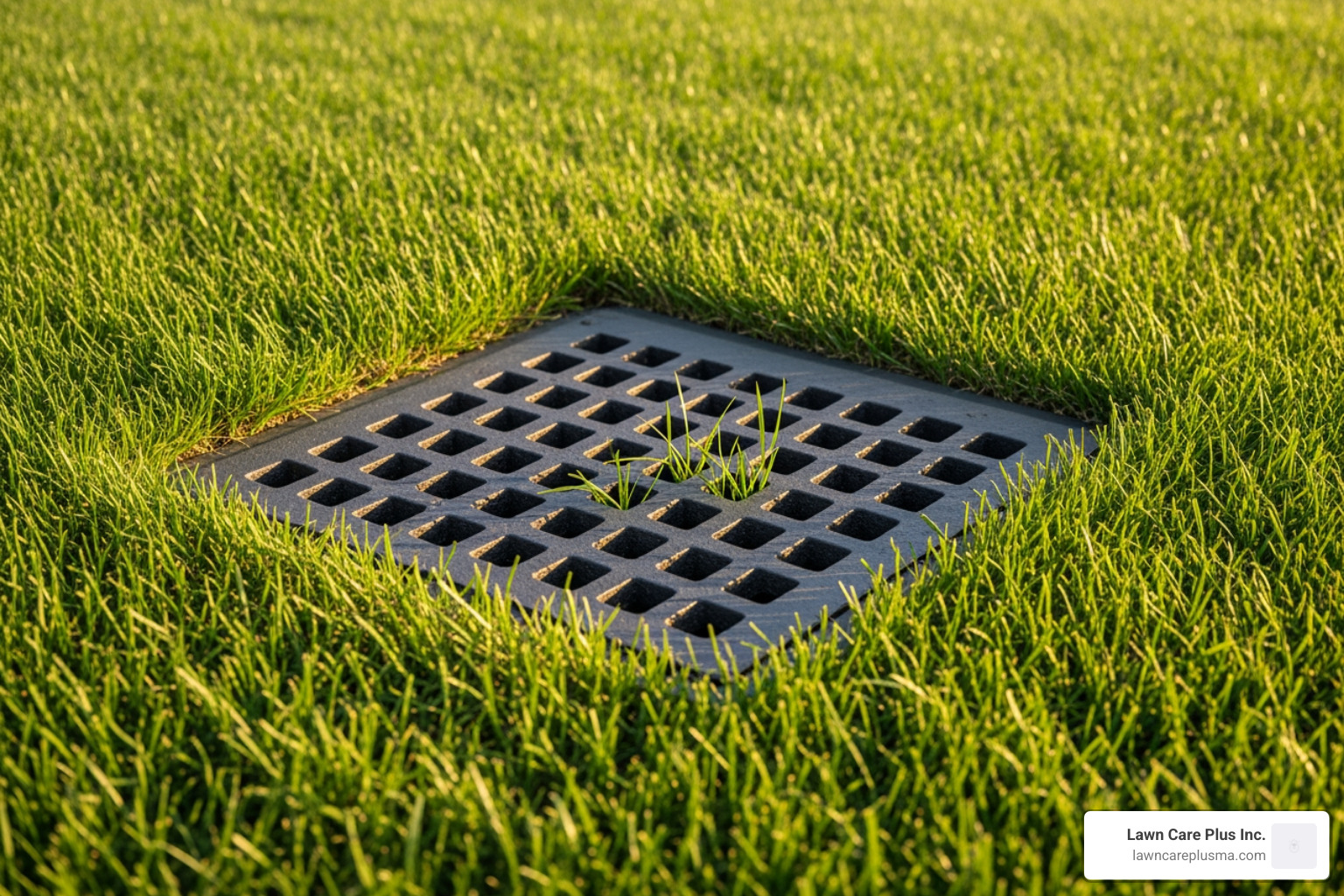
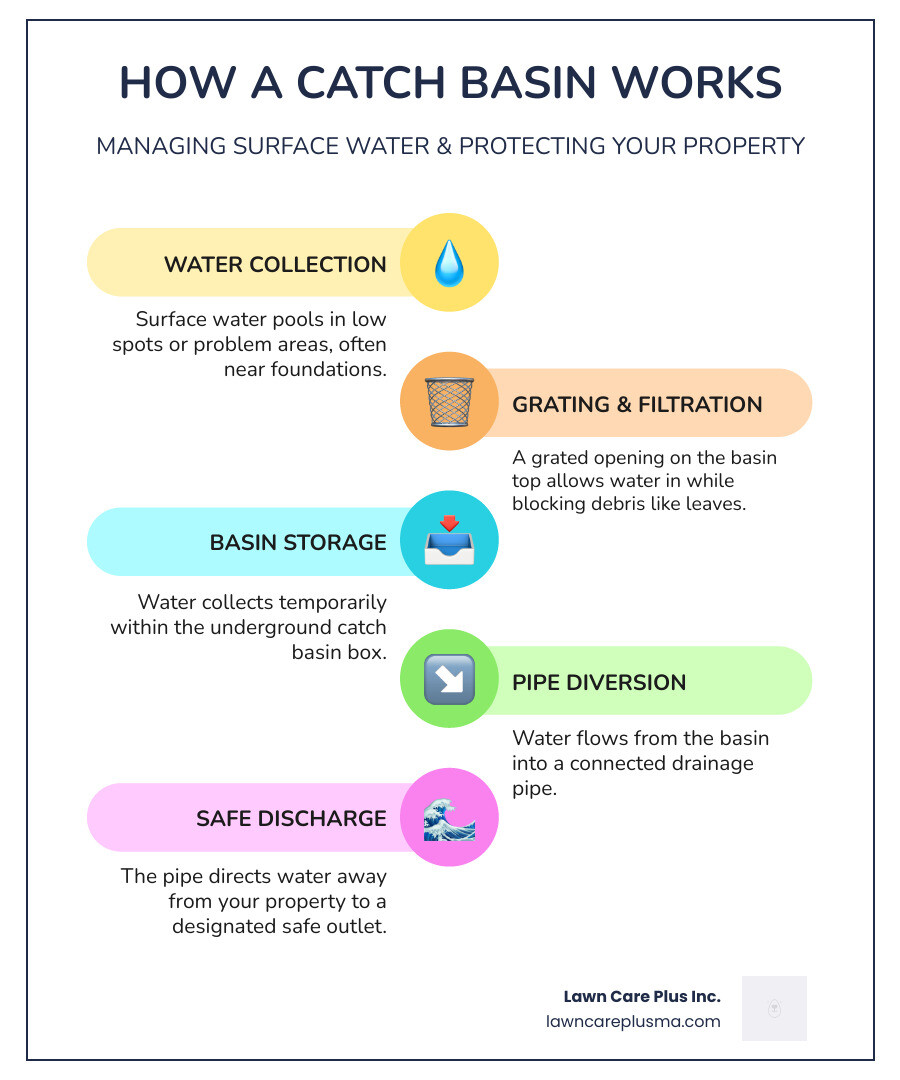
A catch basin is one of the most effective solutions for managing surface water. It’s essentially a drainage box installed in the ground, typically in a low spot where water naturally flows. The basin collects water through a grated opening at the surface, which filters out debris like leaves and twigs. The water then flows through pipes that direct it away from your property to a safe discharge point.
Think of it as a strategic collection point in your yard’s drainage network. Unlike a French drain, which collects water along its entire length through perforated pipe, a catch basin targets specific problem areas where water pools. It prevents erosion, protects your foundation, and keeps your outdoor spaces usable even after heavy rain.
For commercial properties, catch basins are often required by local stormwater regulations to manage runoff from parking lots and paved areas. For residential properties, they’re a smart investment that prevents costly water damage down the road.
As Tim DiAngelis, owner of Lawn Care Plus Inc., we’ve helped countless Boston Metro-West property owners solve drainage issues through proper catch basin installation and integration with comprehensive drainage systems. Understanding the true cost to install a catch basin means looking beyond just the basin itself to consider site conditions, materials, and long-term maintenance.
Cost to install catch basin terms you need:
The National Average Cost to Install a Catch Basin
When we talk about the cost to install a catch basin, we’re looking at a wide range of potential costs. It’s important to note that all prices mentioned here are national averages based on internet data and do not represent actual quotes from Lawn Care Plus Inc. A simple system can start around $2,500, while more complex installations can easily extend upwards of $7,500 or more.
The overall cost to install a new drainage system, which often includes catch basins as a key component, typically ranges from $1,500 to $8,000 nationally. For an average residential property, we often see projects landing in the $4,000 to $12,000 range, depending on the scope. This includes both materials and the labor involved in getting the job done right.
It’s important to remember that these figures are national averages. Your specific location within the Boston Metro-West area, the unique characteristics of your property, and the complexity of your drainage needs will all play a significant role in the final price. For a deeper dive into general yard drainage costs, you can explore guides like How Much Does Yard Drainage Cost?.
Understanding the Cost to Install a Catch Basin with Different Materials
One of the primary drivers of the cost to install a catch basin is the material chosen for the basin itself. The two most common options are plastic and concrete, and they come with distinct price points and benefits.
Plastic Catch Basins:
These are generally the more affordable option. A plastic catch basin unit typically costs between $200 and $600+. When factoring in installation, a plastic catch basin system usually ranges from $1,200 to $3,600+. Plastic basins are lightweight, making them easier to transport and install, which can reduce labor costs. They are often suitable for residential applications where traffic load is minimal and the primary goal is surface water collection.
Concrete Catch Basins:
Concrete catch basins are significantly more robust and, consequently, more expensive. The cost for a concrete catch basin, including installation, can range from $2,000 to $6,000+, or even higher for very large or custom units. Concrete is durable, can withstand heavier loads (like driveways or commercial areas), and generally offers a longer lifespan. Their weight requires heavier machinery for installation, which can increase labor and equipment rental costs.
Here’s a quick comparison to help you weigh your options:
| Feature | Plastic Catch Basin | Concrete Catch Basin |
|---|---|---|
| Material Cost | $200 – $600+ per unit | $1,000 – $3,000+ per unit |
| Installed Cost | $1,200 – $3,600+ | $2,000 – $6,000+ |
| Lifespan | 20-30 years (can be shorter with heavy traffic) | 40-50+ years (very durable) |
| Best Use | Residential yards, gardens, light traffic areas | Driveways, commercial properties, heavy traffic areas |
| Installation | Lighter, easier to handle, less machinery needed | Heavy, requires machinery, more labor-intensive |
| Durability | Good for general use, less resistant to heavy loads | Excellent, highly resistant to heavy loads and impacts |
While some of our research covers specific regional pricing for areas like Tacoma, WA (you can check out their Cost of Catch Basin Installation in Tacoma, WA for an example), we focus on providing a general understanding of how these material choices impact your budget here in Massachusetts.
Key Factors That Influence Installation Costs
The cost to install a catch basin is rarely a one-size-fits-all figure. Several factors come into play, each contributing to the overall complexity and expense of the project. Understanding these influences can help us provide a more accurate estimate for your specific needs:
-
Size and Depth of the Catch Basin: Larger and deeper catch basins require more material and significantly more excavation. A small 6-inch basin for a localized puddle is far less intensive than a 12-inch basin designed to handle substantial runoff from a large patio or driveway. Deeper installations mean more digging, more spoil removal, and potentially specialized equipment.
-
System Complexity: Are we installing a single catch basin, or is it part of a larger, interconnected drainage system with multiple basins, extensive piping, and perhaps a connection to a French drain or dry well? The more intricate the design, the more planning, materials, and labor will be required.
-
Labor Rates: Labor is a significant portion of any drainage project. Based on national averages, hourly rates for skilled drainage professionals typically range from $50 to $150 per hour. The total labor cost will depend on the time required, which in turn is influenced by all the other factors listed here.
-
Site Accessibility: Can our equipment easily access the installation site? If we need to steer narrow pathways, fences, or work in a confined space, it increases the complexity and time required. Hard-to-reach areas may necessitate manual labor or smaller, specialized equipment, both of which can add to the cost.
-
Soil Conditions: The type of soil on your property impacts excavation. Rocky soil, heavy clay, or extremely compacted earth can make digging much more difficult and time-consuming than loose, sandy soil. This directly affects labor hours and the need for heavy-duty excavation equipment.
-
Obstacles (Tree Roots, Utility Lines, Existing Hardscapes): Encountering unforeseen obstacles during excavation can quickly drive up costs.
- Tree Roots: Large tree roots may need to be carefully cut or worked around, adding time and effort.
- Utility Lines: We must carefully identify and avoid underground utility lines (water, gas, electric, communication). This often requires calling Dig Safe and careful, sometimes manual, excavation around these areas.
- Existing Hardscapes: If the catch basin needs to be installed near or within existing patios, walkways, or driveways, we’ll need to carefully cut, remove, and then restore those hardscape elements. This adds to both labor and material costs. More information on how this affects projects can be found in our sidewalk drainage solutions guide.
Each of these elements contributes to the overall cost to install a catch basin, highlighting why a professional on-site assessment is crucial for an accurate estimate.
Beyond the Basin: Additional and Hidden Costs
When budgeting for a catch basin installation, it’s easy to focus solely on the basin itself. However, several other costs can significantly impact the final price tag. Please note that the following cost estimates are national averages based on internet research and do not represent quotes from Lawn Care Plus Inc. Thinking “beyond the basin” helps us prepare for the complete picture.

Excavation and Grading
Before any catch basin can be installed, we need to prepare the site. This almost always involves excavation. Depending on the size and depth of the basin and the connecting pipes, this can be a substantial undertaking. Costs for excavation and grading can range from $1,400 to $6,000 for a typical yard drainage project. This includes digging trenches, removing excavated soil (spoil), and ensuring the proper slope for water flow. If your yard requires significant regrading to direct water towards the catch basin, this will add to the cost.
Landscape Restoration
Once the catch basin and pipes are in place, we don’t just leave a mess. The disturbed areas will need to be restored. This can include:
- Sod Replacement: If we’ve cut through your lawn, new sod or seeding will be necessary to blend the area seamlessly.
- Hardscape Repair: If we had to cut into a patio, walkway, or driveway to install the basin or pipes, those sections will need to be repaired or replaced. This can range from simple patching to more extensive masonry work. We offer comprehensive hardscaping services that can address these needs. Costs for landscape restoration alone can range from $200 for minor work to $10,000 for extensive repairs involving multiple hardscape elements.
Permit and Regulatory Fees
In many towns across the Boston Metro-West area, installing a new drainage system, especially one that alters the natural flow of water or connects to municipal systems, requires permits. These permits ensure that the installation meets local building codes and environmental regulations. Permit and inspection fees typically range from $100 to $300, but for more extensive projects, they can be higher, sometimes ranging from $400 to $2,300 depending on the scope and local requirements. For example, some municipalities, like the Town of Dedham, have Stormwater Utility Fees or specific regulations regarding stormwater management. We always handle the necessary permits to ensure your project complies with local ordinances.
Connecting to Municipal Systems
If your drainage system needs to connect to a municipal storm drain, there might be additional fees, inspections, and specific requirements from the town or city. This is often a more complex process and can add to the overall cost to install a catch basin due to stricter regulations and potential impact fees.
Integrating with Other Drainage Solutions
A catch basin is often just one piece of a larger, effective drainage puzzle. We frequently integrate catch basins with other solutions to create a comprehensive water management system for your property.
- Connecting to Downspouts: One common and highly effective strategy is to connect your home’s downspouts directly to the catch basin or its outflow pipes. This prevents roof runoff from saturating the soil around your foundation. Learn more in our guide on installing a French drain for gutters.
- Sump Pump Lines: If your home has a sump pump, we can direct its discharge line into a catch basin’s outflow, moving that collected groundwater far away from your house.
- Combining with French Drains: Catch basins are excellent for collecting surface water in specific low spots. French drains, on the other hand, are ideal for collecting subsurface water from soggy lawns or redirecting water along a slope. Combining these two systems creates a powerful duo, addressing both surface pooling and groundwater issues. For instance, a catch basin might collect water from a driveway, which then flows into a French drain running along the edge of your yard.
- Retaining Wall Drainage: If you have retaining walls, proper drainage behind them is crucial to prevent hydrostatic pressure buildup. Catch basins can be part of a system that collects water from the top of a retaining wall area, routing it away effectively. See our insights on retaining wall drainage for more details.
Integrating these solutions means a more effective, long-lasting drainage system, but it also adds to the overall design, excavation, piping, and labor costs. However, the long-term benefits of a truly comprehensive system often far outweigh the initial investment.
Long-Term Costs: Maintenance, Repairs, and Lifespan
Once your catch basin is installed, the initial cost to install a catch basin isn’t the end of the story. Like any part of your home’s infrastructure, it requires ongoing care to ensure it functions efficiently for years to come. The following cost estimates are based on national averages from online data and do not represent quotes from Lawn Care Plus Inc.
Lifespan of Catch Basins
The lifespan of your catch basin largely depends on the material chosen and the quality of installation:
- Plastic Catch Basins: Generally last 20-30 years, though this can be shorter in high-traffic areas or if poorly installed.
- Concrete Catch Basins: Are known for their longevity, often lasting 40-50 years or more, especially with proper maintenance.
A well-installed drainage system, regardless of the specific components, is designed to last for 30 to 40 years.
Routine Maintenance
Regular maintenance is key to preventing costly repairs down the line. Catch basins are designed to trap debris, which is great for keeping your pipes clear, but it means the basin itself needs periodic cleaning.
- Cleaning Frequency: We recommend cleaning catch basins at least every six months, or more frequently if your property has many trees or experiences heavy leaf fall. It’s also a good practice to check them before and after heavy rainstorms.
- DIY Maintenance Costs: If you’re handy, you can perform routine cleaning yourself. This involves simply popping off the grate, removing accumulated leaves, sediment, and other debris, and replacing the grate. Tools and supplies for DIY maintenance might cost $50-$200 annually.
- Professional Maintenance Costs: For those who prefer professional service, annual maintenance for a yard drainage system can range from $100-$400 per visit. Some homeowners opt for professional service every few years, which might cost $300-$900+.
Common Catch Basin Problems
Even with good maintenance, problems can arise. Here are some common issues:
- Clogs: The most frequent problem. If debris accumulates above the inlet level, water can’t drain, leading to standing water around the basin.
- Cracks: Over time, especially with concrete, cracks can form due to ground movement, freeze-thaw cycles, or heavy loads. Plastic basins can crack if subjected to extreme pressure or impacts.
- Sinking: Poor soil compaction during installation or significant ground settling can cause the catch basin to sink, disrupting proper water flow and potentially creating trip hazards.
- Mortar Failure: For concrete block catch basins, water infiltration and repeated freeze-thaw cycles can cause the mortar joints to deteriorate, leading to structural instability.
The Cost to Repair or Replace a Catch Basin
The cost to install a catch basin is one thing, but what about when it needs repair or replacement?
- Common Causes of Failure: Catch basins primarily fail due to water infiltration and freeze-thaw cycles, which can “blow out” mortar joints in concrete structures. Incorrect initial installation can also lead to premature failure. This often results in the frame and grate sinking, or worse, the formation of sinkholes around the basin.
- Repair Cost Range: Minor repairs, such as clearing a stubborn clog or patching a small crack, might cost $200-$700. However, major repairs, especially those involving structural damage to a concrete basin, can range from $1,000 to $3,000. If the frame and grate need to be removed, multiple rows of blocks replaced, and the perimeter repatched, costs can escalate to $2,500-$7,500+ per catch basin.
- Replacement Cost Range: Replacing an entire catch basin is often comparable to the cost of a new installation, potentially ranging from $1,800 to $5,400+ for a basic replacement, or higher for more complex scenarios. This includes the cost of removing the old basin and installing a new one.
- Factors Affecting Repair Cost: The severity of the damage is the main determinant. Does the frame and grate need removal? How many rows of concrete blocks need replacing? Will the perimeter patch be asphalt or concrete? (Concrete patches with tack coats are more durable but more expensive than asphalt with hot rubberized crack sealer). Our masonry services can often handle these types of repairs, ensuring the structural integrity and longevity of your drainage system.
Understanding these ongoing and potential future costs helps you make a truly informed decision about your drainage investment.
Frequently Asked Questions about Catch Basin Costs
We often hear similar questions from homeowners in the Boston Metro-West area when they’re considering a catch basin. Let’s tackle some of the most common ones.
How much does a simple plastic catch basin installation cost?
Based on national average data from online sources, which are not quotes from Lawn Care Plus Inc., a basic installation of a plastic catch basin can range from $1,200 to $3,600+. This typically covers the basin unit itself, basic excavation, connecting it to a short run of drainage pipe, and backfilling. This is usually for smaller, less complex areas in your yard where traffic is light and the primary concern is surface water pooling.
Is a concrete catch basin worth the extra cost?
In many cases, yes, a concrete catch basin is absolutely worth the extra cost to install a catch basin. While the initial investment is higher (with national averages ranging from $2,000 to $6,000+ installed), concrete offers superior durability and a significantly longer lifespan compared to plastic. It’s important to remember these are average costs and not a direct quote. If the catch basin is going to be in a high-traffic area, such as under a driveway or near a commercial loading zone, concrete’s ability to withstand heavy loads makes it the only practical choice. It’s more resistant to ground movement and freeze-thaw cycles, which are common concerns here in Massachusetts. Over its longer lifespan, a concrete basin can prove to be more economical, as it requires fewer replacements or major repairs. It’s a classic case of paying a bit more upfront for lasting peace of mind.
Can I install a catch basin myself to save money?
While it might be tempting to tackle a catch basin installation as a DIY project to save on the cost to install a catch basin, we generally recommend against it for anything beyond the simplest surface drain. For minor issues like extending a downspout or installing a very shallow gravel channel, DIY might be feasible. However, installing a true catch basin system involves several critical steps that require expertise:
- Proper Grading and Slope: Ensuring correct pitch for water flow is crucial, and mistakes can lead to water pooling elsewhere or even flowing back towards your foundation.
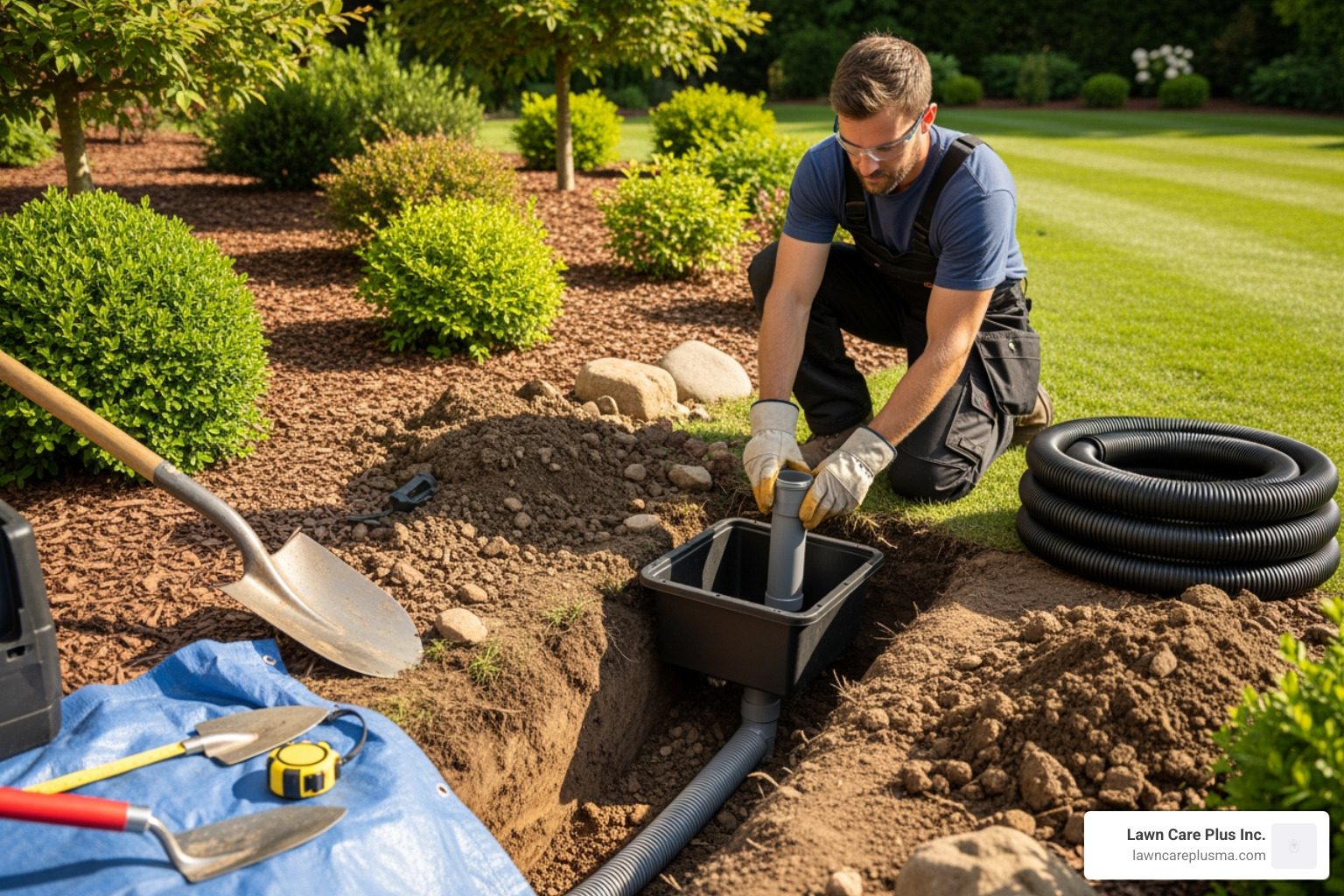
- Excavation and Pipe Laying: Digging trenches, especially deep ones, and correctly laying pipes (often PVC SDR 35 for durability) to ensure proper flow and prevent future clogs requires skill and the right equipment.
- Obstacle Avoidance: Identifying and safely working around underground utility lines and tree roots is paramount.
- Permitting: Many towns require permits for drainage work, and DIYers might miss critical regulations.
- Heavy Lifting: Concrete basins and even large plastic ones, along with excavated soil, can be heavy and require proper lifting techniques or machinery.
Incorrect installation can lead to bigger problems and more expensive repairs down the road. For most catch basin installations, partnering with a professional landscaping company like Lawn Care Plus Inc. ensures the job is done safely, efficiently, and effectively, ultimately saving you time, stress, and potential future costs.
Conclusion: Making a Smart Investment in Your Property
Understanding the cost to install a catch basin is about more than just the initial price tag; it’s about making a smart, long-term investment in your property. As we’ve seen, the national average costs—which are based on internet research and do not represent quotes from Lawn Care Plus Inc.—can vary widely. While a basic installation might start around $1,000, more complex systems or those using durable materials like concrete can push the total past $7,500, especially when factoring in excavation, permits, and landscape restoration.
The key factors influencing these costs — the size and material of the basin, the complexity of the system, site accessibility, and existing obstacles — all underscore the need for a professional assessment. Skipping proper installation or cutting corners on materials can lead to recurring problems, costly repairs, and ultimately, a much higher overall expense.
Investing in a properly designed and installed catch basin system protects your property from the devastating effects of water damage, such as foundation cracks, basement flooding, and eroded landscaping. It preserves your property value, maintains the health of your lawn and garden, and ensures your outdoor spaces remain functional and enjoyable, even after the heaviest Massachusetts downpours.
At Lawn Care Plus Inc., we believe in providing comprehensive drainage solutions custom to the unique needs of properties across Belmont, Boston, Brookline, Newton, Dedham, and all our service areas in the Metro-West. For a comprehensive evaluation of your property’s needs and to discuss how a catch basin can be integrated into an effective water management plan, explore our drainage and hardscaping solutions. Let us help you keep your property dry, healthy, and beautiful for years to come.