
Why Retaining Wall Construction Is Critical for Your Property
Retaining wall construction is the process of building a structure that holds back soil, prevents erosion, and creates usable level spaces on sloped properties. Here’s what you need to know:
Key Steps for Successful Retaining Wall Construction:
- Plan Your Project – Check local codes, call 811 for utility lines, assess soil, and mark your layout.
- Excavate the Foundation – Dig a trench 12-16 inches deep and twice the block width.
- Build a Solid Base – Add 4-8 inches of compacted gravel for a level foundation.
- Lay the First Course – Bury at least half the first row and ensure it’s perfectly level.
- Stack and Backfill – Stagger blocks, backfill with drainage aggregate, and compact thoroughly.
- Install Drainage – Place a perforated drain pipe at the base with 12+ inches of wall rock.
- Add Reinforcement – Use geogrid mesh for walls over 4 feet tall.
- Finish the Top – Secure capstones with construction adhesive.
A well-built retaining wall does more than just hold back dirt. It transforms steep slopes into functional outdoor spaces, protects your property from erosion, and adds serious curb appeal. Landscape redesigns with retaining walls can see over a 100% return on investment and significantly boost homeowner enjoyment.
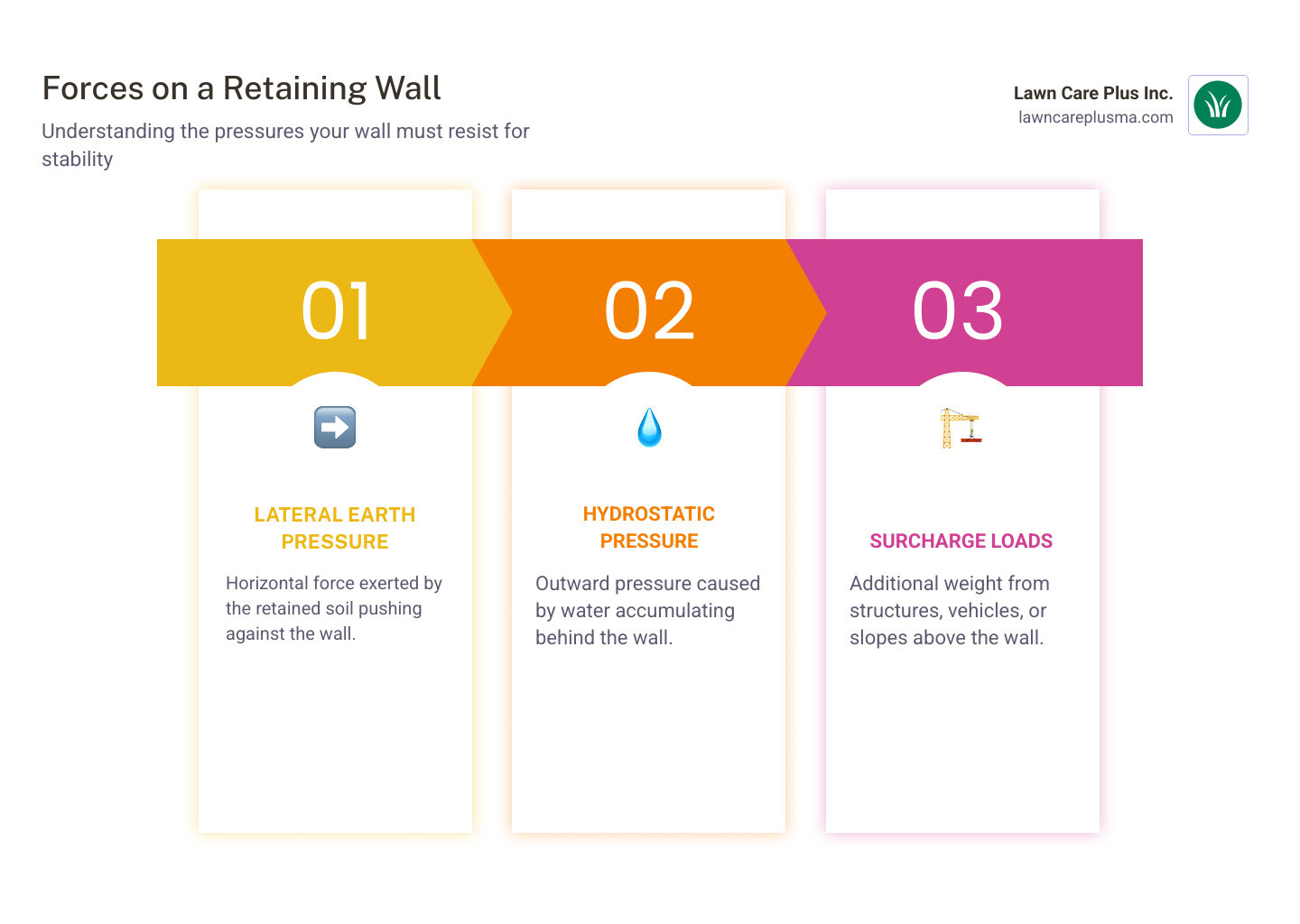
However, most retaining wall failures happen because of poor drainage or inadequate foundation work. When water builds up behind a wall, the hydrostatic pressure can push it outward and cause it to fail. Proper construction techniques are essential.
The stakes are especially high for walls over 4 feet tall. These structural retaining walls must resist significant lateral earth pressure and often require engineering, permits, and reinforcement with geogrid mesh. Even shorter walls need careful attention to detail, from the buried first course to the compacted backfill.
I’m Tim DiAngelis, owner of Lawn Care Plus, Inc., and I’ve spent over a decade helping homeowners and commercial clients throughout Greater Boston create beautiful, durable outdoor spaces. Retaining wall construction is a cornerstone of our hardscaping services—when done right, these structures last for decades and make a dramatic difference in how you can use your property.
Retaining wall construction basics:
Phase 1: Planning and Preparation for a Lasting Wall
Before we even think about digging, thorough planning and preparation are the bedrock of any successful retaining wall construction project. This initial phase dictates the wall’s stability, longevity, and compliance with local regulations.
Site Assessment: Understanding Your Terrain
First, we conduct a comprehensive site assessment. This involves understanding the nuances of your property in Belmont, Boston, Brighton, Brookline, Canton, Chestnut Hill, Dedham, Hyde Park, Jamaica Plain, Mattapan, Medfield, Milton, Needham, Newton, Norwood, Randolph, Readville, Roslindale, Walpole, Watertown, Wellesley, or Westwood.
- Soil Type Analysis: Soil type is critical. Clay soil, common in Massachusetts, expands and exerts pressure, while sandy soil drains too quickly. We evaluate existing soil to see if it’s suitable for backfill or if imported fill is needed. For complex sites, a geotechnical report clarifies soil strength and groundwater levels.
- Property Lines and Utilities: We confirm property lines to avoid disputes and always call 811 before digging. This free service marks underground utilities (gas, water, electric) to prevent dangerous accidents. Knowing their exact location is non-negotiable.
- Local Building Codes and Permits: Local building codes in Massachusetts often regulate retaining walls. Walls over three to four feet typically require a permit and engineering. State regulations may even require an architect on site for walls over four feet. These rules ensure safety and structural integrity, and understanding them is part of responsible retaining wall design.
- Marking the Layout: With permits and utilities marked, we lay out the wall’s path using stakes and a string line. This visual guide ensures accuracy during construction.
- Calculating Materials: We accurately calculate materials by measuring the wall’s dimensions, adding a 10% buffer for cuts and waste. This planning is key for efficiency, following Allan Block Best Practices for retaining wall construction.
Understanding Different Retaining Wall Types
The world of retaining walls is diverse, with each type suited to different purposes and site conditions. Understanding these variations is key to selecting the right solution for your project.
- Gravity Walls: These walls use their own mass to hold back soil. Made from heavy materials like stone or concrete blocks, they are a straightforward solution. Segmental Retaining Walls (SRWs), using interlocking blocks, are a popular, versatile type of gravity wall used to build robust block walls.
- Cantilevered Walls: These are L-shaped or T-shaped structures of reinforced concrete. The base slab uses the weight of the backfill to provide stability. Their reinforced design is ideal for Massachusetts’ freeze-thaw cycles, as it handles the pressure from expanding frozen soil.
- Sheet Piling Walls: Used in soft soils and tight spaces, these walls are made of interlocking sheets (steel, vinyl, or wood) driven deep into the ground for stability.
- Anchored Walls: For massive loads, anchored walls use cables or rods (tiebacks) anchored into the earth behind the wall for extra support against soil pressure.
- Non-structural vs. Structural Walls: The difference is height and purpose. Non-structural walls are typically under 2 feet, used for planters or garden borders. Structural walls are over 2 feet tall, designed to hold back slopes and require engineering and reinforcement (like geogrid) when over 4 feet to withstand earth pressure.
Essential Tools and Materials for Your Project
Equipping ourselves with the right tools and materials is paramount for efficient and safe retaining wall construction.
Essential Tools:
- Shovel: For initial excavation and general digging.
- Tamper (Hand or Plate): Crucial for compacting the subgrade and gravel base, ensuring a stable foundation.
- 4-foot Level: To ensure each block is perfectly level, both front-to-back and side-to-side.
- Rubber Mallet: For adjusting and seating blocks without damaging them.
- Tape Measure: For accurate measurements of length, height, and block placement.
- String Line and Line Level: To maintain straight lines and consistent elevation for the wall courses.
- Safety Glasses: To protect eyes from debris and masonry dust.
- Gloves: For hand protection during handling of rough materials.
- Work Boots: Sturdy footwear for safety and support.
- Wheelbarrow: For transporting materials like gravel, blocks, and soil.
- Masonry Saw (with appropriate blade): For cutting blocks to fit corners, curves, or ends (and a respirator mask when cutting to avoid inhaling dangerous masonry dust).
Essential Materials:
- Retaining Wall Blocks: These come in various styles and colors, from interlocking concrete blocks to natural stone. The choice depends on the wall type and aesthetic preference. We offer a wide selection of blocks for retaining wall projects.
- Crushed Stone/Gravel Base: A critical component for the foundation, typically 4-8 inches deep, providing a stable, level, and well-draining pad.
- Drainage Aggregate (Wall Rock): Free-draining gravel (3/8” to 3/4” particles, ASTM No.57) placed behind the wall to prevent water buildup and hydrostatic pressure.
- 4-inch Perforated Drain Pipe: Installed behind the first course of blocks to collect and divert water away from the wall.
- Geotextile Filter Fabric: Placed between the drainage aggregate and the native soil to prevent soil particles from clogging the drainage system.
- Geogrid: A synthetic mesh reinforcement used for walls taller than three or four feet, tying the wall back into the soil mass for improved stability against overturning forces.
Phase 2: The Ultimate Guide to Retaining Wall Construction
Once the planning is complete and all materials are on-site, the real work begins. This phase requires precision, patience, and adherence to best practices to ensure a durable and attractive retaining wall.
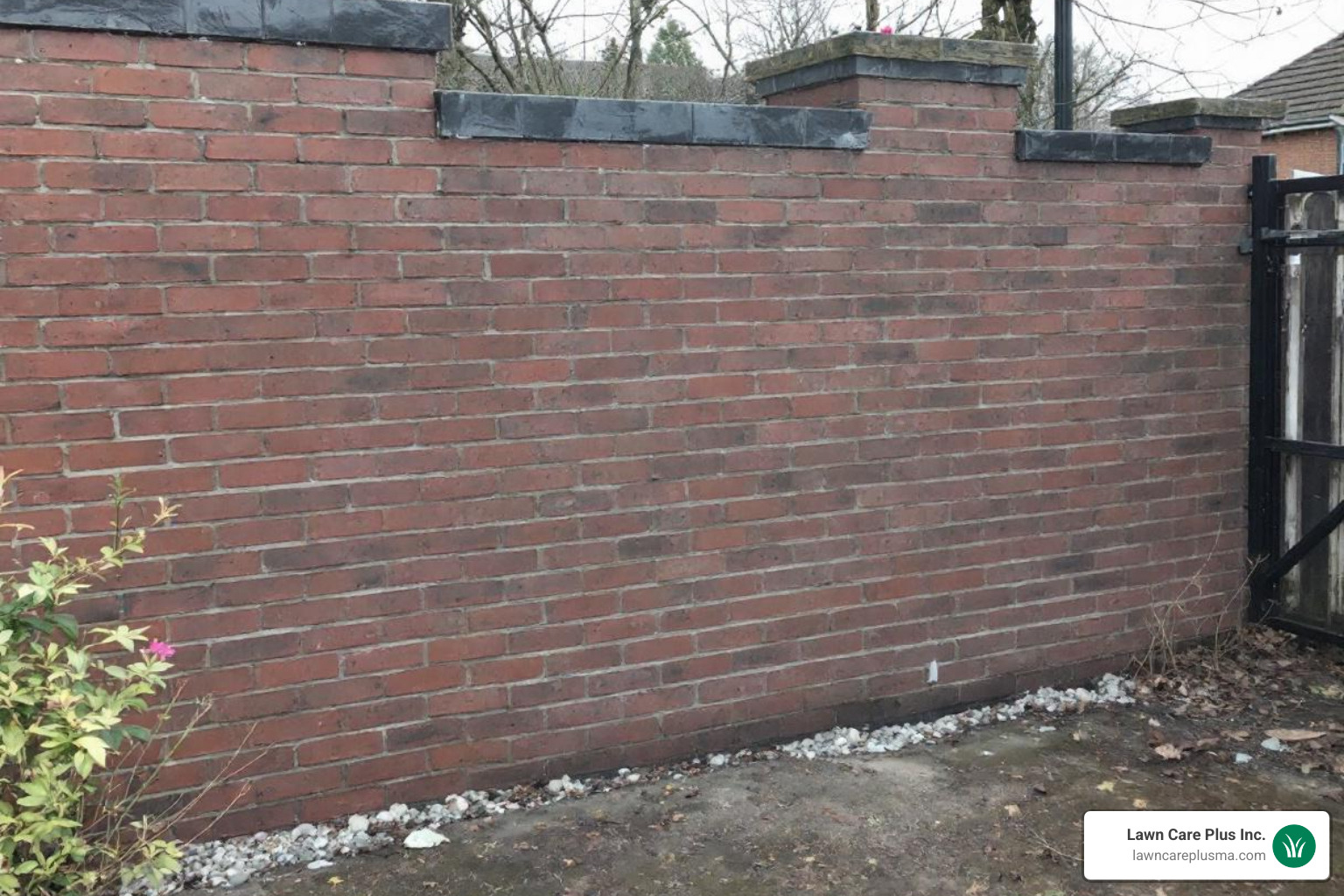
Safety First: Our Commitment to a Secure Site
Safety is paramount on any retaining wall construction site. We prioritize several key precautions:
- Personal Protective Equipment (PPE): Our team wears safety glasses, gloves, and work boots. When cutting blocks, a respirator mask is essential to avoid inhaling harmful masonry dust.
- Heavy Lifting: We use proper techniques or mechanical aids to lift heavy blocks and prevent injury.
- Trench Safety: Trenches can collapse. We ensure they are stable and avoid working alone in deep excavations.
Step 1: Excavating and Building the Foundation
The foundation is arguably the most critical component of any retaining wall. A strong, level, and well-drained base is what prevents future settlement and failure.
- Trench Excavation: We excavate a trench along the marked layout. The trench should be 12 to 16 inches deep and twice the block’s width. This depth allows for a gravel base and for burying at least half of the first course, which anchors the wall. For walls over 3 feet, burying a full block is better. On slopes, we create a stepped, level trench. Learn more about retaining wall foundation requirements.
- Compacting the Subgrade Soil: We compact the subgrade soil at the bottom of the trench to eliminate loose pockets and prevent uneven settlement. If we find poor soil, we replace it or consult a geotechnical engineer.
- Adding and Leveling the Gravel Base: Next, we add a 4- to 8-inch layer of crushed stone or free-draining gravel into the trench. This leveling pad provides drainage and prevents water accumulation. The gravel should be 3/8” to 3/4” particles (ASTM No.57). The base should be at least 6 inches deep and 24 inches wide.
- Compacting the Base Pad: We compact the gravel base with a tamper until it’s solid and perfectly level. This is non-negotiable, as a level base is the most important factor for a long-lasting wall.
Step 2: Laying the Base Course for Flawless Retaining Wall Construction
The first course of blocks sets the stage for the entire wall. Its precision is paramount.
- Importance of the First Course: This initial layer is critical; it determines the wall’s alignment and stability. Any imperfections here will be magnified later, so we take extra care.
- Leveling Front-to-Back and Side-to-Side: Each block in the base course must be perfectly level. We use a 4-foot level to check each block from front to back and side to side.
- Burying the First Course: Burying at least half of the first course below grade provides crucial anchoring and helps the wall resist shifting or toppling.
- Using a String Line for Alignment: To ensure a straight wall, we stretch a string line tightly along the front edge, aligning each block precisely with this guide.
- Tapping Blocks into Place: Once a block is level and aligned, we firmly tap it into the compacted gravel base with a rubber mallet to secure it.
Step 3: Stacking, Backfilling, and Proper Retaining Wall Construction
With the base course established, we proceed with building the wall, ensuring proper structural integrity and drainage.
- Staggering Blocks in a Running Bond Pattern: We stack subsequent courses of concrete block retaining wall units, offsetting the vertical seams by at least 3 inches (ideally half a block) in a running bond pattern. This distributes the load and improves strength.
- Maintaining Block Setback: Many blocks have a built-in lip or pin system that creates a slight setback with each course, improving stability. If not, we create the setback manually.
- Backfilling with Drainage Aggregate: With each course, we backfill the area behind the wall with at least 12 inches of drainage aggregate. This prevents hydrostatic pressure buildup, a primary cause of wall failure.
- Compacting Backfill in Lifts: We place and compact backfill in 6- to 8-inch lifts using a tamper. This prevents voids and ensures solid support for the wall.
- Installing a Perforated Drain Pipe: After the first course, we install a 4-inch perforated drain pipe (holes down) behind the wall. Wrapped in filter fabric to prevent clogging, this pipe collects and diverts water away from the wall’s base. This is a critical step for effective retaining wall drainage.
- Geogrid Installation for Walls Over 4 Feet: For retaining wall construction projects in Massachusetts exceeding 4 feet, or those supporting heavy loads, geogrid reinforcement is required. This synthetic mesh is laid between block courses and extends into the backfill, tying the wall to the soil mass to resist pressure. The first layer goes on the base course, with more layers every 16 inches vertically. Geogrid length should be at least 60% of the wall height. For detailed guidance, refer to a Detailed geogrid connection guide.
Phase 3: Finishing Touches and Advanced Techniques
The final phase of retaining wall construction focuses on aesthetics and functionality, ensuring the wall not only performs its structural role but also improves the landscape.
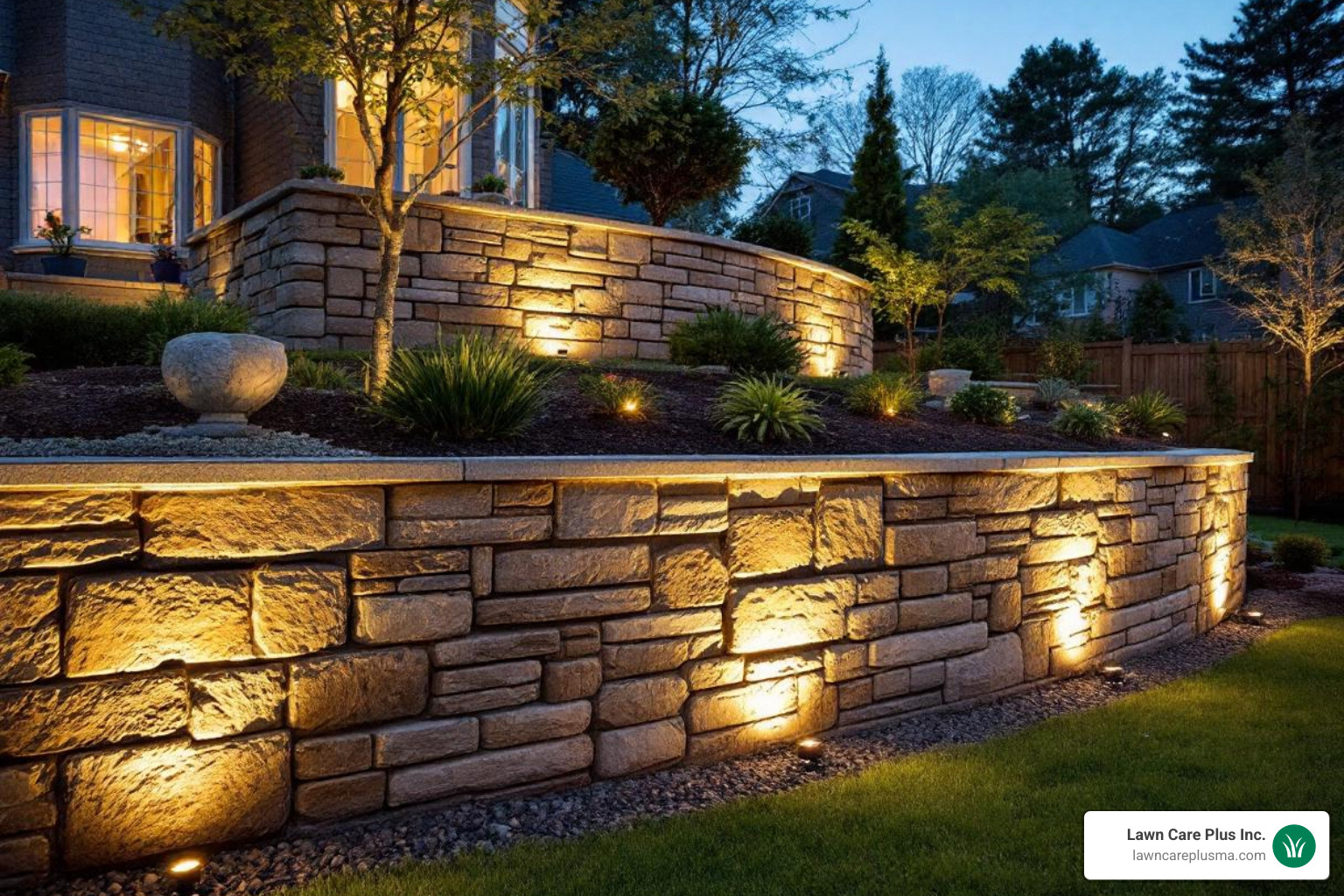
Finishing the Top of the Wall
The top of the retaining wall provides a polished look and protects the underlying structure.
- Capstones and Coping: We finish the wall with capstones or coping blocks. These are flat, decorative units that sit on the top course and can be chosen to match or contrast with the wall blocks.
- Securing with Construction Adhesive: We secure capstones with exterior-grade construction adhesive on clean, dry blocks. An overhang of 1 to 1 1/2 inches creates a drip edge to protect the wall face, contributing to attractive landscape walls.
Handling Corners, Curves, and Transitions
Building a straight wall is one thing, but incorporating intricate designs like corners and curves requires specialized techniques.
- Corners: We use specialized corner blocks or cut standard blocks for seamless 90-degree corners. Proper block overlap and geogrid placement are crucial for stability.
- Curves: To create smooth curves, we trim block flanges to allow articulation. The minimum radius depends on the block system, and we adjust geogrid placement for stability in both inside and outside curves.
- Building Steps and Transitions: Walls can be integrated with stairs and terraces to manage elevation changes. This requires careful planning to incorporate steps or transition between wall heights, following guidelines like those for Steps Through Wall.
Common Mistakes to Avoid
Even experienced DIYers can fall victim to common pitfalls during retaining wall construction. We emphasize avoiding these mistakes to ensure a successful project:
- Improper Foundation Preparation: Skipping or skimping on the compacted gravel base is a recipe for disaster. Without a solid, level foundation, the wall will settle unevenly and eventually fail.
- Forgetting Drainage: Inadequate drainage is the leading cause of retaining wall failure. Ignoring the need for a perforated drain pipe and sufficient drainage aggregate behind the wall will inevitably lead to hydrostatic pressure buildup and collapse.
- Lack of Reinforcement: For taller walls, neglecting to install geogrid reinforcement means the wall won’t have the necessary strength to resist the immense lateral earth pressure, especially in a region like Massachusetts with freeze-thaw cycles.
- Using the Wrong Backfill Material: Using native soil that retains water directly behind the wall instead of free-draining aggregate will exacerbate hydrostatic pressure issues.
- Not Burying the First Course: Failing to embed at least half, or a full block, of the first course significantly compromises the wall’s anchoring and stability.
- Ignoring Hydrostatic Pressure: This silent killer can easily push out an improperly built wall. Always design and build with water management in mind.
Integrating Utilities and Landscaping
A well-designed retaining wall is more than just a structural element; it’s an integral part of your overall landscape design.
- Planning for Pipes and Conduits: If utilities must pass through a wall, it must be planned during the design phase. We avoid placing them in the reinforced zone if possible and follow specific construction details like those for Pipes Installed Perpendicular Through Wall to maintain integrity.
- Creating Built-in Planters: Retaining walls are perfect for creating raised planting beds. We can build terraced walls for multi-level gardens or add planting spaces along patios.
- Adding Landscape Lighting: Integrating lighting into a retaining wall improves aesthetics and extends the use of your outdoor space into the evening.
- Enhancing Outdoor Living: Retaining walls can define patios and create nooks for dining or fire pits. They can also terrace sloped yards, making them functional for gardens or recreation. These applications contribute to dreamy hardscapes pavers and patios for massachusetts gardens.
Frequently Asked Questions about Building Retaining Walls
We often get questions from homeowners in Massachusetts about their retaining wall construction projects. Here are some of the most common inquiries:
How much does a retaining wall cost to build?
The cost of retaining wall construction can vary significantly based on several factors. While we don’t provide specific pricing for Lawn Care Plus Inc. here, we can share some national average costs based on internet data for general reference. Please remember these are not actual costs for Lawn Care Plus, and local prices in Massachusetts may differ.
On average, homeowners can expect to pay anywhere from $25 to $100+ per square foot. This wide range reflects factors like:
- Materials: Concrete blocks vs. natural stone.
- Size: Taller, longer walls need more materials, excavation, and engineering.
- Site Access: Difficult sites increase labor costs.
- Labor: Professional installation is a significant cost factor.
- Features: Integrated lighting or curves add to the expense.
For a more detailed understanding of expenses, you can explore our page on retaining wall cost.
When should I hire a professional instead of doing it myself?
While a small, decorative wall can be a DIY project, hiring a professional like Lawn Care Plus Inc. is essential for:
- Walls Over 3-4 Feet Tall: These walls are structural, often requiring permits and engineering plans to comply with local building codes in Massachusetts.
- Complex Soil Conditions: If your property has clay, loose soil, or a high water table, a professional can design a wall to prevent future failures.
- Critical Structural Support Needed: If the wall will support a driveway, patio, or a significant slope near your home, professional engineering is non-negotiable.
- Proximity to Structures or Property Lines: Building near your home, a neighbor’s property, or utilities requires expert precision.
- When Permits and Engineering are Required: Professionals can seamlessly steer the permitting process and ensure compliance with all codes.
For projects where the stakes are high, the benefits of hiring a professional for your retaining wall installation far outweigh the DIY savings.
What is the most important part of building a retaining wall?
Without a doubt, the most important parts of a retaining wall construction project are the foundation and proper drainage.
- The Foundation: A solid, level, and compacted gravel base is absolutely critical. It distributes the wall’s weight, prevents settlement, and anchors the entire structure.
- Proper Drainage: This is paramount for preventing hydrostatic pressure. An effective drainage system—including a perforated drain pipe and adequate drainage aggregate—prevents water from building up and pushing the wall over.
These two elements, when executed correctly, prevent over 90% of all retaining wall failures.
Your Partner for Flawless Retaining Walls in Massachusetts
Successful retaining wall construction requires meticulous planning and execution. We’ve covered the importance of a robust foundation, proper drainage, and reinforcement like geogrid to ensure a beautiful, enduring structure that can withstand the Massachusetts climate.
A well-built retaining wall does more than just hold back soil; it open ups the full potential of your property, turning challenging slopes into functional and attractive outdoor living spaces. Whether you dream of terraced gardens, a defined patio, or simply need to prevent erosion, the right wall can dramatically improve your home’s value and your enjoyment of it.
For complex projects, walls exceeding 3-4 feet, or simply for the peace of mind that comes with guaranteed, long-lasting results, professional expertise is key. At Lawn Care Plus Inc., we pride ourselves on being your trusted partner for all hardscaping and masonry needs throughout the Boston Metro-West area, including Belmont, Boston, Brighton, Brookline, Canton, Chestnut Hill, Dedham, Hyde Park, Jamaica Plain, Mattapan, Medfield, Milton, Needham, Newton, Norwood, Randolph, Readville, Roslindale, Walpole, Watertown, Wellesley, and Westwood. Our experienced team is equipped to handle every aspect of your retaining wall construction project, ensuring it’s built to last and designed to impress.
Ready to transform your landscape with a flawlessly constructed retaining wall? Contact us for your hardscaping services needs today, and let’s build something amazing together.
