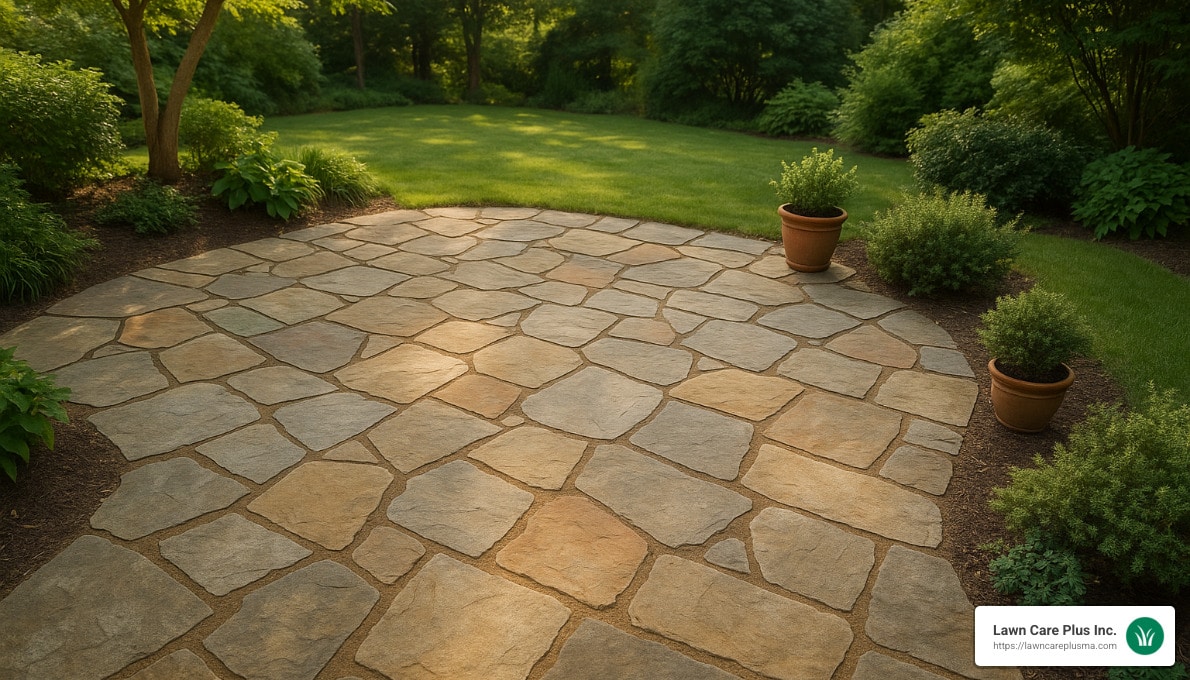
Transform Your Outdoor Space with Flagstone
Flagstone patio installation involves creating a durable, naturally beautiful outdoor surface by arranging flat stones over a properly prepared base. Here’s a quick overview of the process:
- Excavate the area to a depth of 6-9 inches
- Add a base layer of 4-6 inches of compacted gravel
- Spread 1-2 inches of sand or stone dust for leveling
- Arrange flagstones in your desired pattern
- Level each stone individually
- Fill gaps with sand, stone dust, or polymeric sand
If you’re considering adding a flagstone patio to your property, you’re making an excellent choice for both aesthetics and durability. Flagstone patios offer a timeless, natural look that seamlessly blends with any landscape while providing a sturdy surface that can last for decades with proper installation and maintenance.
Unlike uniform concrete or manufactured pavers, flagstone creates a unique, one-of-a-kind patio since no two stones are exactly alike. This natural variation gives your outdoor space character and charm that can’t be replicated with other materials.
While professional installation is always an option, many homeowners find that a DIY flagstone patio project is both rewarding and achievable with proper planning and preparation. As Roger Haywood, a landscape professional, notes: “If you’re doing flagstone – the stone sets on a stone base, not a sand bed.”
The key to a successful flagstone patio lies in proper base preparation and careful stone placement. Whether you choose a dry-set method using compacted gravel and sand or a mortared installation over concrete, the fundamentals remain the same: create a solid foundation, arrange stones thoughtfully, and fill the gaps appropriately.
In this guide, we’ll walk you through everything you need to know to install your own flagstone patio, from selecting the right materials to finishing touches that will make your outdoor space truly shine.
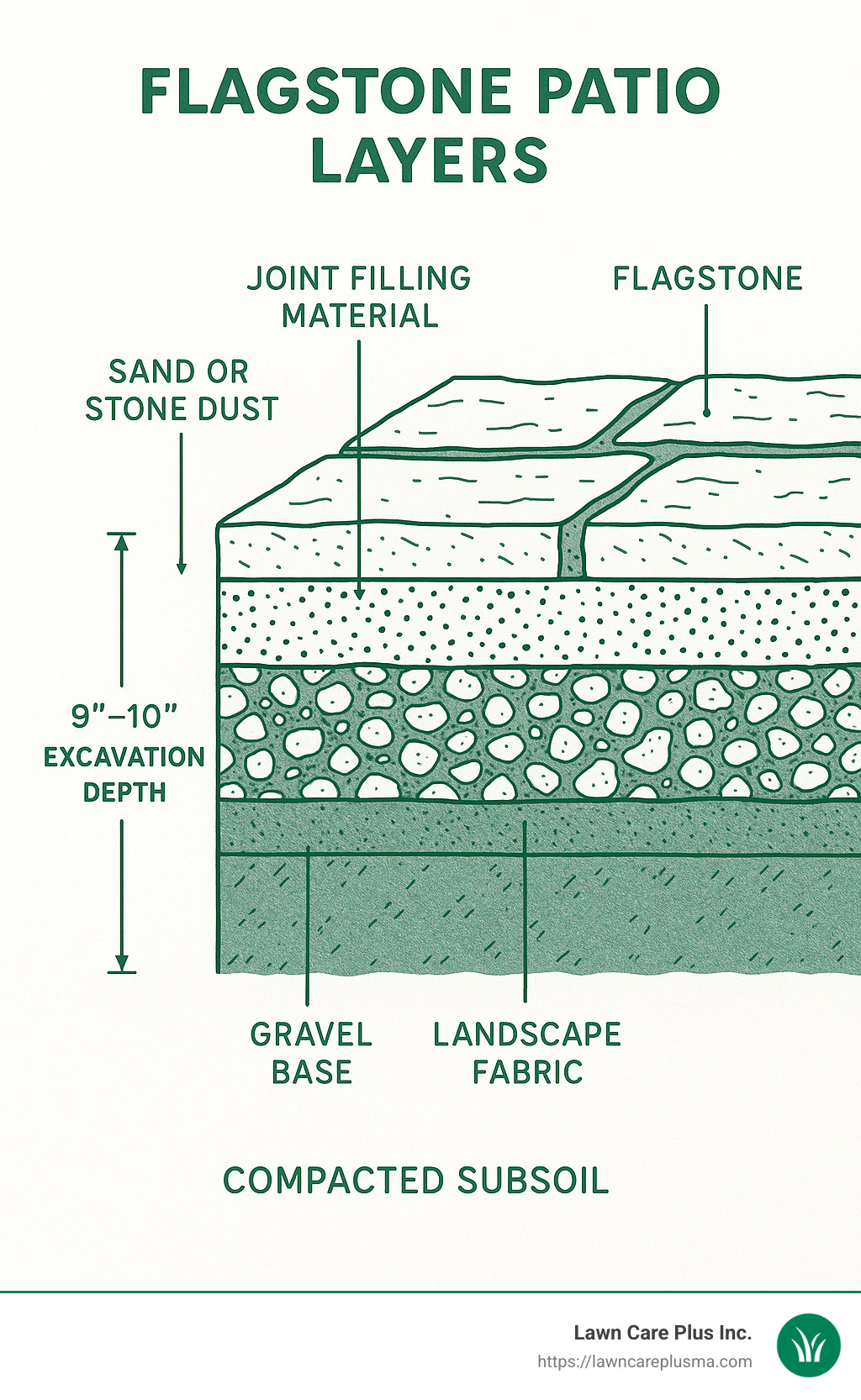
Flagstone patio installation terms simplified:
Understanding Flagstone and Its Benefits
There’s something magical about a flagstone patio that concrete just can’t match. When you walk across those natural stone surfaces, you’re literally treading on pieces of earth that formed millions of years ago. Pretty cool, right?
Flagstone isn’t actually a specific type of stone – it’s a catch-all term for flat stones used in paving. These natural beauties are typically cut from sedimentary rock that naturally splits into those perfect, flat layers we love for patios. What makes flagstone special isn’t just its good looks (though those are certainly a plus!) – it’s the incredible durability and versatility that have made it a favorite for centuries.
Types of Flagstone
When planning your flagstone patio installation, you’ll want to get familiar with the different types available. Each brings its own character to your outdoor space.
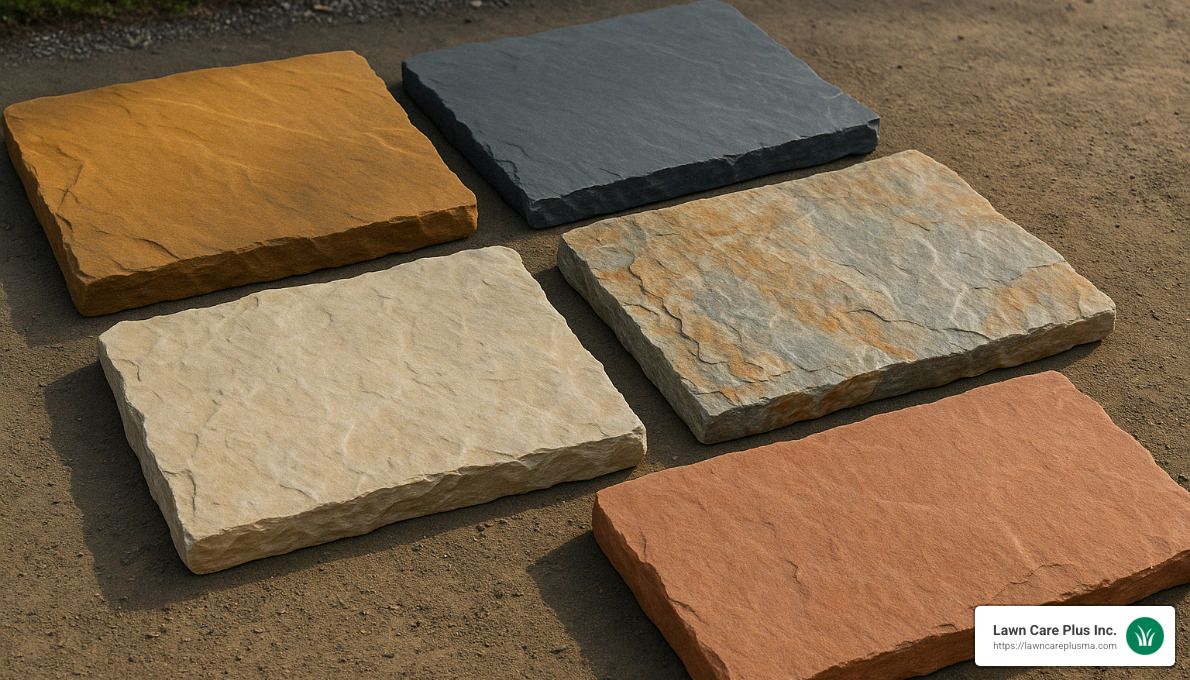
Sandstone is what most people picture when they think of flagstone – those warm earthy tones ranging from tans and browns to rich reds. It’s relatively soft and easy to cut, making it DIY-friendly, while still plenty durable for patio use. Pennsylvania bluestone is a popular variety that, despite its name, offers colors from blue-gray to greenish and even lovely purple tones.
Slate gives you that distinctive layered look with a more uniform surface than other options. Available in sophisticated colors like blue, gray, green, and purple, slate stays remarkably slip-resistant even when wet – a huge plus if you’re installing near a pool area.
Limestone creates a more formal, neat look with its consistent coloration in beige, tan, and gray tones. It’s a bit softer and more porous than other options, so it needs a little extra TLC in areas with freeze-thaw cycles.
Quartzite is the tough guy of the flagstone world – extremely hard and resistant to scratching. It comes in lighter colors like white, beige, and light gray, with a crystalline appearance that adds a subtle sparkle to your outdoor space.
Arizona Flagstone brings the Southwest to your backyard with its distinctive reddish-brown or tan coloration and natural shimmer that catches the light beautifully. As you might guess from the name, it’s primarily quarried in the American Southwest.
Benefits of Choosing Flagstone
Why choose flagstone over other patio materials? The benefits go way beyond just looks.
The natural beauty of flagstone is impossible to replicate. Each stone tells its own geological story, creating a truly one-of-a-kind patio that blends seamlessly with your landscape. Mother Nature is the ultimate designer!
When it comes to exceptional durability, flagstone is hard to beat. A properly installed flagstone patio can last for generations – we’re talking decades of enjoyment with minimal maintenance. These stones have already survived millions of years of geological processes, so they’re well-equipped to handle your summer barbecues.
Safety matters, and the non-slip surface of flagstone provides excellent traction, even when wet. That textured surface that feels so nice underfoot is also keeping you safer than smoother patio materials would.
If you’ve ever burned your feet on hot concrete in summer, you’ll appreciate flagstone’s temperature resistance. While concrete and pavers can become uncomfortably hot, flagstone stays relatively cool underfoot – your bare feet will thank you!
Many homeowners don’t consider permeability when choosing patio materials, but it matters. When installed with sand or gravel joints, flagstone allows water to permeate through rather than run off, helping with drainage and reducing erosion around your patio.
The versatility of flagstone is truly impressive. It works beautifully with various landscape styles, from rustic cottage gardens to formal estate settings. At Lawn Care Plus Inc., we’ve installed flagstone patios that complement everything from traditional New England homes to modern architectural designs throughout the Boston Metro-West area.
Need to make a repair down the road? No problem. With flagstone, you can easily replace individual pieces without disturbing the entire patio. Try doing that with a concrete slab!
As one Massachusetts homeowner who completed their own flagstone patio project enthusiastically shared, “Just gimme an I ❤️ Flagstone bumper sticker. It’s still one of my favorite projects ever.”
With all these benefits, it’s easy to see why flagstone has remained a popular choice for patios throughout the centuries. It’s not just a patio material – it’s an investment in your home’s beauty, functionality, and value.
Planning Your Flagstone Patio Installation
Planning might not be the most exciting part of creating your outdoor oasis, but trust me—it’s the foundation of a successful flagstone patio installation. A little forethought now will save you from headaches (and backaches!) down the road.
Site Selection
Finding that perfect spot for your flagstone patio is like finding the right place to sit at a dinner party—location matters!
Your patio will likely become a favorite gathering space, so position it where it’s easily accessible from your home. Think about how you’ll be using the space throughout the day. Will you be enjoying morning coffee there? If so, an east-facing patio might be ideal. For evening entertaining, consider how the setting sun will affect your comfort level.
Don’t forget to look up and around! Existing trees can provide welcome shade in summer, but they also drop leaves and may have expanding root systems. And while we’re talking about looking around—position your patio to showcase your garden’s best features while screening less attractive views like your neighbor’s cluttered garage.
Here in Massachusetts, we deal with some pretty significant ground movement during freeze-thaw cycles, so try to choose an area that’s relatively level and doesn’t collect water. Your future self will thank you!
Measuring and Layout
Once you’ve picked your spot, it’s time to bring your vision to life with some basic measuring and marking. Grab some stakes and string to outline your patio’s perimeter. This simple step helps you visualize the space and make adjustments before you start digging.
For rectangular patios, calculating square footage is straightforward (length × width), but irregular shapes require a bit more creativity. Try breaking the area into simple geometric shapes, calculate each separately, and add them together.
When ordering materials, flagstone comes in irregular shapes with natural variations—that’s part of its charm! Plan to order about 10-15% more material than your calculated square footage to account for cuts and the inevitable broken piece.
Permits and Regulations
Before you get too far along in your daydreaming, let’s talk about the less exciting but necessary topic of permits and regulations.
In many Massachusetts towns, patios over a certain size require permits. The rules vary widely depending on your location, so check with your local building department. Some areas have strict setback requirements (minimum distances from property lines), especially if you’re near wetlands or conservation areas.
Always, always call 811 before digging. This free service marks underground utility lines so you don’t accidentally cut into gas, electric, or water lines—a mistake that could be dangerous and expensive!
If you live in a neighborhood with a homeowners’ association, review their rules too. Some HOAs have specific guidelines about hardscaping projects, including material choices and approval processes.
Drainage Considerations
Water is both a flagstone patio’s friend and enemy. While we need water for our gardens, allowing it to pool on or under your patio is a recipe for disaster, especially in our Massachusetts climate where freeze-thaw cycles can wreak havoc.
Proper Slope
Your patio needs to gently shed water away from your home’s foundation. A slope of at least 1/4 inch per foot is ideal, though some installations can work with as little as 1/8 inch per foot if you’re aiming for a more level feel.
This slight grade is barely noticeable to the eye but makes all the difference in preventing water accumulation. During your installation, you can establish this slope by setting up level strings across your patio area and measuring down at regular intervals.
As one experienced contractor told me, “A properly pitched gravel base should have a fall of about 2.5 inches over 10 feet—that’s the sweet spot for drainage without feeling like you’re standing on a hill.”
Selecting Installation Method
There are two main approaches to flagstone patio installation, and your choice depends on your specific needs and comfort level with DIY projects.
The dry-set method (also called dry-laid) is where flagstones are placed on a base of compacted gravel and sand without mortar. This approach lets water drain naturally between the stones and gives you flexibility if you need to make adjustments later. It’s generally more forgiving for DIYers and adapts well to our Massachusetts freeze-thaw cycles. Most of our clients at Lawn Care Plus find this method works beautifully for their homes in the Boston Metro-West area.
The mortared method involves setting flagstones in mortar over a concrete base. This creates a more formal, stable surface that’s ideal if you’re planning to place dining furniture or if you want very tight, consistent joints between stones. However, it requires more skill, tools, and is less forgiving if the ground shifts during freeze-thaw cycles.
Both methods can create stunning results, but for most homeowners tackling this as a DIY project, the dry-set method offers the best balance of durability, flexibility, and achievable skill level.
With thoughtful planning, your flagstone patio will become not just a beautiful addition to your landscape but a functional outdoor living space that will bring you joy for many years to come.
Materials and Tools Needed for Flagstone Patio Installation
Ready to transform your outdoor space with a beautiful flagstone patio installation? Let’s gather everything you’ll need before breaking ground. Having all your supplies ready will make the project flow much more smoothly – trust me, there’s nothing worse than being elbow-deep in your project only to realize you’re missing something essential!
Flagstone
The star of the show deserves careful consideration. When I’m helping homeowners select flagstone at Lawn Care Plus, I always recommend seeing it in person if possible. Photos simply don’t capture the true colors and textures!
For quantity, measure your patio area and add about 10-15% extra for cuts and inevitable waste. A good rule of thumb is that one ton of flagstone covers approximately 100-120 square feet when using stones that are 1.5-2 inches thick. Speaking of thickness, don’t go thinner than 1.5 inches for patios – thinner stones might look beautiful initially, but they’ll crack under foot traffic over time.
Consider whether you prefer irregular-shaped stones for a naturalistic look or cut stones for a more formal appearance. The color should complement your home and landscape – blues and grays tend to work beautifully with New England architecture, while warmer tones like rust and tan create a Mediterranean feel.
Base Materials
The foundation of your patio is like the foundation of a house – skimp here, and you’ll regret it later. Here’s what you’ll need:
Gravel forms the main foundation layer. Plan for 4-6 inches of compactible gravel (often called “crusher run,” “road base,” or “2A modified”). To calculate how much you need in cubic yards, multiply your square footage by the depth in feet and divide by 27.
Sand or Stone Dust goes on top of your compacted gravel as a 1-2 inch leveling layer. At Lawn Care Plus, we often recommend stone dust (also called “screenings” or “decomposed granite”) over fine sand because it compacts better and doesn’t wash away as easily in our New England rain.
Landscape Fabric is your unsung hero – it goes between the soil and gravel to prevent weeds from sneaking up and keeps your base materials from mixing with the soil below.
Edge Restraints are optional but helpful for maintaining crisp patio edges over time. You can use plastic edging, metal edging, or create a border of mortared stones.
Joint Filling Material fills the gaps between your flagstones. Options include stone dust, polymeric sand, or regular sand. Polymeric sand hardens when wet, which helps lock stones in place and prevents weeds.
Tools List
Having the right tools doesn’t just make the job easier – it makes it possible! Here’s what you’ll need:
For excavation and base preparation, you’ll need shovels (both flat and pointed), a wheelbarrow (your back will thank you), a rake for leveling, and a tamper or plate compactor. Don’t underestimate the importance of proper compaction – it’s what prevents your patio from settling unevenly later.
You’ll also need a 4-foot level, string line and stakes for marking your area, a tape measure, and marking paint (flour works in a pinch!). A garden hose with spray nozzle is handy for dampening materials during compaction.
For setting the stones, gather a rubber mallet, dead blow hammer, heavy-duty gloves (flagstone can be sharp!), and knee pads (your knees will thank you after hours of stone placement). A mason’s hammer and chisel or brick set help with stone shaping, while an angle grinder with masonry blade makes cutting stones much easier.
Add a couple pieces of 2×4 lumber for screeding your sand or stone dust layer, plus a broom and garden sprayer for final cleanup and joint filling.
Safety Equipment
I can’t stress this enough – safety first! Working with stone is beautiful but potentially hazardous. Always wear eye protection, especially when cutting stone. Use ear protection when operating power equipment and a dust mask when cutting stone or working with dusty materials.
Heavy-duty work gloves protect your hands from cuts and abrasions, while a back brace can help prevent injury during heavy lifting. And those steel-toed boots? They might seem like overkill until you accidentally drop a 40-pound piece of flagstone – then they’re worth their weight in gold!
With all your materials and tools gathered, you’re ready to begin creating a flagstone patio that will improve your outdoor living space for years to come. And remember, if gathering all these supplies seems overwhelming, the team at Lawn Care Plus is always here to help with professional flagstone patio installation throughout the Boston Metro-West area.
How to Install a Flagstone Patio: Step-by-Step Guide
Now that you’ve planned your project and gathered your materials, it’s time to roll up your sleeves and begin the actual flagstone patio installation. Don’t worry—I’ll walk you through each step of the process with clear guidance that’ll help you create a beautiful outdoor space you’ll enjoy for years to come.
Safety Precautions
Before you start moving dirt and stones, let’s talk safety. Check the weather forecast to ensure you’ll have dry conditions for at least 2-3 days—working with wet materials is no fun and can compromise your results.
Always wear appropriate safety gear including gloves to protect your hands from rough stone edges and eye protection, especially when cutting stone. A dust mask is essential when cutting flagstone to avoid inhaling harmful particles.
Remember to stay hydrated and take regular breaks—flagstone work is physically demanding! Use proper lifting technique (bend at the knees, not the waist) to prevent back injuries, and keep a first aid kit nearby, just in case.
Excavation
The foundation of a great patio starts with proper excavation. Begin by marking your patio area using stakes and string or marking paint to clearly outline the perimeter. If you’re building a rectangular patio, double-check that it’s square by measuring the diagonals—they should be equal.
Next, set up level strings to establish your grade. This is crucial for proper drainage—remember that slight slope away from your house (1/4 inch per foot is ideal) will prevent water from pooling or flowing toward your foundation.
Now comes the muscle work—removing sod and topsoil to a depth of 6-9 inches. The exact depth depends on your stone thickness and base requirements. For example, if your flagstones are 2 inches thick and you need 6 inches of base materials, you’ll need to dig down 8 inches.
Once you’ve reached your desired depth, compact the subsoil using a plate compactor or hand tamper. This creates a solid foundation for everything that follows. As one experienced installer advises, “Excavate the area about 8-9 inches deep and compact the sub-grade.”
Base Preparation
With your excavation complete, lay landscape fabric over the compacted subsoil, making sure to overlap seams by at least 6 inches. This simple step prevents weeds from growing up through your patio and keeps your base material from mixing with the soil below—both crucial for long-term stability.
Now it’s time to build your base layer by layer. Add gravel in layers of 2-3 inches at a time, compacting each layer thoroughly before adding the next. The total gravel base should be 4-6 inches when fully compacted. Check your slope frequently using a long straight board and level to ensure proper drainage away from structures.
Next, add a 1-2 inch layer of sand or stone dust (screenings) over the compacted gravel. Many professionals, including our team at Lawn Care Plus, prefer stone dust over sand because it compacts better and doesn’t wash away as easily.
Level this final base layer using a screed board (a straight 2×4) pulled across the surface, maintaining your desired slope. As one landscaper noted, “Put down the base in 2-inch lifts and compact each lift until you get to the desired grade.”
Laying Flagstones
This is where your patio starts to take shape! Begin by organizing your stones by size and thickness. Having them sorted makes selection easier as you work through your installation.
Start placing stones from one edge or corner, working your way across the patio. For irregular patterns, some professionals recommend starting from the center to ensure the best-looking stones are prominently displayed. Maintain consistent joint spacing between stones, typically 1/2 to 2 inches depending on your preference and stone shapes.
Place larger stones at entry points and high-traffic areas for maximum stability. You’ll likely need to cut some stones to fit edges or fill gaps. Mark your cut line with chalk, score with a chisel, then break the stone along the scored line. For more precise cuts, an angle grinder with a masonry blade works wonderfully.
Leveling Stones
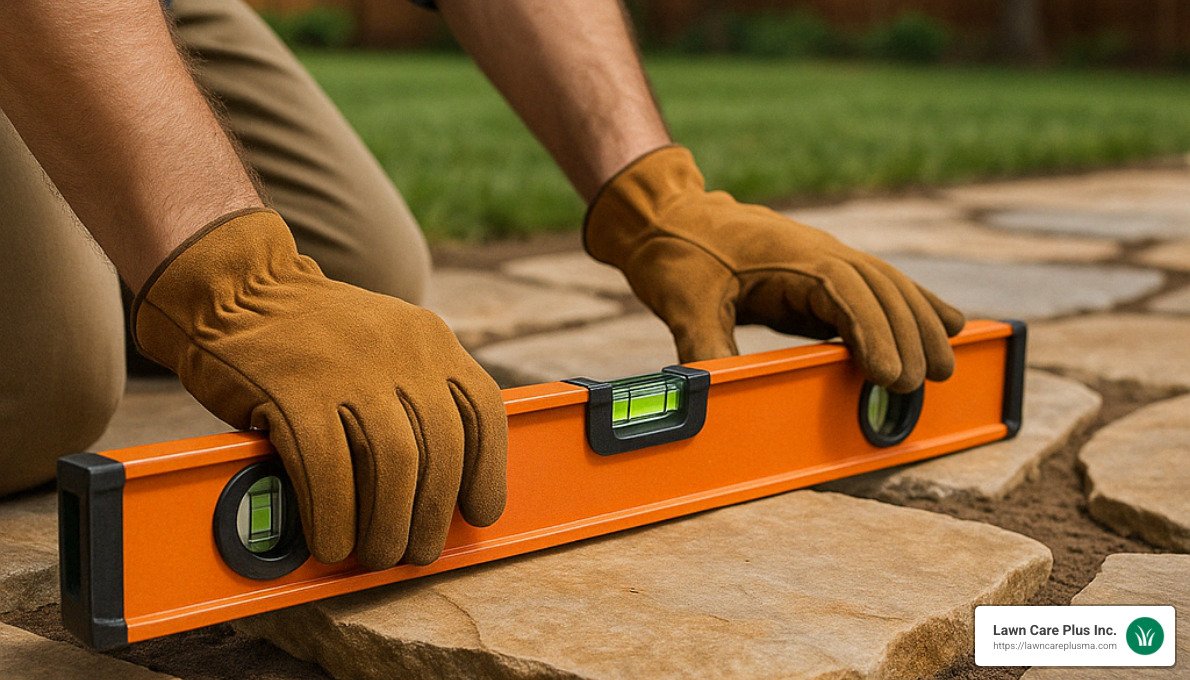
The secret to a professional-looking patio is properly leveled stones. Check each stone for stability as you place it—stones should never rock or wobble. Adjust the height by adding or removing sand/stone dust beneath each stone until it sits perfectly.
Use a rubber mallet to gently tap stones into place and level them with surrounding stones. Check levelness across multiple stones using a long straight edge and level, always maintaining your drainage slope. Also ensure proper height relative to surrounding landscape features, doorways, or existing hardscapes.
Remember what one expert said: “Do not use a compactor on flagstone, use a rubber mallet.” This gentle approach prevents cracking your beautiful (and sometimes expensive) stones.
Filling Joints
The final step brings everything together. Sweep your chosen joint filler (sand, stone dust, or polymeric sand) across the patio surface, working it into the gaps between stones with a broom to distribute the material evenly.
If you’re using polymeric sand, which is my personal favorite for a more permanent installation, mist the surface lightly with water to activate the binding polymers. This helps lock the sand in place and prevents it from washing away during rain.
Add more filler as needed until all joints are completely filled, then clean the stone surfaces thoroughly to remove any excess material. This final cleanup reveals the true beauty of your new flagstone patio.
For more detailed information about our professional installation services, visit our Patio Installation Service page.
Dry-Set Flagstone Patio Installation
If you’re tackling a DIY flagstone patio installation project, the dry-set method is likely your best bet—especially here in Massachusetts where our freeze-thaw cycles can wreak havoc on more rigid installations. This approach allows your patio to “breathe” and adjust slightly with the seasons without cracking or heaving.
Excavation Depth
When it comes to digging out your patio area, you’ll need to go deeper than you might initially think:
For milder climates, 6-8 inches of total depth usually does the trick. But here in Massachusetts? You’ll want to dig 8-12 inches to get below the frost line.
I always remember what a local contractor told me on my first project: “Excavate to a depth that accounts for 4 inches of compacted base, 2 inches of sand, plus the thickness of the flagstones. For example, for 3-inch thick flagstones, a 9-inch excavation is recommended.”
This might seem like a lot of digging (and it is!), but trust me—skimping on excavation depth is something you’ll regret when spring frost heaves your beautiful new patio.
Compacted Gravel Base
Think of your gravel base as the unsung hero of your patio—nobody will see it, but it’s doing all the heavy lifting. For a truly stable foundation:
Use 2A modified gravel or crusher run for your base. These materials contain various sizes of stone that interlock when compacted, creating a solid foundation that won’t shift easily. Add your gravel in thin layers (no more than 2-3 inches at a time), and compact each layer thoroughly before adding the next.
A light misting of water before compaction helps achieve maximum density—but don’t soak it! You’re aiming for damp, not soggy. Maintain your drainage slope throughout the process, checking frequently with a level to ensure that 1/4-inch-per-foot slope away from your house or other structures.
As one seasoned pro recommends: “Lay approximately 6 inches of 2a modified gravel and compact it. Pitch the gravel base at roughly 2.5 inches of fall per 10 feet of run to ensure proper drainage.”
Sand or Stone Dust Layer
Now comes your setting bed—the cushion that helps you level each stone perfectly:
While regular sand works, stone dust (also called screenings or decomposed granite) is often the better choice because it’s more stable and less likely to wash away. Spread a 1-2 inch layer evenly over your compacted gravel base.
Use a screed board (a straight 2×4) to create a smooth, even surface while maintaining your drainage slope. Unlike your gravel base, don’t compact this layer—it should remain loose enough that you can make small adjustments to stone height as you place them.
“Usually, the author does not use screenings deeper than about 2 inches,” one professional advises. “If a stone needs to be raised a full 3 inches, additional gravel should be used beneath the screenings.”
Arranging Stones
This is where your artistic side gets to shine! Arranging your flagstones is like working on a giant, heavy puzzle:
Before placing stones in your setting bed, consider doing a “dry layout” on nearby ground to experiment with patterns. Some people prefer to start from a fixed edge like your house, while others begin from the center for a more natural look.
Keep your gaps consistent—typically 1/2 to 2 inches between stones—and rotate pieces to find arrangements that fit well together. For edges and awkward spaces, you’ll likely need to cut some stones. An angle grinder with a masonry blade works well, or you can score and break stones for a more rustic edge.
As one DIY enthusiast perfectly put it: “Do you like puzzles? Then you’ll love putting together a flagstone patio.” It’s challenging but deeply satisfying to see your pattern emerge.
Filling Gaps with Sand or Gravel
The final step brings everything together and gives your patio that finished look:
You have several options for filling the joints between your stones. Regular sand is traditional and inexpensive. Stone dust matches your setting bed and creates a unified look. Polymeric sand (my personal favorite) hardens when wet to lock stones in place and prevent weeds—a huge time-saver for maintenance.
Sweep your chosen material across the patio surface, working it into all the joints. A light misting with water helps the filler settle deeply into the gaps. Don’t be surprised if you need to add more filler in a few days or weeks—it’s normal for it to settle over time.
For more information about polymeric sand and its benefits, check out this Guide to Polymeric Sand.
The beauty of a dry-set patio is its natural look and ability to flex slightly with ground movement. With proper installation, your flagstone patio will provide decades of outdoor enjoyment with minimal maintenance—the perfect backdrop for everything from morning coffee to evening gatherings.
Mortared Flagstone Patio Installation
While the dry-set method is popular for DIY projects, a mortared flagstone patio offers distinct advantages in certain situations. If you’re creating a formal outdoor dining area or live in a region with extreme weather conditions, this more permanent installation might be your best bet.
Concrete Slab Base
The foundation of any mortared flagstone patio installation is a proper concrete base. This isn’t a step you can skip or shortcut—it’s absolutely essential for long-term stability.
Begin by excavating the area deep enough to accommodate all your layers: a 4-inch concrete slab, plus the thickness of your mortar bed and flagstones. Once you’ve reached the proper depth, add a 2-4 inch layer of gravel as a sub-base and compact it thoroughly using a plate compactor.
Next, create forms around the perimeter using 2x4s secured with stakes. These forms will hold your concrete in place while it sets. Don’t forget to add reinforcement—wire mesh or rebar placed in the middle of the slab will significantly increase its strength and durability.
When you’re ready to pour, make sure your concrete is 4 inches thick and maintains that crucial slight slope for drainage (remember our magic number: 1/4 inch per foot). After pouring, give the surface a broom finish to create texture. This rougher surface provides better adhesion for the mortar you’ll apply later.
Patience is key here—allow your concrete to cure for at least 7 days before moving forward. I know it’s tempting to rush ahead, but proper curing time ensures your base will support your beautiful stones for years to come.
Mixing Mortar
Getting your mortar mix just right is crucial for proper adhesion between your concrete base and flagstones. The standard mixture consists of 1 part portland cement, 3 parts sand, and a small amount of lime to improve workability.
If you’re working in colder weather (below 50°F), consider using mortar additives specifically designed for low temperatures. These will help ensure proper curing despite the chill.
A pro tip from our team at Lawn Care Plus: mix small batches of mortar—only prepare as much as you can use within 1-2 hours. This prevents waste and ensures your mortar maintains the perfect consistency throughout your project. Speaking of consistency, aim for mortar that’s thick enough to hold its shape but wet enough to be workable—think of a thick peanut butter texture.
For those looking to add a designer touch, consider adding mortar dye that complements your flagstone color. This small detail can lift the finished look of your patio tremendously.
Setting Stones in Mortar
This stage requires precision and patience, but the results are worth the extra effort. Start by thoroughly cleaning your concrete base and dampening it slightly—this prevents the concrete from pulling moisture out of your mortar too quickly.
Apply a 1-inch layer of mortar to a small section of the base—only work in areas you can complete within 30 minutes to prevent the mortar from drying out before you set your stones. Press each flagstone firmly into the mortar bed, wiggling it slightly to ensure good contact. This wiggling motion helps eliminate air pockets and creates a stronger bond.
Check the level and height of each stone relative to surrounding stones as you go. This attention to detail will give you a smooth, even surface that’s both beautiful and functional. Maintain consistent joint width between stones (typically 1/2 to 1 inch for mortared installations) for a professional appearance.
Be vigilant about cleaning excess mortar from stone surfaces immediately using a damp sponge. Dried mortar is extremely difficult to remove without damaging the natural beauty of your flagstone.
Filling Joints with Mortar
After setting all your stones, it’s time to fill those joints. Prepare a slightly wetter mortar mix than what you used for setting the stones—this makes it easier to work into the joints completely.
You have options for application: use a mortar bag (similar to a pastry bag) for more precise control, or a pointing trowel for wider joints. Whichever method you choose, ensure the joints are filled completely with no air pockets or voids.
Wait until the mortar is “thumbprint hard”—meaning it leaves a slight impression when pressed with your thumb—before tooling the joints. This creates a smooth, slightly concave finish that sheds water efficiently. Continue cleaning any mortar smears from stone surfaces before they dry completely.
Curing Times
Proper curing is essential for strength in any mortared flagstone patio installation. After completing your patio, cover it with plastic sheeting to prevent rapid drying, which can lead to cracking. Mist the surface daily for at least 3 days to ensure proper curing—this slow curing process results in stronger mortar bonds.
Keep foot traffic off your new patio for at least 24-48 hours, and wait 7-10 days before placing heavy furniture on it. I know it’s hard to wait when you’re excited about your new outdoor space, but this patience will pay off with a patio that lasts for decades.
As one masonry expert wisely states: “A concrete base is required whenever using mortar joints between natural flagstones because without it, the mortar will start to crack.”
The mortared installation method requires more skill, materials, and time than a dry-set patio, but the end result is an exceptionally stable and formal surface that can withstand even the harshest New England winters we experience here in Massachusetts.
Tips for a Successful Flagstone Patio Installation
After helping countless homeowners throughout the Boston Metro-West area with their flagstone patio installation projects, we’ve gathered these expert tips to help ensure your project’s success.
Importance of Proper Base
The foundation of your patio determines its longevity, and this is something we simply can’t stress enough. In Massachusetts, where freeze-thaw cycles are common, a minimum of 6 inches of compacted gravel is essential. Think of your base as the unsung hero of your patio—it does all the hard work while getting none of the glory!
Always compact in layers rather than all at once. Multiple thin layers (2-3 inches each), properly compacted, create a much more stable base than trying to compact a single thick layer. It might seem time-consuming, but this step will pay dividends for years to come.
“Flagstone sets on a stone base, not a sand bed,” is advice we share with all our clients. Use proper road base or crusher run gravel for your foundation. Rounded pea gravel might look pretty, but it won’t compact effectively and will shift over time.
Want to check if you’ve compacted enough? Walk across your base—it should feel firm underfoot with minimal give. If you’re leaving footprints or feeling any bounce, keep compacting!
Avoiding Common Mistakes
We’ve seen plenty of DIY patio projects go sideways, and the same issues tend to crop up time and again. Insufficient excavation tops the list—many homeowners simply don’t dig deep enough, which inevitably leads to settling and shifting stones down the road.
Another frequent issue is improper slope. Without adequate slope away from your home (minimum 1/4 inch per foot), water can pool on or under your patio, causing damage that’s costly to repair. A properly sloped patio shouldn’t look sloped to the naked eye, but will quietly direct water away from your foundation.
“Do not set flagstones in fine sand,” is a warning we often share. Fine materials like play sand or bar sand might seem convenient, but they’re ant magnets and tend to wash away with the first heavy rain. Stick with stone dust or coarse sand specifically designed for hardscaping.
Watch out for inconsistent joint width as well. While natural variation is part of flagstone’s charm, joints that vary too dramatically can make your patio look unplanned and create tripping hazards. Aim for joints between 1/2″ and 2″ for a natural but intentional appearance.
Ensuring Proper Drainage
Water is both friend and foe to your outdoor spaces. Without proper drainage, even the most beautiful patio will deteriorate quickly. Throughout your installation, check your grade frequently with a long level to ensure you’re maintaining that critical slope away from structures.
Consider adding a 6-12 inch gravel border around your patio to help manage runoff. This not only looks attractive but serves as a functional transition between your patio and lawn or garden areas.
For properties with challenging drainage issues, don’t hesitate to install a French drain or dry well. Yes, it’s extra work, but it’s far easier to address drainage during installation than to tear up your beautiful new patio later.
In some landscapes, shallow drainage ditches (swales) can neatly direct water away from your patio while adding visual interest to your yard. These can be disguised as decorative dry creek beds—function and beauty working together!
Selecting Appropriate Joint Filler
The material between your stones affects both the look and longevity of your patio. Stone dust or decomposed granite offers a natural appearance that blends seamlessly with the flagstone but may need occasional refilling as it settles.
Regular sand is budget-friendly but requires more frequent maintenance and doesn’t discourage weed growth as effectively as other options. If you go this route, be prepared for a bit more weeding in your future.
Polymeric sand has become increasingly popular, and for good reason. It forms a more durable bond when wet and helps prevent weed growth. As one of our professionals recommends: “Instead of traditional mortar, consider using polymeric sand between your flagstones. It inhibits weed growth, resists erosion from rain, and provides greater flexibility for a more durable patio.”
For the gardeners among us, consider growing materials between stones. Creeping thyme, moss, or other low-growing plants create a living patio that softens the hardscape and adds wonderful fragrance when stepped upon.
Compacting Layers
Proper compaction technique can make or break your patio’s stability. While a plate compactor rental might seem like an unnecessary expense, it’s absolutely worth it for proper base preparation. Your back will thank you too!
Always work from the outside in when compacting—start at the edges and work toward the center to avoid trapping air pockets. Make multiple passes over each area, approaching from different directions for thorough compression.
A professional trick is to lightly mist (not soak) each layer before compacting. The slight dampness helps the particles bind together more effectively, creating a more stable base.
And please remember this crucial point: “Do not use a compactor on flagstone, use a rubber mallet.” The vibration from a compactor can crack your beautiful stones, while a rubber mallet allows for gentle but effective settling.
By following these tips from our experienced team at Lawn Care Plus Inc., you’ll be well on your way to creating a beautiful, long-lasting flagstone patio that transforms your outdoor living space. And remember, if the DIY route feels overwhelming, we’re always here to help with professional installation services that ensure your patio will stand the test of time.
Costs and Time Estimates for DIY Flagstone Patio Installation
Let’s talk dollars and hours – the two things everyone wants to know before diving into a flagstone patio installation project! Understanding both the financial investment and time commitment will help you plan realistically and avoid those mid-project “what have I gotten myself into?” moments.
Material Costs
The biggest chunk of your budget will go toward materials, with flagstone itself being the star (and most expensive) player:
Flagstone costs can vary dramatically depending on the type you choose and where you live. Pennsylvania bluestone might make your wallet wince a bit more than some local varieties. Expect to pay anywhere from $10 to $30 per square foot for the stone itself. That’s quite a range, I know! The difference comes down to stone quality, thickness, and how far it traveled to reach you.
For your base materials, you’ll need to budget for:
- Gravel or crusher run: About $30-60 per ton
- Sand or stone dust: Around $40-70 per ton
- Landscape fabric: Between $0.50-1.50 per square foot
Don’t forget about what goes between your beautiful stones! Joint filling materials will run you:
- Regular sand: $3-5 per 50-pound bag
- Stone dust: $40-70 per ton
- Polymeric sand: $25-40 per 50-pound bag (more expensive but worth considering for its weed-prevention and stability benefits)
Unless you already have a garage full of specialty tools, factor in some equipment rental costs:
- Plate compactor: $60-100 per day (essential for proper base preparation)
- Wet saw for cutting stone: $75-150 per day (optional but makes precise cuts much easier)
For perspective, a modest 200-square-foot patio (roughly the size of a small dining area) will typically cost between $855 and $8,400 in materials alone for a DIY project. This wide range reflects the enormous difference stone choice makes in your budget. These are average costs based on internet data and not actual costs for Lawn Care Plus.
Estimated Total Costs
Your installation method significantly impacts your bottom line. Here’s how the numbers break down:
| Installation Method | Material Costs (200 sq ft) | Equipment Rental | Total DIY Cost | Professional Installation |
|---|---|---|---|---|
| Dry-Set Method | $1,800-3,500 | $150-250 | $1,950-3,750 | $4,000-8,400 |
| Mortared Method | $2,500-4,500 | $200-350 | $2,700-4,850 | $5,000-10,000 |
As you can see, going the professional route approximately doubles your investment, but brings expertise, efficiency, and often a warranty with it. These figures represent averages based on internet data and not actual costs for Lawn Care Plus Inc. Your specific project might fall outside these ranges depending on site conditions, stone selection, and current material prices in the Boston Metro-West area.
Estimated Time
Time is just as important as money when planning your flagstone patio installation. Here’s what most DIYers experience:
For a typical 100-200 square foot patio, plan on dedicating 2-5 full days of work. First-timers should add a generous 30-50% buffer to whatever time estimate seems reasonable – trust me on this one! There’s a learning curve with stone work that simply can’t be rushed.
Your timeline will stretch longer if you’re:
- Working with a particularly intricate pattern requiring lots of stone cutting
- Dealing with challenging site conditions like clay soil or roots
- Installing in the mortared method (which requires concrete curing time)
- Working solo instead of with a helper (flagstone is heavy!)
Professional installers can typically complete about 100 square feet per day for dry-set installations, but they’ve done this hundreds of times before. As one of our contractors at Lawn Care Plus likes to say, “Pros make it look easy because they’ve already made all the mistakes you’re about to make.”
A realistic DIY timeline might flow something like this:
- Day 1: Site preparation and excavation (the most physically demanding day)
- Day 2: Base installation and compaction (crucial for long-term stability)
- Day 3-4: Stone layout and adjustment (the creative, puzzle-solving phase)
- Day 5: Joint filling and final touches (the satisfying final stretch)
This assumes you’re working full days with cooperative weather. Many homeowners spread the work across several weekends, turning it into a month-long project. There’s nothing wrong with that approach – in fact, it gives you time to rest those muscles and make thoughtful decisions along the way.
In our Massachusetts climate, timing your project during the mild days of late spring or early fall can make the experience much more pleasant. Nobody wants to be compacting gravel in 90-degree August heat or trying to level stones with numb fingers in November!
Maintenance Tips for Your Flagstone Patio
A well-installed flagstone patio isn’t just a beautiful addition to your outdoor space—it’s an investment that can last for decades with proper care. After helping countless homeowners throughout the Boston area maintain their patios, I’ve gathered some tried-and-true tips to keep your flagstone patio installation looking its best year after year.
Cleaning Methods
That gorgeous natural stone deserves regular attention to keep it looking its best. Think of cleaning your patio like you would any other part of your home—a little routine care prevents bigger problems down the road.
Start with a weekly sweep using a stiff-bristled broom to remove leaves, dirt, and debris before they have a chance to stain or decompose on your beautiful stones. For general cleaning, a garden hose with a spray nozzle works perfectly—just avoid pressure washers, which can be too harsh and might damage the stone or wash out your carefully placed joint material.
When your patio needs a deeper clean, mix a gentle solution of dish soap and water, then scrub with a stiff brush. Be sure to rinse thoroughly afterward to prevent any soap residue.
Different stains call for different approaches. For organic stains like leaf marks or bird droppings, a solution of 1 part bleach to 10 parts water works wonders—just scrub gently and rinse well. Oil or grease spills? Act quickly by sprinkling cat litter or cornstarch to absorb the mess before it sets in. For those stubborn rust spots that sometimes appear, a paste made from lemon juice and salt left for several hours can break down the stain naturally.
Moss and algae tend to make themselves at home on patios, especially in shady areas. A simple solution of 1 part white vinegar to 4 parts water can help keep these unwanted guests at bay. For more stubborn growth, look for commercial cleaners specifically designed for natural stone.
Sealing Stones
Not every flagstone patio needs sealing, but it’s worth considering if your stone is particularly porous (like some sandstones), if your patio sees a lot of food and drink action, or if you want to improve those gorgeous natural colors in your stone.
When it comes to sealers, you’ve got options. Penetrating sealers provide invisible protection without changing how your stone looks—perfect if you love that natural appearance. Enhancing sealers deepen the stone’s natural color while providing protection, giving your patio that “just rained on” look all the time. Acrylic sealers create a glossier finish, though many homeowners find this look a bit too artificial for natural flagstone.
The application process isn’t complicated, but timing matters. Start with a thoroughly clean patio and allow it to dry completely—at least 24 hours of good weather. Apply your chosen sealer according to the manufacturer’s instructions (usually with a roller, brush, or sprayer), add a second coat if recommended, and then give it proper time to cure before hosting that backyard barbecue.
Most sealers need to be reapplied every 2-3 years, depending on how much weather and foot traffic your patio experiences. Mark your calendar so you don’t forget this important maintenance step!
Repairing Cracks
Even with the best flagstone patio installation, Mother Nature sometimes has her way. Small hairline cracks can develop in individual stones over time, especially in our Massachusetts climate with its freeze-thaw cycles.
For those tiny cracks, a mixture of epoxy and stone dust in a matching color can fill the gap beautifully. Mix it to a paste-like consistency, press it into the crack, and wipe away any excess before it dries.
If a stone breaks significantly or develops a major crack, replacement is usually your best bet. Carefully remove the damaged stone, clean out the base material underneath, add fresh sand or stone dust for leveling, and install a new stone that matches your existing patio as closely as possible in size, shape, and color.
Re-leveling Stones
Our New England winters can be tough on patios. Frost heave or natural settling might cause some stones to become uneven over time, creating tripping hazards or places where water pools after rain.
When you notice uneven stones, it’s best to address them promptly. Carefully pry up the affected stone using a flat pry bar, adjust the base material beneath by adding or removing sand/stone dust as needed, then reset the stone checking that it’s level with its neighbors. Finish by refilling the joints with your chosen material.
As one of our clients in Framingham told us after learning this technique, “I was amazed at how easy it was to fix that one wobbly stone that had been driving me crazy for months!”
Preventing Moss and Weeds
The battle against unwanted greenery in your patio joints is ongoing, but you’ve got plenty of weapons in your arsenal.
Regular cleaning is your first line of defense—moss and weeds have a harder time establishing themselves on a well-maintained patio. When you do spot weeds popping up, pull them by hand when they’re small, before they develop deep root systems that can be more disruptive to remove.
For a chemical-free approach, boiling water poured directly on weeds is surprisingly effective at killing them without harming your stones. A vinegar solution (equal parts white vinegar and water) sprayed on weeds on sunny days can also work wonders.
Keep those joints filled with sand or stone dust—this minimizes the spaces where weeds can establish themselves. Many of our Metrowest clients have found that polymeric sand, which hardens when wet, provides excellent weed resistance compared to regular sand.
For more detailed information on maintaining your flagstone patio, check out this helpful guide on Maintaining a Flagstone Patio.
With a little regular attention, your flagstone patio will continue to be the outdoor centerpiece of your home for many years to come. As we often tell our clients at Lawn Care Plus, “The time you invest in maintaining your patio now will pay dividends in beauty and longevity later.”
Frequently Asked Questions about Flagstone Patio Installation
Should You Hire a Professional or DIY Your Flagstone Patio Installation?
The age-old question of DIY versus hiring a pro is perhaps the most common dilemma homeowners face when considering a flagstone patio installation. While there’s something deeply satisfying about building something with your own hands, it’s important to honestly assess whether this particular project matches your skills and resources.
Flagstone patio installation requires moderate to advanced DIY skills. You’ll need to be comfortable with precise measurements, proper excavation techniques, and compaction methods. The process demands patience for detail work as you place each stone, not to mention the physical stamina needed for lifting heavy materials and repetitive mallet work. As one professional installer aptly put it, “Natural stone requires setting each piece multiple times with mallet work” – a simple statement that hints at the meticulous nature of the job.
Time is another crucial factor to consider. A typical 200 square foot patio might take a first-time DIYer anywhere from 3-7 full days of dedicated work. If you’re working on weekends only, your beautiful patio project could stretch across an entire month. And that’s assuming cooperative weather – rain delays can extend your timeline significantly, while professional crews typically complete about 100 square feet per day.
Many DIYers underestimate the challenges involved. Achieving proper drainage slopes requires attention to detail, cutting irregular stones demands practice, and the physical demands of moving materials shouldn’t be taken lightly. As one homeowner humorously reflected after completing their DIY patio, “If I ever write an article about how to build a patio, I’m going to start by asking the reader why the hell they want to build a patio themselves?”
While the DIY approach certainly saves on labor costs, don’t forget to factor in equipment rentals ($200-500), the potential cost of mistakes, and the value of your time. Professionals often receive trade discounts on materials that might partially offset their labor costs.
For smaller patios (under 100 square feet) with simple designs on relatively level sites, a dedicated DIYer with some hardscaping experience can achieve good results. But for larger projects, complex designs, challenging sites, or when longevity is a priority, the expertise that our Lawn Care Plus Inc. team brings – from specialized equipment to material knowledge – often proves invaluable. For more information about our professional patio construction services, visit our Patio Construction page.
How Do You Handle Drainage Issues with a Flagstone Patio?
Proper drainage is absolutely critical for the longevity of your flagstone patio installation, especially here in Massachusetts where freeze-thaw cycles can wreak havoc on improperly drained patios.
The foundation of good patio drainage is creating a slight slope away from buildings. We typically recommend a 1/4 inch per foot grade (about 2%). This means that for a 10-foot patio section, you’ll want a 2.5-inch drop from one side to the other. While this sounds substantial on paper, it’s barely noticeable when walking on the finished patio, yet it’s sufficient to prevent water from pooling. During installation, use a long level with a measured spacer to continually check your slope.
Your choice of base materials significantly impacts drainage performance. Crushed stone or gravel base allows water to percolate through, while rounded stones like pea gravel should be avoided as they don’t compact properly. If your property has clay soil or particularly stubborn drainage issues, consider adding a layer of coarse drainage gravel below your standard base. One advantage of dry-laid patios is that the small gaps between stones allow some water to drain through the surface, as one landscape professional noted: “Flagstone’s narrow packed joints allow water to permeate instead of running off, which can help prevent water pooling and potential damage.”
For properties with more severe drainage challenges, consider installing a perimeter drain (French drain) around the patio, creating landscape swales to direct water away, or adding catch basins at low points. In extreme cases, you might need drainage pipes beneath the patio that connect to a broader drainage system.
How Long Does It Take to Install a Flagstone Patio?
When planning your flagstone patio installation, setting realistic timeline expectations is crucial for a stress-free project.
The size and complexity of your project are the primary determinants of installation time. Professional teams typically install about 100 square feet per day, while DIYers might complete 50-75 square feet daily. Intricate patterns with many cuts will significantly extend your timeline compared to simpler layouts. Don’t underestimate site preparation needs – extensive grading, solving drainage problems, or dealing with difficult soil conditions can add days to your project. And if you’re opting for a mortared installation rather than dry-laid, expect the process to take 30-50% longer.
Weather conditions can either be your ally or your nemesis. Installation should never be attempted during rainy periods, as moisture can compromise your base preparation. Extreme heat makes working with mortar challenging, while temperatures below 40°F aren’t suitable for mortared installations. For best results, plan your project during moderate weather seasons.
Be realistic about daily working hours too. While professional crews typically work 8-10 hour days, DIYers often work shorter days due to the physical demands of the job. Don’t forget to include time for material delivery and tool preparation, and always add buffer days for unexpected challenges.
A typical timeline for a 200 square foot DIY flagstone patio might look like this: 1-2 weeks for planning and ordering materials, 1-2 days for site preparation and excavation, 1-2 days for base installation and compaction, 2-3 days for stone layout and fitting, and 1 day for joint filling and finishing. That’s a total of 5-8 active installation days.
As one contractor noted, “A medium-sized flagstone patio can typically be installed in 2-5 days” by professionals, but first-time DIYers should plan for the longer end of that range – or beyond. The satisfaction of a job well done comes not just from the finished product, but from enjoying the process along the way.
Conclusion
There’s something truly special about standing on a completed flagstone patio for the first time. After the dust settles (literally!) and you’ve swept those final joints clean, you can step back and admire a change that will improve your outdoor living space for decades to come.
Your journey through flagstone patio installation has likely taught you more than you expected about patience, precision, and the satisfaction of creating something beautiful with your own hands. The natural beauty of each unique stone, now carefully placed in your landscape, creates a timeless outdoor space that connects your home to nature in a way few other materials can.
The success of your patio begins with thoughtful planning. Taking time to design a space that complements your home, selecting stones that match your aesthetic vision, and preparing for proper drainage pays dividends for years to come. The foundation truly makes the difference between a patio that lasts for decades and one that requires constant maintenance – those hours spent on careful excavation and meticulous base compaction are never wasted effort.
Whether you chose the flexibility of a dry-set installation or the permanence of a mortared approach, your attention to detail during stone placement and leveling has created a surface that’s both beautiful and functional. As one homeowner proudly shared, “Our flagstone patio has become the heart of our outdoor living – it’s where we gather with friends, enjoy morning coffee, and watch the sunset.”
The journey doesn’t end with installation. Regular maintenance keeps your investment looking its best – occasional cleaning, addressing any settling promptly, and refreshing joint material when needed will ensure your patio continues to be a source of pride and enjoyment.
While many homeowners successfully tackle flagstone patio installation as a DIY project, others find that professional installation provides peace of mind and superior results. At Lawn Care Plus Inc., we bring decades of experience creating beautiful, durable flagstone patios throughout the Boston Metro-West area. Our team understands the unique challenges of Massachusetts soil conditions and climate, ensuring your patio will withstand our harsh freeze-thaw cycles.
We handle everything from initial design consultation through material selection and expert installation, creating outdoor spaces that perfectly complement your home and landscape. Our attention to proper base preparation and drainage ensures your investment will stand the test of time.
For more information about our comprehensive hardscaping services, including flagstone patios, walls, and walkways, visit our Hardscaping Services page.
Whether you’ve completed your patio yourself or are considering professional installation, we hope this guide has provided valuable insights for your project. With the right preparation, quality materials, and careful installation, your new flagstone patio will be a beautiful gathering space for family memories for many years to come.