Why Understanding Commercial Snow Removal Pricing Matters
Understanding how to charge for commercial snow removal is crucial for businesses in the Boston Metro-West area. When winter storms hit, reliable service is essential to maintain safety, accessibility, and operations.
Quick Answer: Commercial snow removal pricing typically uses one of three models:
- Seasonal contracts – A fixed fee for the entire winter season.
- Per-push/per-visit – Payment for each snow clearing service.
- Per-inch pricing – Tiered rates based on snowfall depth.
The right model depends on your property size, typical snowfall, and budget.
Commercial properties face unique winter challenges. Unlike residential driveways, commercial lots require immediate attention to ensure customer and employee safety, prevent slip-and-fall accidents, and avoid potential lawsuits. Property managers need transparent pricing to budget effectively and avoid unexpected costs during heavy snow seasons.
Understanding modern pricing options helps property managers make informed decisions while ensuring contractors receive fair compensation for their services and equipment.
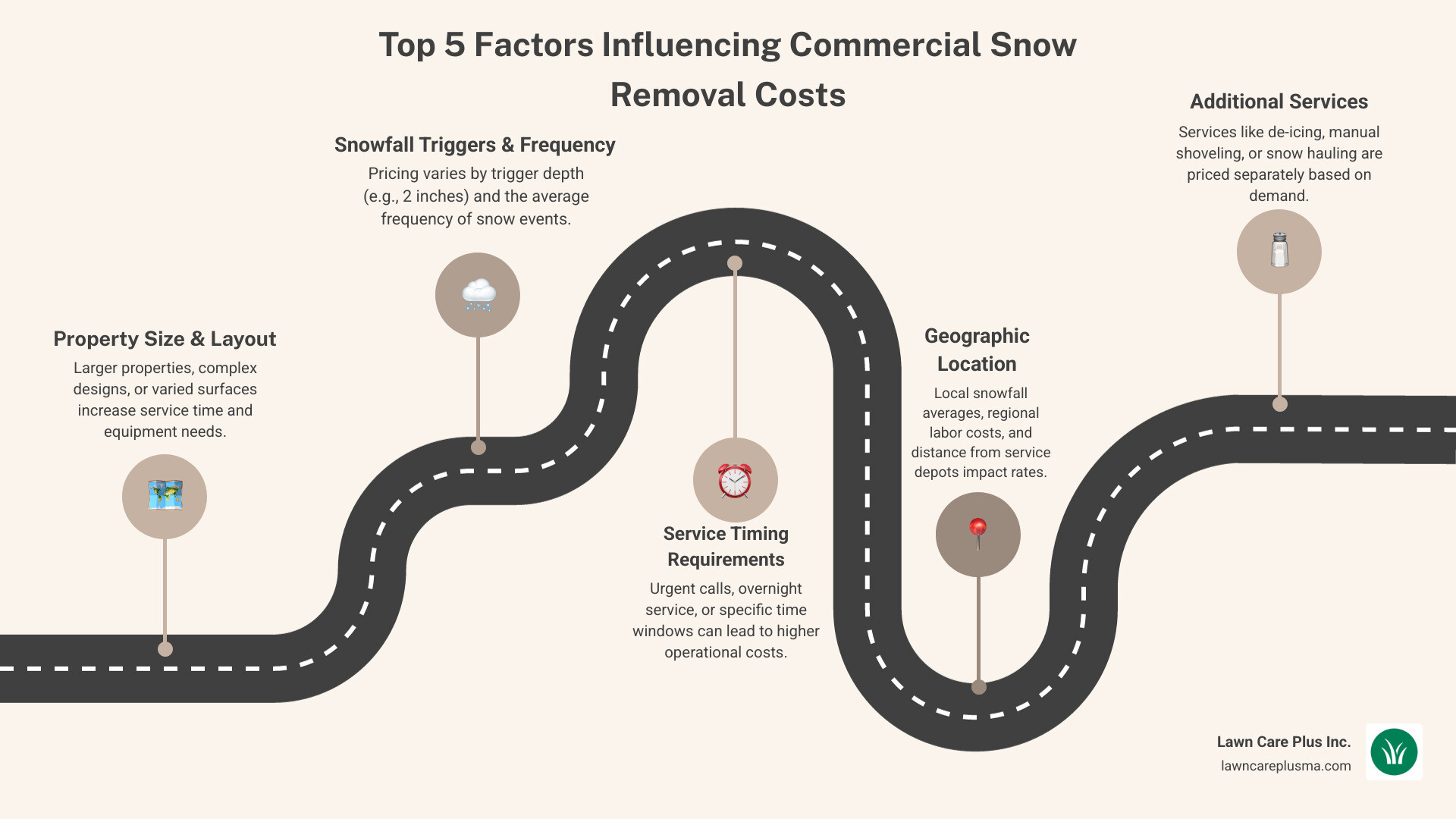
How to charge for commercial snow removal terms to know:
Key Factors That Determine Snow Removal Rates
The cost of commercial snow removal depends on the unique challenges of each property. Key details like size, layout, and location directly shape the final quote.
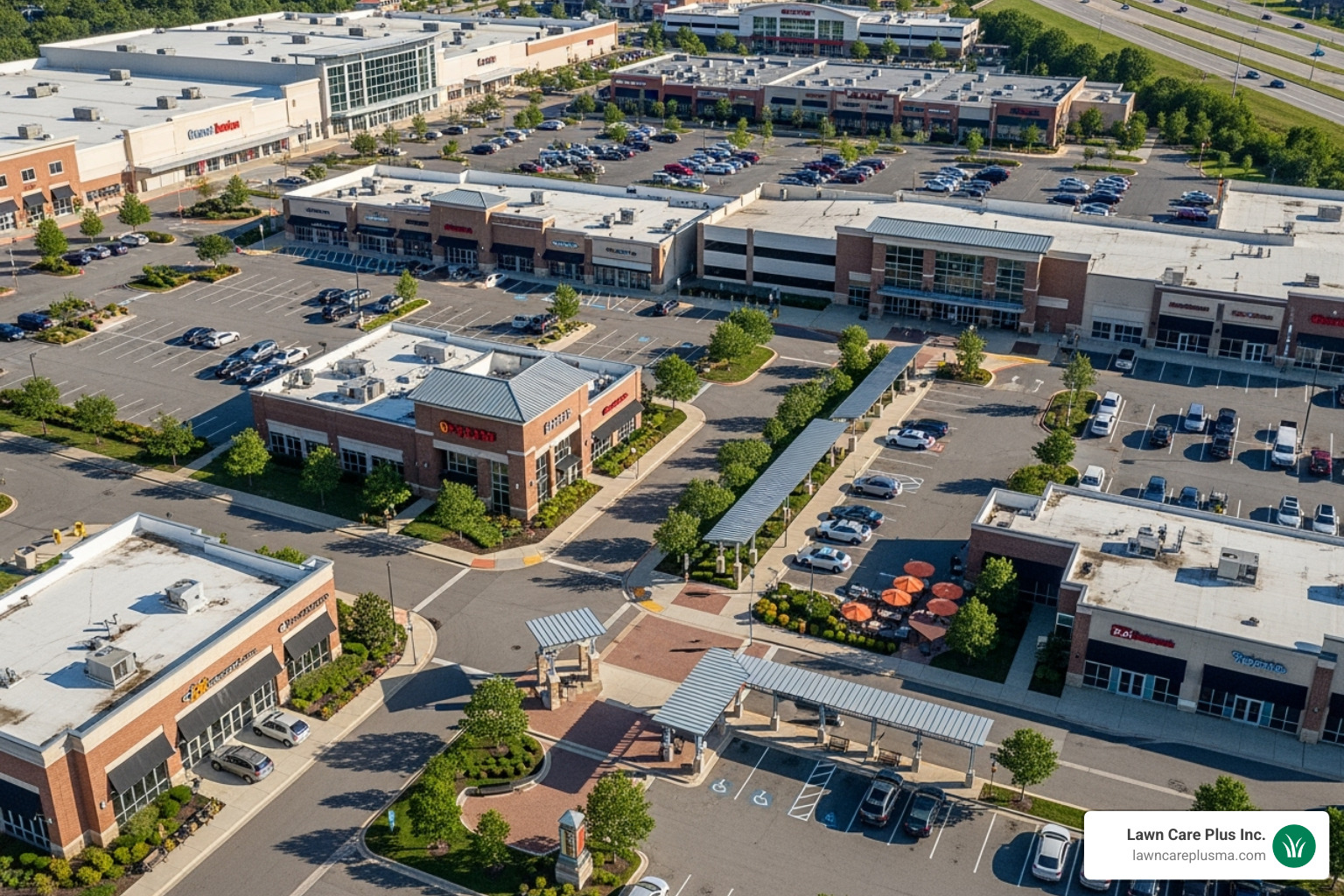
Several factors influence the final price:
- Property size and layout: A sprawling, complex shopping center requires more time and different equipment than a small office building.
- Obstacles: Light poles, landscaping islands, and tight corners require careful maneuvering with smaller equipment or hand shoveling.
- Snow placement areas: On-site snow piling is efficient. Hauling snow off-site increases costs due to additional equipment and time.
- Snowfall frequency and accumulation triggers: Clearing after two inches of snow versus four inches significantly impacts seasonal costs.
- Service timing requirements: Pre-dawn clearing or 24/7 monitoring during storms affects scheduling and labor costs.
- Location: Properties in the Boston Metro-West area have different needs; urban sites may have limited snow storage, while suburban ones may have longer travel times.
For a broader view of year-round care, our guide to commercial property maintenance offers valuable insights.
How Property Size and Layout Impact Your Quote
When we assess your property, we analyze its unique characteristics to provide an accurate quote.
- Square footage provides a baseline, but complexity matters more. A 5,000 sq. ft. lot with numerous walkways and entrances requires more work than a simple, open space.
- Parking lots versus walkways: Large lots can be cleared quickly with a plow, but walkways and entrances require detailed handwork, increasing labor costs.
- Number of entrances: Each entrance is a critical safety zone that must be cleared and often de-iced.
- Slopes and inclines: These areas are a technical challenge, often requiring immediate de-icing and specialized plowing techniques to ensure safety.
- Surface types: Asphalt and concrete are standard, but decorative pavers or stamped concrete require gentler methods to prevent damage. Our hardscaping services experience helps us protect these surfaces.
The Role of Snowfall and Service Triggers
New England winters are unpredictable, so understanding local snowfall patterns is key to pricing.
- Average regional snowfall: We use historical data to structure seasonal contracts. You can research historical snowfall data for your area to understand typical conditions.
- Per-inch pricing models: This flexible approach adjusts costs based on actual snow accumulation.
- Trigger depth settings: This determines when we begin service. Most businesses choose a trigger between two and four inches, depending on their needs (e.g., a medical facility may need a lower trigger than a warehouse).
- Zero-tolerance policies: This premium service is for properties that cannot afford any accumulation. It requires continuous monitoring and immediate response, resulting in higher costs.
- Storm severity: Light, fluffy snow is easier to clear than heavy, wet snow. Ice storms require specialized equipment and materials, which are factored into our planning.
Breaking Down the Costs: Pricing for Different Snow Management Services
Understanding how to charge for commercial snow removal involves breaking down costs for different services. Winter maintenance is a toolkit of solutions—including plowing, de-icing, shoveling, and snow hauling—that can be combined to fit a property’s needs.

We break down quotes by service category. Plowing handles large areas, salting and de-icing prevent ice, shoveling covers detailed work, and snow hauling removes excess snow. A small office might only need plowing and salting, while a large retail complex could require all services. Bundling services often provides better value and ensures comprehensive coverage from a single, reliable team.
Plowing Large Areas: Parking Lots and Driveways
Plowing is the foundation of winter maintenance. Costs can be structured as per-push pricing (a set fee each time we clear) or per-visit rates (covering all work during a service call). For major storms requiring continuous work, hourly rates for heavy equipment are common, especially for large commercial complexes.
Please note that these are average costs based on internet data, not actual costs for Lawn Care Plus. Our pricing will be provided in a detailed quote.
According to industry data, plowing visits typically range from $100 to $600. For specific depths, costs might be $60 to $300 for 4-6 inches, with an additional $3 to $30 per extra inch. Hourly rates for equipment and operators can range from $60 to $500 per hour. For more details, see our commercial snow plowing near me services.
De-Icing and Salting for Safety
Clearing snow is only half the battle; de-icing is essential for liability protection. We typically price these services per application, with costs varying based on the material used. Basic rock salt is common, but premium ice melters are more effective in extreme cold and gentler on surfaces. Pre-treatment before a storm can prevent snow from bonding to pavement, making plowing more effective.
Please note that these are average costs based on internet data, not actual costs for Lawn Care Plus. Our pricing will be provided in a detailed quote.
Industry averages for de-icing range from $50 to $1,000 per application, depending on property size and material choice.
Manual Labor: Shoveling Walkways and Entrances
Shoveling walkways and entrances ensures every part of your property is safe and accessible. This detailed work is often priced at hourly rates due to varying property layouts. For simpler needs, we may offer per-visit flat fees to cover essential areas like entrances, exits, and stairs. We pay special attention to high-traffic entrances and ensure compliance with local sidewalk clearing regulations.
Please note that these are average costs based on internet data, not actual costs for Lawn Care Plus. Our pricing will be provided in a detailed quote.
Manual clearing services typically range from $25 to $450 per hour, with per-visit rates for sidewalks from $30 to $210. Learn more about our detailed property work with our walkway installations.
Snow Hauling and Relocation
Snow hauling is necessary when on-site storage is full, or when snow piles block visibility or parking. This is a common challenge for urban commercial properties. We price hauling per truckload, which covers heavy equipment, fuel, and disposal time. An alternative is on-site snow stacking, which requires careful planning to avoid blocking access or causing drainage issues.
Please note that these are average costs based on internet data, not actual costs for Lawn Care Plus. Our pricing will be provided in a detailed quote.
Snow hauling typically ranges from $230 to $1,700 per truckload. Heavy equipment services run $175 to $1,000 per hour, and removing built-up snow banks can cost $345 to $2,000 per service.
How to Charge for Commercial Snow Removal: Choosing a Contract Model
Choosing the right contract model is key to managing winter maintenance costs. When discussing how to charge for commercial snow removal, we help property managers select a model based on their budget, property needs, and risk tolerance.
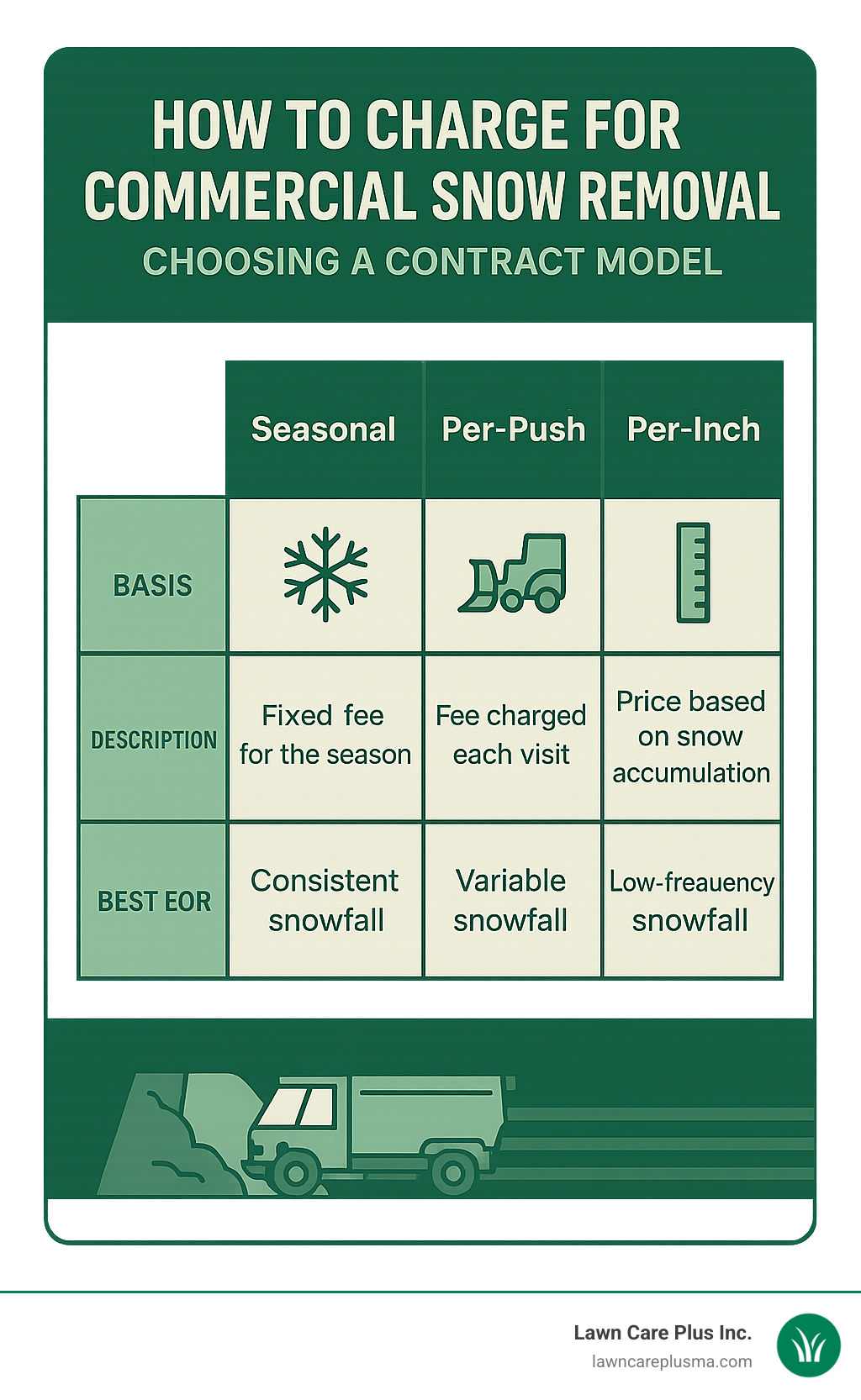
Modern snow removal contracts are custom to client needs. We believe in contract clarity, with no confusing terms. Our agreements clearly define services, timing, and costs, following professional guidelines from organizations like SIMA (Snow & Ice Management Association). To learn more, see our guide on snow plowing contracts.
Seasonal (Fixed-Fee) Contracts
Seasonal contracts offer predictable budgeting. You pay a set amount for the entire winter season (typically November-March), eliminating surprise bills. This model provides financial peace of mind.
Most seasonal contracts are all-inclusive, covering all winter maintenance needs. The season length is clearly defined. To protect both parties during exceptionally heavy winters, most contracts include snowfall caps or “blizzard clauses.” If snowfall exceeds a set amount, additional charges may apply.
- Pros: Budget predictability and consistent service.
- Cons: You may pay more in a mild winter.
Pay-Per-Push or Per-Visit Contracts
This pay-as-you-go model offers maximum flexibility—if it doesn’t snow, you don’t pay. The contract must clearly define a “push” or “visit,” typically tied to a specific trigger depth (e.g., 2 inches of accumulation). This prevents confusion about when charges apply.
The cost variability is this model’s main feature. You save money during mild winters, but costs can add up quickly during stormy periods. This approach is ideal for areas with infrequent snowfall or for businesses whose operations are less sensitive to minor accumulations.
Per-Inch and Per-Event Contracts
For the most precise pricing, per-inch and per-event contracts align your costs directly with the amount of snowfall. Tiered pricing by snow depth means costs scale with the storm’s intensity. For example, you might pay one rate for 1-3 inches and a higher rate for 4-6 inches.
Charging per storm event is a similar approach, focusing on the number of distinct weather events. The key to these contracts is measuring snowfall accurately, using reliable methods and local weather data to ensure transparency and trust. To manage risk, these contracts may also include caps for extreme weather events.
Strategies for Creating a Competitive and Profitable Quote
Creating a competitive and profitable quote requires balancing client value with business sustainability. For us, understanding how to charge for commercial snow removal is about transparent pricing that builds lasting relationships with our Boston Metro-West clients.

Every quote starts with understanding our true costs, including:
- Overhead: Insurance, equipment maintenance, office expenses, and fuel.
- Labor costs: Wages, travel time, and overtime for our experienced crews working in challenging conditions.
- Equipment and fuel costs: The purchase, maintenance, and fuel for our commercial-grade plows, spreaders, and loaders.
- Insurance and liability: Comprehensive coverage is essential to protect our business and our clients from the significant risks of snow removal.
- Profit margin: A reasonable margin ensures we can reinvest in equipment, retain skilled employees, and remain a stable partner for our clients.
For more details on our service agreements, explore our commercial snow removal contracts.
Calculating Your Base Rate: The First Step in How to Charge for Commercial Snow Removal
An accurate base rate is the foundation of a fair quote. This involves a detailed assessment of the property and operational costs.
- Estimating time on site: We walk every property to identify obstacles like light poles, hydrants, and tight corners that affect efficiency.
- Factoring in travel time: We serve the entire Boston Metro-West region, and the time and fuel required to travel between jobs is a real cost.
- Calculating equipment operational costs: This includes immediate expenses like fuel and long-term costs like wear and tear, repairs, and depreciation.
- Determining labor expenses: We calculate costs based on fair wages that reflect the skill and difficult conditions of the job, including overtime during major storms.
Finalizing the Quote: Key Considerations for How to Charge for Commercial Snow Removal
Once we have our base costs, we finalize a quote that is fair and sustainable.
- Adding a profit margin: Industry standards typically range from 20% to 50%, allowing us to handle unexpected costs and invest in the business.
- Presenting a professional proposal: We provide detailed breakdowns of included services, timing, and service triggers to ensure clear communication.
- Clearly defining the scope of work: We specify which areas will be plowed, shoveled, and de-iced. This detail protects both parties and aligns expectations.
- Outlining payment terms: We specify payment due dates and how additional services or seasonal adjustments are handled.
Our goal is to build long-term partnerships through competitive and sustainable pricing.
Frequently Asked Questions about Commercial Snow Removal Pricing
Property managers often ask about how to charge for commercial snow removal, seeking fair, predictable pricing for unpredictable winter weather. Here are answers to the most common questions.
What is a fair price for a small commercial parking lot?
The price depends on several factors. A simple rectangular lot is easier and cheaper to clear than one with islands, tight corners, or limited space for snow piles. The required timing of service also plays a big role.
Please note that these are average costs based on internet data, not actual costs for Lawn Care Plus. Our pricing will be provided in a detailed quote.
For small commercial lots, average per-visit plowing costs can range from $100 to $300. Very small properties might see costs from $35 to $250. Comprehensive service including de-icing and walkway clearing can range from $230 to $690 per event. Key factors include obstacles, snow placement options, and overall service complexity. We always recommend a custom quote for accurate pricing.
Is a seasonal contract always the most cost-effective option?
It depends on your budget and risk tolerance. Seasonal contracts offer budget predictability, which is a major advantage for financial planning. You know your exact costs for the entire winter.
However, in a mild winter, you might pay more than with a per-push model. Conversely, seasonal contracts provide excellent value during heavy winters, protecting you from skyrocketing costs when storms are frequent. The decision involves assessing the risk of a mild versus a severe winter and deciding whether you prefer budget certainty over potential savings. For businesses with zero-tolerance policies, seasonal contracts are often the most practical choice.
What key items should be included in a commercial snow removal contract?
A solid contract prevents confusion and should clearly define the following:
- Service triggers: The exact conditions that initiate service (e.g., 2 inches of snow, ice formation).
- Scope of services: A detailed list or map of which areas get plowed, shoveled, and de-iced.
- Timing of service: When clearing will be completed (e.g., before 6 AM, within two hours of a storm’s end).
- Payment terms: The pricing model (seasonal, per-push, etc.) and billing schedule.
- Proof of insurance: Verification of the contractor’s liability coverage to protect your business.
- Communication protocols: How to contact the provider and receive service updates.
A well-written contract protects both parties and ensures smooth operations all winter.
Conclusion
Figuring out how to charge for commercial snow removal can seem complex, but understanding the pricing factors is about more than getting a good deal—it’s about protecting your business. A reliable snow removal plan is an investment in safety, accessibility, and continuity.
This guide has covered key factors, from property layout to contract models like seasonal, per-push, and per-inch pricing. The right choice depends on your specific needs and budget.
Professional commercial snow removal ensures your employees and customers are safe, protecting your reputation and preventing potential lawsuits. Trying to cut corners often leads to bigger problems. A reliable provider with transparent pricing is a partner in keeping your business running smoothly all winter.
At Lawn Care Plus Inc., we understand that every commercial property in the Boston Metro-West area has unique needs. We believe in straightforward pricing that provides both value and peace of mind.
Ready to get a winter maintenance plan that actually works? For a detailed and transparent quote custom specifically to your Massachusetts property, explore our Snow Management services. When the next storm hits, you’ll be glad your property is in capable hands.