Why a Landscape Brick Wall Is One of the Best Investments You Can Make for Your Property
Landscape brick walls are one of the most versatile and timeless features you can add to your home’s outdoor space. Here’s a quick look at what they do and why homeowners love them:
- Define spaces – Create clear boundaries between garden beds, patios, and lawn areas
- Retain soil – Hold back sloped ground to prevent erosion and create usable flat areas
- Boost curb appeal – Add a classic, polished look that complements almost any home style
- Add function – Support steps, seat walls, fire pits, outdoor kitchens, and more
- Last for decades – When built right, brick walls are extremely durable in all seasons
Whether you want to manage a slope in your backyard, frame a garden bed, or simply add structure and character to your property, a brick wall can do the job beautifully.
Brick walls also do something that’s easy to overlook: they shape how people experience your outdoor space. As one technical guide on brick landscape architecture puts it, a well-planned garden wall “leads the sojourner through a series of spatial relationships” — guiding movement, framing views, and creating a sense of place.
That’s especially true here in Greater Boston, where properties often deal with uneven grades, freeze-thaw cycles, and tight lot sizes. A properly built brick wall solves real problems while looking great doing it.
I’m Tim DiAngelis, owner of Lawn Care Plus, Inc., and over more than a decade serving homeowners across Greater Boston and Metro-West, I’ve seen how a well-designed landscape brick wall can completely transform a property. In this guide, I’ll walk you through the most creative and practical ideas to help you get started.
Landscape brick wall terms you need:
Popular Types of Landscape Brick Walls
When we sit down with homeowners in towns like Newton or Brookline to discuss a new project, the first question is usually: what is the wall actually going to do? The answer determines the engineering and the look.
| Feature | Retaining Walls | Freestanding Walls |
|---|---|---|
| Primary Purpose | Holds back soil/grade changes | Decorative, divides space, privacy |
| Structural Need | High (requires drainage and footings) | Moderate (needs stable foundation) |
| Thickness | Usually double wythe or reinforced | Can be single or double wythe |
| Application | Slopes, terraced gardens, driveways | Courtyards, patio borders, property lines |
Beyond these basic categories, there are several specialized styles that can add architectural flair to your yard. For more inspiration on the planning phase, check out our guide on retaining wall design.
Serpentine and Curved Designs
One of the most famous examples of a landscape brick wall is the serpentine wall, popularized by Thomas Jefferson at the University of Virginia. These walls are “S” shaped, and while they look purely decorative, they are actually a masterclass in efficiency.
Because the curves provide natural lateral strength, a serpentine wall can often be built just one brick thick (4 inches) without needing heavy reinforcement. According to technical standards, the radius of curvature for a 4-inch wall should be no more than twice the wall’s height above the ground, and the depth of that curve should be at least half the height. If you are looking for visual inspiration, you can browse 75 brick retaining wall landscape ideas to see how modern designers use these curves to soften hard landscapes.
Pier and Panel Systems
If you have a long stretch of land to cover, a pier and panel system is often the way to go. This design uses thick, sturdy brick piers (the “posts”) spaced at regular intervals, with thinner brick panels (the “walls”) in between them. This is a great way to save on material costs while maintaining high structural stability. We often recommend this for landscape walls in Canton, MA, where property lines can be quite long. The piers provide the necessary anchorage, while the panels create the visual barrier.
Straight Garden Walls
These are the classic “low walls” you see bordering a driveway or a flower bed. While they look simple, they have specific engineering rules. For a straight unreinforced wall to withstand standard wind pressure (around 10 psf), the height above the ground shouldn’t exceed three-fourths of the wall thickness squared. It sounds like a math homework problem, but it’s the secret to making sure your wall doesn’t lean after a few years of New England weather!
Essential Materials for a Durable Landscape Brick Wall
In Massachusetts, our weather is tough on masonry. Between the humid summers and the brutal freeze-thaw cycles of winter, your materials have to be top-notch. If you are searching for brick masons near me, make sure they are using the following specifications.

Choosing the Right Brick for Your Landscape Brick Wall
Not all bricks are created equal. For any wall exposed to the elements, you must use Grade SW (Severe Weathering) bricks. These bricks are specifically manufactured to resist damage from freezing while saturated with water. Bricks used for interiors or protected areas often fail ASTM C216 standards when used outdoors, leading to crumbling and “spalling” (where the face of the brick pops off).
When it comes to style, products like Laredo retaining garden walls offer a two-block system that mimics the look of traditional brick while providing the convenience of modern modular systems. Whether you choose traditional red clay or a weathered, tumbled texture, ensure the color matches your home’s existing architecture for a cohesive look.
Mortar and Workmanship
The “glue” holding your wall together is just as important as the bricks. For landscape walls, we recommend Type S mortar. A typical mix consists of:
- 1 part portland cement
- 1/2 part hydrated lime
- 4 1/2 parts sand
This mixture provides the perfect balance of strength and flexibility. Excellent workmanship is non-negotiable here. All head, bed, and collar joints must be completely filled with mortar to prevent water from getting inside the wall, which is the number one cause of masonry failure in cold climates.
Coping and Flashing Essentials
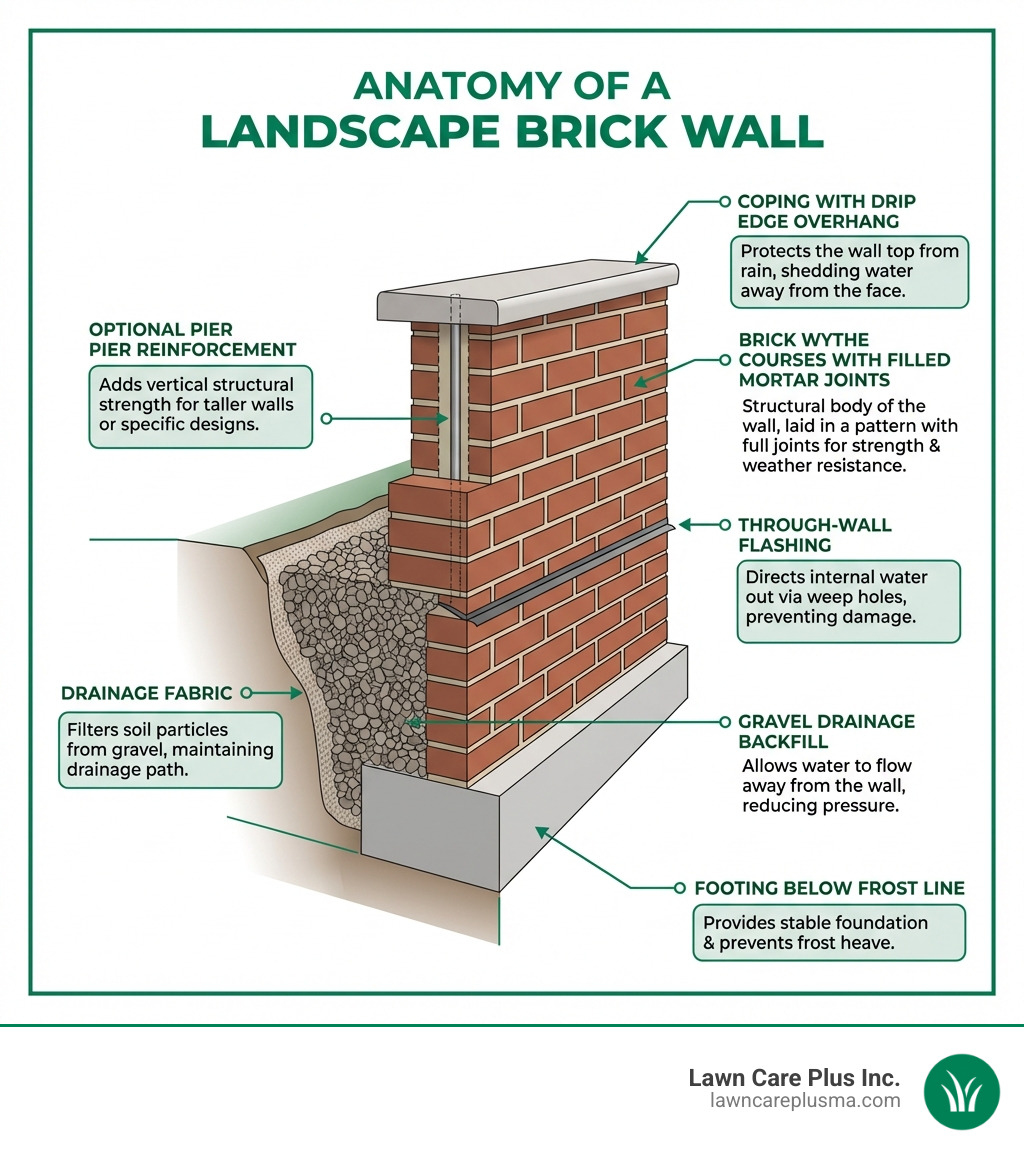
The top of your wall is its first line of defense. Coping is the cap that sits on top—it can be made of stone, precast concrete, or specialized header bricks. A good coping should overhang the wall by at least half an inch on both sides and include a “drip edge” to lead water away from the face of the brick. Beneath that cap, we install through-wall flashing to ensure that any moisture that does get in can find its way out rather than sitting inside the wall and freezing.
Key Design and Engineering Considerations
Building a landscape brick wall that lasts requires more than just stacking bricks. It requires a solid understanding of what’s happening beneath the surface.
The Importance of a Strong Foundation
In the Boston area, your wall is only as good as its foundation. We always place footings in undisturbed earth below the frost line. If a foundation is too shallow, the ground will “heave” when it freezes, cracking your beautiful brickwork. For most residential walls, a foundation capable of handling 3,000 psf of soil pressure is the standard. You can learn more about this critical step in our guide to retaining wall foundations.
Drainage and Moisture Management
Water is the enemy of masonry. When soil behind a retaining wall gets soaked, it becomes incredibly heavy—exerting “hydrostatic pressure” that can push a wall right over. To prevent this, we use:
- Gravel Backfill: A layer of crushed stone behind the wall to let water drop straight down.
- Drainage Fabric: To keep soil from clogging up your gravel.
- Weep Holes: Small openings at the base of the wall to let that collected water escape.
Proper retaining wall drainage is what separates a wall that lasts 50 years from one that fails in five.
Integrating the Wall with Your Home’s Architecture
A brick wall shouldn’t look like an afterthought. It should feel “inevitable,” as if it was always meant to be there. For traditional homes in areas like Dedham or Milton, red brick with white mortar joints provides a classic, formal look.
You can soften the look of the masonry by integrating it with your plantings. Pachysandra is a fantastic groundcover that surrounds the base of a wall without overgrowing it, maintaining clear views of the brickwork. For a more modern look, consider pairing your brick with drought-tolerant succulents or structural hedges. If you need more creative sparks, check out these retaining wall ideas.
Creative Applications and Integrated Features
Once you have the basics down, you can start having fun with the design. A landscape brick wall can be much more than just a barrier.
- Seat Walls: Build your wall to “sitting height” (usually 18-20 inches) around a patio or fire pit to provide extra seating for guests.
- Outdoor Kitchens: Use brick walls to house your grill, pizza oven, or outdoor fridge, creating a permanent entertaining station.
- Garden Steps: Brick-riser steps with stone treads are a durable and elegant way to manage elevation changes.
- Driveway Edging: A low brick wall can prevent soil from washing onto your driveway while providing a clean, manicured edge for your lawn.
- Pillars and Mailboxes: Matching brick pillars at the end of a driveway or a custom brick mailbox housing can tie your entire front yard together.
For more on how to combine these elements, see our section on retaining walls and landscaping.
Estimating the Cost of Your Project
When planning your budget, it’s important to understand the variables. Based on internet data, the cost for a professional landscape brick wall installation can vary wildly depending on the height, length, and site conditions.
- Average Cost Range: $25 to $60 per square foot.
- High-End Custom Work: Can exceed $180 per square foot for complex designs with premium materials and significant excavation.
Note: These are average costs based on internet research and are not actual quotes for Lawn Care Plus Inc. services. Every property in the Boston Metro-West area is unique, and factors like soil type, slope, and access will impact the final price. For a deeper dive into budgeting, read our retaining wall cost guide.
Frequently Asked Questions
What is the best mortar for a brick garden wall?
For most residential landscape applications, Type S mortar (conforming to ASTM C270) is the gold standard. It’s made of 1 part portland cement, 1/2 part hydrated lime, and 4 1/2 parts sand. This mix offers high lateral strength, which is vital for walls that have to resist wind and soil pressure.
How high can I build a brick landscape wall without reinforcement?
This depends on the thickness of the wall and local building codes. In Massachusetts, any retaining wall over four feet tall generally requires a structural engineer or architect to sign off on the plans. For smaller, unreinforced straight walls, we follow the rule that the height shouldn’t exceed $0.75 times text{thickness}^2$ to stay safe under standard wind loads.
Do I need a concrete foundation for my brick wall?
Yes. Because of the freeze-thaw cycles in our region, a brick wall built directly on dirt will shift and crack within a single season. You need a compacted gravel base or a poured concrete footing that sits below the frost line to ensure the wall stays level and structurally sound.
Conclusion: Let Lawn Care Plus Build Your Legacy
A landscape brick wall is more than just a home improvement project—it’s a permanent addition to your property’s legacy. It provides the structure that allows the rest of your landscape to shine.
At Lawn Care Plus Inc., we’ve spent years perfecting the art of masonry and hardscaping in the Boston Metro-West area. Whether you’re in Belmont, Newton, Needham, or anywhere in between, our experienced team understands the local soil, the local weather, and the high standards of our local homeowners. From initial design to the final brick laid, we handle every detail with precision and care.
If you’re ready to add beauty, value, and function to your yard with a professional landscape retaining wall, we’re here to help. Contact us today to start a conversation about your next project. Let’s build something that lasts together!