
Understanding the Magic of Hydroseeding
Hydroseeding is a planting process that uses a slurry of seed, mulch, fertilizer, and water sprayed over prepared ground to establish new lawns quickly and efficiently.
If you’re wondering what hydroseeding is and whether it’s right for your property, here’s what you need to know:
- Definition: A method of applying seed, fiber mulch, tackifier (glue), fertilizer, and water in one liquid application
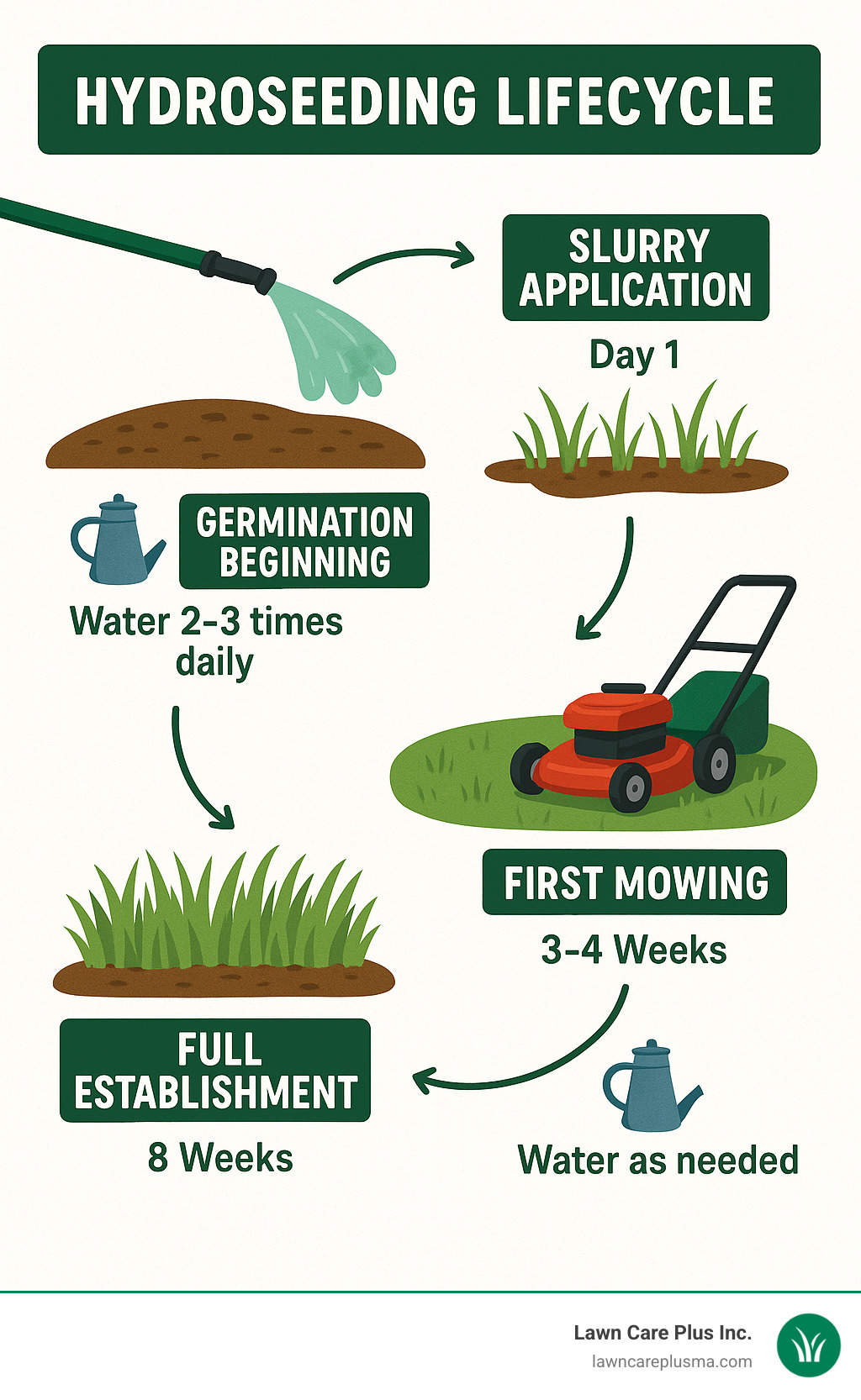
- Timeline: Seeds germinate in 5-7 days; first mowing at 3-4 weeks; full establishment in 8 weeks
- Best For: Large areas, slopes, erosion control, and cost-effective lawn establishment
- Cost Effectiveness: Typically 60-75% less expensive than sod, though more than traditional seeding
- Maintenance: Requires consistent watering (2-3 times daily) for the first 21 days
“More efficient than traditional seeding and more affordable than laying sod, hydroseeding strikes a fine balance for lawn care,” notes industry professionals.
Hydroseeding works by creating an ideal environment for seeds to germinate and grow. The slurry forms a protective layer that retains moisture, prevents erosion, and provides essential nutrients. This method has been used since the 1940s when Maurice Mandell first applied it to steep highway slopes in Connecticut.
For homeowners and property managers in the Boston Metro-West area, hydroseeding offers a practical solution for establishing lush, uniform lawns without the high costs of sod. The process is particularly valuable for larger properties or areas with erosion concerns.
With proper care and maintenance, a hydroseeded lawn can transform bare soil into a vibrant green space that improves your property’s appearance and value.
Similar topics to hydroseeding:
– hydroseeding cost
– hydro grass seed
– hydro seeds for grass
What Is Hydroseeding and How Does It Work?
Ever seen those trucks spraying a green slurry across bare soil, almost like painting the ground? That’s hydroseeding in action – a remarkable planting technique that’s changing barren landscapes into lush lawns across Massachusetts.
Hydroseeding (sometimes called hydraulic mulch seeding) combines seeds, water, fiber mulch, tackifier, fertilizer, and occasionally biostimulants into a slurry that’s applied to prepared soil using a high-pressure hose. The result? A perfect mini-ecosystem for seeds to thrive.
“One of the primary benefits of hydroseeding is establishing a turf or lawn quickly with an ideal environment for the seeds to germinate and grow,” explains our lawn care specialists at Lawn Care Plus Inc.
This innovative approach wasn’t always around. Back in the 1940s, a forward-thinking fellow named Maurice Mandell pioneered the technique to stabilize steep highway slopes in Connecticut. Today, hydroseeding has become the go-to method for establishing lawns, controlling erosion, and bringing life back to disturbed areas throughout Massachusetts and beyond.
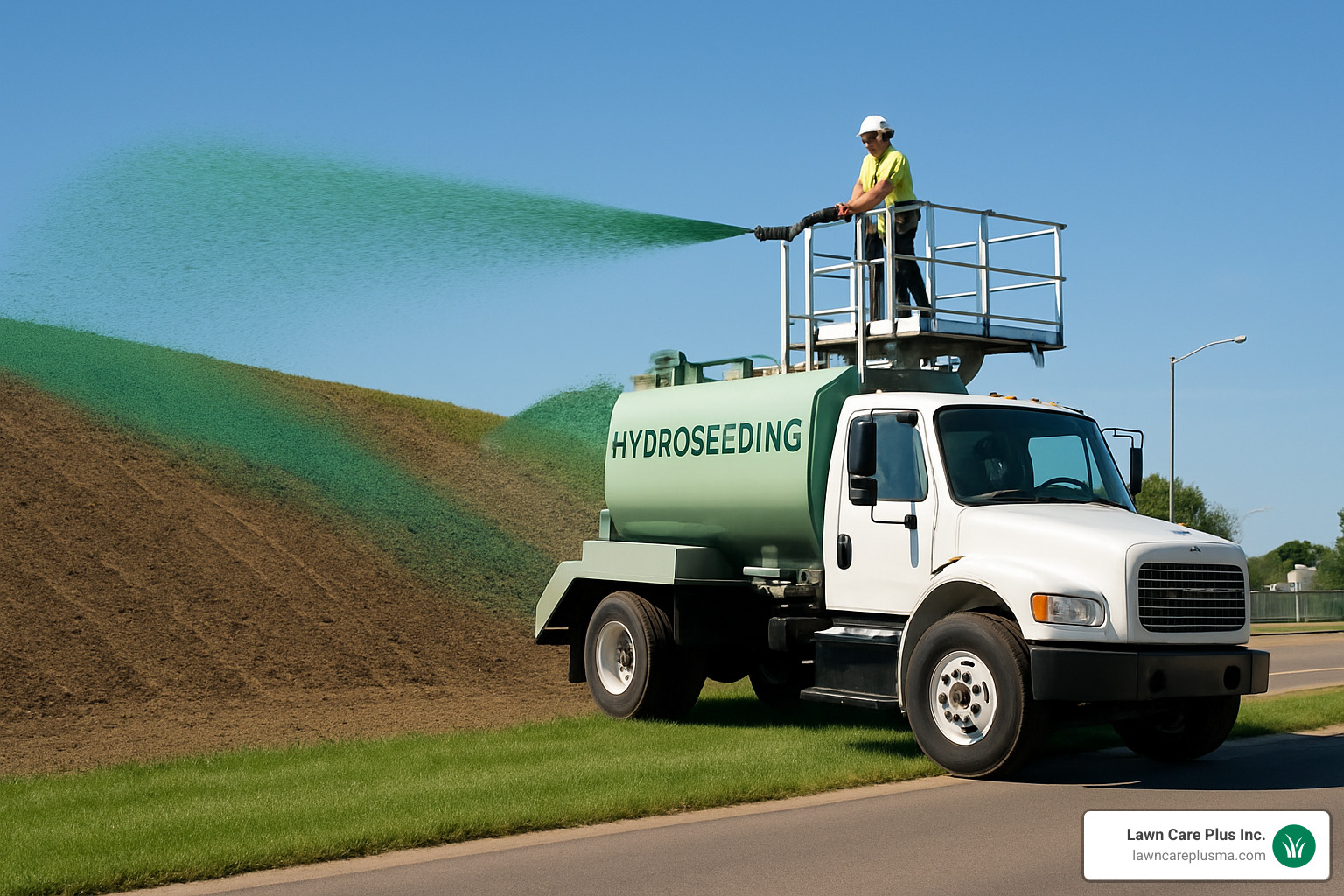
The genius of hydroseeding lies in how it works. The mulch creates a protective blanket that holds moisture against the soil – up to ten times its weight in water! Meanwhile, the tackifier acts like nature’s glue, keeping everything in place even during heavy New England downpours. The fertilizer provides immediate nutrition, and the slurry hugs every contour of your soil, ensuring seeds make perfect contact where they need to grow.
At Lawn Care Plus Inc., our professional-grade equipment can efficiently cover large areas with consistent application. Even those tricky spots on your property where traditional seeding methods struggle? We can reach them.
Hydroseeding Mixture Ingredients
The real magic of hydroseeding happens in the mix. Think of it as a customized recipe for your specific lawn needs.
The grass seed selection is crucial – we don’t just use any old seeds. For Boston Metro-West properties, we typically blend Kentucky bluegrass for those sunny spots in your yard, tall fescue for drought resistance and shade tolerance, perennial ryegrass for quick establishment, and fine fescues for those deeply shaded areas. This blend approach ensures your lawn can handle whatever New England weather throws at it.
The fiber mulch component, usually made from wood or paper fibers, creates that protective blanket over your seeds. It’s like tucking your seeds in with a moisture-retaining blanket that prevents erosion while slowly decomposing to add organic matter to your soil.
Then there’s the tackifier – think of it as nature’s glue. This binding agent holds everything in place, preventing washout during those unexpected rainstorms. It’s particularly important if your Newton or Brookline property has slopes or areas prone to erosion.
The fertilizer component is typically a balanced starter formula with higher phosphorus content to encourage strong root development. It releases gradually, supporting continued growth long after application.
Depending on your specific soil conditions, we might also include biostimulants to improve root development, soil amendments to adjust pH levels, growth improvers to speed up germination, and that green dye that helps us track coverage (don’t worry – it’s harmless and temporary!).
Having worked throughout communities like Needham and the entire Boston Metro-West area, we’ve developed specialized mixtures that account for local soil conditions and microclimate variations. What works best in Wellesley might need tweaking for Weston – and we know the difference.
Hydroseeding Timeline: What to Expect
Patience is key with hydroseeding, but the results are worth the wait. Here’s what your lawn journey typically looks like:
During the first few days after application, you’ll notice that bright green color from the dye. There’s no visible growth yet, but behind the scenes, the germination process is beginning. This is when consistent watering is absolutely critical.
Around days 5-7, the magic starts happening – tiny green shoots emerge as germination begins. The faster-growing grasses like ryegrass lead the way, while the green dye starts to fade. Keep up with that frequent watering (2-3 times daily)!
By the second week, you’ll see more widespread germination and seedlings developing their first root systems. The lawn begins taking on a more uniform green appearance. Maintain consistent moisture without creating puddles.
When weeks 3-4 arrive, your grass typically reaches 3-4 inches – time for that satisfying first mowing! The root systems continue developing, and you can begin reducing watering frequency (though not the amount each time). You might be tempted to walk on your new lawn, but limited foot traffic is best.
During weeks 5-8, you’ll notice the lawn thickening and filling in those bare spots. The slower-germinating grasses like Kentucky bluegrass establish themselves, and root systems grow deeper. This is when we might recommend fertilization, and you can resume normal (but careful) foot traffic.
After 8+ weeks, celebration time! Your lawn achieves full coverage and density with a well-established root system. Now you can shift to a regular maintenance schedule and normal use.
“Newly hydroseeded lawns must remain undisturbed for 3-5 weeks to allow proper germination and establishment,” advises our lawn care team. “Patience during this period pays dividends in long-term lawn health and appearance.”
For our Boston-area clients, we always emphasize that seasonal timing affects this timeline. Spring and fall applications typically follow this schedule closely, while summer applications may require additional watering, and winter applications might delay germination until temperatures warm.
Curious to learn more about hydroseeding? Check out our detailed guide on What is Hydroseeding? or explore options for Hydro Seeds for Grass to find the perfect mix for your property.
Hydroseeding vs. Sod vs. Hand Seeding: Cost, Speed, and Results
Deciding how to establish your new lawn can feel overwhelming. Should you go with hydroseeding, traditional sod, or good old-fashioned hand seeding? As we help homeowners across Newton, Wellesley, and other Boston Metro-West communities create beautiful lawns, we’re often asked which method delivers the best bang for your buck.
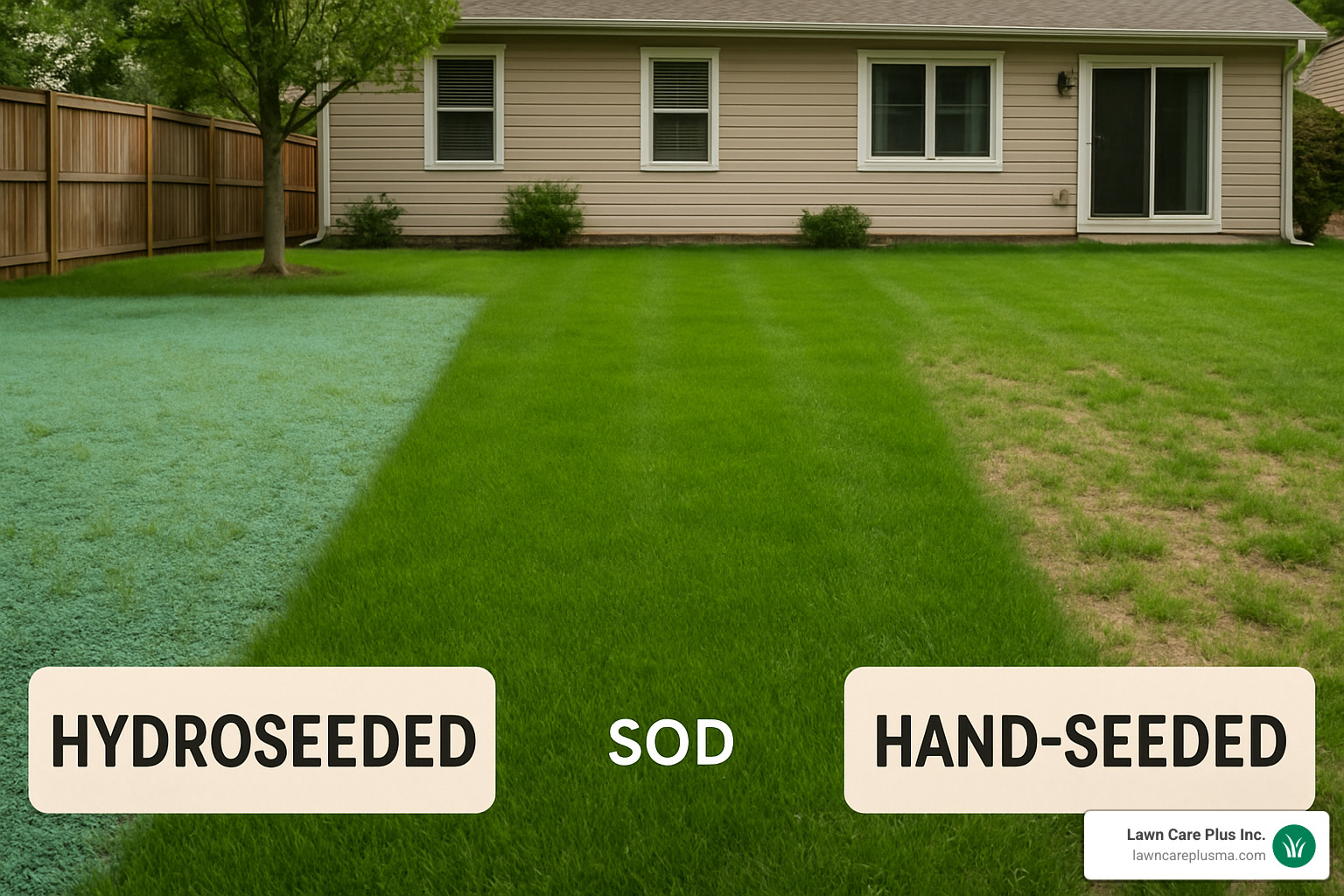
Let’s break down what you can expect from each method in terms of cost, how quickly you’ll be enjoying your new lawn, and the quality of results you’ll see.
When it comes to your wallet, there’s quite a range between these options. Based on industry averages (not specific to Lawn Care Plus Inc.), hydroseeding typically costs between $0.06 and $0.22 per square foot. Compare that to sod installation at $0.31 to $0.82 per square foot, while hand seeding runs about $0.02 to $0.08 per square foot.
What does this mean for a typical 5,000 square foot suburban yard? Based on internet averages, you might pay $300-$1,100 for hydroseeding, $1,550-$4,100 for sod, or $100-$400 for hand seeding. That’s quite a difference!
But cost isn’t everything. How long are you willing to wait for your green carpet? With sod, you’ll get that instant gratification of a green lawn, though you’ll need to wait 2-3 weeks before it’s rooted enough for light use. Hydroseeding finds the middle ground – you’ll see little green sprouts in just 5-7 days, mow for the first time around 3-4 weeks, and enjoy a fully established lawn in about 8 weeks. Traditional hand seeding requires the most patience, with germination taking 7-21 days and full establishment stretching to 8-12 weeks or more.
“I always tell my clients that hydroseeding is like the Goldilocks of lawn establishment – not too expensive, not too slow, just right for most properties,” shares one of our lawn specialists.
What about sweat equity? Sod installation is physically demanding, requiring heavy lifting and precise placement. Hand seeding might seem easier upfront, but demands meticulous ground preparation and more follow-up maintenance. Hydroseeding requires moderate preparation but specialized equipment handles the heavy lifting, allowing for quick, uniform application.
For those beautiful rolling properties in places like Lincoln or Concord, erosion control becomes crucial. Hydroseeding shines here – its mulch and tackifier components help prevent seed washout even on slopes. Sod provides immediate coverage but can be tricky to install on steep areas. Hand seeding offers poor erosion resistance without additional protective measures.
When it comes to appearances, sod gives you that picture-perfect lawn instantly, though those seam lines might be visible initially. Hydroseeding creates remarkably uniform coverage with a natural look, while hand seeding can result in patchy areas that require touch-ups.
Looking at long-term performance, we’ve found that hydroseeded lawns often develop stronger, deeper root systems since they grow directly in your native soil from day one. Sod can sometimes struggle to establish deep roots, particularly in challenging soil conditions. Hand-seeded lawns eventually develop good root systems but require more attentive care during establishment.
For most of our Boston Metro-West clients, hydroseeding hits that sweet spot of reasonable cost, manageable waiting time, and excellent long-term results. It’s particularly valuable for larger properties where sod costs would be prohibitive, or for areas where erosion control matters.
As you weigh your options, consider your priorities:
– Need a lawn immediately for an upcoming event? Sod might be your answer.
– Working with a tight budget and have patience? Hand seeding could work with proper care.
– Want balanced value with excellent long-term results? Hydroseeding typically delivers the best overall value.
Learn more about specific cost factors in our detailed Hydroseeding Cost guide, which breaks down what influences pricing in the Boston area.
Pros, Cons, and Ideal Use Cases of Hydroseeding
When it comes to establishing a beautiful lawn, hydroseeding offers a compelling middle ground between traditional seeding and sod installation. But like any lawn establishment method, it comes with its own set of advantages and limitations that are worth understanding before you make your decision.
Advantages of Hydroseeding
The popularity of hydroseeding throughout the Boston Metro-West area isn’t just a coincidence – there are substantial benefits that make it a go-to choice for many property owners.
First and foremost, hydroseeding creates remarkably uniform coverage. The slurry application ensures seeds spread evenly across your entire lawn area, eliminating those frustrating patchy spots often seen with hand seeding. When those seeds germinate together in their protective mulch blanket, you get a lawn that looks like it’s all growing at the same pace – because it is!
“I was amazed at how evenly my lawn came in after hydroseeding,” shares one Needham homeowner. “It looks like it was all planted on the same day – because it was!”
For larger properties, hydroseeding truly shines in the cost department. If your lawn exceeds 5,000 square feet, you’ll typically see significant savings compared to sod installation. Based on internet averages (not specific to Lawn Care Plus Inc.), hydroseeding generally runs about 60-75% less expensive than laying sod.
Got slopes or areas prone to erosion? hydroseeding might be your best friend. The mulch-tackifier combination creates a protective barrier that holds everything in place, even during those notorious New England downpours. This makes it particularly valuable for the rolling landscapes common in communities like Newton and Brookline.
Unlike the “what you see is what you get” nature of sod, hydroseeding allows for completely customized seed blends custom to your property’s unique conditions. We can adjust the mix for those tricky areas that get partial shade, high traffic, or have different soil compositions – all in a single application.
Perhaps most importantly for long-term lawn health, hydroseeding promotes stronger root development. Seeds that germinate directly in your soil typically develop deeper, more extensive root systems than transplanted sod, resulting in better drought resistance and overall hardiness. Scientific research on riparian revegetation has demonstrated successful vegetation establishment using hydroseeding techniques even in challenging environmental conditions. You can learn more about this research in this scientific study on ecological engineering.
Limitations to Consider
While hydroseeding offers numerous advantages, it’s not without its challenges. Being honest about these helps ensure you make the right choice for your specific situation.
The most significant commitment with hydroseeding is the initial watering requirement. Newly hydroseeded lawns demand consistent moisture – typically light watering 2-3 times daily for the first few weeks. Without an irrigation system, this can become a part-time job, especially during hot weather.
Patience is also necessary. While hydroseeding establishes faster than traditional seeding, it still requires about 8 weeks before your lawn can handle regular foot traffic. For families with active children or pets, this waiting period can feel particularly long.
Weather timing is crucial for success. Heavy rains shortly after application can potentially wash away portions of the slurry on steep slopes, while application during extreme heat can stress emerging seedlings. In our Boston-area climate, spring and fall applications typically yield the best results.
For very small lawn areas (under 1,000 square feet), the equipment setup and minimum service charges for hydroseeding may not be as cost-effective as other options. The economics of hydroseeding improve significantly with scale.
Finally, proper soil preparation remains essential. Even the most perfectly applied hydroseeding mixture can’t overcome poor grading, inadequate soil amendments, or improper pH levels. The old landscaper’s saying holds true: “Preparation determines success.”
Ideal Use Cases for Hydroseeding
Based on our experience serving communities throughout the Boston Metro-West area, hydroseeding proves particularly valuable in several specific scenarios.
Large residential properties in spacious neighborhoods like Needham, Milton, and similar communities benefit tremendously from the cost savings and quality results of hydroseeding. When you’re looking at establishing thousands of square feet of lawn, the economics become particularly favorable.
Properties with sloped areas or erosion concerns find hydroseeding especially valuable. The erosion control capabilities make it ideal for hillsides, berms, and areas with potential runoff issues. The tackifier component helps seeds stay firmly in place even during heavy New England rains.
Commercial properties and developments requiring large-scale turf establishment often turn to hydroseeding for its efficient, cost-effective results. The ability to cover vast areas quickly—often tens of thousands of square feet in a single day—makes it particularly attractive for commercial applications.
When existing lawns have been damaged by construction, disease, or other factors, hydroseeding provides an effective renovation solution without the high cost of sod. It’s particularly useful for blending repaired areas with existing turf.
Properties with varying conditions across the landscape benefit from hydroseeding’s adaptability. The ability to customize seed mixes for different zones means your front yard that basks in full sun can receive a different blend than the shaded side yard, all in a single application.
At Lawn Care Plus Inc., we carefully evaluate each property individually to determine if hydroseeding aligns with your specific goals, budget, and timeline. Our extensive experience throughout the Boston Metro-West area gives us valuable insight into local soil conditions, microclimates, and other factors that influence lawn establishment success.
Step-by-Step Hydroseeding Process & Post-Care
When you choose hydroseeding with Lawn Care Plus Inc., you’re getting more than just a spray-on lawn—you’re getting a carefully orchestrated process designed to give your new grass the best possible start. Here’s how we transform bare soil into lush, green lawn throughout the Boston Metro-West area:
Pre-Application Preparation
Successful hydroseeding begins long before the slurry touches your soil. Our team starts with a thorough soil test to determine your soil’s pH (ideally between 6.5-7.0), nutrient profile, and composition. This critical step helps us customize the perfect seed mix and amendment strategy specifically for your property.
Next comes the real grunt work—clearing and grading. We’ll remove rocks, debris, and any struggling vegetation before carefully grading your property to ensure proper drainage. Those small dips and bumps might seem minor now, but they can lead to puddles or dry spots later, so we take the time to get this right.
“As most of us know, little can be done to change the New England weather, but much can be accomplished with the soil,” our team often reminds clients. We’ll incorporate quality compost or topsoil as needed, typically 2-3 inches, and add lime or sulfur based on your soil test to create the perfect growing environment. A good tilling to create a loose seedbed about 2-3 inches deep gives those new roots room to establish quickly.
The Hydroseeding Application
With your soil properly prepped, we move to the exciting part—mixing and applying the hydroseeding slurry. Our technicians carefully measure each component: water, your custom seed blend, fiber mulch, starter fertilizer, tackifier (the “glue” that holds everything in place), and that distinctive green dye that helps us track coverage.
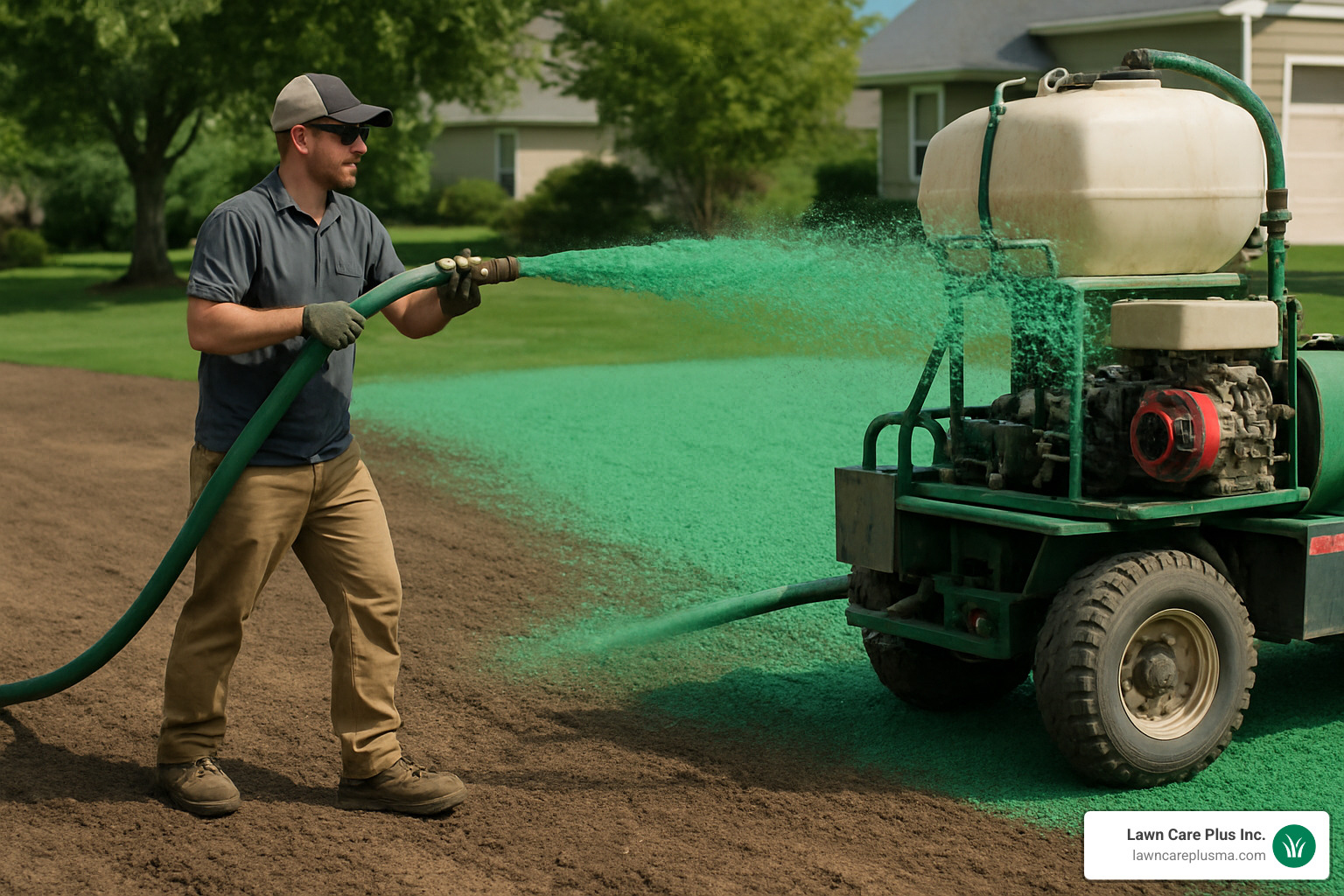
Using professional-grade equipment, we apply this mixture evenly across your prepared soil, paying special attention to edges and transitions. The right thickness is crucial—too thin won’t provide enough protection, while too thick can inhibit germination. Our experienced team knows exactly how to get it just right.
Post-Application Care
Now comes the most critical period—those first few weeks after application. For the first 21 days, consistent moisture is absolutely essential. We recommend light watering 2-3 times daily (morning, midday, and afternoon) to keep the mulch matrix consistently moist without creating runoff or puddles.
Around week 3, as your seedlings establish, you’ll begin transitioning to less frequent but deeper watering. This encourages roots to grow downward rather than staying near the surface. Early morning watering gives the best results, allowing moisture to penetrate before the day’s heat.
At the 4-6 week mark, your new lawn will benefit from its first fertilization. We recommend applying a balanced fertilizer after the first or second mowing, focusing on nitrogen to support leaf development. Just be sure to avoid weed-and-feed products during this sensitive establishment period.
Speaking of mowing, you’ll typically be ready for that first cut when your grass reaches about 3-4 inches in height. Remember the one-third rule—never remove more than a third of the blade length in a single mowing. Sharp mower blades are essential to prevent pulling those young seedlings right out of the ground, and avoid tight turns that can damage your establishing turf.
As your lawn matures, you’ll settle into a regular maintenance routine with mowing at 2.5-3.5 inches, seasonal fertilization, and eventually (after about 3 months) weed control if needed. We might recommend overseeding any thin areas after the 8-week mark to ensure complete coverage.
DIY Hydroseeding vs. Hiring a Pro
While DIY hydroseeding is certainly possible, it comes with some significant challenges. You’ll need to choose between small handheld units or larger trailer-mounted rentals, neither of which match the capacity or consistency of professional equipment. Getting the slurry mixture just right takes experience, and even application requires practice to avoid thin or overly thick areas.
Based on internet research, DIY hydroseeding typically costs about $0.07-$0.15 per square foot when factoring in equipment rental, materials, and your time—potentially saving some money but without any guarantees on the results.
Professional hydroseeding with Lawn Care Plus Inc. brings several advantages to your project. Our commercial-grade equipment features higher capacity tanks, powerful agitation systems for better mixing, and precision nozzles for uniform coverage. More importantly, you benefit from our expertise with Massachusetts growing conditions and our knowledge of which seed blends thrive in different microclimates throughout the Metro-West area.
Our comprehensive service includes soil testing, amendment recommendations, site preparation guidance, professional-grade materials, and support throughout the establishment period. For most homeowners in places like Chestnut Hill, Brighton, or Watertown, this expertise translates to better results and less hassle despite the higher initial investment.
Tips to Maximize Success
Timing is everything when it comes to hydroseeding in Massachusetts. Schedule your project for spring (April-June) or fall (August-October) to avoid the stress of summer heat and water restrictions. For fall applications, allow at least 45 days before the first frost for proper establishment.
Manage your irrigation carefully—consider temporary sprinklers or a permanent system, and use timers to ensure consistent watering even when you’re away. Water early morning and late afternoon to minimize evaporation, and adjust your schedule as your lawn establishes.
Control traffic by keeping people, pets, and equipment off newly hydroseeded areas for at least 4-6 weeks. Temporary fencing works wonders, and designating an alternative relief area for dogs can save your new lawn from those dreaded yellow spots.
Pay special attention to slopes by requesting additional tackifier in the mix and considering erosion control blankets for very steep areas. Creating horizontal furrows before application can help prevent runoff, and these areas often need more frequent (but lighter) watering.
Plan for long-term success with a seasonal fertilization schedule, regular aeration and overseeding, and integrated pest management to prevent weed and insect issues. Consider soil testing every 2-3 years to monitor nutrient levels and keep your lawn at its best.
By following these guidelines and working with our experienced team at Lawn Care Plus Inc., your hydroseeded lawn will develop into a lush, healthy landscape that improves your property’s beauty and value for years to come. For more detailed information, check out our guide on how to install a new lawn from seed.
Frequently Asked Questions about Hydroseeding
Curious about hydroseeding for your property? At Lawn Care Plus Inc., we field questions daily from homeowners throughout the Boston Metro-West area. Here are straightforward answers to what our customers ask most often:
How much does hydroseeding cost and what drives price?
When clients ask about hydroseeding costs, I always explain that several factors influence the final price tag:
The size of your project plays a major role—larger areas typically benefit from better economies of scale, bringing your per-square-foot cost down. Meanwhile, smaller projects might have minimum service charges that make the rate seem higher.
Your property’s condition matters too. If we need to perform extensive grading or add significant soil amendments, this preparation work will affect your total investment. Properties with good soil quality naturally require less prep work.
The seed blend you select makes a difference as well. Premium mixes designed for Massachusetts conditions cost more than basic varieties, but they often deliver better long-term results. If you have special challenges like deep shade or high traffic areas, specialized seed blends might be recommended.
Site accessibility can significantly impact costs. If our trucks can’t easily reach your planting area, we might need special equipment or additional labor to complete the job properly.
The terrain of your property matters too—steep slopes require extra care during application and often need additional tackifier (the “glue” that holds everything in place) to prevent erosion, which affects materials costs.
Even timing affects pricing, with spring and fall being our busiest seasons when demand is highest.
Based on internet research (not specific to Lawn Care Plus Inc.), hydroseeding typically ranges from $0.06 to $0.60 per square foot across the industry. These are just averages—your specific property needs will determine your actual investment. We’re always happy to provide a personalized quote after seeing your space.
Can hydroseeding be done on existing lawns?
This is a common misconception I often need to clear up: hydroseeding works best on bare soil rather than over existing grass. The process depends on good seed-to-soil contact, which is difficult to achieve when existing turf is in the way.
For properties with existing lawns, we typically recommend one of two approaches:
If your lawn is more than half weeds or severely damaged, a complete renovation makes the most sense. We’ll kill the existing vegetation, remove the dead material, till the soil, regrade as needed, and then apply the hydroseeding slurry. This gives you a fresh start with optimal growing conditions.
For lawns that are just thin or have patchy areas, a partial renovation might be more appropriate. We’d start by core aerating thoroughly and dethatching to expose soil. In these cases, slice-seeding often works better than traditional hydroseeding, or we might use a modified approach with reduced mulch content.
As one of my colleagues puts it, “You need bare ground to hydroseed properly; you should remove weeds and debris before application for the best results.”
We’re always happy to evaluate your existing lawn and recommend the most appropriate approach for your specific situation—whether that’s full hydroseeding, overseeding, or a customized combination of techniques.
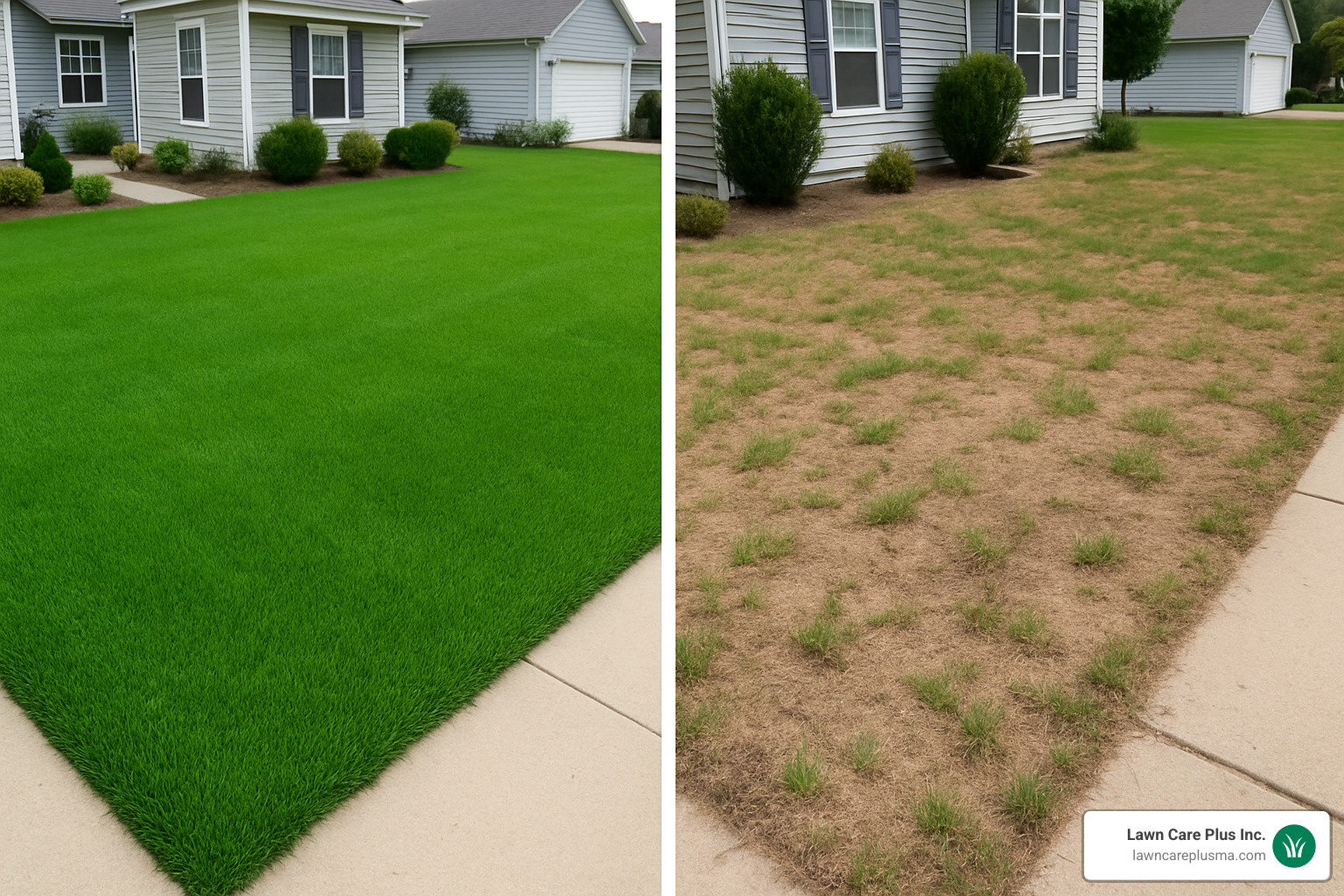
What causes hydroseeding failure?
Even with the best intentions, hydroseeding sometimes falls short of expectations. After years of working with Boston-area properties, I’ve seen these common causes of failure:
Inadequate watering tops the list. Those first 2-3 weeks are critical—newly hydroseeded lawns need consistent moisture with light waterings 2-3 times daily. Many homeowners underestimate this commitment, especially during hot weather.
Poor soil preparation is another culprit. Compacted soil prevents roots from establishing properly, while improper pH or insufficient organic matter can stunt growth from the start. This is why we emphasize soil testing and thorough preparation.
Timing matters enormously. Applying hydroseeding during July’s heat or just before winter frost significantly reduces success rates. In our Massachusetts climate, spring and fall applications typically yield the best results, when temperatures are moderate and natural rainfall helps with establishment.
Erosion and washout can undo all your good work, especially on slopes. Heavy rains shortly after application can carry away seeds and mulch. For challenging sites, we often recommend additional tackifier or erosion control measures to protect your investment.
Seed selection must match your specific conditions. Using varieties ill-suited to your sun/shade patterns, soil type, or expected traffic levels can lead to disappointing results, even if initial germination looks promising.
Weed competition from existing weed seeds in your soil can overwhelm young grass seedlings. Proper site preparation helps minimize this issue by reducing the weed seed bank in your soil.
Finally, premature traffic from people, pets, or equipment can damage delicate seedlings. Areas should remain undisturbed for at least 4-6 weeks to allow proper establishment.
At Lawn Care Plus Inc., we help clients throughout Newton, Brookline, Needham and the entire Boston Metro-West area avoid these pitfalls through careful planning, proper preparation, and detailed post-application care instructions. We want your new lawn to thrive, not just survive!
Conclusion & Next Steps
Hydroseeding offers that sweet spot between traditional seeding and sod installation that many homeowners are looking for. It’s like finding that perfect middle ground – not too expensive, not too slow to establish, but still delivering professional results that will make your neighbors take notice.
Throughout the Boston Metro-West area, we’ve seen how hydroseeding transforms bare soil into lush, green landscapes that homeowners fall in love with. The beauty of this method lies in its versatility and adaptability to our unique New England conditions.
When you weigh the benefits, it’s easy to see why hydroseeding has become increasingly popular:
Hydroseeding delivers exceptional value, typically costing 60-75% less than sod installation while providing far superior results to traditional hand seeding. For budget-conscious homeowners who don’t want to sacrifice quality, it’s an ideal solution.
The versatility of hydroseeding makes it perfect for properties of all sizes – from modest suburban yards in Watertown to sprawling estates in Newton. The same technique scales beautifully for commercial properties too.
Those challenging slopes that seem to wash away with every rainstorm? Hydroseeding excels at erosion control, with the tackifier working like natural glue to hold everything in place until your grass establishes a strong root system.
Perhaps most importantly, hydroseeding allows us to customize seed blends specifically for your property’s unique conditions. That shady corner near your maple tree needs a different blend than your sun-drenched front yard, and hydroseeding makes these adaptations simple.
At Lawn Care Plus Inc., we’ve refined our hydroseeding process through years of experience serving communities throughout Belmont, Boston, Brighton, Brookline, and the entire Metro-West region. We don’t just spray and walk away – our comprehensive approach includes thorough soil testing, meticulous site preparation, professional application with top-quality materials, and detailed aftercare guidance.
The success of your hydroseeded lawn depends significantly on proper preparation and post-application care. We’ll be there every step of the way, providing clear instructions and support throughout the establishment process. With our guidance, you’ll know exactly when to water, when to mow, and how to nurture your new lawn through its critical establishment phase.
For larger properties, commercial spaces, or challenging sites with slopes or erosion concerns, hydroseeding often represents the optimal solution. Even for standard residential lawns, the quality results and cost savings compared to sod make it worth considering.
Ready to transform your property with a beautiful new lawn? Contact Lawn Care Plus Inc. today to schedule a consultation and site evaluation. Our experts will assess your specific needs, discuss options, and provide a detailed recommendation and quote for your hydroseeding project.
With proper timing, professional application, and diligent aftercare, your hydroseeded lawn will provide years of enjoyment and improve your property’s beauty and value.
Learn more about our lawn care services