
Why Proper Channel Drain Installation Protects Your Property
Channel drain installation is one of the most effective ways to redirect surface water away from driveways, patios, and walkways before it causes real damage.
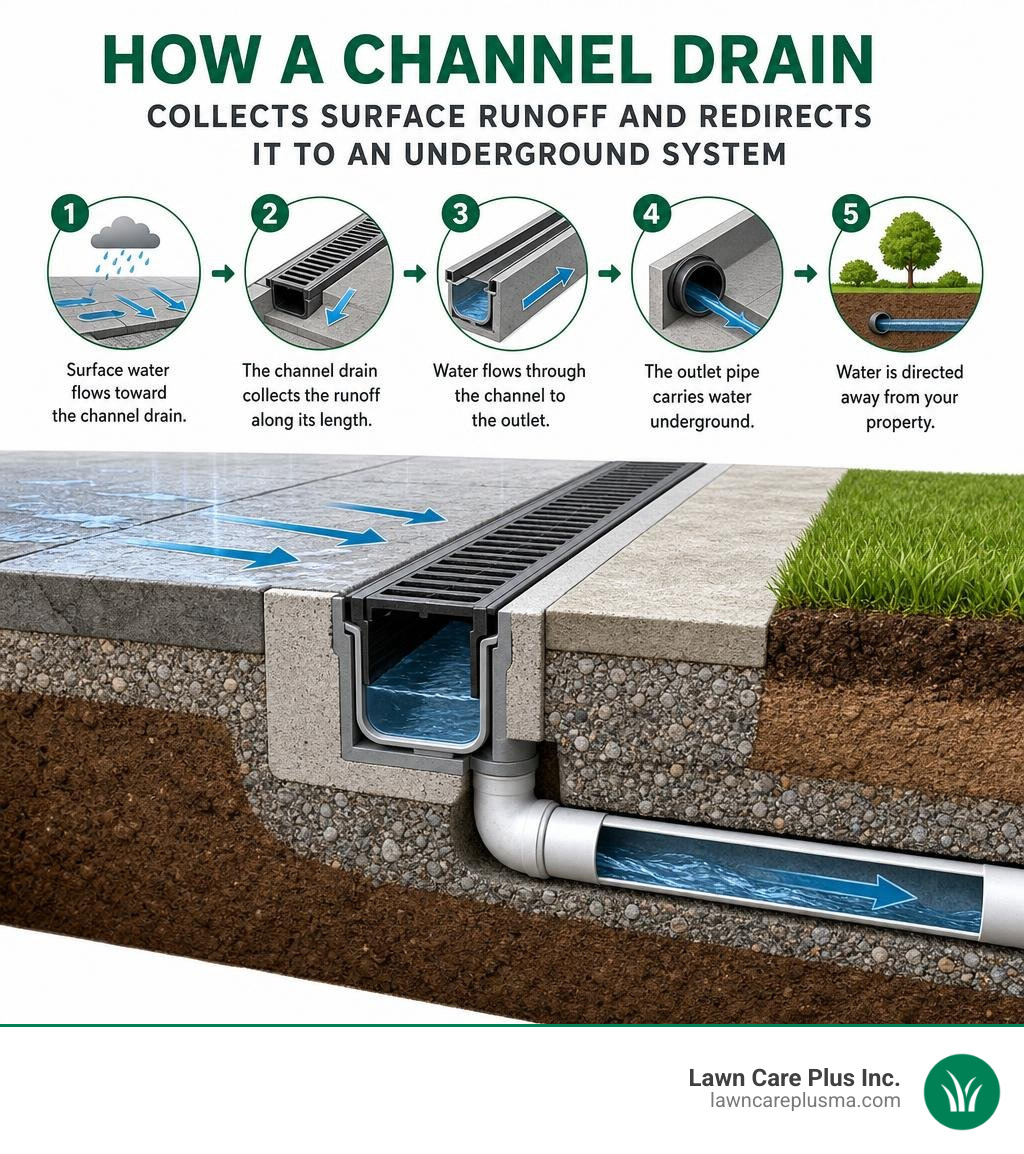
Here is a quick overview of how it works:
- Excavate a trench along the area where water collects or flows
- Set the channel sections with a minimum slope of 1/8 inch per foot toward the outlet
- Encase the channel in concrete (minimum 4 inches on each side for standard loads)
- Connect the outlet to an underground pipe or catch basin
- Install the grate flush with the surrounding surface and allow concrete to cure for 24 hours
That is the core process. The sections below cover each step in detail, including load ratings, materials, and when to call a pro.
Proper drainage is essential for protecting outdoor and indoor spaces from water damage. In Greater Boston and Metro-West, where the region receives roughly 45 inches of rain per year and freeze-thaw cycles can turn minor pooling into cracked hardscape within a few seasons, getting drainage right is not optional — it is foundational.
Water always finds the path of least resistance. If your driveway, patio, or garage threshold is that path, you will see pooling, erosion, and eventually structural damage. A well-installed channel drain intercepts that water at the surface and moves it safely away.
I’m Tim DiAngelis, owner of Lawn Care Plus, Inc., and over more than a decade of hardscaping and property maintenance work across Greater Boston, our team has handled countless channel drain installation projects for both residential and commercial clients. In the sections below, I’ll walk you through exactly how it’s done.
Channel drain installation glossary:
What is a Channel Drain and Why Do You Need One?

A channel drain—often referred to as a trench drain—is a long, linear drainage system designed to capture sheet flow across large, flat surfaces. Unlike standard point drains (which require grading from four different directions to a single spot), a channel drain only requires the surrounding hardscape to slope in one direction. This makes it the perfect solution for driveways, garage thresholds, pool decks, and patio borders.
When heavy New England rains hit areas like Newton, Brookline, or Milton, water quickly sheets off impermeable surfaces. Without a linear drainage barrier, this runoff can cause severe soil erosion, wash away expensive mulch, and pool against building foundations. Over time, hydrostatic pressure can force water through basement walls, resulting in costly structural repairs.
To prevent this, a channel drain acts as a continuous gutter built directly into the ground. It consists of two main parts:
- The Channel Body: The subsurface trough that collects and channels water. These are commonly made from durable materials like high-density polyethylene (HDPE) or polymer concrete, both of which resist chemical deterioration and handle extreme freeze-thaw cycles.
- The Removable Grate: The top cover that allows water to enter while keeping out leaves, twigs, and other debris. Grates can be made of plastic, galvanized steel, brass, or cast iron, depending on the aesthetic and weight load required.
Implementing these systems properly is a key part of protecting your hardscape investments. For a deeper look at integrating these systems into your overall landscape, check out our guide on The Best Hardscape Drainage Solutions for Any Property as well as our detailed article, Keep Your Yard Dry: The Essential Guide to Channel and Area Drains.
Determining Load Ratings and Flow Capacity
Before digging a single scoop of dirt, you must select a drain with the correct load rating and flow capacity. Installing a residential-grade plastic drain across a driveway where heavy delivery trucks back in will inevitably result in a crushed, useless system.
Load ratings are classified under the EN 1433 standard, which rates systems from Class A through Class F. Here is a breakdown of the classifications you are most likely to use:
| Load Class | Load Rating (PSI / Lbs per Foot) | Typical Applications |
|---|---|---|
| Class A | 1–60 PSI / 3,372 lbs per foot | Pedestrian traffic, residential patios, walkways, and bicycle paths. |
| Class B | 61–175 PSI / 12,300 lbs per foot | Light vehicular traffic, residential driveways, and private garages. |
| Class C | 176–325 PSI / 28,100 lbs per foot | Commercial parking lots, delivery docks, and medium-duty truck traffic. |
| Class D | 326–575 PSI / 89,900 lbs per foot | Heavy-duty commercial applications, gas stations, and highways. |
For standard backyard patios or walkways in Belmont or Wellesley, a Class A system like the NDS Slim Channel Drain (which features a load recommendation of Class A) works beautifully. However, for any driveway application, we always step up to a Class B or Class C rating to ensure the system can handle the weight of SUVs, utility vans, and heavy snowplows during our harsh Massachusetts winters.
Flow Capacity and Slot Width
Flow capacity is determined by the width of the channel and the open area of the grate. A standard 4-inch wide channel is highly versatile and handles the vast majority of residential runoff. To put this in perspective, a typical 1/2-inch slot opening on a standard grate can handle roughly 11 gallons of water per minute per foot of drain.
When designing commercial spaces or areas with massive roof runoff, referencing engineering manuals like the Dura Slope Trench Drain Quick Start Guide is critical for calculating precise watershed requirements.
Step-by-Step Guide to Channel Drain Installation

Now let’s dive into the physical work. While a channel drain installation is highly satisfying, it requires precise execution to ensure water flows where you want it to.
Essential Tools and Materials:
- Shovel and trenching spade
- Spirit level and mason’s string line
- Tape measure and marker
- PVC glue and silicone sealant (or butyl caulk)
- 4,000 PSI concrete mix
- Rebar stakes (for suspended installation)
- Wheelbarrow or concrete mixer
- Screws or tie wire
Step 1: Trench Excavation and Layout
Mark the path of your drain using stakes and a mason’s string line. Dig the trench so that it is wide and deep enough to accommodate both the channel drain and its concrete encasement.
For standard Class A or B residential installations, you need at least 4 inches of concrete surrounding the channel on both sides, as well as 4 inches of concrete beneath it. This means if your channel is 4 inches wide and 5 inches deep, your excavated trench should be roughly 12 inches wide and 9 inches deep.
Step 2: Establishing the Slope
Water relies entirely on gravity to move. Your trench must have a continuous downward slope toward your discharge point. We recommend a minimum slope of 1/8 inch per foot (approximately a 1% to 2% grade).
To verify this, tie a string line tight between your starting and ending stakes, level the string, and then measure down from the string at regular intervals to ensure your trench bed drops consistently. If you are using pre-sloped channels (such as systems with a built-in 0.5% fall), you can excavate a flat trench, but you must still verify that the channel sections are installed in the correct numerical order pointing toward the outlet.
Step 3: Assembling the Channel Sections
Always start your assembly from the deepest point (the discharge outlet) and work your way backward upstream.
- Lay out your channel sections next to the trench. Most high-quality systems have arrows stamped on the side; these arrows must point in the direction of water flow.
- Apply a generous bead of high-quality silicone sealant or butyl caulk to the interlocking joints.
- Click or slide the sections together. If you need to customize a length, most plastic channels can be easily cut with a handsaw or miter saw in 6-inch increments.
- Attach the end caps and the bottom or end outlet adapters. Secure these connections with PVC glue to ensure they remain completely watertight.
For visual learners, watching a step-by-step video can be incredibly helpful. You can refer to this excellent video on How to Install a Channel Drain | Ask This Old House to see these physical steps in action.
Step 4: Positioning the Channel (Suspended Method)
Floating or shifting is a major risk when pouring concrete around lightweight plastic channels. To prevent this, we prefer the suspended installation method:
- Drive rebar stakes into the bottom of the trench at 3-to-4-foot intervals along both sides of the channel path.
- Attach the channel to the rebar stakes using specialized anchor clips, tie wire, or self-tapping screws.
- Use your spirit level to adjust the height of the channel until it is exactly 1/8 inch below the final height of your surrounding pavement (this minor recess ensures water actually enters the drain rather than pooling along the edge).
Step 5: Pouring the Concrete Encase
Before pouring concrete, always place the grates into the channel body or use temporary wood inserts. The weight and pressure of wet concrete can easily bow the plastic channel walls inward, making it impossible to fit your grates later. Cover the top of the grates with painter’s tape or plastic wrap to keep cement from clogging the slots.
- Mix your 4,000 PSI concrete to a low-slump consistency.
- Pour the concrete evenly on both sides of the channel to prevent it from shifting or tilting.
- Use a concrete vibrator or a spade to consolidate the pour, eliminating any air pockets or voids beneath the channel.
- Trowel the concrete surface, sloping it gently down toward the edge of the grate.
Step 6: Curing and Finishing
Let the concrete cure for at least 24 hours before removing the protective tape from your grates. Avoid driving any vehicles over the new drain for at least 72 hours to allow the concrete to reach its full structural strength.
Average Installation Costs
When planning your project, budgeting is a key step. Based on national internet data averages, a professional channel drain installation typically ranges from $1,500 to $6,500. For highly complex projects—such as heavy-duty commercial parking lots, long runs requiring deep asphalt cutting, or systems requiring extensive excavation through clay soils—prices can reach $19,500 or more.
Please note: These are average costs based on internet data and do not represent actual pricing for Lawn Care Plus, Inc. Every property in the Boston Metro-West area has unique soil, grading, and structural needs that require an on-site evaluation.
Connecting to Underground Piping and Catch Basins
A channel drain is only as good as its outlet. Collecting water is pointless if it has nowhere to go. The discharge end of your channel drain must connect securely to a solid underground pipe system that carries the runoff to a safe release point, such as a dry well, a pop-up emitter, or a catch basin.
Most residential channel systems feature built-in knockouts or outlet adapters designed to transition directly to 3-inch or 4-inch Schedule 40 PVC or triple-wall pipe.
Why Integrate a Catch Basin?
We highly recommend connecting your channel drain directly to an inline catch basin before routing the water to your main exit line.
- Debris Trapping: Even with grates in place, fine silt, sand, and organic matter will slip into the channel. A catch basin acts as a settlement trap, allowing heavy debris to sink to the bottom while clean water exits through the upper pipe.
- Easy Cleanouts: It is much easier to scoop leaves and sand out of a single, accessible catch basin than it is to clear a clogged 100-foot underground pipe.
When making these connections, always clean the pipe ends and apply a high-quality PVC primer and cement. This prevents joint separation when the surrounding soil shifts during winter freeze-thaw cycles. For a comprehensive overview of how subsurface systems work together, read our Drainage Solutions Complete Guide.
For commercial or highly engineered layouts, referring to technical documents like the ACO Site Installation Manual ensures your pipe sizes and connections meet local building codes and flow requirements.
Frequently Asked Questions About Channel Drains
What is the proper slope for a channel drain installation?
A channel drain must have a minimum slope of 1/8 inch per foot (approximately a 1% to 2% grade) toward the discharge outlet. Without this slope, water will sit stagnant in the bottom of the channel, leading to mosquito breeding, unpleasant odors, and silt accumulation. If your yard or driveway is completely flat, you must use a pre-sloped channel system where the internal depth of the channel increases sequentially to create gravity-fed flow.
How do you maintain a channel drain after installation?
Maintaining your channel drain is simple but crucial:
- Remove the Grates: Most modern grates snap out or are held in place by a few screws. Remove them at least twice a year (ideally during spring and late autumn).
- Clear Debris: Scoop out any accumulated leaves, pine needles, or silt.
- Flush the System: Use a high-pressure garden hose or a pressure washer to flush remaining fine sediment down toward your catch basin or outlet.
- Inspect the Outlet: Ensure your discharge pipe or pop-up emitter is clear of obstructions like grass clippings or rodent nests.
When should I hire a professional for channel drain installation?
While a simple walkway drain can be a DIY weekend project, you should hire a professional team like Lawn Care Plus, Inc. if:
- You face complex grading challenges: If water needs to travel uphill or around tight curves, professional laser-leveling is required.
- The installation crosses vehicular areas: Driveways require precise concrete encasement and heavy Class B or C load-rated materials to prevent collapse.
- Wetlands regulations apply: In Greater Boston towns like Weston, Wellesley, or Concord, redirecting surface runoff near ponds, streams, or protected buffer zones can trigger the Massachusetts Wetlands Protection Act, requiring Conservation Commission approval and professional design.
Conclusion
A properly designed and installed channel drain is one of the smartest investments you can make to protect your Massachusetts home or business. From preserving your hardscape patios to preventing foundation water damage, keeping surface water under control is essential for long-term property value.
At Lawn Care Plus Inc., we have spent years solving the unique drainage and hardscaping challenges that homeowners face throughout the Boston Metro-West area—including Belmont, Newton, Brookline, Milton, and beyond. Whether you need a simple patio drainage solution or a complete land drainage system integrated into a gorgeous new driveway, our experienced team is here to help.
If you are ready to stop worrying about the next heavy rainstorm, contact us today to schedule a professional consultation!