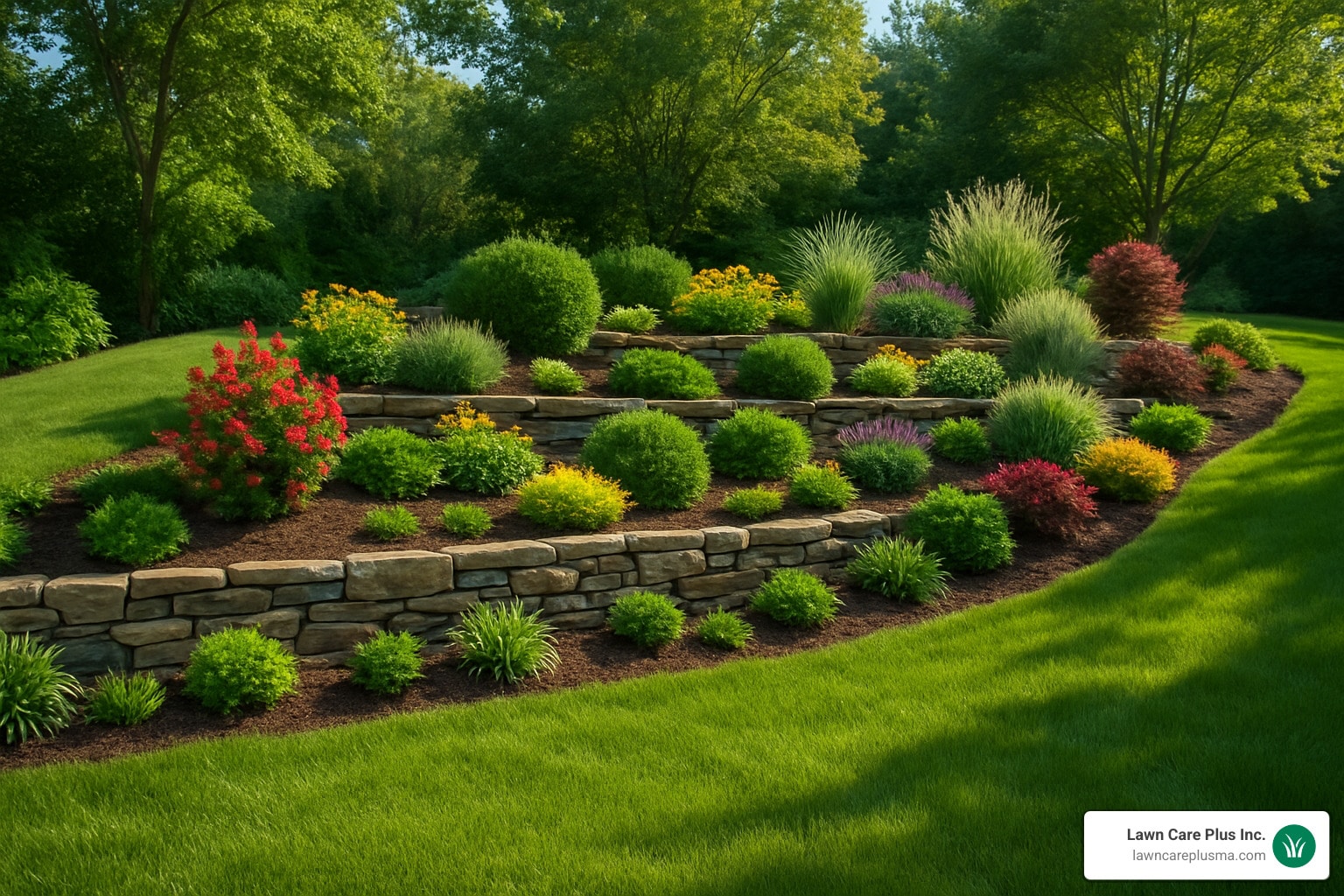
Transform Your Sloped Yard into a Functional Masterpiece
Ever looked at that sloping backyard and thought, “What a waste of space”? You’re not alone. A retaining wall landscape might just be the solution you’ve been searching for.
I remember chatting with a homeowner who watched our crew installing a stone wall and innocently asked, “Is that it? You just knock the rocks into place?” That question perfectly captures how deceptively simple these structures appear from the outside looking in.
In reality, a retaining wall landscape does far more than just hold back dirt. These versatile features can completely transform your property from problematic to picturesque.
What exactly can a well-designed retaining wall do? For starters, it can hold back soil on slopes and prevent erosion that might otherwise damage your property over time. But the magic really happens when these walls create flat, usable spaces where there was once just an awkward incline.
Most residential retaining walls stand between 2-4 feet tall (anything over 4 feet typically requires professional engineering). They come in various materials to match your home’s aesthetic – from concrete blocks and natural stone to timber, gabion baskets, and brick.
The benefits extend far beyond just practical considerations. A thoughtfully designed retaining wall landscape can increase your usable yard space by up to 50%, dramatically improve drainage issues, add built-in seating for entertaining, and significantly boost your property’s value.
“Retaining walls can heighten the beauty of any landscape,” notes Whitlam Landscapes. Whether you’re dealing with a sloping backyard that’s become your property’s neglected corner or simply want to add visual interest, these structures transform challenging terrain into your home’s most striking feature.
Beyond their structural benefits, retaining walls open up a world of design possibilities. Imagine terraced gardens cascading down your once-unusable slope, built-in seating areas for summer gatherings, framed patios for outdoor dining, integrated lighting elements for evening ambiance, or even dramatic backdrops for water features and fire pits.
A well-executed retaining wall landscape neatly solves the dual challenge many homeowners face: managing difficult terrain while adding significant aesthetic appeal to your property.
Want to learn more about bringing a retaining wall landscape to your property? Check out these helpful resources:
– concrete retaining wall block
– retaining wall foundation
– retaining wall repair near me
1. Level-Up Living Space: Terraces & Patios
Imagine stepping into your backyard and instead of facing an awkward slope, you find a series of beautiful, usable outdoor rooms. That’s the magic a retaining wall landscape can bring to your property.
Here in the Boston Metro-West area, we’ve watched countless homeowners’ faces light up when they see how terracing transforms their once-challenging yards into their favorite places to spend time.
“I never thought we’d actually use that part of our yard,” one Framingham homeowner told us after we completed her terraced garden project. Now it’s where she hosts summer gatherings.
Terracing with retaining walls isn’t just about holding back soil—it’s about reclaiming your property. Studies have shown that a well-designed retaining wall landscape can increase usable yard space by up to 50% on sloped properties. That steep, awkward hillside you’ve been struggling to mow? It could become a series of flat, functional spaces for entertaining, gardening, or simply relaxing with a good book.
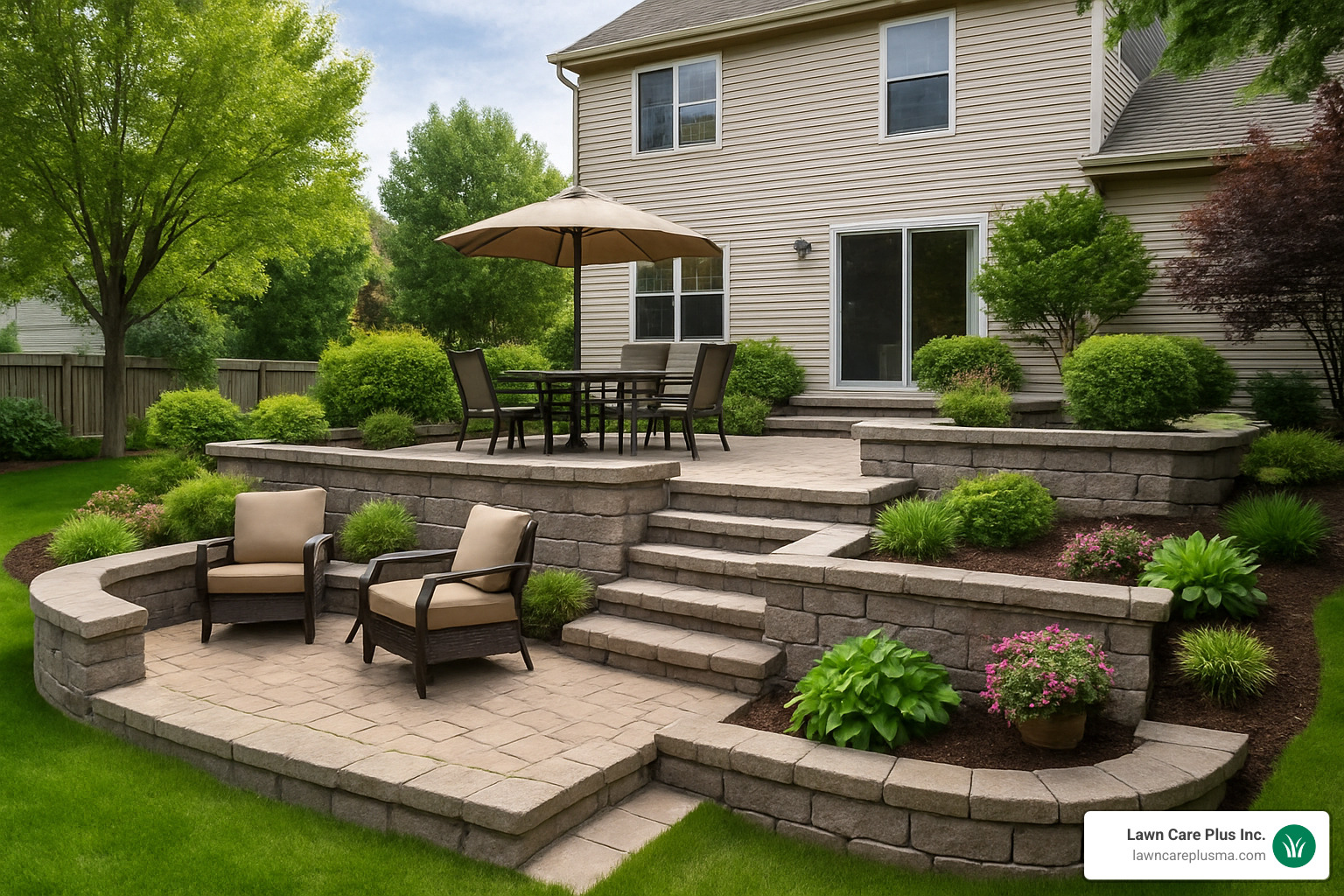
As hardscape expert Joe Raboine explains, “Retaining walls create topographic interest while serving practical purposes like raised garden beds.” This versatility allows your outdoor space to be both beautiful and functional.
When considering a retaining wall landscape project, you’ll need to decide between a single large wall or multiple tiered walls. Here’s how they compare:
| Feature | Single Large Wall | Multiple Tiered Walls |
|---|---|---|
| Visual Impact | Can appear imposing | Creates natural transition |
| Usable Space | One large flat area | Multiple functional zones |
| Construction | May require engineering | Simpler individual walls |
| Planting Options | Limited to top and bottom | Multiple planting beds |
| Cost | Higher for tall walls | Distributed across smaller walls |
| Permit Requirements | Often needed for walls >4ft | May avoid permits with smaller walls |
At Lawn Care Plus Inc., we typically recommend a terraced approach for slopes greater than 3:1 (for every 3 feet of horizontal distance, there’s 1 foot of vertical change). This creates a more natural look while making each level accessible and functional.
The beauty of terraced retaining walls is their dual-purpose nature. As industry experts note, “As beautiful as they are functional, retaining wall systems take your style to new levels of interest and refinement.” Your walls can define outdoor rooms, create natural transitions between spaces, and turn your challenging slope into your property’s most distinctive feature.
For properties with significant slopes, we often design multiple tiers that step down gradually, creating natural flow throughout your landscape while maximizing every square foot of usable space.
Learn more about our approach to Retaining Walls and Landscaping
2. Conquer Erosion with a Living Retaining Wall Landscape
Erosion control is perhaps the most practical function of a retaining wall landscape. Here in Massachusetts, where we experience everything from heavy spring downpours to brutal winter freeze-thaw cycles, keeping soil where it belongs isn’t just about aesthetics—it’s essential for protecting your property investment.
You know what we hear all the time? “The wall looked fine until that big rainstorm, then suddenly it was leaning!” This is because, as one of our contractors likes to say, “Water always wins… unless you plan for it.”
“Poor drainage or no drainage leads to most retaining wall failures,” caution industry experts. “The soil behind the retaining wall becomes saturated, and the wall cannot support the saturated soil and the weight of water.”
Think of your retaining wall landscape as a shield against nature’s persistent attempts to flatten your yard. When we build walls for our Boston Metro-West neighbors, we incorporate several essential drainage elements that work together:
- Perforated drain pipes tucked behind the wall collect water before it can become problematic
- Gravel backfill creates pathways for water to flow away from your wall
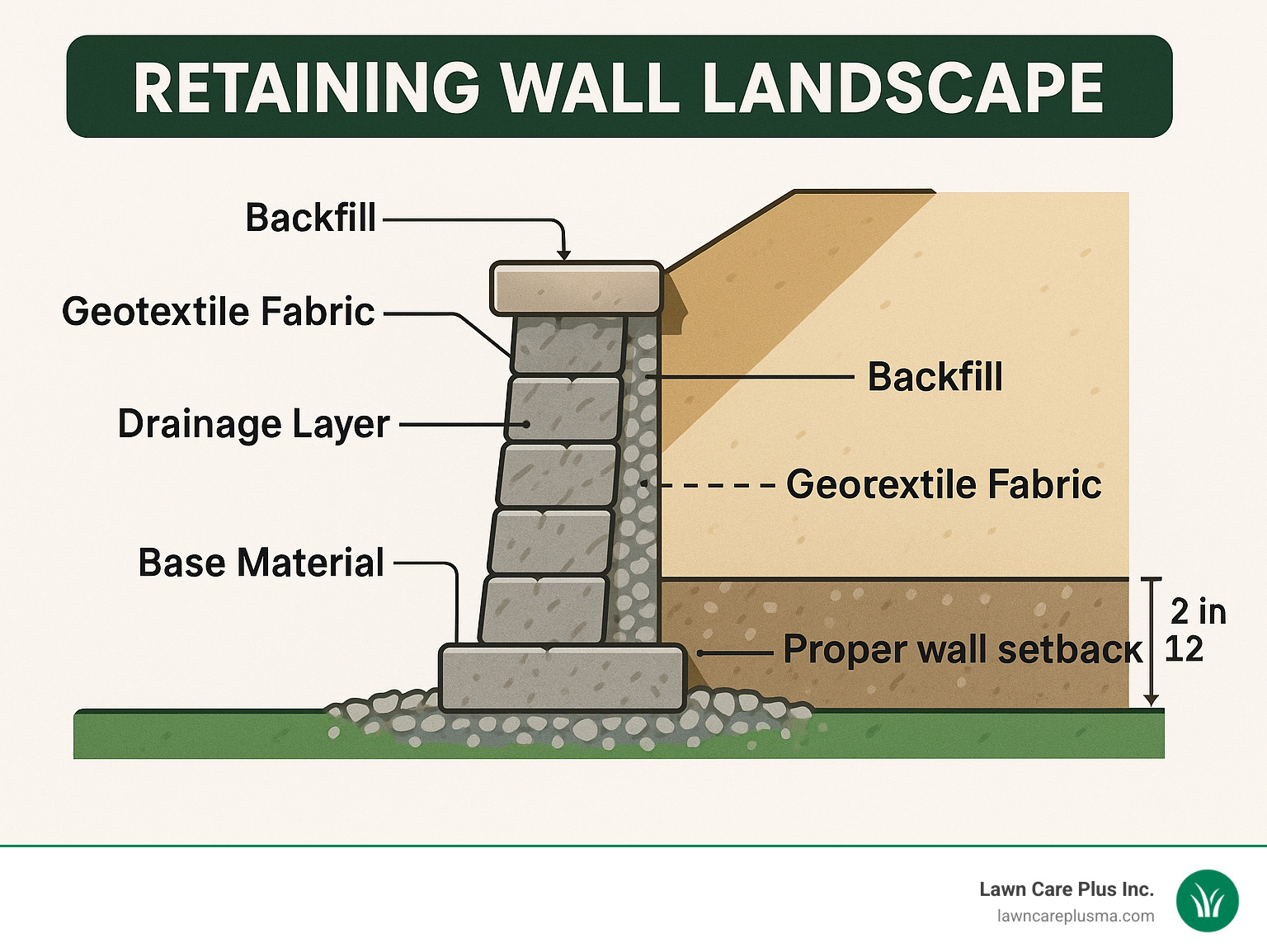
- Proper wall setback (typically 1 inch per foot of height) accounts for natural pressures
- Strategically placed weep holes release water pressure rather than letting it build up
For properties with significant water challenges (you know who you are—the folks with the squishy lawn all spring!), we might recommend a check-dam system or integrate your retaining wall with a beautiful rain garden. This approach not only controls erosion but creates a haven for native plants and beneficial insects. It’s problem-solving that looks gorgeous while it works.
“Hydrostatic pressure from water buildup behind a wall is the primary cause of most retaining wall failures,” explains one landscape architect we work with. “It’s like having a swimming pool pushing against the back of your wall.” By designing with water management as our priority, we ensure your retaining wall landscape stands strong for decades, not just seasons.
Find more about our Retaining Wall Drainage solutions
Soil & Water Science Behind a Retaining Wall Landscape
Understanding what’s actually in your yard is crucial for proper retaining wall design. Different soil types behave dramatically differently when wet:
Clay soils retain water and expand like a sponge, creating significant pressure behind walls. These are common in parts of Metro-West and require extra drainage consideration.
Sandy soils drain quickly (great!) but may not provide adequate stability (not so great). These often need reinforcement techniques.
Loam soils offer that “just right” balance of drainage and stability that makes construction more straightforward.
In Massachusetts, we often encounter a variety of soil conditions within the same property—clay in one corner, sandy loam in another. That’s why we always conduct thorough site assessments before designing your retaining wall landscape.
The science of proper drainage isn’t just one solution but several layers working together:
First comes a base layer of compacted crushed stone (usually 4-6 inches) that creates a solid foundation. Next, we add geotextile fabric—think of it as a coffee filter that keeps soil in place while letting water pass through. Behind the wall goes drainage gravel (¾-inch clean stone) that creates channels for water flow, while perforated pipe at the base collects and redirects that water away from your wall.
As our lead mason often tells clients, “It’s not the wall that fails; it’s the drainage.” The wall is only as good as what you can’t see behind it. We’ve fixed enough failing walls to know that cutting corners on proper drainage is penny-wise but pound-foolish.
When done right, a retaining wall landscape doesn’t just hold back soil—it works with nature rather than against it, creating a sustainable solution that improves your property for years to come.
3. Blend Beauty & Seating: Built-In Benches
There’s something magical about outdoor spaces that invite you to sit and stay awhile. That’s exactly what happens when your retaining wall landscape does double duty as built-in seating—creating natural gathering spaces that feel like they’ve always been part of your yard.
“Many retaining walls end up as garden or terrace backdrops,” notes Mauricio Lobeira of Ten Plus Three. “It has a nice, organic flow and makes the seating feel of a piece with its surroundings,” adds Patricia Benner of Benner Landscape Design.
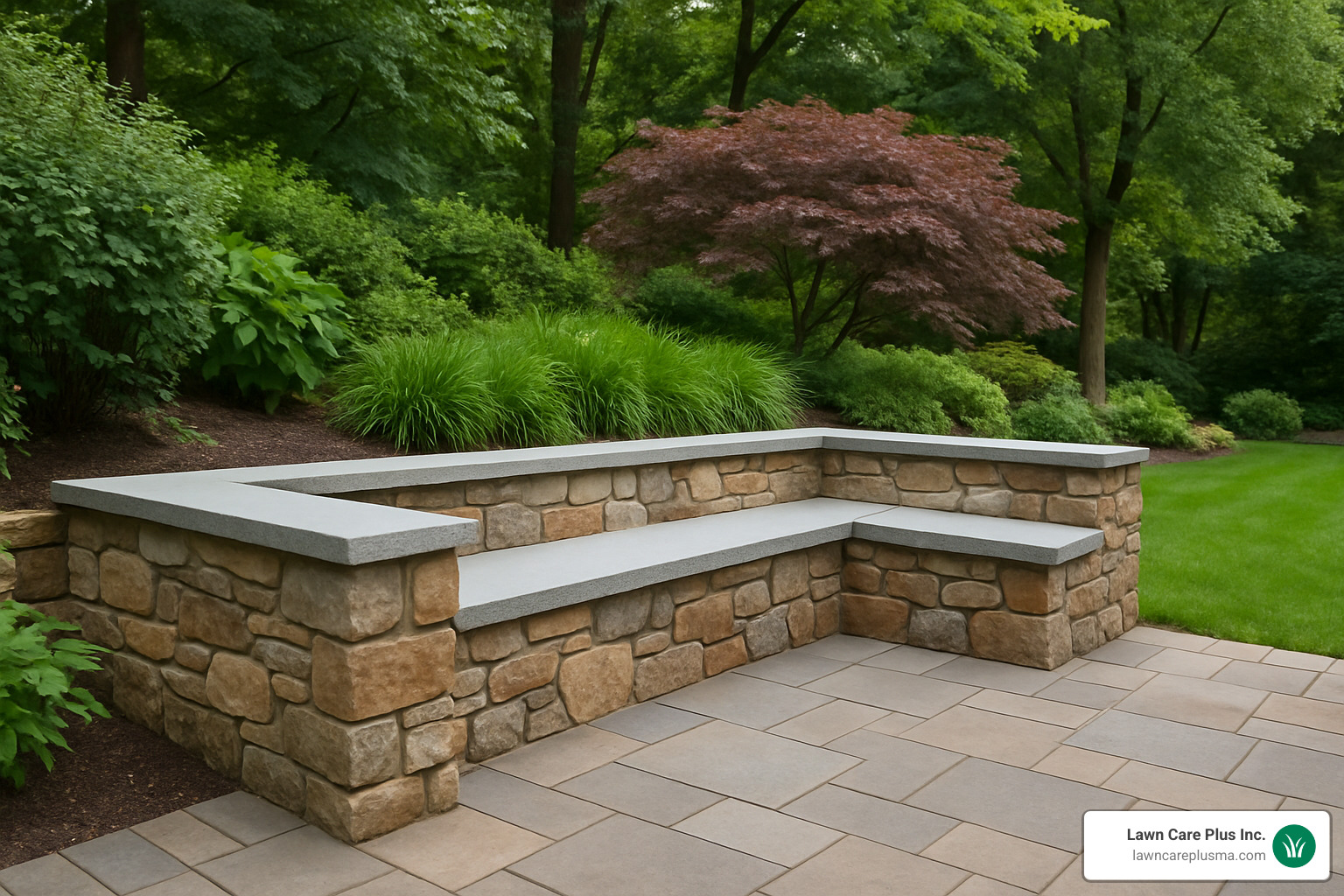
Unlike patio furniture that needs to be stored away for winter or replaced every few years, a well-built seat wall becomes a permanent feature of your landscape. It creates what designers call “outdoor rooms”—defined spaces that encourage conversation and connection. These social zones naturally draw people together, whether for morning coffee or evening gatherings.
Here in the Boston Metro-West area, we’ve found that natural stone or concrete block walls with smooth bluestone or granite caps make ideal seating areas. These materials not only stand up to our tough New England weather but also warm up quickly in the spring sun, making them comfortable places to perch even on cooler days.
Explore our Retaining Wall Design options
Pro Tips for a Comfortable Retaining Wall Landscape Seat
When we design a retaining wall landscape with integrated seating at Lawn Care Plus, we pay careful attention to the human scale of the wall. After all, comfort makes all the difference between a wall people actually use versus one that just looks nice.
The perfect seat wall height is 18-24 inches—roughly the same as a dining chair. This height works well for most adults and older children. For the seating surface, we recommend a 12-18 inch depth that gives people enough room to sit comfortably without feeling perched on the edge.
The cap material matters tremendously for comfort. We typically choose caps with smooth, slightly rounded edges to prevent discomfort on the backs of legs. A small 1-inch overhang on the cap serves both aesthetic and practical purposes—it creates a nice shadow line while preventing rainwater from running down seated guests’ legs.
“Scaling the wall appropriately also plays a key role in creating a relatable human scale within the space,” explains Duan Tran of KAA Design. This human-centered approach ensures your retaining wall feels welcoming rather than imposing.
For extra comfort and style, we often suggest subtle lighting integrated into the wall face, nearby plantings for shade and privacy, and perhaps some weather-resistant cushions for color and softness (though these should be stored when not in use).
We’ve noticed that the most successful seat walls are those positioned to capture views or create intimate conversation areas. At Lawn Care Plus Inc., we’ve built countless seat walls that have become the heart of our clients’ outdoor spaces—places where memories are made, one sunset conversation at a time.
4. Illuminate the Night: Lighting in Retaining Walls
There’s something truly magical about a retaining wall landscape after the sun goes down. When thoughtfully illuminated, those same structures that provide practical support during the day transform into dramatic nighttime features that bring your outdoor space to life.
“One lesson here is that framing is everything,” notes Amy Hovis of Eden Garden Design. This principle perfectly captures why lighting your retaining walls can completely change how you experience your yard after dark.
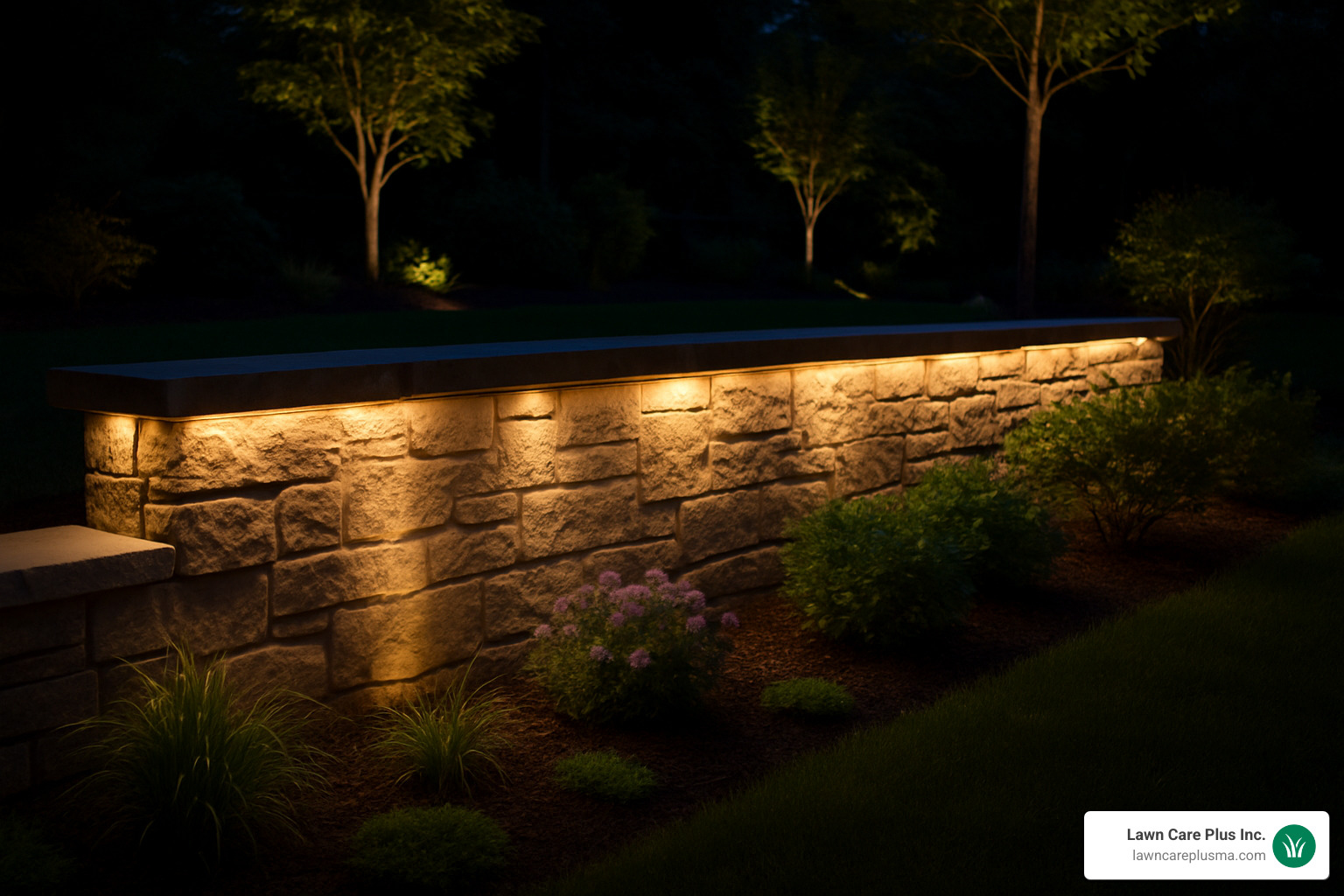
When we design lighting for our Boston Metro-West clients, we love exploring the rich possibilities modern options provide. LED strip lighting tucked beneath wall caps creates a floating effect that’s both neat and unexpected. Recessed step lights guide your path safely while adding a warm glow to your landscape. For walls with interesting texture or stonework, uplighting dramatically highlights these features, while downlighting from nearby trees casts beautiful shadow patterns across the wall’s surface. We can even incorporate niche lighting into built-in planters or decorative alcoves for added visual interest.
The secret to successful retaining wall landscape lighting isn’t just about what fixtures you choose—it’s about planning ahead. One mistake we see homeowners make is not thinking about lighting until after their wall is built. We always recommend installing conduit during construction, even if you’re not ready to add lighting immediately. This simple step prevents headaches (and unnecessary costs) down the road.
According to recent research on outdoor lighting trends, homeowners are increasingly viewing landscape lighting as an essential component rather than a luxury add-on. And for good reason—it extends your outdoor living hours and showcases your investment beautifully.
Wiring a Retaining Wall Landscape for Future Fixtures
At Lawn Care Plus Inc., we approach retaining wall lighting with both today and tomorrow in mind. We typically recommend low-voltage systems (12V) for their safety, energy efficiency, and easier installation. During construction, we strategically place conduit sleeves throughout the wall, creating pathways for future wiring changes without disturbing your hardscape.
We also install junction boxes at key locations to provide easy access points for maintenance or upgrades. Many of our clients appreciate having smart timers and controls that allow them to create different lighting scenarios for different occasions—bright illumination for gatherings, subtle glow for quiet evenings. And because we understand New England weather, we use only weatherproof connections that stand up to our challenging climate.
“Run electrical lines during wall installation if planning integrated lighting,” is advice we give to every client considering a retaining wall landscape. This simple foresight can save significant expense compared to retrofitting lighting later.
One client in Framingham had us install basic conduit during their retaining wall construction, even though they weren’t ready for lighting. Two years later, when they decided to add lighting for an upcoming wedding, the installation was smooth, quick, and far less expensive than it would have been without that preparation.
Whether you’re looking for subtle ambiance or dramatic effect, thoughtful lighting transforms your retaining wall from a daytime workhorse into a nighttime showpiece that you’ll enjoy for years to come.
5. Step in Style: Integrated Stairs & Pathways
One of the most practical improvements to a retaining wall landscape is the addition of integrated stairs and pathways. These elements not only improve access between levels but also create a sense of journey through your landscape.
“Incorporate steps or doorways into sloped retaining walls for easier access,” recommend hardscape experts. This integration creates a cohesive design rather than appearing as an afterthought.
When designing stairs within a retaining wall system, we consider both aesthetics and safety. Natural stone treads, concrete pavers, or timber risers can all be selected to complement the wall material while providing secure footing.
For properties in Belmont, Newton, or Brookline with significant elevation changes, a well-designed stairway can transform a challenging slope into an neat transition between outdoor rooms. The stairs themselves become a design feature rather than merely functional elements.
Find Retaining Wall Builders Near Me
Calculating Safe Stair Dimensions in a Retaining Wall Landscape
Safety is paramount when designing stairs within a retaining wall landscape. These guidelines ensure comfortable and secure passage:
- Rise (vertical height): Ideally 7 inches per step (6-8 inch range)
- Tread (horizontal surface): Minimum 11 inches deep for comfortable footing
- Consistency: All steps should have identical dimensions
- Landings: Include a landing every 8-10 steps on longer staircases
- Width: Minimum 36 inches for residential use (wider for main pathways)
- Lighting: Integrated step lighting for safety after dark
“Carve out a new path,” suggests one landscape designer, noting how stairs can invite exploration of previously inaccessible areas of your property.
For our clients in the Boston Metro-West area, we often recommend materials that stand up to freeze-thaw cycles while providing slip-resistant surfaces. Thermal bluestone, granite, or textured concrete pavers are excellent choices for our New England climate.
At Lawn Care Plus Inc., we ensure that all stairways in your retaining wall landscape not only meet building codes but improve the overall design while providing safe passage between levels.
6. Multi-Tier Gardens for Plant Lovers
A tiered retaining wall landscape is a plant lover’s paradise, creating multiple levels where your botanical treasures can truly shine. Instead of a boring, hard-to-use slope, imagine a series of beautiful garden “rooms” cascading down your property.
“The math makes gardeners smile,” says one landscape architect we work with. “Tiered retaining walls can create up to 3-4 times more planting area on a slope compared to a single wall or unmodified hillside.” That’s triple or quadruple the space for your favorite perennials, shrubs, and flowering plants!
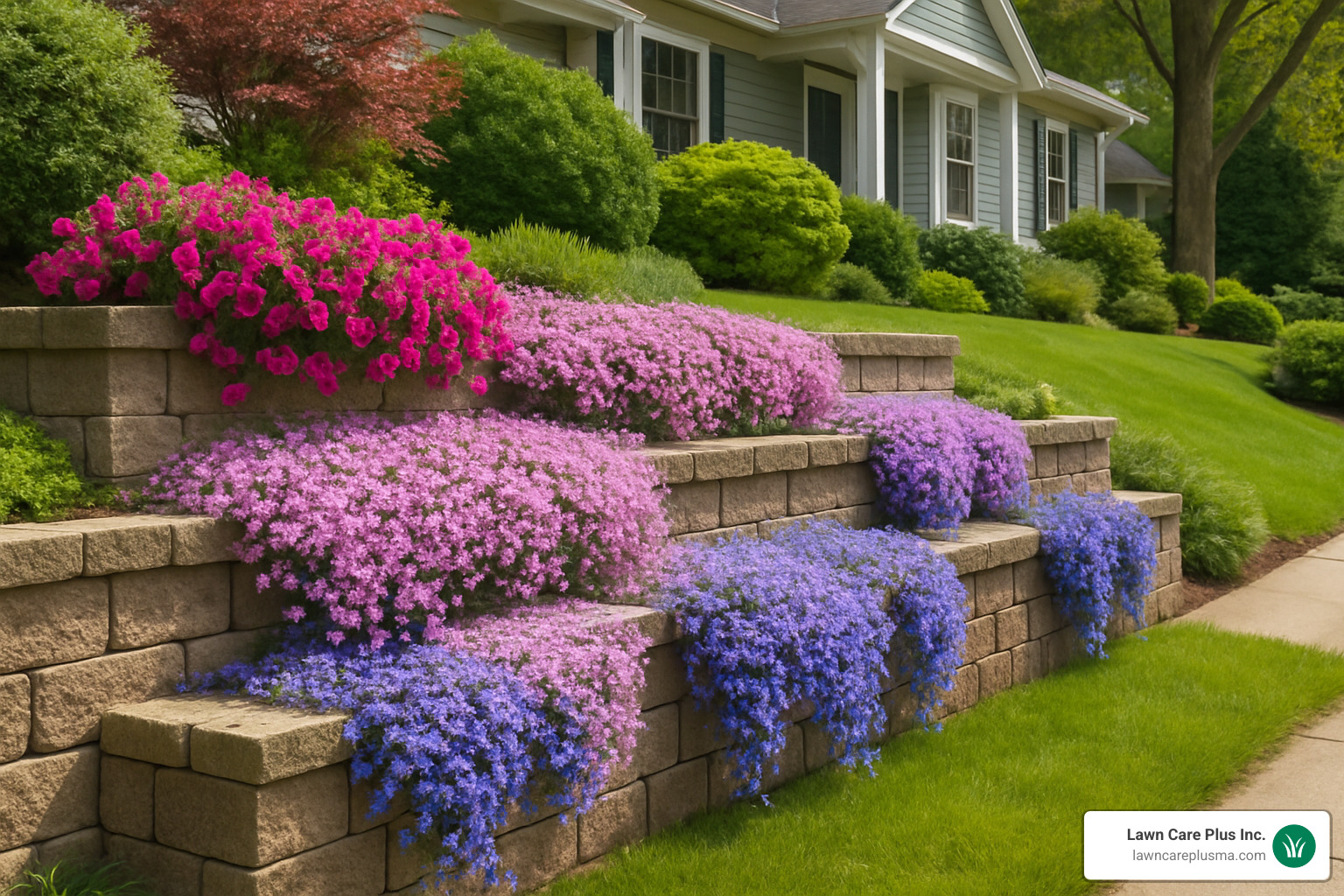
What makes tiered gardens so visually striking is the natural layering effect. Your eye travels from the tall architectural plants at the back to colorful flowering perennials in the middle, then down to cascading plants spilling over the edges, with ground covers filling in flat surfaces. It’s like nature’s own theater, with plants performing at different heights.
For our clients in Milton, Needham, and Newton, we’ve transformed steep, unusable banks into stunning garden showcases. One homeowner told us, “I went from avoiding that side of my yard to spending most of my gardening time there!”
“Leave planting pockets in dry-laid stone walls to soften their appearance,” is advice we often follow when building natural stone walls. These little nooks allow plants to emerge directly from the wall face, blurring the line between hardscape and landscape for a more natural, established look.
Proper irrigation is crucial for tiered gardens. Our team at Lawn Care Plus often designs custom drip irrigation systems that deliver water precisely where needed, reducing waste and preventing erosion. These systems can be zoned to match the different water needs at each level of your retaining wall landscape.
Find Retaining Wall Design Ideas for Every Style of Home
Choosing Plants that Thrive in a Retaining Wall Landscape
One of the most exciting aspects of a tiered retaining wall landscape is the variety of microclimates it creates. Each level and position offers slightly different growing conditions:
At the top of the wall, you’ll want drought-tolerant plants that won’t need frequent watering (which could destabilize the wall). Plants like lavender, Russian sage, and ornamental grasses thrive here, creating a beautiful backdrop without demanding much water.
Along the wall face, cascading varieties steal the show. We love using creeping thyme, sedums, and ivy that spill over the edges, softening the hardscape with living texture. One client called these “living waterfalls” when they saw how beautifully they draped over their new walls.
At the base of the wall, moisture-loving plants flourish in the natural water collection area. This is perfect for hydrangeas, astilbe, and ferns that appreciate the extra moisture but still need good drainage.
Between tiers, Mediterranean herbs like rosemary, sage, and thyme thrive in the good drainage and heat reflection provided by the walls. These spots often warm up earlier in spring, extending your growing season.
“Soften harsh edges with greenery,” is a design principle we follow religiously at Lawn Care Plus. The right plants can transform even the most utilitarian wall into a garden feature that looks like it’s been there forever.
For Massachusetts retaining walls, we often recommend native perennials like Black-eyed Susan and Coneflower, which provide color while supporting local pollinators. Ornamental grasses like Little Bluestem add movement and winter interest. For woody plants, Lowbush Blueberry offers spring flowers, summer fruit, and spectacular fall color, while Creeping Phlox creates a waterfall of color in spring.
Our team at Lawn Care Plus Inc. can help you select the perfect plant palette for your specific retaining wall landscape conditions, ensuring year-round beauty with plants that will thrive in our sometimes challenging New England climate.
7. Water & Fire Features That Wow
Nothing transforms a retaining wall landscape quite like the elemental drama of water and fire. These features lift your outdoor space from merely functional to truly magical, creating a multisensory experience that captivates guests and provides daily enjoyment for your family.
“The sound of water brings a sense of peace to any landscape,” explains one of our designers at Lawn Care Plus. “And there’s something primal about gathering around fire that brings people together in conversation.”
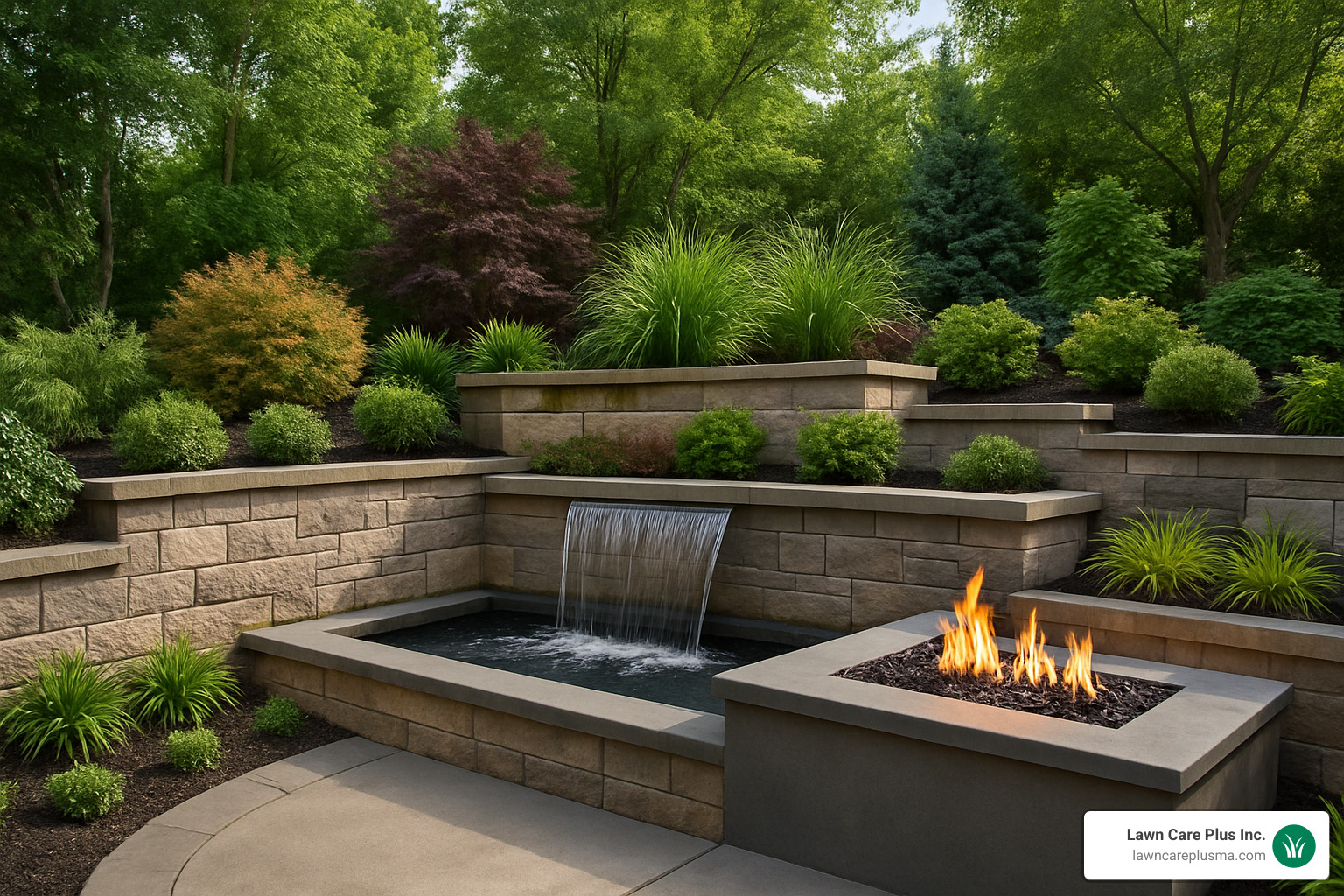
We’ve installed countless water features in Massachusetts retaining wall landscapes, with sheer descents being particularly popular. These create a smooth, glass-like sheet of water flowing over the wall face – especially stunning when lit from below at night. For a more natural look, pondless waterfalls offer the visual and auditory pleasure of cascading water without the maintenance of a traditional pond. The water simply disappears into a hidden reservoir of stone, where it’s recirculated to the top.
For smaller spaces, bubbling boulders provide gentle water movement and soothing sounds without the splash zone of larger features. Many of our Metro-West clients also love wall-mounted spouts – these architectural elements can range from simple copper pipes to elaborate carved stone faces.
When the temperatures drop in our New England evenings, nothing beats gathering around a fire feature. Built-in fire pits surrounded by seating walls create natural conversation areas that extend your outdoor living season by months. We’re seeing more clients request linear fire tables incorporated directly into the top of their retaining wall landscape – these sleek designs offer warmth without obstructing views.
“The beauty of integrating a fire feature with your retaining wall is the seamless design,” notes our hardscape specialist. “We use specially designed heatproof blocks that can withstand high temperatures, ensuring both safety and longevity.”
Learn more about our Concrete Block Retaining Wall options
Integrating Utilities Safely Behind a Retaining Wall Landscape
The magic of these features depends entirely on proper behind-the-scenes preparation. When we design a retaining wall landscape with water or fire elements, we think about the infrastructure first.
Gas lines for fire features must be properly sized, protected, and always installed by licensed professionals. We carefully plan the route, ensuring accessibility for future maintenance while keeping lines hidden from view. In Massachusetts, most gas installations require permits, which our team handles as part of the project management.
Electrical components need equally careful attention. We install weather-rated conduit with proper sealing at all junction points, thinking ahead about lighting, pumps, and any smart controls you might want. For water features, we place lines below the frost line (critical in our climate!) and incorporate proper drainage and winterization capabilities to prevent damage during freezing temperatures.
“Always plan for accessibility,” reminds our lead installer. “Even the best systems need occasional maintenance, so we create inconspicuous access points that don’t compromise the design.”
Massachusetts regulations require an architect for retaining walls taller than four feet – especially important when integrating utilities where safety codes must be strictly followed. At Lawn Care Plus Inc., we handle all the coordination, ensuring your retaining wall landscape features aren’t just beautiful but built to code with safety as our priority.
The combination of dancing flames and flowing water against the strong backdrop of a well-built retaining wall creates a landscape that engages all the senses – truly an outdoor living space that will draw you outside day after day, season after season.
8. Bold Material Mixes: Stone, Timber, Gabion & Steel
The material you choose for your retaining wall landscape isn’t just a practical decision—it’s a statement about your home’s character and your personal style. Today’s homeowners are increasingly mixing materials to create walls with distinctive personality and visual interest.
“Mix retaining wall materials,” suggest design experts who’ve seen how combining textures and elements can transform an ordinary wall into a landscape focal point. This approach lets you showcase the strengths of each material while creating something truly unique.
Here in Massachusetts, we’ve helped countless homeowners find their perfect material match from these popular options:
Natural stone like granite, fieldstone, and bluestone brings timeless New England charm and incredible durability. As one expert points out, “Natural stone retaining walls can support themselves without mortar by virtue of their weight.” This traditional dry-stacking technique not only looks authentic but allows for natural drainage—a win-win for both aesthetics and function.
Modular concrete blocks offer consistency and reliability with a surprising range of textures and colors. These engineered products have come a long way from the basic gray blocks of yesteryear, now mimicking natural stone with remarkable accuracy.
Timber creates a warm, organic feel that blends beautifully in woodland settings. While not as long-lasting as stone or concrete, a well-built timber wall brings natural beauty and can be the perfect complement to a wooded property.
Gabion cages—those metal baskets filled with stone—provide an industrial-modern look that’s gaining popularity. They offer excellent drainage and can be filled with local stone for a more sustainable approach.
Corten steel delivers sleek, contemporary lines with its distinctive rust-colored patina. This weathering steel actually protects itself by forming a stable rust layer, making it surprisingly durable for outdoor applications.
Explore our Block Retaining Wall options
Material Showdown for a Retaining Wall Landscape
When we sit with clients at their kitchen tables across Framingham, Wellesley, or Weston, comparing materials for their retaining wall landscape, we focus on these key factors:
| Material | Durability | Typical Lifespan | Maintenance | Aesthetic Style |
|---|---|---|---|---|
| Natural Stone | Excellent | 100+ years | Minimal | Traditional, rustic |
| Concrete Block | Very Good | 50-100 years | Low | Contemporary, versatile |
| Timber | Moderate | 15-25 years | Moderate | Natural, warm |
| Gabion | Good | 50+ years | Low | Modern, industrial |
| Steel | Good | 25-50 years | Low | Contemporary, minimalist |
The investment required varies widely based on internet data. Natural stone typically ranges from $25-150 per square foot, making it often the premium choice but one that delivers century-plus durability. Concrete blocks offer excellent value at $15-60 per square foot, while timber walls run $20-60 per square foot. More specialized options like gabion ($30-90 per square foot) and steel ($50-180 per square foot) occupy the middle to upper ranges.
“Natural stone walls are preferred by professionals for their classic, timeless look,” according to many industry sources. While often requiring a larger initial investment, their exceptional longevity and minimal upkeep requirements often make them the most cost-effective solution over decades of ownership.
Some of our favorite projects involve thoughtful material combinations—perhaps a natural stone base with timber accents, or concrete block structural walls with natural stone veneer. These pairings can reduce costs while maximizing visual impact.
At Lawn Care Plus Inc., we love helping homeowners find the perfect material mix for their property’s unique characteristics and their personal design preferences. Whether you’re drawn to the timeless appeal of natural stone or the clean lines of contemporary materials, we’ll guide you through options that balance beauty, durability, and value in your retaining wall landscape.
9. Big on Value: Boosting Curb Appeal & ROI
There’s something truly magical about a well-executed retaining wall landscape. Beyond solving those pesky slope issues, these hardscape heroes can dramatically transform your property’s appearance and potentially put more money in your pocket when it’s time to sell.
“I never imagined our front yard could look so polished,” shared one of our Wellesley clients after we installed a natural stone retaining wall to frame their sloped entrance. This sentiment echoes what real estate experts consistently tell us: retaining walls can significantly boost property value by enhancing curb appeal and creating more functional outdoor living space.
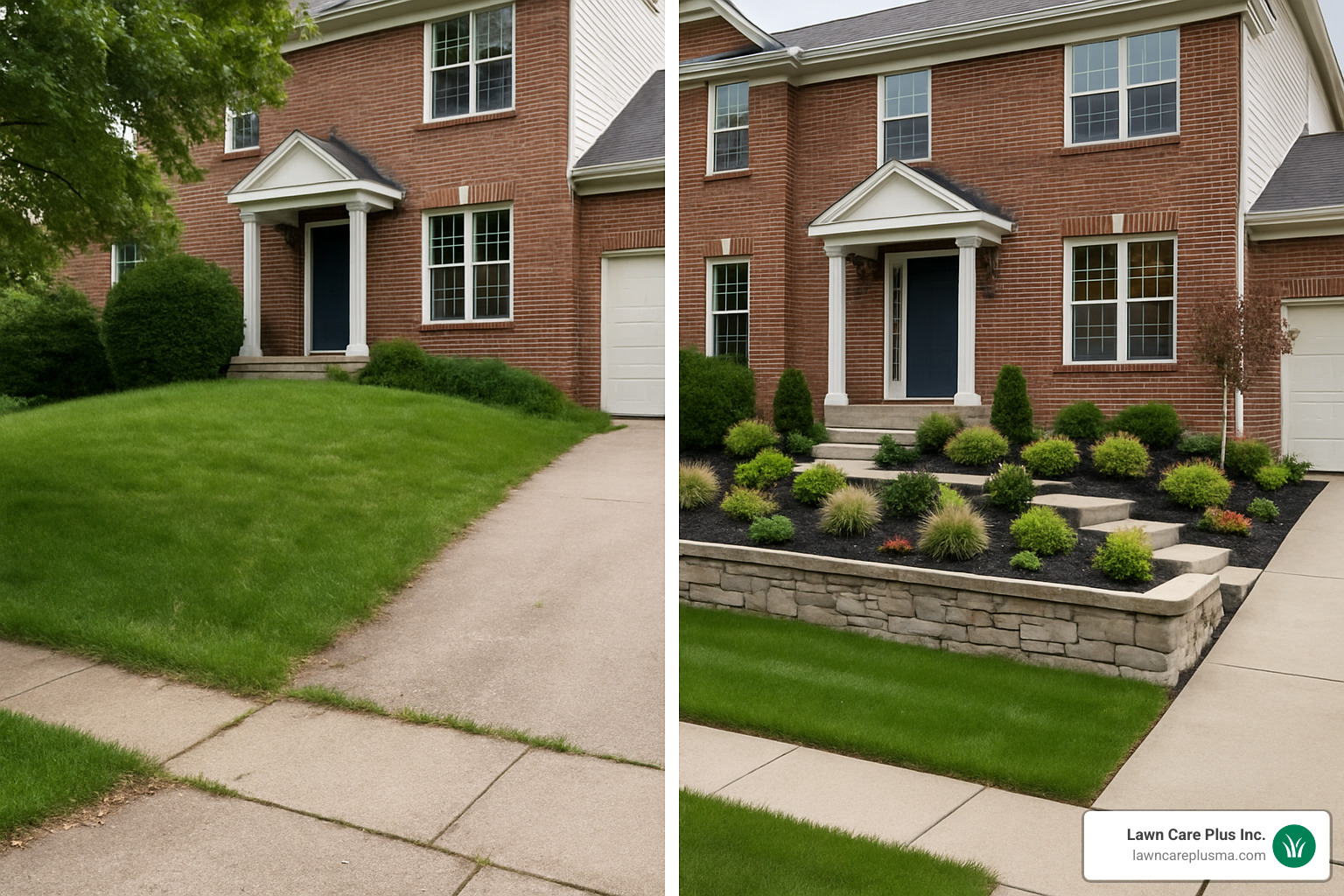
Here in the Boston Metro-West area, where many properties feature challenging terrain, a thoughtfully designed retaining wall landscape can truly set your home apart. Your neighbors might even experience a touch of landscape envy!
The value boost comes from several practical improvements that buyers immediately recognize:
First, you’re literally creating more usable land on your property. That steep, awkward slope becomes flat, functional space for entertaining, gardening, or simply enjoying your morning coffee.
Second, a properly built retaining wall system silently protects your property from erosion and drainage issues – problems that can seriously scare away potential buyers.
Third, the architectural presence of well-designed walls adds structure and intentionality to your landscape. Rather than looking like a random collection of plants, your yard tells a cohesive design story.
Fourth, defined outdoor “rooms” effectively extend your living space beyond your home’s walls. In our post-pandemic world, these outdoor living areas have become increasingly valuable to homebuyers.
“A well-designed landscape with retaining walls doesn’t just look pretty – it transforms problematic areas into premium space,” explains one local real estate agent we work with. “Buyers immediately see the value.”
Learn more about Retaining Wall Cost factors
Average Cost Ranges for a Retaining Wall Landscape
When our clients ask about investing in a retaining wall landscape, we help them understand the general price ranges they might expect. Based on internet data (not our specific pricing), average costs typically fall within these ranges:
For basic walls with simple designs and standard materials, expect to invest roughly $20-60 per square face foot. These projects typically focus on functionality with straightforward aesthetics.
Mid-range installations with more design elements and better materials generally run $60-120 per square face foot. These walls often incorporate some custom features or higher-quality stone.
Premium designs with top-tier materials and custom features can range from $120-180+ per square face foot. These showcase walls might include natural stone, integrated lighting, custom seating, and other luxury touches.
What causes these wide ranges? Several factors come into play:
Your material choice makes perhaps the biggest difference – natural stone typically costs more than concrete blocks, but its timeless appeal often justifies the investment. Wall height significantly impacts cost too, as taller walls require more engineering expertise and materials.
Site accessibility can dramatically affect labor costs – that gorgeous but hard-to-reach backyard slope will require more time and effort than an easily accessible front yard. Complex drainage requirements add costs but are absolutely essential for long-term stability.
As landscape architect Joseph Heuttl wisely notes, “Walls are a long-term investment. You can change planting every ten years, but walls are forever.” This perspective highlights why cutting corners rarely makes sense with retaining walls.
At Lawn Care Plus Inc., we provide detailed, transparent estimates that account for all aspects of your retaining wall landscape project. We’ll help you understand exactly where your investment goes and how to maximize value while creating a stunning, functional outdoor space that will serve your family for decades to come.
Planning a Retaining Wall Landscape That Lasts
Building a retaining wall landscape isn’t just about creating something beautiful for today—it’s about constructing a feature that will stand strong for decades. The best walls combine thoughtful planning, proper engineering, and quality construction from the very beginning.
“Any wall over 4 ft tall often requires an engineer’s approval or permit,” is a common refrain among landscape professionals. This isn’t just bureaucratic red tape—it’s because taller walls face tremendous pressure from the soil they hold back and need specialized structural solutions to remain safe.
Before breaking ground on your retaining wall landscape, you’ll need to steer several important considerations. Local building codes vary significantly across Newton, Wellesley, and other Boston Metro-West communities, with each having their own requirements. Soil conditions on your property will dictate your foundation approach—what works perfectly in Needham’s rocky soil might fail completely in Natick’s clay-heavy terrain.
Don’t forget to check property lines and setback requirements, as these can impact where your wall can be placed. And always, always locate underground utilities before any excavation begins—a lesson many homeowners have learned the hard way.
“Check local building codes to determine if a permit and engineer’s approval are required,” is advice worth its weight in gold. This simple step can save you from potential legal headaches and safety issues down the road.
Find The Benefits of Hiring a Professional for Your Retaining Wall Installation
When to Call the Pros for Your Retaining Wall Landscape
While that small garden wall might seem like a perfect weekend project, many retaining wall landscape situations call for professional expertise. As one landscape designer with 15 years of experience puts it: “If your wall is higher than 3 feet and your slope is steep, then I strongly recommend you hire a structural engineer, soils engineer, and a skilled contractor.”
This advice is particularly important when dealing with walls over 3 feet high, which require technical understanding of structural principles that go beyond most DIY skill sets. Poor soil conditions present another red flag—that sandy or clay-heavy soil might need specialized foundations or drainage solutions that professionals know how to implement.
Steep slopes create unique challenges even during the construction process itself. One wrong move on an unstable hillside can lead to dangerous situations. Water management issues also require expertise—a wall that doesn’t properly address drainage will almost certainly fail, often catastrophically and without warning.
Complex designs involving curves, multiple tiers, or integrated features like lighting and irrigation demand specialized knowledge to execute properly. These elements can transform a basic wall into a showstopping landscape feature, but only when done right.
At Lawn Care Plus Inc., we’ve seen it all across the Boston Metro-West area. Our team provides comprehensive services from that crucial initial site assessment through engineering, permitting, construction, and landscape integration. We’ve built our reputation on creating retaining wall landscapes that don’t just look beautiful on day one, but continue performing beautifully for decades to come.
Frequently Asked Questions about Retaining Wall Landscapes
How high can I build without an engineer?
“So, can I just build this wall myself?” It’s a question we hear often at Lawn Care Plus Inc., and the answer isn’t quite as straightforward as you might hope.
In most Massachusetts towns and cities, retaining walls under 4 feet tall typically don’t require engineered plans. But here’s the catch many homeowners don’t realize – that measurement is from the bottom of the footing to the top of the wall, not just the part you can see above ground!
Once your retaining wall landscape exceeds that 4-foot threshold, professional engineering becomes necessary to ensure it won’t fail over time. Think of it as insurance for your investment.
Even for those “simpler” shorter walls, proper construction techniques make all the difference between a wall that lasts decades and one that starts leaning after a single winter. That’s why at Lawn Care Plus Inc., we apply sound engineering principles to walls of every height – it’s just good practice that saves headaches down the road.
What is the best drainage method?
Water is both the essential element of life and the mortal enemy of your retaining wall landscape. As one of our veteran installers likes to say, “It’s not usually the wall that fails – it’s the drainage behind it.”
The most effective drainage system typically includes four key components working together:
- A generous layer of clean gravel (¾-inch stone) creating a drainage zone behind the wall
- A perforated drain pipe at the base, wrapped in filter fabric to prevent clogging
- Careful grading that directs surface water away from the wall’s top edge
- Strategic weep holes or drainage gaps in the wall face to release pressure
The specific approach we recommend depends on your unique site conditions. Clay soils hold more water and need more extensive drainage than sandy sites. Steeper slopes generate more runoff than gentle ones. Higher walls face greater hydrostatic pressure than lower ones.
This is why cookie-cutter solutions often fall short. Our team at Lawn Care Plus Inc. designs custom drainage solutions for each project based on thorough site analysis. It might seem like overkill, but when winter freeze-thaw cycles put your wall to the test, you’ll appreciate the attention to detail.
Can a retaining wall landscape survive New England freeze-thaw cycles?
Ah, the special challenge of building anything permanent in New England! Our freeze-thaw cycles are notorious for heaving pavers, cracking concrete, and yes – pushing over poorly-built retaining walls.
The good news? With proper construction techniques, your retaining wall landscape can absolutely withstand our challenging climate. The key is understanding how freeze-thaw cycles affect soil and planning accordingly.
When water in soil freezes, it expands by about 9%, creating tremendous outward pressure against your wall. To counter this natural force, we take several critical steps:
First, we install proper foundations below the frost line – typically 4 feet deep in Massachusetts. This prevents the base of your wall from shifting during winter’s grip.
We’re also particular about material selection, using only products specifically rated for freeze-thaw conditions. Not all stones or blocks are created equal when it comes to moisture absorption!
Drainage, as mentioned earlier, becomes even more crucial in our climate. Proper backfill materials and adequate drainage pathways prevent water accumulation that would otherwise expand when frozen.
One of our clients in Newton had a previous wall fail after just two winters. When we rebuilt it with proper drainage and base preparation, the difference was night and day. Five years later, it hasn’t shifted an inch despite several brutal winters.
At Lawn Care Plus Inc., our decades of experience in the Boston Metro-West area have refined our techniques specifically for New England conditions. We build retaining wall landscapes that don’t just survive our winters – they shrug them off year after year.
More info about landscape retaining walls
Conclusion
A retaining wall landscape is truly one of the smartest investments you can make in your property. Throughout this guide, we’ve seen how these versatile structures do far more than simply hold back soil – they transform your entire outdoor living experience.
Think about what we’ve finded together: retaining walls can convert those frustrating slopes into beautiful, usable terraced spaces where you can garden, entertain, or simply relax. They silently work to prevent erosion and manage water flow, protecting your property from damage year after year.
“As beautiful as they are functional, retaining wall systems take your style to new levels of interest and refinement,” as industry experts so aptly put it. This perfect marriage of practicality and beauty is what makes retaining walls stand out in the landscape world.
I’ve seen countless properties throughout Newton, Brookline, and the entire Boston Metro-West area completely transformed by thoughtfully designed retaining walls. From the dramatic lighting that creates evening magic to the integrated seating that invites conversation, these aren’t just walls – they’re outdoor living improvements.
Remember Joe’s backyard in Belmont? Before his tiered retaining wall landscape, that steep slope was nothing but wasted space and a mowing hazard. Now it features three beautiful garden terraces connected by neat stone steps, with built-in lighting that showcases his property well into the evening hours.
At Lawn Care Plus Inc., we approach every retaining wall landscape project with this transformative potential in mind. Our decades of experience throughout Massachusetts have taught us that these structures are indeed “forever” elements in your landscape – which is precisely why quality design, engineering, and construction matter so much from the very beginning.
Whether you’re dreaming of creating a dramatic multi-tiered garden, incorporating a water feature that becomes the focal point of your yard, or simply need a practical solution for a problem slope, we bring comprehensive expertise to your project. From that first site visit through the final planting, our team ensures your retaining wall not only solves problems but improves your property’s beauty and value for decades to come.
Ready to transform your challenging terrain into your property’s most striking feature? Let’s talk about how a retaining wall landscape can work wonders for your outdoor space.
Learn more about landscape retaining walls