
Why Every Property Owner Needs a Snow Removal Agreement
A snow plowing contract is a legal agreement between a property owner and a contractor that outlines the scope of services, payment terms, and responsibilities for winter weather management. This document protects both parties by clearly defining expectations, preventing disputes, and establishing liability coverage.
Key components include the contract type, scope of work, payment terms, insurance requirements, response times, and termination clauses. Without a proper agreement, property owners in the Boston Metro-West area risk being left without service during critical storms, while contractors face unclear expectations.
As one Massachusetts property manager noted: “We thought a handshake deal would work fine until a major storm hit and our ‘contractor’ was nowhere to be found. Now we never operate without a detailed written contract.”
A well-written contract eliminates guesswork. It ensures your parking lots stay accessible, your walkways remain safe, and your business can operate normally during the harshest New England winters. Most commercial agreements last one year, but some extend to three years for budget predictability.
Know your snow plowing contract terms:
- how much does commercial snow removal cost
- commercial snow removal services
- commercial snow removal companies
What is a Snow Plowing Contract and Why is it Crucial?
In New England, a snow plowing contract is a legally binding document that defines the obligations between a property owner and a snow removal provider. It’s a blueprint for peace of mind that prevents misunderstandings about the scope of work, payment, and liability.
A well-defined contract sets clear expectations, outlines responsibilities, and provides financial security for both parties. It transforms a potentially chaotic winter into a manageable operation, ensuring your property remains safe and accessible.
As one Massachusetts property manager shared, “We thought a handshake deal would work fine until a major storm hit and our ‘contractor’ was nowhere to be found. Now we never operate without a detailed written contract.” This highlights the importance of having everything in writing. While many services are paid ‘per job,’ seasonal contracts often span one to three years for budget predictability.
More info about Commercial Snow Removal Services
For the Property Owner (Client)
A comprehensive snow plowing contract offers numerous benefits to ensure your winter operations run smoothly:
- Ensures Service Reliability: A contract guarantees a professional team is committed to your property, with clear response times and service triggers (e.g., service begins at 2+ inches of snow).
- Manages Budget: A seasonal or fixed-fee contract provides predictable winter maintenance costs, avoiding fluctuating per-event charges.
- Defines Service Levels: The contract details what areas will be cleared (parking lots, sidewalks, entrances) and to what standard, ensuring your property meets safety requirements.
- Mitigates Liability: A clear contract outlines who is responsible for snow and ice removal, helping protect you from potential slip-and-fall liability claims.
- Guarantees Safe Access: Timely clearing allows your business to operate without disruption and keeps pathways safe for customers, employees, or residents.
- Protects Property from Damage: Contracts can include clauses about how snow is piled and how to handle accidental property damage during plowing.
For the Snow Removal Contractor
For us at Lawn Care Plus Inc., a well-crafted contract is equally vital:
- Guarantees Payment: It secures our revenue by clearly outlining payment terms, schedules, and methods, minimizing disputes.
- Defines Responsibilities: The contract precisely delineates the scope of work, preventing “scope creep” and ensuring both parties are on the same page.
- Limits Liability: By defining our role and responsibilities, the contract helps limit our liability and clarifies our status as an independent contractor.
- Manages Client Expectations: Clarity on response times, triggers, and service limitations leads to more satisfied customers and fewer misunderstandings.
- Demonstrates Professionalism: A comprehensive contract builds trust and confidence with our clients, setting a high standard for service.
- Secures Seasonal Work: Contracts provide guaranteed work, offering financial stability and allowing us to invest in top-tier equipment and staff for the Boston Metro-West community.
Choosing Your Agreement: Types of Snow Removal Contracts
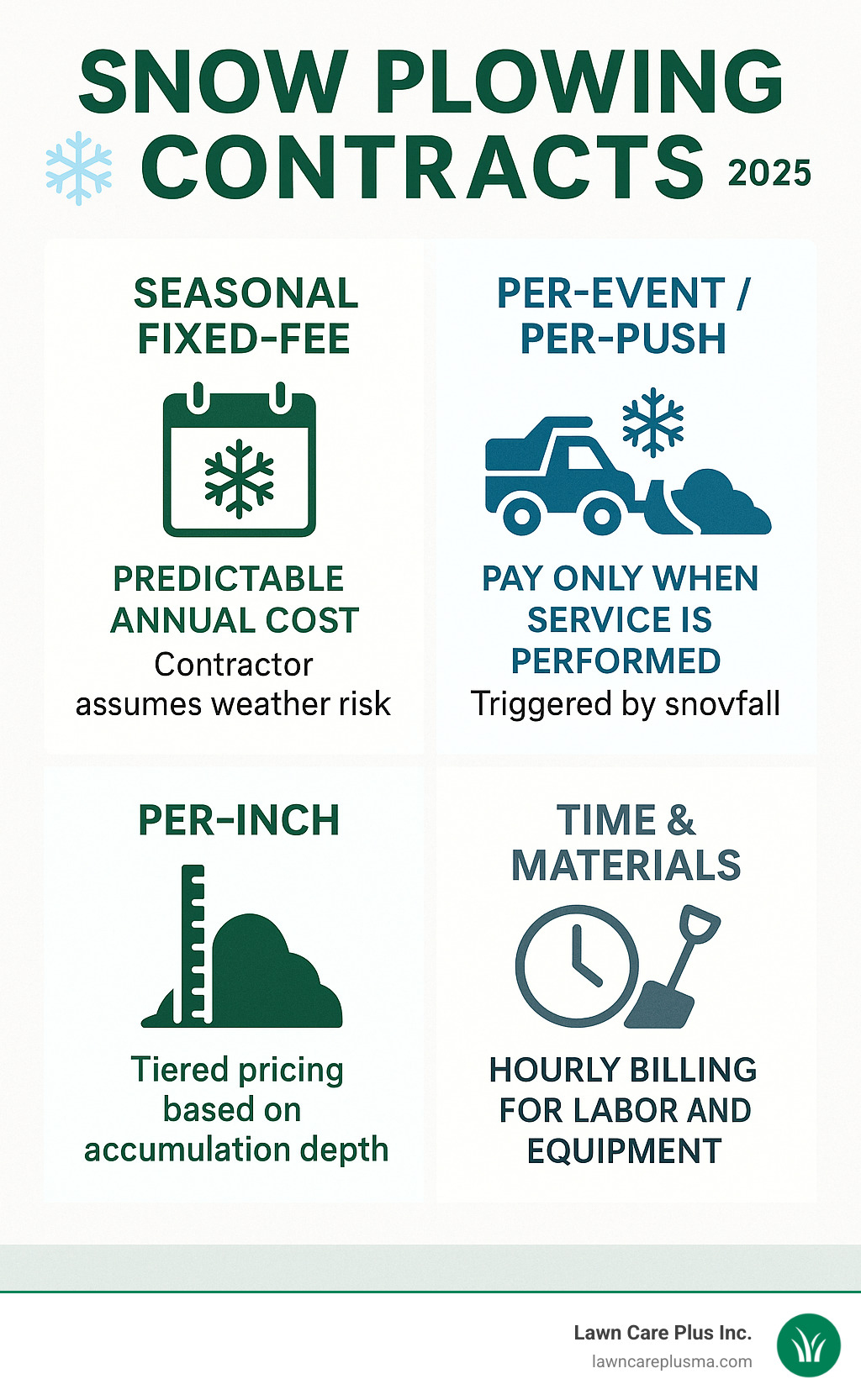
The type of snow plowing contract you choose impacts budget predictability, risk, and service delivery. Understanding the different pricing models helps property owners and contractors find the right fit. A common element is the ‘snow event trigger,’ often 2 or more inches of snow, which signals when service is required.
How Much Does Commercial Snow Removal Cost?
Here’s a quick comparison of the main contract types:
| Contract Type | Cost Predictability (Client) | Risk (Client) | Risk (Contractor) | Best-Fit Client |
|---|---|---|---|---|
| Seasonal (Fixed-Fee) | High | High (light snow years) | High (heavy snow years) | Businesses/properties needing predictable annual budgeting, regardless of snowfall; those prioritizing peace of mind over potential savings in mild winters. |
| Per-Event/Per-Push | Medium | Medium (unpredictable snowfall) | Medium (unpredictable snowfall) | Residential properties or smaller commercial sites with variable snowfall; those who prefer to pay only when service is rendered. |
| Per-Inch/Per-Accumulation | Medium | Medium (scales with snowfall) | Medium (scales with snowfall) | Clients in areas with highly variable snowfall, seeking a fair pricing model that adjusts to the actual amount of snow received; often commercial properties. |
| Time & Materials (T&M) | Low | High (unpredictable costs) | Low (guaranteed payment for work) | Properties with complex layouts, unusual obstacles, or highly specialized needs where the scope of work is difficult to pre-define; emergency services or specific ad-hoc tasks. |
Seasonal (Fixed-Fee) Contract
This contract offers a single, fixed fee for all snow removal services for an entire winter season. This provides predictable budgeting, which is ideal for commercial properties and HOAs in the Boston Metro-West area. The contractor assumes the risk of a heavy snow season, while the client may pay more in a light one. These contracts often span one to three years and typically include plowing, shoveling, and de-icing.
Per-Event or Per-Push Contract
This model is straightforward: you pay each time a service is performed, typically when snow accumulation hits a pre-defined trigger (e.g., 2 inches). You pay only for services rendered, making it a cost-effective option for residential properties or sites with unpredictable weather. Billing is itemized for each event, providing clear cost tracking.
Per-Inch or Per-Accumulation Contract
The per-inch contract uses a tiered pricing model where the cost scales with snow depth. For example, clearing 0-3 inches has one price, while 3-6 inches costs more. This model is fair for both parties during heavy storms, as compensation reflects the effort required. The contract should specify an objective source for snow measurements to ensure billing transparency.
Time and Materials (T&M) Contract
A T&M contract is used for complex or unpredictable scenarios. You are billed at an hourly rate for labor and equipment, plus the cost of materials like salt. While it offers less budget predictability, it’s ideal for properties with intricate layouts or for specific tasks like snow hauling. We maintain detailed logs of time and materials for accurate billing.
Crafting Your Ironclad Snow Plowing Contract: Key Clauses and Considerations
A snow plowing contract is your winter blueprint, ensuring everyone knows what to expect. While online templates exist, consulting a legal expert is wise, as every property is unique. The more specific your agreement, the less chance for confusion.
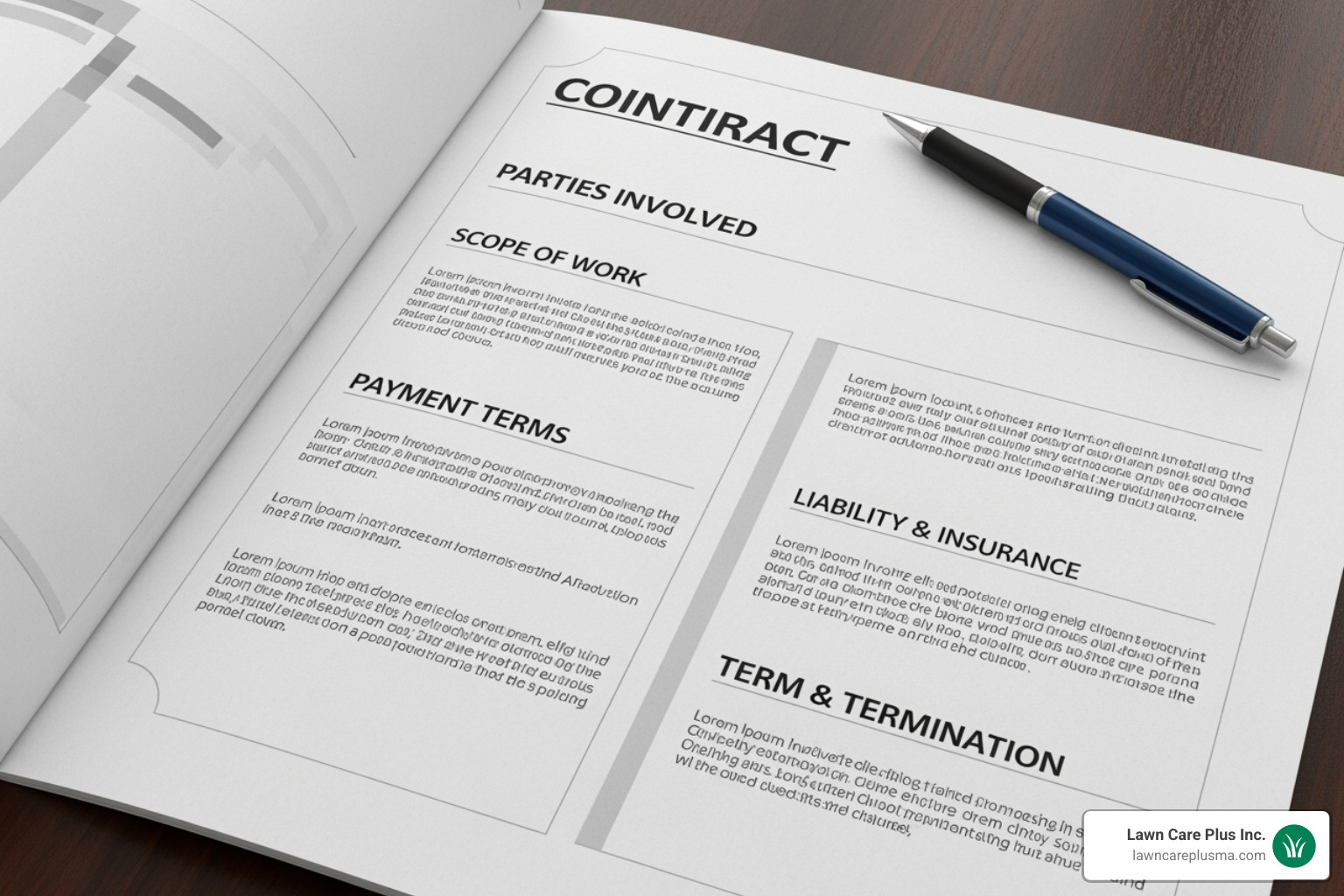
Here’s what makes a contract truly ironclad:
Download a sample contract from Landscape Ontario
Essential Information and Term of Agreement
Every contract must start with the basics: the full legal names of the property owner and the snow removal company, and the exact property address. The agreement should also specify the service dates (e.g., November 1st to April 15th) and the contract duration (typically one to three years for commercial clients). Finally, include renewal and termination clauses that explain how to continue or end the agreement, including notice periods and valid reasons.
Defining the Scope of a Snow Plowing Contract
This section leaves no room for guesswork. It should clearly list all areas to be serviced, such as parking lots, driveways, walkways, entrances, and loading docks, often clarified with a site map. It must also define service triggers, like an accumulation of 2 inches of snow, which dictates when work begins. Other details include response time, whether pre-treatment or post-storm cleanup is included, and the agreed-upon plowing standards (e.g., bare pavement vs. safely passable).
More info about Commercial Property Snow Removal
Specifics for Ice Management and Snow Hauling
Ice is often trickier than snow. The contract must specify if de-icing services (salting, sanding, liquid de-icers) are included or extra. It should also define application triggers (e.g., at contractor discretion or client approval) and acknowledge the limitations of ice melt products. For cleared snow, the contract should detail plans for on-site snow stacking (banking), including safe locations, or off-site snow hauling, which is typically an additional service with its own costs.
Payment Terms and Compensation
Clear financial terms prevent billing surprises. This section outlines the pricing structure (seasonal, per-event, etc.) and the payment schedule, including due dates and accepted methods. To ensure timely payment, it may also include terms for late fees. For new clients, a retainer is common to secure commitment and cover initial prep costs.
Liability, Insurance, and Your Snow Plowing Contract
This is a critical section for peace of mind. We provide proof of insurance via a Certificate of Insurance (COI) showing:
- General Liability Coverage: Protects against injury or property damage claims.
- Workers’ Compensation: Covers our employees if they are injured on the job.
- Automobile Liability: Covers accidents involving our service vehicles.
The contract should name you as an “additional insured” on our policy for added protection. It will also include a “hold harmless clause” and an “indemnification” clause to protect you from claims arising from our work. The contract will define how property damage is handled and include clauses for “acts of God” (e.g., extreme blizzards) to manage expectations during impossible conditions.
Massachusetts Snow Removal Law
Tailoring Your Approach: Commercial, Residential, and Government Contracts
The right snow plowing contract depends on the property type. The scale of work, liability risks, and bidding process vary significantly between commercial, residential, and government jobs.
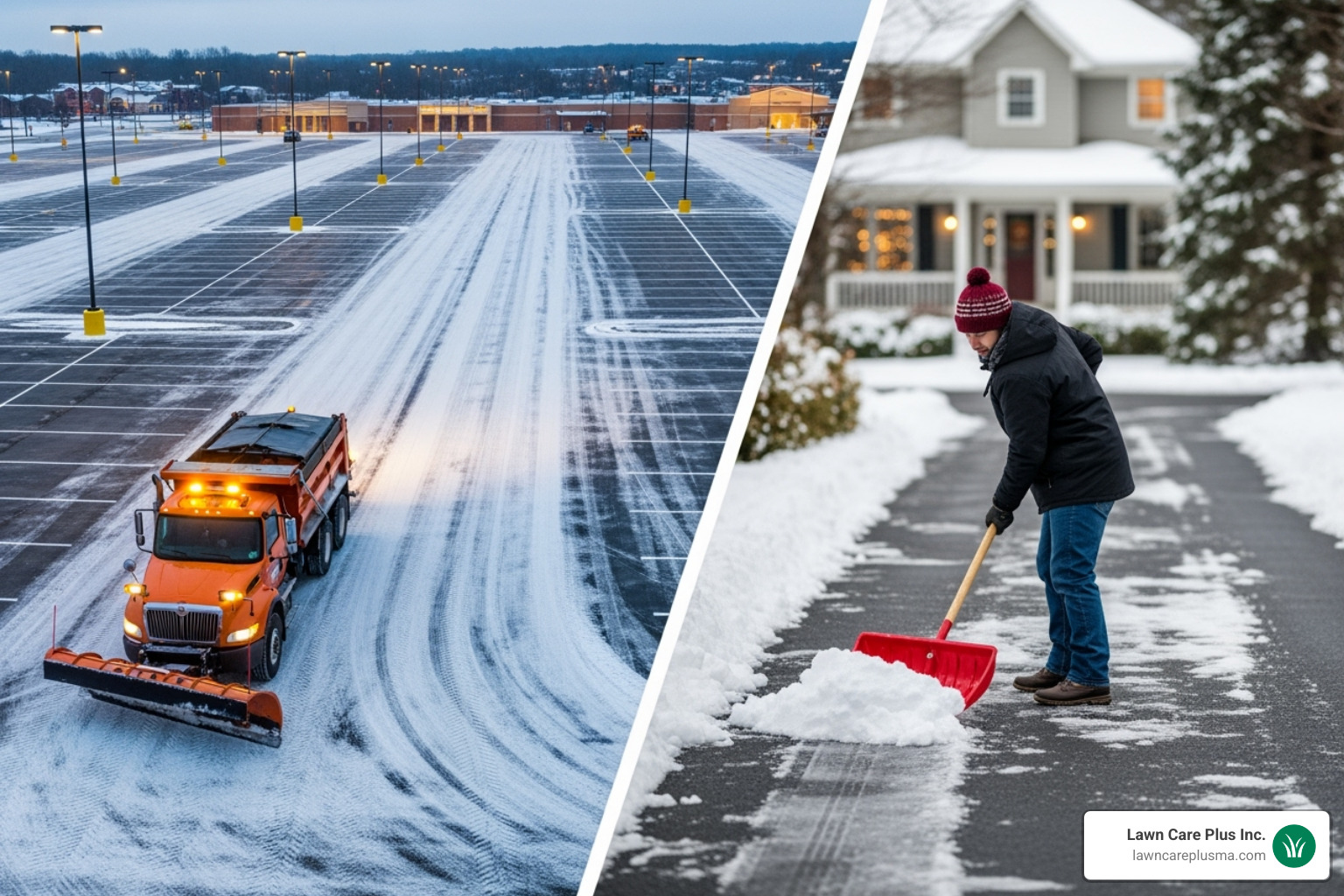
Commercial vs. Residential Contracts
Commercial snow removal contracts are for larger properties like retail centers, healthcare facilities, and office parks. The stakes are higher due to heavy foot and vehicle traffic, increasing slip-and-fall liability. This demands fast response times, 24/7 service availability, and detailed site maps. To ensure budget predictability and consistent service, businesses often prefer multi-year agreements (one to three years).
Residential snow removal contracts focus on smaller properties like driveways and walkways for individual homes. While safety is paramount, response times can be more flexible. Per-push contracts are popular for their cost-effectiveness, and the agreements are generally less complex than their commercial counterparts.
More info about Commercial Plowing Contracts
How to Secure Government Snow Removal Contracts
Securing a government contract is a structured, competitive process. It typically begins with a formal Request for Proposal (RFP), which requires registering as a vendor on government bidding portals. Key requirements often include:
- Mandatory site visits to understand the job’s scope.
- Strict insurance requirements, often with high liability limits and naming the government entity as an “additional insured.”
- Detailed paperwork and certifications.
- Performance bonds to guarantee you can complete the work.
- Compliance with all federal and state regulations (e.g., OSHA) and strict adherence to deadlines.
As a Massachusetts-based company, we understand the local requirements for securing these contracts.
Find government snow removal bids
Frequently Asked Questions about Snow Removal Agreements
Navigating snow removal contracts can bring up questions. Here are answers to some common inquiries to help you feel confident in your winter plan.
What happens if there is an unusually heavy snow season with a seasonal contract?
The primary benefit of a seasonal snow plowing contract is budget predictability. You pay one flat fee, so if a record-breaking amount of snow falls, your cost does not change. The contractor assumes the financial risk of a heavy winter, which is factored into the seasonal rate based on historical weather data. While some contracts may have caps, a typical fixed-fee agreement means the contractor bears the cost of extra work.
Who is responsible for slip-and-fall accidents on a property under contract?
Responsibility is determined by the contract terms and the principle of negligence. A well-written snow plowing contract defines the contractor’s scope of service (when and where we clear snow and ice). The property owner is ultimately responsible for site safety, but the contractor is liable for accidents caused by their own negligence or failure to meet contractual obligations. We carry General Liability insurance and include indemnification clauses to protect both parties, which is why clear documentation and service logs are vital.
Can I request extra services not included in my contract, like clearing a different area?
Yes, most contracts include an “Extra Work” clause. To request a service beyond the defined scope, you would typically submit a written request. We would then provide a quote for the additional work, which would be billed separately from your main contract fee. This ensures both parties agree on the scope and cost before work begins.
Secure Your Peace of Mind This Winter
As winter settles over the Boston Metro-West area, the question isn’t if snow will fall, but if you are ready. A clear snow plowing contract is your best defense against unpredictable New England winters, turning potential chaos into calm assurance.
A strong contract is a win-win. It provides property owners with reliable service and predictable budgeting, while ensuring contractors understand the scope of work. We’ve covered different agreement types—from Seasonal to Per-Event—and the crucial clauses that protect everyone involved.
At Lawn Care Plus Inc., we pride ourselves on offering comprehensive snow management services custom to residential and commercial clients across Massachusetts. We serve communities like Belmont, Boston, Brookline, Canton, Dedham, Needham, Newton, Norwood, Walpole, and many other Metro-West towns. Our experienced team is committed to keeping your property safe and accessible all winter long.
Don’t let winter’s whims disrupt your life or business. Let’s work together to create a snow removal agreement that keeps your property clear and safe.
Contact us for comprehensive Snow Management Services
