
Bricks and Pavers: What’s the Difference and Which Should You Choose?
Bricks and pavers are both popular choices for walkways, driveways, and patios — but they are not the same thing, and choosing the wrong one can cost you.
Here’s a quick comparison to help you decide:
| Feature | Clay Bricks | Concrete Pavers |
|---|---|---|
| Material | Natural fired clay | Cement, sand, and aggregates |
| Color retention | Excellent — color is baked in | Fades over time |
| Durability | Very high | High |
| Maintenance | Low | Low to moderate |
| Aesthetic | Warm, natural, develops patina | Uniform, wider style range |
| Best for | Traditional and heritage looks | Modern designs, budget projects |
Clay bricks have been used in paving for roughly 6,500 years — dating back to ancient Mesopotamia — and their core design has barely changed. That kind of staying power says a lot.
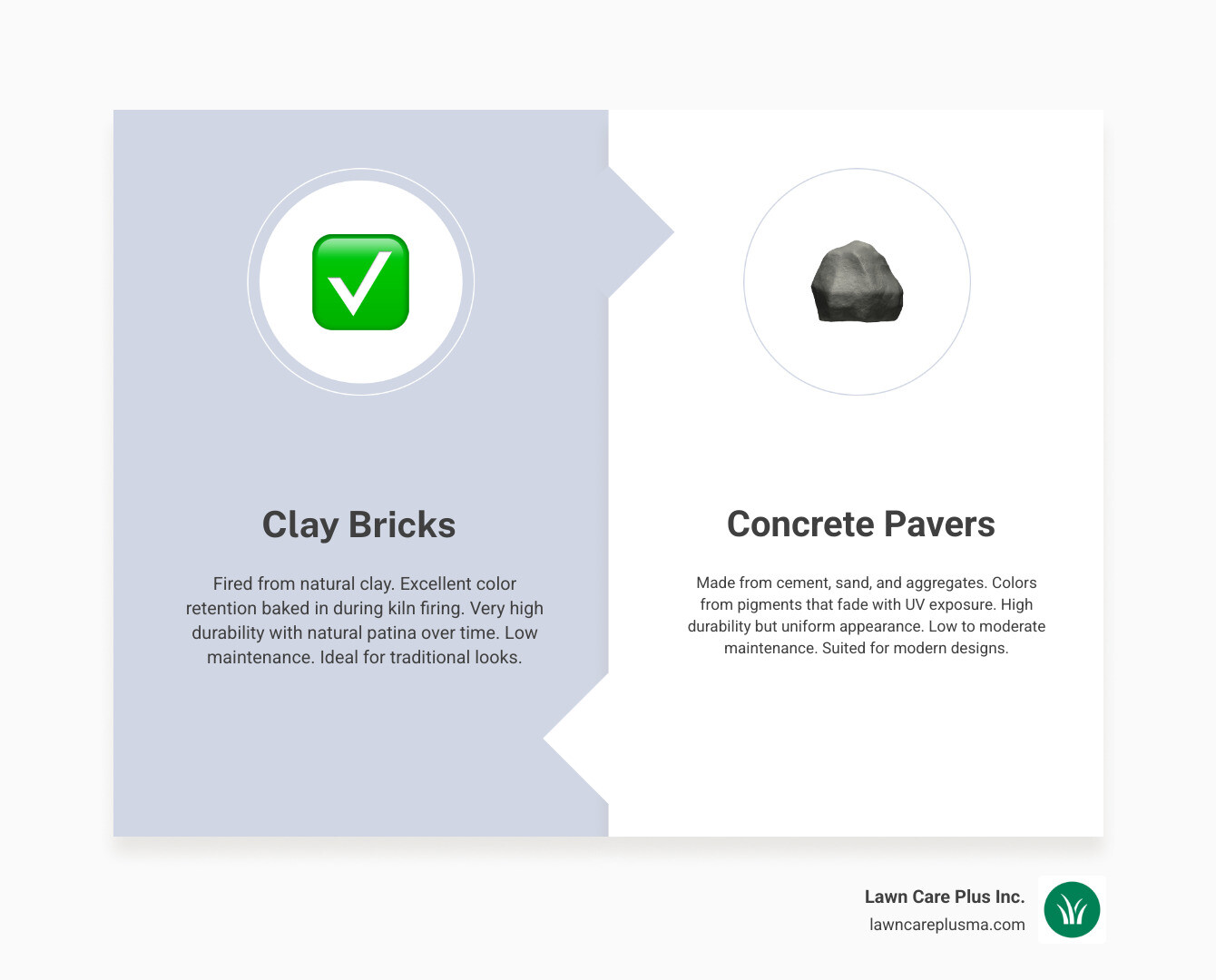
Concrete pavers are a more modern option. They offer more shape and color variety upfront, but the color is achieved through dyes that can fade with sun and weather exposure. Clay pavers, on the other hand, get their color from the clay itself, locked in during kiln firing.
Both materials work well for walkways. But they perform differently over time, cost differently to install, and look very different in a landscape.
I’m Tim DiAngelis, owner of Lawn Care Plus, Inc., a full-service landscaping and hardscaping company based in Roslindale, Massachusetts — and I’ve spent over a decade helping Boston-area homeowners choose and install the right bricks and pavers for their outdoor spaces. In this guide, I’ll walk you through everything you need to know to make a confident decision for your project.
Easy bricks and pavers glossary:
Understanding the Difference Between Clay Bricks and Concrete Pavers
When we talk about bricks and pavers, it’s easy to get the two confused. After all, they both go on the ground, and they both look great. However, the fundamental difference lies in how they are born.
Clay bricks are made from natural earth and fired in a kiln at incredibly high temperatures. This process creates a chemical bond that makes the brick exceptionally hard and gives it its permanent color. On the other hand, concrete pavers are a mixture of cement, sand, and aggregates that are poured into molds and vibrated to achieve density. They rely on added pigments for their color.
While both are technically “paving stones,” their performance under the Massachusetts sun and snow varies. Clay bricks are essentially a natural stone product made by humans, while concrete pavers are a manufactured masonry product. If you want to dive deep into the technical specifications, the BIA Technical Note 14 – Paving Systems Using Clay Pavers is the gold standard for understanding these differences. For those specifically looking for local help, check out our guide to brick masonry services.
What are Clay Paving Bricks?
Clay paving bricks have a pedigree that would make a royal family jealous. Fired bricks have existed for approximately 6,500 years. The earliest examples were found in northern Mesopotamia (modern-day Iraq/Syria) and Chengtoushan, China, originating around 4,500 BCE.
These aren’t just the bricks used for the walls of your house. Paving bricks are specifically engineered to be laid flat and walked (or driven) upon. They are fired at higher temperatures to reduce porosity, meaning they won’t soak up water and crack during our brutal Boston freeze-thaw cycles. Because they are natural, they have a warmth and “soul” that is hard to replicate. If you’re looking for a classic look, you’ll want to talk to specialized brick walkway installers.
The Versatility of Modern Bricks and Pavers
Don’t think that choosing clay means you’re stuck with one look. Modern manufacturing and traditional techniques offer an incredible range of styles:
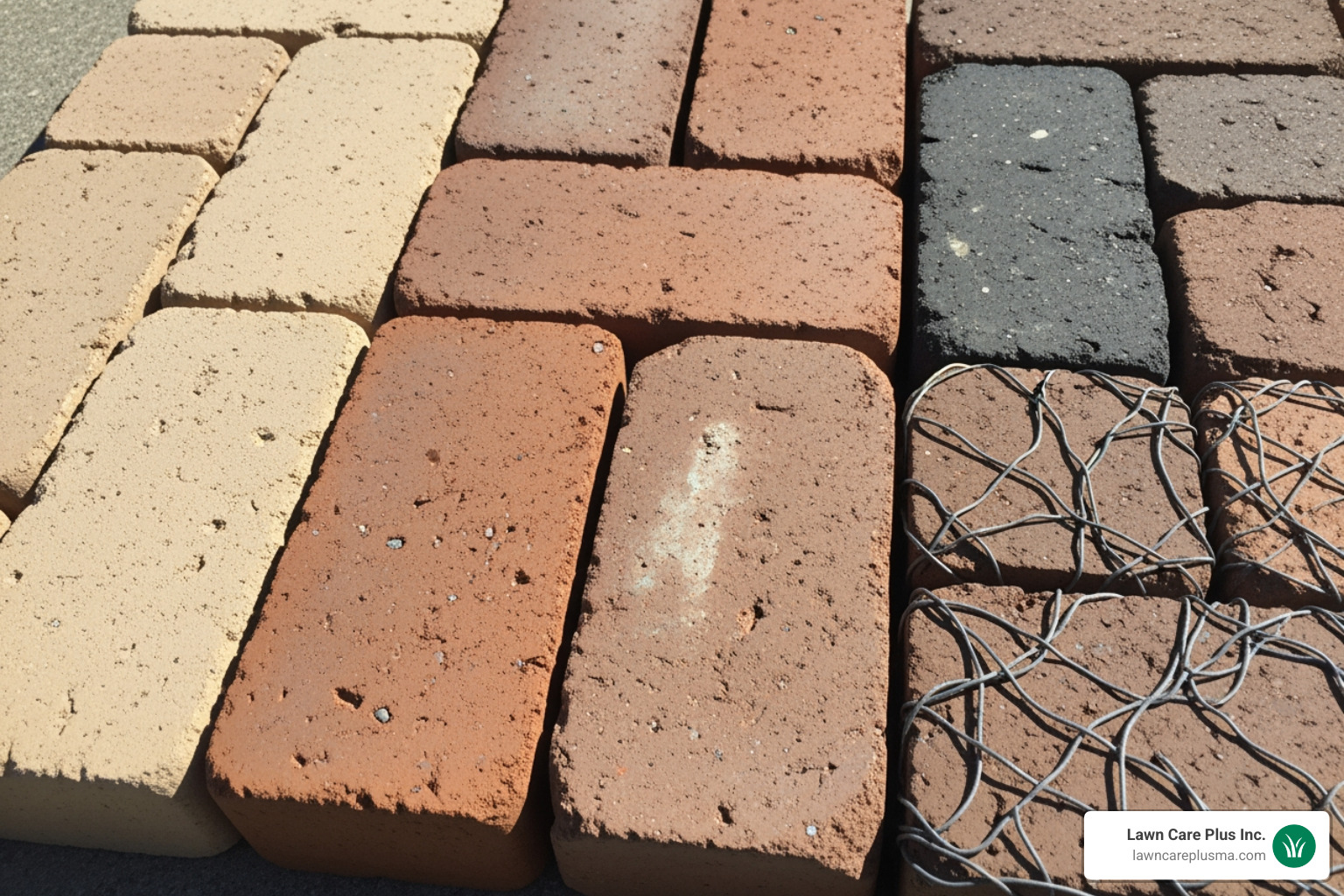
- Handmade Styles: These feature subtle variations in color, texture, and shape. They are perfect for cottage gardens or heritage restorations where you want it to look like the path has been there for a century.
- Dutch Pavers: These are often smaller and more compact, inspired by the traditional streets of the Netherlands. They create a tightly laid, cobbled effect that is very popular in contemporary European-style designs.
- Extruded Bricks: These are made by pushing clay through a die and cutting it. They are very uniform and have crisp edges, making them ideal for modern, clean-lined landscapes.
- Molded Textures: These are dropped into molds, resulting in a more rustic, “old-world” appearance with slightly rounded edges.
Selecting the right one involves balancing aesthetics with functionality. You can read more in our best pavers for walkways guide.
Advantages of Clay Pavers for Walkways and Driveways
In our experience serving areas like Newton and Brookline, we see a lot of homeowners leaning toward clay for its long-term benefits. Here is why bricks and pavers made of clay often win the day:
- Fade Resistance: Because the color is “fired in,” it is UV resistant. A red clay brick will be just as red in fifty years. Concrete pavers, unfortunately, tend to fade to a grayish hue as the pigments wash out over time.
- Non-Slip Surface: Clay has a naturally abrasive texture, providing excellent traction even when wet. This is a huge safety plus for walkways in rainy or snowy weather.
- Frost Resistance: High-quality clay pavers have low water absorption, which is critical for surviving Massachusetts winters without spalling or cracking.
- Natural Patina: Unlike many materials that just look “old” as they age, clay bricks develop a beautiful patina. They actually look better ten years after installation than they did on day one.
- Compressive Strength: Clay is incredibly strong. It can handle the weight of heavy vehicles, making it a top choice for driveways as well as paths.
For those concerned about accessibility, clay systems can be designed to meet all standards, as outlined in BIA Technical Note 14E – Accessible Clay Brick Pavements. You can explore more benefits of paver walkways to see how they fit your lifestyle.
Installation Methods: Sand-Set vs. Mortar-Set Systems
How you lay your bricks and pavers is just as important as the bricks themselves. There are three main ways we handle this in the Boston Metro-West area:
Sand-Set (Flexible)
This is the most common method for residential walkways. The bricks are laid on a bed of compacted sand over a gravel base. The joints are then filled with sand.
- Pros: It allows for slight movement (perfect for frost heave), it’s easy to repair (just pop a brick out and replace it), and it’s generally more cost-effective.
- Cons: Can be prone to weeds if not maintained with polymeric sand. Check out our specific guide on how to install a paver walkway for a step-by-step look at this process. You can also dive into the technicalities with BIA Technical Note 14A.
Mortar-Set (Rigid)
In this method, the bricks are set into a bed of wet mortar over a concrete slab, and the joints are grouted.
- Pros: Extremely stable and has a traditional, masonry look. No weeds!
- Cons: More expensive because it requires a concrete base. If the base cracks due to shifting soil, the bricks and grout will crack too.
Bituminous Bed
This is a hybrid method often used in commercial settings or high-end driveways. The bricks are set in a thin layer of asphalt-based adhesive over a concrete base. It provides the stability of mortar with a tiny bit of flexibility.
Permeable Options
For eco-conscious homeowners in places like Watertown or Belmont, permeable clay pavers are a fantastic choice. These are designed with larger joints or special shapes that allow rainwater to soak back into the ground rather than running off into the street. This helps with local drainage and reduces the load on city sewers.
Durability, Maintenance, and Long-Term Aesthetics
One of the reasons we love bricks and pavers is that they are relatively low-maintenance. However, “low” doesn’t mean “no.”
- Weathering and Efflorescence: You might occasionally see a white, powdery substance on your bricks. This is called efflorescence — it’s just natural salts migrating to the surface. It usually washes away with rain, but we can also clean it if it’s stubborn.
- Joint Sand Stabilization: For sand-set paths, we recommend using polymeric sand. This sand has a binder that hardens when wet, keeping the bricks locked in place and preventing ants and weeds from moving in.
- Cleaning: A simple power wash every few years is usually all it takes to keep a clay walkway looking brand new.
- Restoration: If you have a historic home in Boston or Cambridge with an original brick path that’s looking a bit wonky, don’t tear it out! We can often lift the old bricks, re-level the base, and relay them. For more on this, see our brick restoration guide.
Cost Analysis: What to Expect for Your Project
When planning your budget, it’s important to look at both the material cost and the labor. While concrete pavers are often cheaper to buy, clay bricks frequently offer a better return on investment because they don’t need to be replaced as often.
| Material Type | Estimated Material Cost | Durability Rating | Maintenance Level |
|---|---|---|---|
| Basic Concrete Paver | Lower | High | Moderate |
| Standard Clay Brick | Medium | Very High | Low |
| Handmade/Dutch Clay | Higher | Exceptional | Low |
Note: These are average costs based on internet data and not actual costs for Lawn Care Plus. Prices for materials and installation can range from $10 per square foot to over $60 per square foot depending on the complexity and material choice.
Factors that affect your final price include:
- Site Prep: Does an old concrete walkway need to be jackhammered out?
- Pattern Complexity: A simple running bond is faster to lay than an intricate herringbone.
- Access: Can we get our equipment into your backyard easily, or are we carrying bricks through a narrow gate in Brookline?
For a deeper dive into the numbers, check out the cost to install a paver walkway.
Frequently Asked Questions about Bricks and Pavers
Are clay pavers suitable for high-traffic driveways?
Absolutely. In fact, many historic streets in European cities are still paved with clay bricks that have seen centuries of traffic. For a residential driveway, we typically use bricks that are 50mm to 80mm thick (about 2 to 3 inches). When installed over a proper base, they have an incredible load-bearing capacity that rivals or exceeds concrete.
What are the most popular design patterns for walkways?
The pattern you choose changes the “vibe” of your home:
- Herringbone: The classic. It’s the strongest pattern because the bricks interlock, preventing shifting. It looks great on both traditional and modern homes.
- Basketweave: Provides a charming, woven look that is perfect for garden paths.
- Running Bond: Simple and clean. It’s great for making a narrow path look longer.
- Stacker Bond: Very modern, but requires a very stable base as the bricks don’t interlock.
You can see these patterns in action in our guide on building a paver patio.
Do clay pavers require sealing to prevent fading?
No! That is the best part. Unlike concrete, which needs to be sealed every few years to keep its color from bleaching out, clay is colorfast. You can seal them if you want a “wet look” or extra protection against oil stains on a driveway, but it is not necessary for color retention.
Conclusion
Choosing between bricks and pavers is a big decision for your home’s curb appeal and functionality. While concrete pavers offer a wide range of initial styles and a lower entry price, the timeless beauty, durability, and fade resistance of clay bricks are hard to beat — especially in the varied climate of Massachusetts.
At Lawn Care Plus Inc., we’ve been the go-to experts for landscaping and hardscaping in the Boston Metro-West area for years. Whether you are in Newton, Needham, or Milton, our team has the experience to help you design and install a walkway that will last for generations. From site prep to the final sweep of joint sand, we handle it all with the care your home deserves.
Ready to transform your outdoor space? Explore our professional walkway and stair installation services and let’s get started on your dream project today!
