
Why Commercial Snow Removal Contracts Are Critical for Business Success
Commercial snow removal contracts are legally binding agreements between property owners and snow removal contractors that define services, pricing, and responsibilities during winter. These contracts protect businesses from liability while ensuring safe, accessible properties throughout the snow season.
Key contract types include:
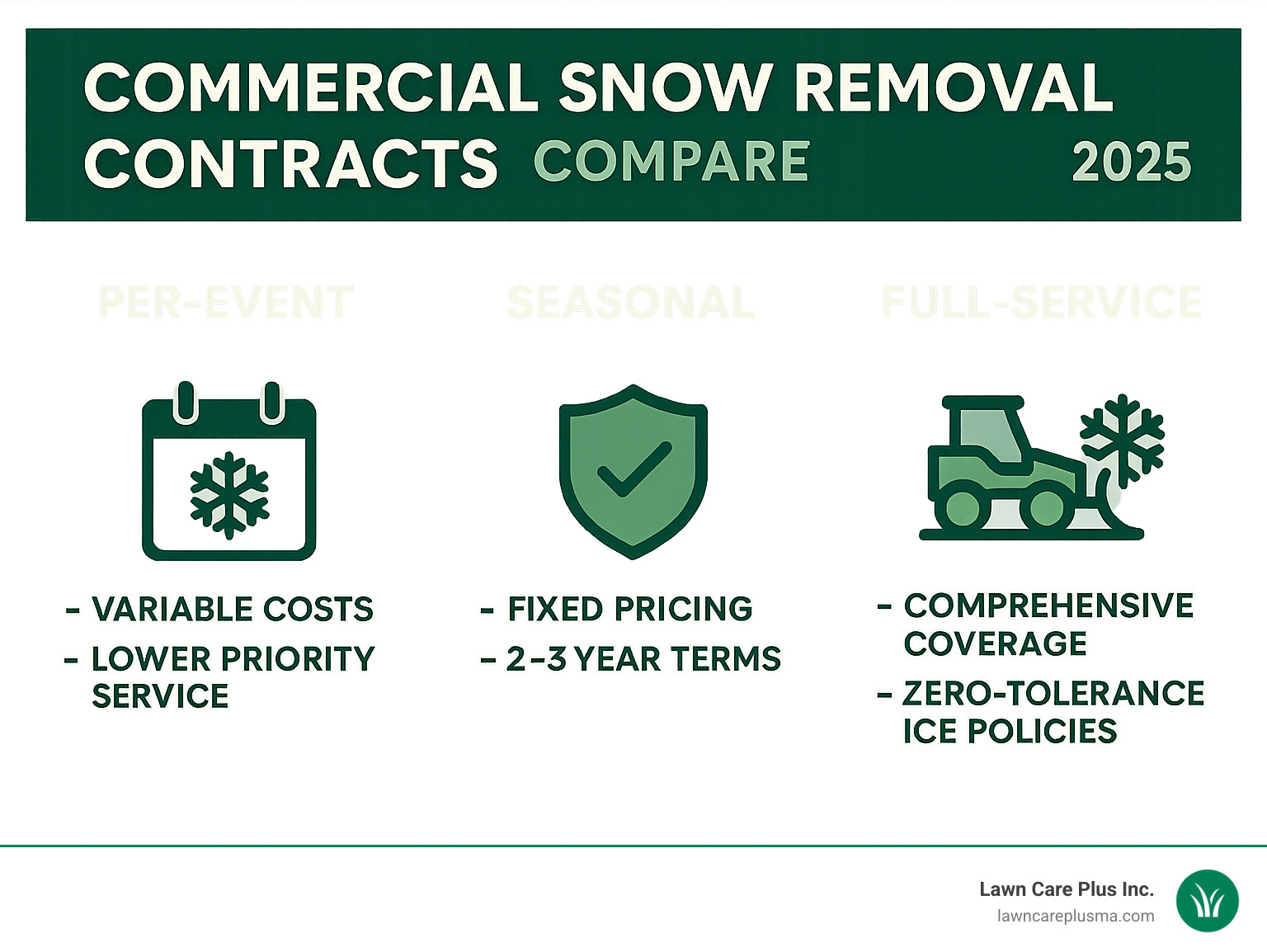
- Per-Event Contracts – Pay only when snow is removed (typically after a specific trigger, like 2+ inches).
- Seasonal Contracts – A fixed price for the entire winter season, often for 2-3 years.
- Full-Service Contracts – Comprehensive coverage including proactive ice management and site monitoring.
Essential contract components:
- Clear scope of work and designated service areas
- Specific snow accumulation triggers for service
- Guaranteed response times
- Insurance and liability provisions
- Payment terms and schedules
A single snowstorm can shut down your business, create dangerous conditions, and expose you to costly slip-and-fall lawsuits. Without a contract, you’re gambling with your business continuity, reputation, and bottom line. Smart property managers start their procurement process as early as May to secure competitive pricing and favorable terms. Waiting until the first snowfall leads to higher costs and rushed, unclear agreements. A reliable snow removal contract isn’t just about clearing parking lots—it’s about protecting your business.
Easy commercial snow removal contracts glossary:
- commercial snow removal services
- how much does commercial snow removal cost
- commercial snow removal companies
Decoding the Different Types of Commercial Snow Removal Contracts
When winter weather threatens your business, having the right commercial snow removal contracts in place can make all the difference between smooth operations and costly disruptions. Think of it like choosing an insurance policy—you want coverage that fits your specific needs and budget without leaving you exposed when a storm hits.
| Contract Type | Cost Structure | Predictability | Ideal Property Type |
|---|---|---|---|
| Per-Event | Pay-per-push; variable costs based on snowfall | Low | Properties in low-snowfall areas or those with a higher tolerance for budget fluctuations. |
| Seasonal | Fixed price for the entire winter season | High | Businesses requiring budget certainty and consistent, reliable service (e.g., retail, office parks). |
| Full-Service | All-inclusive premium fixed price | Highest | Critical facilities like hospitals, distribution centers, or properties with zero-tolerance policies for snow and ice. |
Key Components of an Ironclad Agreement
Your commercial snow removal contract is the blueprint for winter peace of mind. A well-crafted agreement protects everyone and sets clear expectations, preventing disputes during a storm. We encourage clients to review resources like the Snow Removal Contract Template | Samples (3) to understand what a comprehensive contract should include. The key is leaving nothing to chance.

Defining the Scope of Work
This section must be crystal clear about what gets done, where, and how. We start every partnership by creating a detailed site map that marks every area to be serviced, eliminating confusion for our crews.
- Priority areas are marked first: main entrances, loading docks, emergency exits, and high-traffic walkways.
- All areas to be cleared are identified, including parking lots, driveways, sidewalks, and stairs.
- Snow pile locations are designated to prevent drainage issues or blind spots. The contract should specify if snow will be banked on-site or hauled away, which is necessary for properties with limited space.
More info about hardscaping services
Service Triggers and Response Times
This section requires precision to avoid confusion about when service begins.
- Snow accumulation triggers define when crews are dispatched. The standard is often 2 inches, but it can be customized to your property’s needs.
- Ice events need special attention. Smart contracts include pre-treatment clauses for applying deicers before a storm to prevent ice from bonding to surfaces.
- Response times are guaranteed after a trigger event. This is critical for businesses that open early.
- Post-storm follow-up provisions should be included for return visits to touch up areas or reapply treatments as conditions change.
Legal, Insurance, and Liability Clauses
This is your safety net. A legitimate contractor will provide proof of insurance without hesitation.
- Insurance coverage is the foundation. We carry comprehensive general liability coverage to protect against personal injury and property damage claims.
- Indemnification clauses and hold-harmless agreements define who is responsible if an incident occurs, clarifying responsibilities before problems arise.
- Pre-existing damage documentation protects everyone. We conduct site inspections before the season to document the condition of curbs, pavement, and other features, creating a clear baseline.
Investing in crew training, such as programs from Effective training, reduces accidents and claims, which benefits everyone. A solid contract isn’t about preparing for failure—it’s about setting everyone up for success.
Understanding Pricing and Influencing Factors
The cost of commercial snow removal contracts is based on clear factors. Your property’s unique characteristics, the required service level, and the de-icing materials used all determine the final investment.
According to the median pay for grounds maintenance workers, the rate is around $17.05 per hour. However, professional snow removal rates vary significantly based on equipment, expertise, and market demand, often commanding higher rates due to the investment and urgency involved.
How Property Characteristics Affect Cost
Every commercial property is different, which directly impacts your snow removal cost. A simple, flat lot is less expensive to clear than a complex property with multiple obstacles.
- Total square footage is the starting point, but the number of parking spaces and length of walkways also add to the time and labor required.
- Obstacles like decorative islands, fire hydrants, and light poles require operators to slow down and maneuver carefully.
- Topography and drainage are key. Sloped properties or those with poor drainage often require more de-icing applications to manage ice buildup.
How Weather Variability Impacts Pricing
Winter weather’s unpredictability plays a big role in pricing commercial snow removal contracts.
- Average snowfall data provides a baseline, but severe winters can deviate significantly from the norm.
- The risk of severe storms is factored in, as major blizzards require continuous work, concentrating labor and fuel costs into a short period.
- This variability makes the per-event versus seasonal cost comparison critical. In a heavy snow year, a seasonal contract is often more cost-effective.
- Fuel cost fluctuations and material availability, such as salt shortages during harsh winters, can also affect operating costs and pricing.
What Factors Influence the Pricing of commercial snow removal contracts?
Beyond property and weather, several other factors shape your investment:
- Contract type: Per-event, seasonal, and full-service contracts have different cost structures.
- Level of service: A zero-tolerance policy that keeps your property clear at all times costs more than a contract with higher accumulation triggers.
- Geographic location: Urban properties may have higher labor costs and require more expensive snow hauling due to space limitations.
- Type of de-icing materials: Liquid deicers may be more effective or eco-friendly than rock salt but have a different cost profile. Standard salt is also less effective in extreme cold.
- On-site vs. off-site snow hauling: Banking snow on-site is economical, but hauling it away is necessary when space is limited, adding to the cost.
The Procurement Process: Don’t Wait for the First Flake
The best time to secure your commercial snow removal contracts isn’t right before the first snowfall, but months in advance. Proactive planning is essential for securing the service you need at a competitive price.

Waiting until October or November is a common mistake. By then, the best contractors are often booked, leading to higher prices, limited options, and rushed agreements. Your property could end up at the bottom of the priority list when the first big storm hits.
The Ideal Timeline for Securing a Contractor
For the best results, follow this procurement timeline:
- Spring Planning (May-July): Research contractors, request quotes, and compare offerings.
- Summer Site Visits: Walk the property with potential contractors to identify obstacles, plan snow pile locations, and map efficient equipment routes.
- Fall Contract Finalization: Have your contract signed and in place by early autumn. This allows the contractor to prep equipment and train crews for your property.
- Winter Execution: With a plan in place, your contractor can provide professional, efficient service when the snow arrives.
- Post-Season Review: After winter, review the service to identify improvements for the next season. More info about spring yard clean ups
Vetting Your Snow Removal Partner
Choosing the right contractor is a critical business decision. Here’s what to look for:
- References: A reputable contractor will provide references. Call them to ask about response times, communication, and overall satisfaction.
- Insurance Verification: Ensure they have comprehensive general liability, commercial auto, and workers’ compensation coverage. A minimum of $1,000,000 in coverage is a common requirement.
- Equipment and Manpower: Assess if they have the right equipment and sufficient crews to handle your property and a major storm.
- Contingency Plan: Ask what happens if equipment breaks down. Professionals have backup equipment and personnel.
- Communication Processes: Clear communication is crucial. Understand how they will notify you of service and how you can reach them with issues.
Best Practices for Managing Risk in commercial snow removal contracts
Smart risk management creates a smooth partnership all winter.
- Pre-season site inspections with your contractor establish a baseline of your property’s condition, preventing disputes over damages.
- Detailed service documentation from your contractor keeps everyone accountable. Maintain your own logs as well.
- A single point of contact on your team streamlines communication and ensures faster problem resolution.
- Understanding de-icing methods helps you make informed choices. Rock salt can damage surfaces, while liquid de-icers are often gentler and better for pre-treatment.
- A post-season cleanup and review ensures your property is restored and provides feedback for future service.
Frequently Asked Questions about Commercial Snow Removal Contracts
We get a lot of questions about commercial snow removal contracts. Here are the most common ones, with our straight-up answers.
What is the most significant risk for businesses without a proper snow removal contract?
The most significant risk is liability from slip-and-fall lawsuits, which can lead to devastating financial consequences from legal fees and settlements. Beyond liability, there’s also the risk of business disruption. If customers and employees cannot safely access your property, you face lost revenue, decreased productivity, and a damaged reputation. A proper commercial snow removal contract mitigates these risks by creating a clear plan for safety and accessibility.
How much do commercial snow removal services cost?
The honest answer is that costs vary widely, much like the price of a car. Based on industry data we’ve gathered from various sources (and remember, these are market averages, not our specific prices), here’s a general idea:
- Per-push contracts for smaller commercial properties can range from $150 to $500 per event. For larger or more complex sites, this could increase to $1,500 or more per event.
- Comprehensive seasonal contracts for large commercial campuses can range from $10,000 to over $50,000 for the winter. For properties with extensive needs and zero-tolerance policies, seasonal costs could exceed $150,000.
The wide range reflects factors like property size, complexity, and service level. We always recommend getting a detailed quote customized to your exact needs.
Should I choose a contract with a snow cap?
A snow cap sets a limit on the total snowfall covered by a seasonal contract. If snowfall exceeds this cap, you pay extra, often at a higher per-inch or per-event rate. While this may seem cost-effective for mild winters, New England’s unpredictable weather can lead to unexpected, budget-breaking bills in a heavy snow year. For this reason, a true fixed-price seasonal contract without a snow cap generally offers superior budget protection and peace of mind. It provides a single, predictable cost for the entire season, balancing the risk between the client and contractor over the contract’s term.
Ensure Your Property is Safe and Accessible This Winter
For commercial snow removal contracts, preparation and partnership are key. Winter weather demands that your property is either safe and accessible or it’s not—there is no middle ground for your customers and employees.
The central theme of this guide is that proactive planning pays off. Starting your contractor search in late spring or early summer is essential for securing quality service at competitive rates. Waiting until fall often leads to higher costs and lower-quality service.
Choosing the right contract type is critical. A seasonal contract without a snow cap offers budget certainty, while a full-service contract provides the highest level of protection for critical operations. Per-event contracts may seem appealing but carry the risk of high costs in heavy snow years.
Vetting your contractor is about more than price. You need a partner with proper insurance, backup equipment, and clear communication protocols. The cheapest bid is rarely the best value when liability and business continuity are at stake. The relationship should be a true partnership, with a contractor who knows your property and has a plan for any winter scenario.
At Lawn Care Plus Inc., we’ve been helping businesses across the Boston Metro-West area manage winter weather for years. We serve communities from Belmont to Watertown, and everywhere in between, including Boston, Brighton, Brookline, Canton, Chestnut Hill, Dedham, Hyde Park, Jamaica Plain, Mattapan, Medfield, Milton, Needham, Newton, Norwood, Randolph, Readville, Roslindale, and Walpole.
Our approach to commercial snow removal contracts focuses on building long-term partnerships. We take the time to understand your property, business needs, and budget to create a plan that keeps your property safe and accessible.
Don’t let another winter catch you unprepared. The best time to secure your snow removal partner was last spring. The second-best time is right now.
Contact us for a comprehensive commercial property maintenance plan
