
Why Deck Builders Are More Than Just Tools
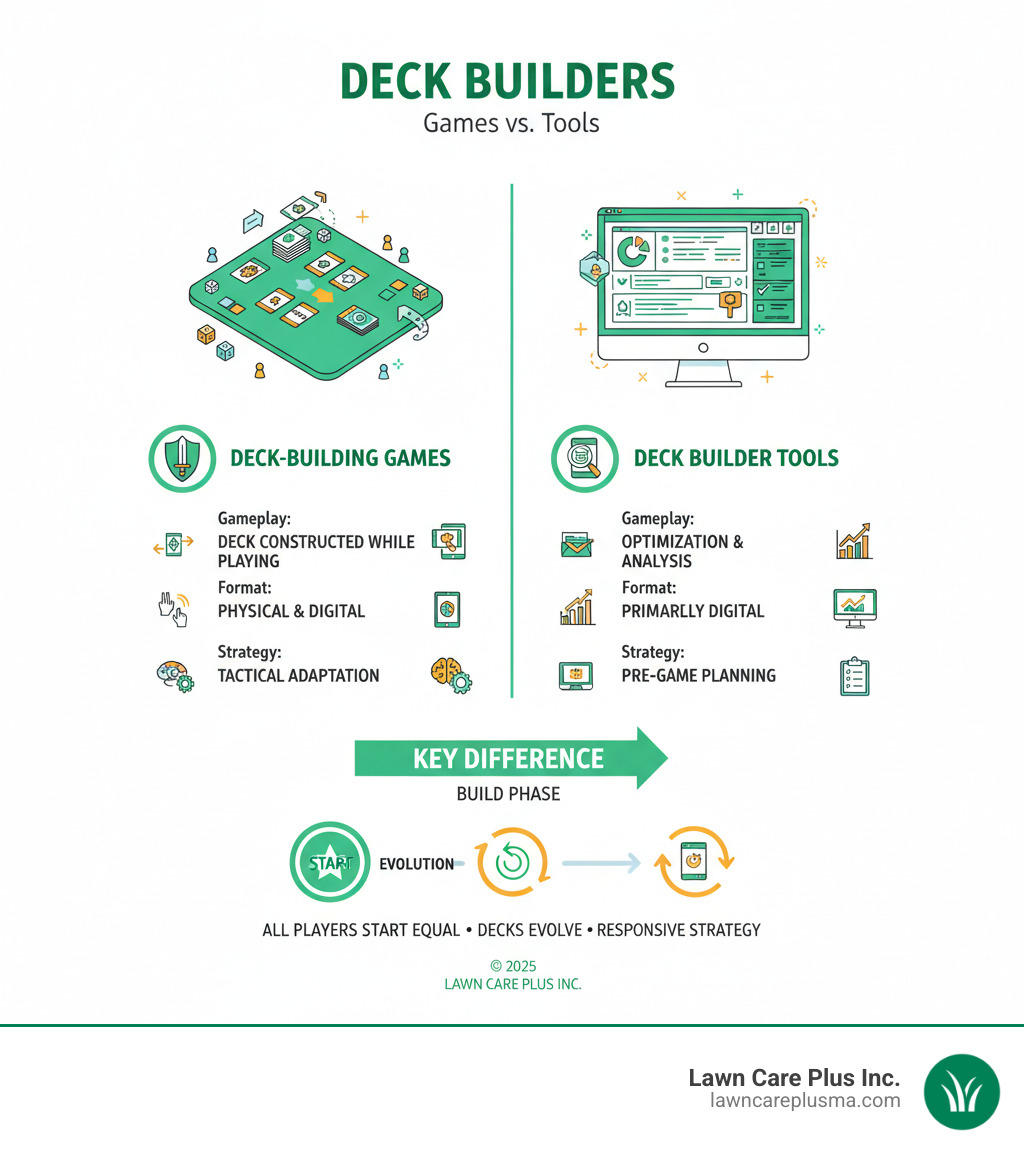
A deck builder in gaming refers to both a genre of card games where you construct your deck during gameplay and the digital tools that help you optimize your card selection and strategy. Here’s what you need to know:
Understanding Deck Building Tools:
- Deck-Building Games – Card or board games where building your deck is core gameplay (like Dominion or Slay the Spire)
- Deck Builder Tools – Digital applications that help you search cards, analyze statistics, and optimize your deck construction
- Key Difference from CCGs – Unlike collectible card games, deck-builders don’t use randomized booster packs and everyone starts equal
- Strategic Value – These tools visualize your deck’s curve, test sample hands, and help you identify winning card combinations
Whether you’re shuffling physical cards at your kitchen table or clicking through a digital interface, deck-building games offer something special. They combine the thrill of findy with deep strategic thinking. Every game starts with a small, weak deck of basic cards. But that’s just the beginning.
As you play, you acquire more powerful cards from a shared market, gradually changing your deck into a finely-tuned engine. The best part? You’re not locked into decisions you made before the game started. Every choice happens in real-time, responding to what’s available and what your opponents are doing.
The genre has exploded since Dominion set the standard in 2008. Now we have everything from cooperative adventures like Harry Potter Hogwarts Battle to roguelike video games like Slay the Spire, which helped define an entirely new subgenre when it launched in 2017.
I’m Tim DiAngelis, owner of Lawn Care Plus Inc., and while my expertise lies in building beautiful outdoor spaces rather than card combinations, I appreciate how both deck builders and landscape designers share a common goal: creating something functional and beautiful from individual components. Just as a deck builder tool helps gamers optimize their strategy, proper planning and the right materials transform an ordinary backyard into an extraordinary outdoor living space.
Key deck builder vocabulary:
What is a Deck-Building Game? The Core Mechanics
Picture this: you’re sitting down to play a card game, but instead of arriving with a carefully crafted deck, everyone starts with the same humble pile of basic cards. That’s the magic of a deck-building game.
A deck-building game turns the traditional card game format on its head. Creating and improving your deck isn’t pre-game prep—it’s the entire point of playing. You begin with a small collection of weak cards, perhaps giving you a single coin or an extra card. As the game unfolds, you’ll buy better cards from a shared marketplace, slowly turning your starter deck into a well-oiled machine.
The goal? Build a more efficient and powerful deck than your opponents. Depending on the game, you might be racing to collect victory points, defeating monsters, or conquering territories. Every card you add changes how your deck performs, creating unique combinations and strategies. This constant evolution means no two games ever feel quite the same.

As Destructoid.com puts it perfectly, “So what exactly is a deck-building game anyway?” It’s a game where building your deck is just as important as playing the cards themselves.
The Building Blocks of Gameplay
Let’s break down how a typical deck builder works. The mechanics are simpler than they sound.
Everyone begins with their starting deck, usually identical to everyone else’s. These basic cards might let you gain one or two coins, or draw an extra card. Nothing exciting yet, but they get the ball rolling.
On your turn, you’ll play cards to generate in-game currency. This currency lets you “purchase” new cards from the central market—a shared pool of available cards that all players can see and buy from. These market cards pack more punch than your starting cards, offering stronger effects, more money, or direct victory points.
When you buy a new card through card acquisition, it doesn’t go into your hand. Instead, it lands in your discard pile. You’ll have to wait a bit before using your new purchase.
The discard pile mechanics create an exciting rhythm. After you finish your turn, everything goes into your discard pile—cards you played and cards you didn’t. When your draw deck runs empty, you shuffle your discard pile to create a fresh draw deck. This means every card you buy will eventually cycle back into your hand, becoming part of your growing arsenal.
One of the most powerful strategies involves deck thinning. Many games let you remove weak cards from your deck entirely. Getting rid of those basic starter cards means you’re more likely to draw your powerful combinations. It’s like pruning a garden—sometimes you need to cut away the weak growth to help the strong parts flourish.
Strategy vs. Luck
While there’s randomness in drawing cards, deck-building games give you plenty of control to outsmart bad luck and reward smart planning.
The central market constantly shifts as players buy cards and new ones appear. You can’t just follow a memorized strategy. You need to adapt on the fly, deciding which cards fit your current plan, when to streamline your deck, and how to set up powerful card combos.
This engine building aspect is deeply satisfying. The cards you buy early set up even stronger plays later. Maybe you grab cards that let you draw more cards, which then lets you play more money-generating cards, which then lets you buy even better cards. It’s a snowball effect of your own design.
The continuous decision-making keeps you engaged. Should you buy that powerful card now, or two cheaper ones? Is it time to thin weak cards, or keep building? The replayability comes from finding new synergies and refining your approach each game. Like designing a patio or garden, there are endless strategies to explore in deck-building games.
From Tabletop to Pixels: The Evolution of the Deck Builder Genre
The deck-building game genre may be young, but it’s had quite the journey. What started as a fresh twist on tabletop gaming has exploded into the digital field, spawning countless variations and capturing the hearts of strategy gamers everywhere.

The Origins: A New Genre is Born
Before deck-building games came along, collectible card games (CCGs) like Magic: The Gathering ruled the card game world. The catch? CCGs required players to buy randomized booster packs, which meant your success often depended on how much money you’d invested in your collection.
The deck builder genre changed all that. It emerged as a breath of fresh air, giving everyone an equal starting point. The first game to experiment with this idea was StarCraft: The Board Game in 2007. But it was Dominion, released in 2008, that truly cracked the code and became a sensation.
Dominion’s brilliance lay in its simplicity. Everyone starts with the same basic cards. Everyone has access to the same market. Your success depends entirely on the choices you make during the game, not the size of your wallet. This approach resonated with players who wanted strategy to trump collection size.
The core difference between a deck builder and a CCG comes down to timing and fairness. In deck-building games, you don’t buy randomized packs, and you construct your deck during gameplay rather than before. This levels the playing field completely, making every match a test of strategy rather than spending power.
Just as a skilled gardener selects and arranges plants to create a beautiful landscape, a great deck builder player chooses cards to craft a winning strategy. Speaking of building, if you’re looking to create your own outdoor masterpiece, we at Lawn Care Plus Inc. specialize in designing beautiful outdoor living spaces. Check out more info about our Deck and Patio Builder services in Massachusetts, including Belmont, Boston, Newton, and Dedham.
The Rise of the Roguelike Deck Builder
When deck-building mechanics jumped from tabletops to computer screens, something magical happened. Digital versions of physical deck-building games had existed for a while, faithfully recreating their cardboard cousins. But then came the roguelike deck-builder, and everything changed.
This subgenre blends the strategic satisfaction of building your deck during gameplay with the thrilling unpredictability of roguelike games. What does that mean? Think procedurally generated challenges, permanent consequences when you lose, and randomized rewards that keep you on your toes. Every single playthrough feels completely different.
Slay the Spire burst onto the scene in 2017 and proved this combination was pure gaming gold. The game masterfully married tactical card play with roguelike exploration, creating an experience that was both deeply strategic and wildly unpredictable. As Julian Gollop observed in “The Gollop Chamber: Rise of the roguelike deck builder”, this new wave of games captivated players with its perfect blend of tactical depth and unexpected twists.
In roguelike deck-builders, you’re not just building a deck—you’re forging a unique path through each run, adapting to whatever the game throws at you. Sometimes you’ll triumph gloriously. Other times you’ll crash and burn spectacularly. Either way, you’ll want to jump right back in for another attempt.
Popular Subgenres and Examples
The beauty of deck-building mechanics is their flexibility. The core concept has branched out into numerous subgenres, each offering its own unique flavor of strategic card play.
Pure deck-builders keep things focused on the cards themselves, with minimal other mechanics cluttering the experience. Dominion remains the gold standard here, alongside games like Ascension: Deckbuilding Game and Star Fields. These games are all about acquiring the right cards and playing them at the perfect moment.
Deck-building with board movement adds an exciting spatial element to the mix. Clank! A Deck-Building Adventure exemplifies this brilliantly. You’re using cards to move through a dungeon, snatch treasure, and escape—all while trying not to make too much noise that might wake the dragon. With over 42,000 voters giving it an impressive 7.78 average rating on BoardGameGeek, it’s clear players love this combination.
Cooperative deck-builders let you team up with friends instead of competing against them. Harry Potter Hogwarts Battle: A Cooperative Deck-Building Game brings players together to defend the wizarding world from dark forces. There’s something special about building your deck alongside your teammates, working toward a shared victory.
Player versus player combat takes deck-building in a more aggressive direction. Games like Star Fields and Hero Fields pit you directly against opponents in a race to reduce their health to zero. You’re building your deck to become an unstoppable combat machine.
Roguelike deck-builders have already earned their own discussion above, with Slay the Spire leading the charge alongside titles like Dream Quest and Monster Train. These digital experiences offer endless replayability through their procedurally generated challenges.
Thematic deck-builders wrap the mechanics in beloved franchises and rich storytelling. Legendary: A Marvel Deck Building Game lets you assemble superhero teams to battle supervillains, earning a solid 7.53 average rating from over 22,000 voters. DC Deck-Building Game: Confrontations and Mistborn: The Deckbuilding Game offer similar experiences in their respective universes. Even Magic: The Gathering offers “Deck Builder’s Toolkits” to help new players get started, with toolkits scoring an impressive 7.57 average from nearly 40,000 voters.
The genre’s evolution shows no signs of slowing down. From humble beginnings on kitchen tables to complex digital adventures, deck builders continue to captivate players who love the combination of strategic planning and in-the-moment decision making.
Crafting Your Winning Strategy: How to Use a Deck Builder Tool
While the joy of deck-building games lies in the in-game construction, digital deck builder tools lift the experience by allowing players to carefully plan, analyze, and optimize their strategies outside of active gameplay. These tools are invaluable for competitive players and enthusiasts alike, offering a virtual laboratory for perfecting your card combinations.

Step 1: Know Your Game and Your Goal
Before you even open a digital deck builder, you need to understand exactly what you’re trying to accomplish. Think of it like planning a landscape project—you wouldn’t start digging without knowing what you want to create, right?
Start by mastering your game’s core rules and win conditions. Are you racing to accumulate victory points? Trying to defeat an opponent in direct combat? Surviving a gauntlet of challenges? Each objective demands a different approach to deck construction.
Next, dive into the meta-game. For popular competitive games, there’s always a prevailing strategy—the decks and tactics that dominate tournaments and online play. Understanding the meta helps you anticipate what you’ll face and how to counter it. It’s like knowing which plants thrive in Massachusetts weather before you start your garden.
You’ll also want to familiarize yourself with common deck archetypes. Aggro decks focus on quick, early damage to overwhelm opponents before they can establish defenses. Control decks disrupt your opponent’s plans and win through attrition and powerful late-game plays. Combo decks seek specific card combinations that create explosive, often game-winning turns. Midrange decks balance early defense with strong mid-game threats, while Ramp decks accelerate resource generation to play powerful cards earlier than usual.
Understanding these archetypes guides your card selections and helps you build something cohesive. As the “Learn how to build a Riftbound Deck” guide wisely notes, your central strategy piece is the keystone of everything else, and you should build around what you genuinely enjoy while considering how different elements work together.
Step 2: The Art of Card Selection and Synergy
Here’s where the real magic happens. A truly great deck isn’t just a pile of individually powerful cards—it’s more like a well-designed patio where every stone complements the others and the whole structure works together beautifully.
The concept of card synergy is fundamental. You’re looking for cards that make each other better. Does one card draw the exact resource another needs? Does it enable a devastating combination? For games like Riftbound, this means ensuring all cards match your Legend’s Domain Identity and respecting limits like the maximum of three signature cards per matching Champion tag.
Your deck curve matters tremendously. This refers to how your cards are distributed across different resource costs. Pack too many expensive cards, and you’ll struggle early while opponents build momentum. Load up on cheap cards, and you’ll run out of steam when the game goes long. The Riftbound guide highlights this perfectly, noting that competitive decks often lean into a primary resource with seven to eight of the main type and four to five of the secondary.
Think about resource management too. How smoothly does your deck generate and spend its resources? You want a steady flow, not feast or famine. And don’t forget about culling weak cards—sometimes removing the mediocre cards from your deck is just as important as adding powerful ones. Deck thinning increases your chances of drawing your best cards when you need them most.
Your ultimate goal is creating a powerful engine—a set of cards that work together to consistently generate advantage, whether that’s drawing more cards, producing resources, or dealing damage. Once your engine starts running, it should propel you steadily toward victory.
Step 3: Using a Digital Deck Builder for an Edge
This is where digital tools really shine. A good deck builder provides insights and capabilities that would be nearly impossible to achieve with just physical cards and a notepad.
Most tools offer comprehensive card library search functions, letting you filter by cost, type, effect, and keywords. Need a three-cost card that draws two more cards? You can find every option in seconds. For games like Magic: The Gathering, sites like Archidekt maintain extensive, searchable databases of thousands of cards.
The statistics and analysis features are where things get really interesting. A quality deck builder shows you your average card cost, how your card types are distributed, and often pulls in data about win rates and usage rates from the broader player community. The Best Clash Royale Decks – RoyaleAPI page, for example, provides detailed stats like average Elixir cost, usage rate, and win rate for popular decks, giving players concrete data to analyze the meta.
Mana curve visualization tools create a visual graph of your deck’s resource distribution. One glance tells you if you’re top-heavy with expensive cards or lacking late-game punch. It’s the difference between guessing and knowing.
Some advanced tools even let you draw sample hands or run basic playtesting simulations. You can see what your opening turns might look like without actually starting a game. This helps you spot problems before they cost you victories.
Finally, there’s the community aspect. Most digital platforms let you save, share, and discuss your decks with other players. You can browse popular builds, get feedback on your creations, and find strategies you never considered. The Deck Shop tool for Clash Royale even lets you load your player profile and build war decks while connecting with the community. For those who want to dive deep into deck construction, resources like Archidekt offer comprehensive databases and community features.
Just as we at Lawn Care Plus Inc. use professional tools to design the perfect outdoor space for clients in Belmont, Boston, Newton, and Dedham, competitive gamers use digital deck builder tools to craft winning strategies. The principle is the same: thoughtful planning and the right tools make all the difference.
Frequently Asked Questions about Deck Builders
What’s the main difference between a deck-building game and a collectible card game (CCG)?
The key difference comes down to timing and equality. In a deck-building game, everyone begins on the same footing with an identical starter deck. The magic happens during the game itself, as you acquire cards from a shared market and refine your strategy in real-time. There are no booster packs to chase, no rare cards to hunt down, and no advantage from having a bigger collection than your friends.
Collectible card games (CCGs) work completely differently. In a CCG, you build your deck before you sit down to play, drawing from your personal collection of cards. That collection typically comes from purchasing randomized booster packs, trading with other players, or buying individual cards. The “collectible” aspect means that players with larger collections often have access to more powerful cards and diverse strategies.
Think of it this way: a deck-building game is like a race where everyone starts with the same basic car and upgrades it during the race itself. A CCG is like showing up to the race with whatever vehicle you could afford to build beforehand. Both can be incredibly fun, but they offer fundamentally different experiences.
What makes a deck-building game so engaging for players?
There’s something deeply satisfying about watching a weak pile of cards transform into a well-oiled machine right before your eyes. That sense of progression is immediate and tangible. You start your first turn with basic resources and limited options, but by the end of the game, you’re executing powerful combinations that would have been impossible just minutes earlier.
The strategic depth keeps your brain engaged throughout. Every decision matters. Should you buy that expensive card now or save up for something better? Which weak cards should you remove from your deck? How can you adapt when your opponent snags the card you wanted? The market constantly shifts, forcing you to think on your feet and adjust your plans.
High replayability means you’ll rarely play the same game twice. Different card combinations appear in the market, opponents pursue varying strategies, and you’ll find new synergies each time you play. This variety keeps the game fresh even after dozens of sessions.
Players also love the customization and personalization aspect. While everyone starts with identical cards, your deck quickly becomes a reflection of your unique strategy and playstyle. Some players build aggressive decks that win quickly, while others prefer patient, engine-building approaches. It’s your creation, shaped by your decisions.
For physical board games, there’s also a tactile satisfaction that shouldn’t be underestimated. The feel of shuffling your growing deck, the anticipation of drawing cards, and the physical act of arranging your purchases on the table all contribute to an immersive, engaging experience.
Can I play deck-building games on a computer?
You absolutely can, and the digital versions offer some wonderful advantages! Many classic tabletop deck-building games have been faithfully adapted for computers and mobile devices. These digital versions handle all the bookkeeping for you, automatically shuffling, tracking resources, and managing card effects, which lets you focus purely on strategy.
But the digital world has also given birth to something even more exciting: video games built specifically around deck-building mechanics. The roguelike deck-builder subgenre has become incredibly popular, with games designed from the ground up for digital play. These games combine deck-building with procedurally generated challenges, permanent death mechanics, and complex card interactions that would be nearly impossible to manage with physical cards.
Digital deck-building games also offer robust online multiplayer options, connecting you with players worldwide. You can test your strategies against opponents at any time, day or night, without needing to coordinate schedules or gather around a table.
Whether you prefer the faithful recreation of a tabletop classic or the unique experiences only possible in digital formats, there’s a deck builder game waiting for you on your computer or mobile device. Just as we at Lawn Care Plus Inc. can transform your backyard, digital tools can turn a simple card game concept into an endlessly entertaining experience.
Conclusion
The world of deck builders – whether we’re talking about strategic card games or the digital tools that optimize them – offers something truly special. It’s about taking individual pieces and changing them into something greater than the sum of their parts. Every card you add, every weak card you remove, and every synergy you find contributes to a creation that’s uniquely yours.
There’s real satisfaction in watching a carefully planned strategy come together, whether you’re drawing that perfect hand in a roguelike deck-builder or finally assembling the combo you’ve been building toward all game. The joy comes from understanding how each element works together, how timing matters, and how small decisions early on can create powerful outcomes later.
This principle of thoughtful building resonates with us here at Lawn Care Plus Inc. Just as gamers carefully select cards that complement each other and create something beautiful, we approach outdoor spaces with the same dedication. From deck building to custom decks and patios, we understand that every element – from the foundation to the finishing touches – needs to work in harmony.
We serve communities throughout the Boston Metro-West area, including Belmont, Boston, Brighton, Brookline, Newton, Dedham, Canton, and Walpole. Whether you need outdoor deck builders who understand structural integrity or landscape designers who can envision your dream outdoor space, our experienced team brings the same strategic thinking that makes a great deck builder successful in gaming.
From crafting card combos to designing a beautiful outdoor space, the principles of good building are universal. It’s about vision, planning, and execution. It’s about knowing when to add something new and when to remove what isn’t working. Most importantly, it’s about creating something that brings joy and serves its purpose beautifully.
Ready to build your perfect outdoor space? Contact us for your patio construction needs!
