What Is Granular Lawn Fertilizer — and Do You Need It?
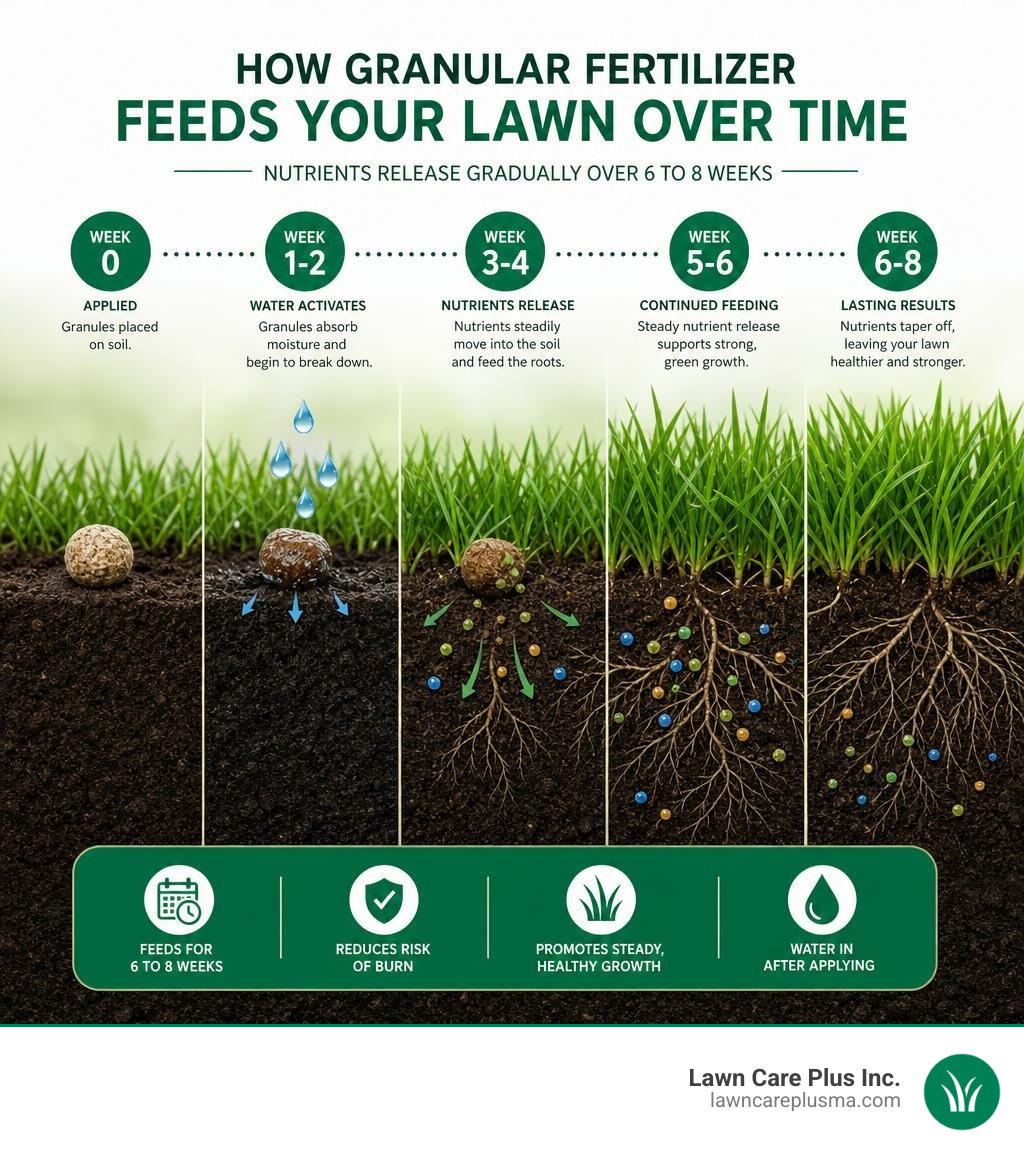
Granular lawn fertilizer is a dry, pellet-based fertilizer that slowly releases nutrients into the soil over several weeks, feeding your grass steadily without the risk of sudden burn or rapid nutrient loss.
Quick answer for busy homeowners:
- What it is: Solid pellets containing nitrogen (N), phosphorus (P), and potassium (K) that break down after watering
- How it works: Nutrients release slowly over 6–8 weeks as pellets dissolve in soil moisture
- Best for: Regular seasonal feeding, large lawn areas, and low-maintenance fertilization schedules
- How to apply: Use a broadcast or drop spreader, then water in with at least 1/4 inch of irrigation
- When to apply: During active growing periods — typically spring and fall for cool-season grasses, summer for warm-season grasses
If you’ve ever walked out to a patchy, pale lawn and wondered what it’s missing, the answer is usually nutrients. Soil doesn’t stay rich on its own — grass pulls from it constantly, and rain and irrigation wash nutrients away over time.
Granular fertilizer is one of the most practical ways to fix that. It’s affordable, easy to apply, and lasts far longer than liquid alternatives. That makes it a favorite for homeowners and property managers who want results without constant upkeep.
I’m Tim DiAngelis, owner of Lawn Care Plus, Inc., a full-service landscaping company serving Greater Boston and Metro-West — and after more than a decade of maintaining residential and commercial lawns across New England, granular lawn fertilizer is one of the tools I rely on most to keep turf healthy through our tough, season-shifting climate. In this guide, I’ll walk you through everything you need to know to choose, apply, and time it right.
Granular lawn fertilizer basics:
- 16 0 8 fertilizer
- best fertilizer for zoysia grass
- diy lawn fertilization guide
Granular vs. Liquid Fertilizer: Key Differences
When you walk down the lawn care aisle or browse online, you will find two main options: granular pellets and liquid sprays. While both deliver essential nutrition to your grass, they do so in completely different ways.
Liquid fertilizer is a fast-acting solution. It is absorbed quickly through the grass blades (foliar absorption) and the roots, providing an almost immediate green-up. However, these nutrients typically wash through the soil or fade within 1 to 2 weeks, meaning you have to apply them much more frequently.
Granular lawn fertilizer, on the other hand, is built for the long haul. Because the nutrients are packed into solid pellets, they must be broken down by water and soil microbes before the grass can use them. This process creates a “spatial difference” in how nutrients are distributed and absorbed, providing a steady, controlled feed that lasts anywhere from 6 to 8 weeks.
To help keep your Lawn Care and Maintenance simple, we have broken down the core differences in the table below:
| Feature | Granular Fertilizer | Liquid Fertilizer |
|---|---|---|
| Nutrient Release Rate | Slow and steady (lasts 6–8 weeks) | Rapid and immediate (lasts 1–2 weeks) |
| Application Frequency | Low (every 1.5 to 2 months) | High (every 2 to 3 weeks) |
| Cost-Effectiveness | High (very economical when bought in bulk) | Medium to Low (more expensive per square foot) |
| Risk of Leaf Burn | Low (if applied correctly and watered in) | Medium to High (if concentrated or applied in heat) |
| Visual Application Tracking | Easy (you can physically see the pellets on the ground) | Difficult (sprays are invisible once applied) |
| Primary Benefit | Long-term soil nutrition and root strength | Quick visual boost before an event |
Benefits of Granular Fertilizer
The biggest advantage of using granular fertilizer is its slow-release nature. Many professional-grade granular formulas use polymer-coated or sulfur-coated urea. These coatings dissolve slowly, preventing “nutrient dump” and drastically reducing the risk of nitrogen burn.
Because the nutrients release over a longer period, your lawn grows at a manageable, consistent rate rather than experiencing a sudden, overwhelming surge of growth that forces you to mow every three days.
Additionally, granular fertilizer is incredibly cost-effective. Buying in bulk is easy—a single 18 lb bag of certain granular fertilizers can cover up to 5,000 square feet, while larger 45 lb bags can cover up to 15,000 square feet. This makes it the most budget-friendly choice for larger properties in Belmont, Newton, or Milton.
Disadvantages of Granular Fertilizer
While we love granular options, they aren’t without a few drawbacks. First, granular fertilizers naturally contain a higher salt content. If applied too heavily or during dry spells, this salt can build up in the root zone. This can actually cause newly developing roots to steer away from the fertilizer instead of growing toward it, which can stunt young turf.
Granular pellets also require moisture to activate. If we experience a dry Massachusetts summer, those pellets will simply sit on top of your soil doing nothing until it rains or you run your irrigation system. Finally, handling heavy 40-pound bags and pushing a spreader around a sloped backyard can be a real workout compared to carrying a lightweight hose-end sprayer!
Choosing the Right Granular Lawn Fertilizer for Your Grass
Your lawn is a living, breathing ecosystem, and its nutritional needs depend heavily on your grass type, soil structure, and local weather. Applying the wrong product at the wrong time won’t just waste your money—it can actively damage your turf. To make sure you get the best results, you need to understand what is inside that bag of fertilizer.
Before you buy, it’s always a good idea to read up on how to avoid common mistakes, which you can do in our guide on how to Don’t Let Your Lawn Down with the Wrong Fertilizer.
Understanding NPK Ratios in Granular Lawn Fertilizer
Every bag of fertilizer features three prominent numbers on the front label—such as 24-0-6, 32-0-5, or 20-0-2. This is the NPK ratio, representing the percentage of Nitrogen (N), Phosphorus (P), and Potassium (K) inside the bag.
- Nitrogen (N): Drives top growth, leaf development, and that deep, dark green color.
- Phosphorus (P): Stimulates early root growth and seedling development. (Many Massachusetts municipal laws restrict phosphorus application on established lawns unless a soil test proves a deficiency, which is why many standard maintenance fertilizers show a “0” for the middle number).
- Potassium (K): Improves overall disease resistance, cold hardiness, and drought tolerance.
When shopping for high-quality Granular Lawn Fertilizers, you will want to match the NPK blend to your lawn’s current needs. For example, a high-nitrogen blend like Pennington 32-0-5 is fantastic for driving thick green growth.
If you are looking for a balanced, premium option, a blend like Flagship 24-0-6 combines quick- and slow-release nitrogen with 3% iron and bio-solids to feed both the grass and the soil biology.
For lawns suffering from summer heat stress or recovering from a rough New England winter, a low-nitrogen, high-potassium blend is best. This is why a custom mix like a 16-0-8 fertilizer is often considered the secret weapon for professional-grade turf management.
Organic vs. Synthetic Granular Options
Another choice you will face is deciding between synthetic and organic granular fertilizers.
Synthetic fertilizers are chemically manufactured to provide precise, highly concentrated nutrient levels. They work quickly and are excellent for targeted corrections. However, they don’t do much to improve the underlying soil structure.
Organic granular fertilizers are made from natural sources like dehydrated poultry waste, feather meal, bone meal, or soybean meal. A great example of this is Grass Genie Premium Organic Lawn Food, which features a 10-0-6 organic analysis.
Another highly popular option is Milorganite Organic Slow-Release Nitrogen Fertilizer, which uses heat-treated microbes to deliver a slow, non-burning feed.
Organic fertilizers are excellent because they:
- Boost the population of beneficial soil microorganisms.
- Improve soil structure and natural water retention.
- Integrate soil amendments like humic acid, which helps plant roots absorb locked-up nutrients more efficiently.
- Carry an incredibly low risk of burning your grass, even if you accidentally over-apply.
If your lawn has compacted soil, hard clay, or persistent dry spots, using a natural soil conditioner like Revive Organic Granular Fertilizer can help break up the dirt, allowing water and nutrients to penetrate much deeper into the root zone.
How to Apply Granular Fertilizer for Best Results
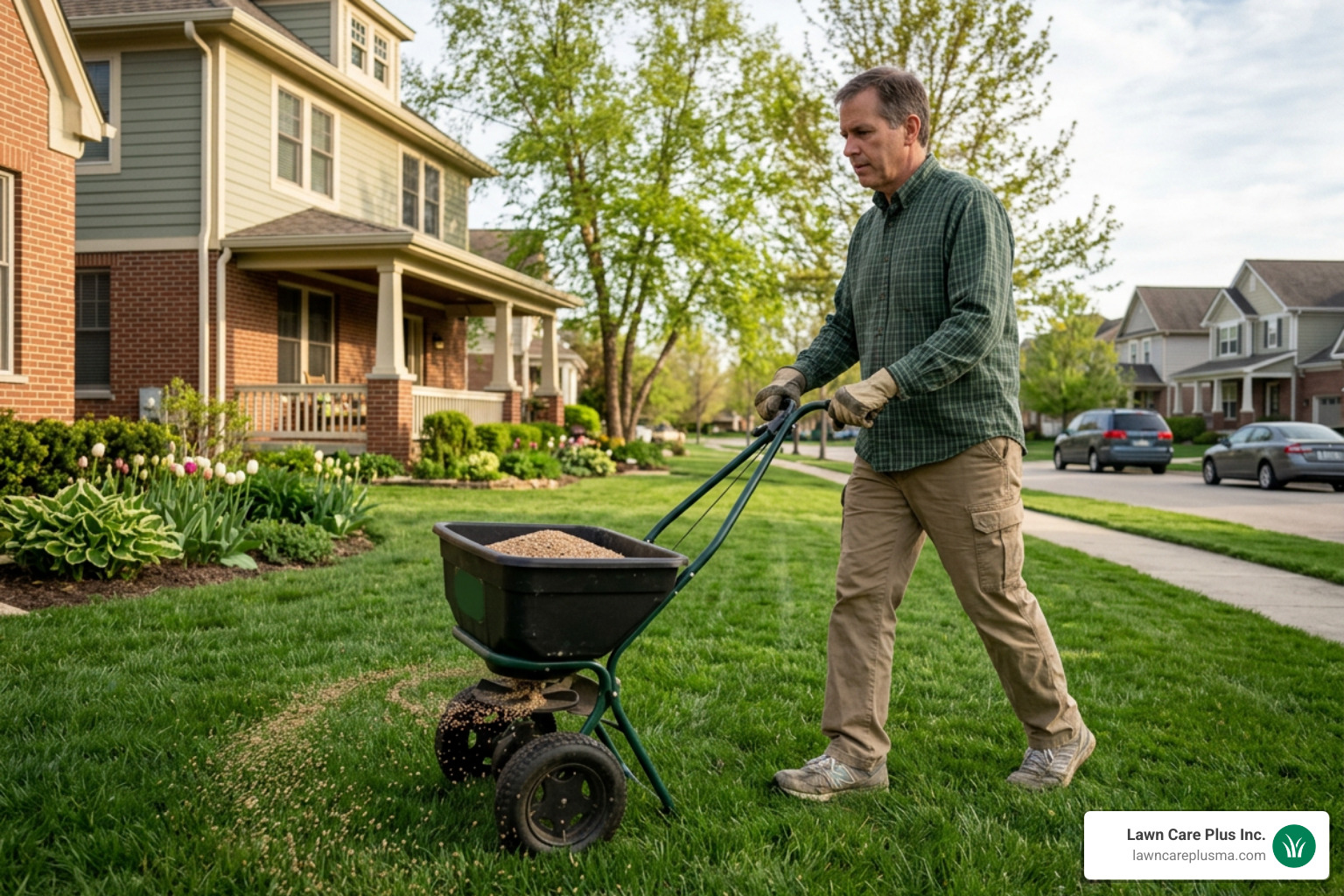
Applying granular fertilizer isn’t difficult, but it does require a bit of strategy. If you just walk across your yard throwing handfuls of pellets like you’re feeding chickens, you’re going to end up with a striped, patchy, and potentially burned lawn.
For a complete step-by-step walkthrough on handling this yourself, check out our diy lawn fertilization guide.
How to Apply Granular Lawn Fertilizer Safely
To get a perfectly even application, you will need a mechanical spreader.
- Broadcast Spreaders: These are best for medium to large lawns. They feature a spinning disc underneath the hopper that flings the granules in a wide arc. They are fast and efficient but require care around garden beds and driveways.
- Drop Spreaders: These drop the granules straight down between the wheels. They provide ultimate precision, making them perfect for tight properties in Boston, Brookline, or Cambridge where you want to keep fertilizer out of your flower beds.
Pro-Tips for Safe Application:
- Calibrate Your Spreader: Always check the back of your fertilizer bag for the recommended spreader setting.
- Fill on a Hard Surface: Never fill your spreader while standing on your lawn. If you spill a concentrated pile of fertilizer on the grass, it will kill that spot. Fill it on your driveway or patio instead, and sweep up any spills.
- Keep Moving: Always start walking before you open the spreader chute, and close the chute before you stop walking.
- Sweep Hard Surfaces: Iron-heavy fertilizers (like those with 3% or more iron) can leave ugly, rust-colored stains on concrete. Always sweep or blow any stray granules off your walkways, driveways, and patios back onto the grass before watering.
- Protect Pets and Kids: While high-quality granular fertilizers are safe, it is best practice to keep pets and children off the lawn until the fertilizer has been watered in and the grass is completely dry.
Seasonal Timing and Frequency
In Massachusetts, our cool-season grasses (like Kentucky Bluegrass, Perennial Ryegrass, and Tall Fescue) have two main active growth spurts: spring and fall.
- Early Spring (April – May): Apply a light, nitrogen-rich fertilizer once the grass wakes up from winter dormancy and starts actively growing. This helps the lawn recover from winter stress.
- Late Spring (Late May – June): Apply a balanced slow-release fertilizer to help the grass build up strength before the summer heat hits.
- Summer (July – August): Avoid high-nitrogen fertilizers during the hottest months. Instead, use natural-based blends like Derby Green 20-0-2, which uses sea kelp and organic nutrients to help the grass tolerate heat and drought without forcing excessive growth.
- Fall (September – October): This is the most important fertilization window of the year. Applying a root-strengthening fertilizer in the fall helps your lawn store nutrients in its root system, ensuring it survives the freezing winter and emerges strong and green the following spring.
Frequently Asked Questions about Granular Fertilizer

How long does it take for granular fertilizer to work?
Because granular fertilizers are slow-release, you won’t see results overnight. Typically, you will start to notice a deeper green color and thicker growth within 7 to 14 days after application, provided the lawn has been watered. The nutrients will then continue to feed your lawn steadily for the next 6 to 8 weeks.
Do I need to water after applying granular fertilizer?
Yes, absolutely. Granular fertilizer cannot feed your lawn until it dissolves. You should water your lawn with at least 1/4 inch of water within 48 hours of application. This washes the granules off the grass blades and down into the soil, activating the nutrients and preventing leaf burn. If rain is in the forecast (a gentle shower, not a torrential downpour), you can let mother nature do the watering for you!
How much does professional lawn fertilization cost?
Please note that these are average costs based on internet data and not actual costs for Lawn Care Plus.
For homeowners looking to hire a professional service to handle their seasonal fertilization, pricing varies depending on the size of your property and the specific program you choose. On average, a professional lawn fertilization application can range anywhere from $50 to $450 per treatment. Smaller residential properties in areas like Roslindale or Brighton will fall on the lower end of this spectrum, while larger estates in Medfield, Canton, or Needham with extensive acreage will fall on the higher end.
Conclusion
Maintaining a lush, vibrant green lawn in Massachusetts doesn’t have to be a guessing game. By choosing a high-quality granular lawn fertilizer, matching the NPK ratio to your lawn’s seasonal needs, and applying it evenly with a calibrated spreader, you can build a deep, resilient root system that stands up to New England’s unpredictable weather.
Of course, we know that life gets busy. Between work, family, and trying to enjoy our short summer months, finding the time to calibrate spreaders, store heavy bags, and track soil temperatures can be tough.
If you would rather spend your weekends relaxing, let us handle the hard work. At Lawn Care Plus Inc., we provide professional, tailored fertilization and lawn care programs throughout the Boston Metro-West area—including Belmont, Boston, Brighton, Brookline, Canton, Chestnut Hill, Dedham, Hyde Park, Jamaica Plain, Mattapan, Medfield, Milton, Needham, Newton, Norwood, Randolph, Readville, Roslindale, Walpole, and Watertown.
Ready to get the greenest lawn on the block? Explore our Lawn Care Services today and request a free estimate!