
Why Most Retaining Walls Fail (And How to Prevent It)
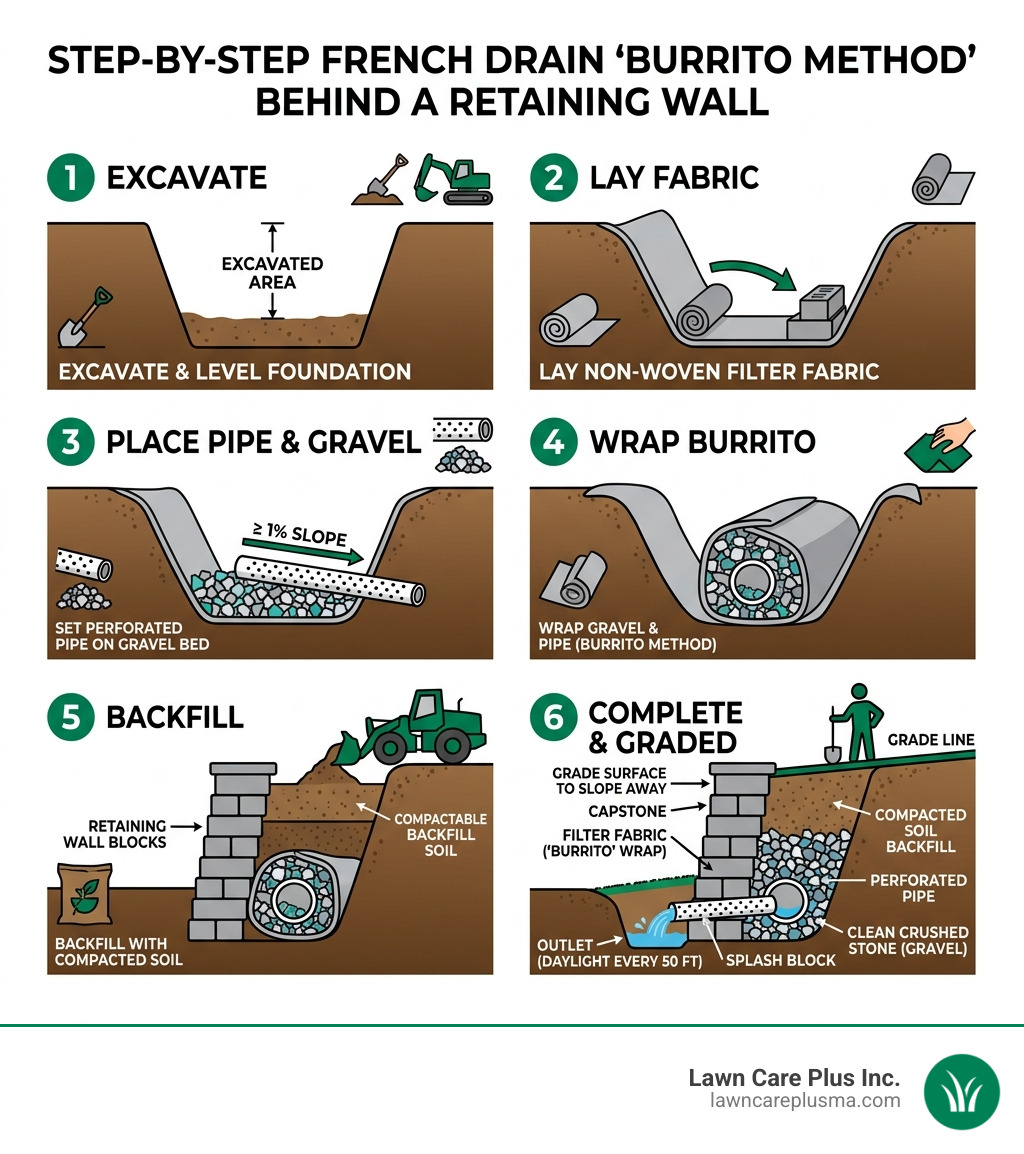
Building a retaining wall with french drain integration is the single most important step you can take to protect your wall from premature failure. Here’s what that process looks like at a glance:
- Excavate behind the wall down to the footing level
- Lay filter fabric along the excavated slope before setting the first course
- Place perforated pipe at the base on a gravel bed, sloped at least 1% toward an outlet
- Backfill with 12+ inches of clean crushed stone around the pipe
- Wrap the gravel with filter fabric to keep soil out
- Daylight the pipe every 50 feet to a safe discharge point
- Grade the surface to slope water away from the wall
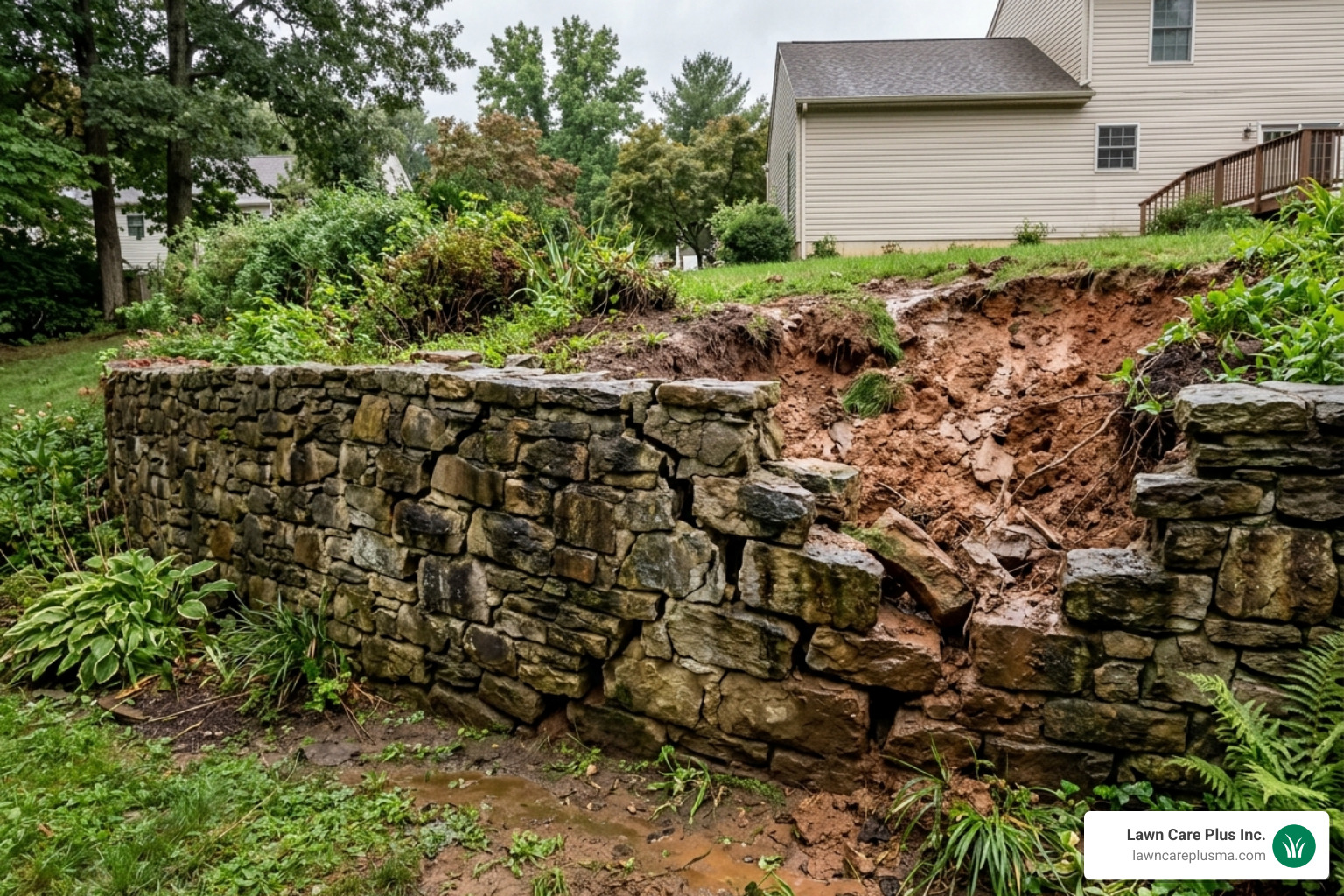
Without this system, water builds up behind the wall and creates hydrostatic pressure — a silent, relentless force that causes bulging, cracking, and eventually, complete structural collapse. Even a modest 3-foot wall is vulnerable, especially in Greater Boston’s heavy clay soils and through 20 or more freeze-thaw cycles every winter.
Water problems rarely announce themselves dramatically. More often, a wall that looked perfectly fine for years slowly starts to lean, crack, or push outward — and by then, repairs cost far more than prevention ever would have.
I’m Tim DiAngelis, owner of Lawn Care Plus, Inc., and over the past decade I’ve built and repaired retaining walls across Greater Boston and Metro-West — seeing how often drainage is the difference between a wall that lasts 30 years and one that fails in five. Building a retaining wall with french drain systems is something our team takes seriously on every project, and this guide walks you through exactly how to do it right.
Glossary for building a retaining wall with french drain:
Why Building a Retaining Wall with French Drain is Essential
When we talk to homeowners in Newton, Milton, or Needham, we often hear the same thing: “It’s only a small wall, do I really need all that gravel and pipe?” The answer is a resounding yes. In fact, skipping drainage is the number one reason we get calls for retaining wall repair near me.
The Invisible Enemy: Hydrostatic Pressure
Think of the soil behind your wall as a giant sponge. When it rains in Massachusetts—and it does, to the tune of about 45 inches a year—that soil soaks up water. Saturated soil is significantly heavier than dry soil. This weight creates hydrostatic pressure, a force that pushes against the back of your wall.
According to Retaining Wall Drainage NYC: Prevent Wall Failure, this pressure is the primary cause of structural failure. If that water has nowhere to go, it will eventually find a way out by cracking your masonry or pushing the entire wall over.
The Clay Soil and Freeze-Thaw Factor
In towns like Belmont and Watertown, we deal with heavy clay soil. Clay holds onto water like a toddler holds onto a favorite toy—it doesn’t want to let go. This slow drainage increases the time your wall spends under pressure.
Furthermore, we experience 20 to 30 freeze-thaw cycles every winter. When trapped water freezes, it expands. This “frost heave” can shift even heavy stone blocks. A properly installed retaining wall drainage system ensures that water is removed before it can freeze and wreak havoc.
Even Short Walls Need Love
You might think a 3-foot wall is safe, but even short walls can bulge or collapse if the soil behind them becomes a “pudding” of mud. Without a drain, the soil loses its internal strength, and the wall is left to do all the work alone. Building a retaining wall with french drain components acts as an insurance policy for your landscape investment.
Key Components of a Retaining Wall Drainage System
To build a system that lasts until 2056 and beyond, you need the right “guts.” It’s not just about the pretty stones on the outside; it’s about the engineering on the inside.
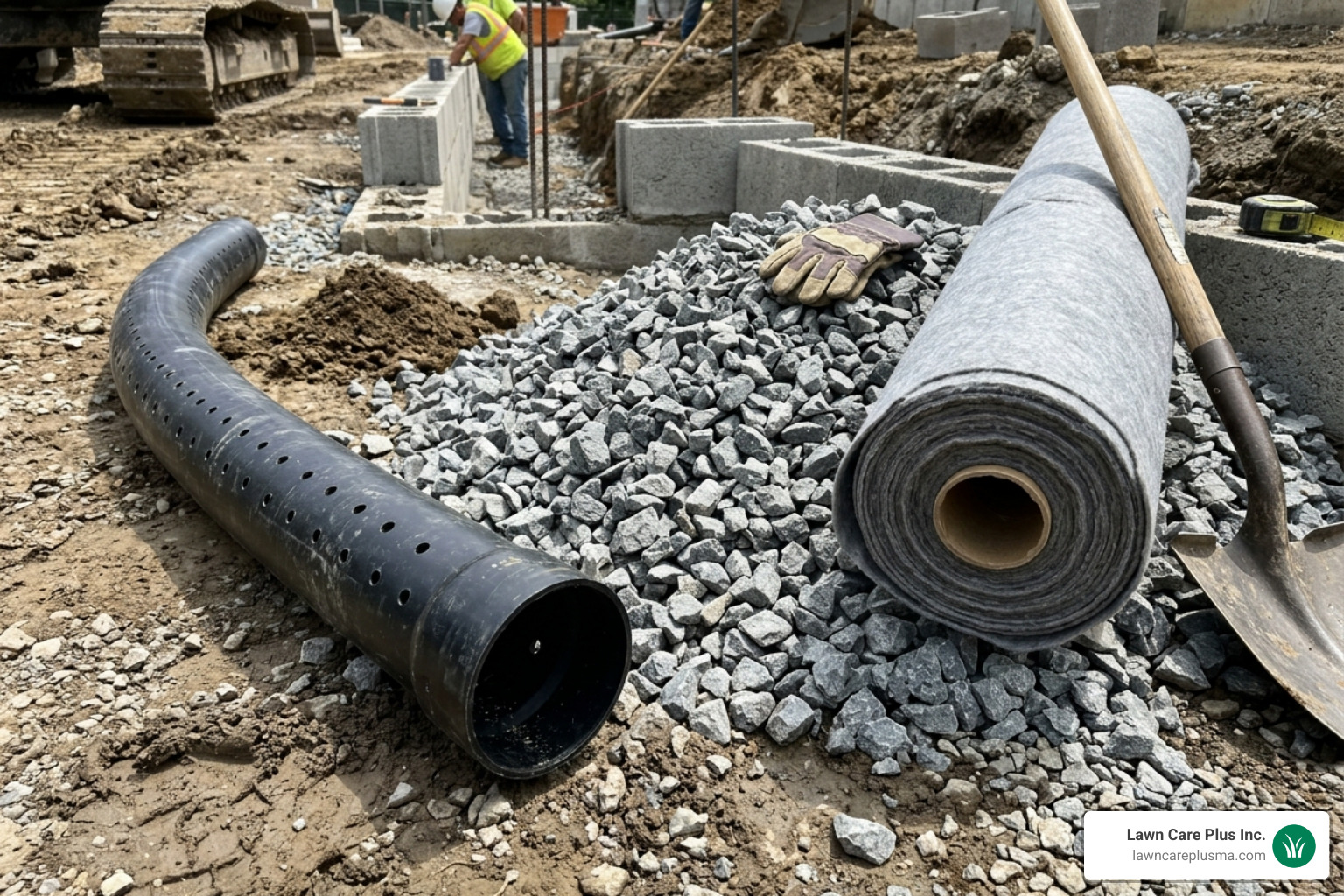
1. Perforated Drain Pipe
This is the heart of the French drain. We typically use 4-inch perforated NDS pipe or Schedule 40 PVC. Perforated means it has small holes that allow water to enter the pipe so it can be whisked away. As noted in How to Build a Retaining Wall with Drainage | 8 Easy Steps, the pipe should be placed with the holes facing downward. This might seem counterintuitive, but it allows the water level to rise into the pipe from the bottom and flow away before the entire trench is saturated.
2. Angular Drainage Gravel
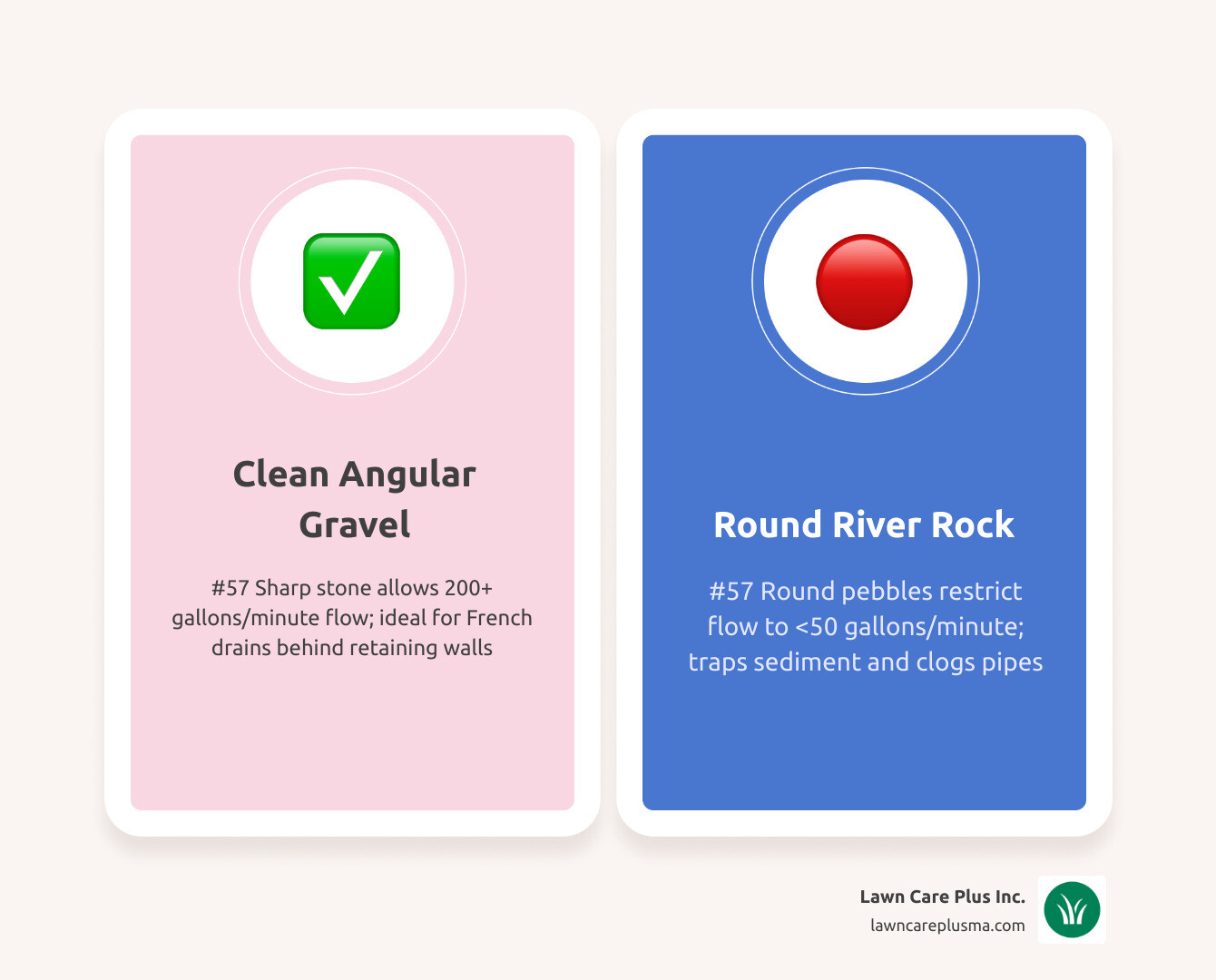
Don’t use pea stone or rounded river rocks for the structural backfill. You want 3/4-inch angular crushed stone. Why? Because angular stones lock together like a jigsaw puzzle, providing structural support for the wall while still leaving plenty of “void space” for water to flow through. We recommend a minimum 12-inch gravel zone directly behind the wall. For steep slopes in areas like Brookline or Waltham, we often increase this to 18-24 inches.
3. Geotextile Filter Fabric
This is the “skin” of your drainage burrito. Geotextile for French Drain is a permeable fabric that allows water to pass but blocks fine soil particles. Without it, the surrounding soil will eventually clog the spaces between your gravel and fill your pipe with silt, rendering the whole system useless.
4. Weep Holes
For solid walls, like those made of poured concrete or mortared stone, weep holes are essential. These are small openings near the base of the wall that allow any water that makes it to the face of the wall to escape. They prevent the “pudding effect” and relieve pressure directly at the source.
Essential Tools List:
- Stakes and string line for layout
- Laser level or transit (to ensure that 1% slope)
- Hand tamper or plate compactor
- Shovels and pickaxe
- Masonry saw (for cutting blocks)
- Rubber mallet
Step-by-Step: Building a Retaining Wall with French Drain
Ready to get your hands dirty? Follow this roadmap to ensure your retaining walls stay standing for decades. If this looks like more than a weekend project, you can always look for retaining wall builders near me to handle the heavy lifting.
Step 1: Planning and Layout
Mark your wall’s path using a garden hose for curves or stakes and string for straight lines. Check with your local building department in towns like Newton or Dedham; often, walls over 4 feet require a permit and a structural engineer’s stamp.
Step 2: Excavation
Dig your trench. For the leveling pad, you want a trench at least 12 inches wider than the block and deep enough to bury at least half of the first course plus 6 inches of gravel base.
Step 3: The Leveling Pad
This is the most critical step for wall stability. Fill the trench with 6 inches of compactible base material (like 3/4-inch minus) and compact it thoroughly. It must be perfectly level from side to side and front to back.
Step 4: Setting the Base Course
Lay your first row of blocks. If they have a rear lip, remove it for this course so they sit flat. Use your rubber mallet to settle each block. Once the base is set, your building retaining walls complete guide moves to the drainage phase.
Excavation and Pipe Placement for Building a Retaining Wall with French Drain
Now we get to the “French” part of the drain.
- Placement: The drain pipe should be placed on the “surcharge side” (the uphill side) of the wall. It should sit just behind the first course of blocks, slightly above the footing level.
- The Slope: You need a minimal slope of 1 percent. This translates to approximately 1 inch of drop for every 8 feet of run. If the pipe is level, the water will just sit there. We use a laser level to ensure the water has a clear, downhill path to the exit.
- The Fabric: Before laying the pipe, drape your filter fabric into the excavation, leaving enough excess to fold it over the top later. This creates the “burrito” wrap.
Backfilling Your Building a Retaining Wall with French Drain Project
Backfilling isn’t just about dumping dirt; it’s a layered process.
- The Gravel Zone: As you stack each course of block, add your 3/4-inch angular crushed stone directly behind the wall. This zone should be at least 12 inches wide.
- Compaction: This is where many DIYers fail. You must backfill and compact in “lifts” of 6 inches. If you dump 3 feet of stone and try to compact the top, the bottom will stay loose, leading to settling and wall tilting later.
- The Wrap: Once your gravel is within 6 inches of the top of the wall, fold the excess filter fabric over the stone. This prevents the topsoil from washing down into your clean gravel.
- Topsoil and Grading: Finish the last 6 inches with low-permeability soil (like clay-heavy topsoil). Grade the surface so that water flows away from the wall, not toward it. This reduces the amount of water the French drain has to handle in the first place.
Our hardscaping services always emphasize this layered approach because we know that the “unseen” parts of the wall are what keep the “seen” parts beautiful.
Cost and Maintenance Considerations for Drainage Systems
Building a retaining wall with french drain components does add to the initial cost, but it’s significantly cheaper than rebuilding a failed wall.
Average Costs for Retaining Wall Drainage
When estimating your retaining wall cost, these are average costs based on internet data and not actual costs for Lawn Care Plus. Actual site conditions in the Boston area, such as buried ledge or heavy roots, can impact the final price.
| Material/Service | Estimated Cost Range (Wide Range) |
|---|---|
| Perforated Pipe (per ft) | $15 – $60 |
| Drainage Gravel (per ton) | $40 – $150 |
| Filter Fabric (per roll) | $100 – $450 |
| Professional Installation (Total Project) | $3,000 – $18,000+ |
Note: The high end of the range reflects complex projects with significant excavation, high-end stone, or engineered requirements for walls over 4 feet.
Maintenance: Keeping the Water Flowing
A properly installed system can last 20–30 years, but it’s not completely “set and forget.”
- Annual Inspection: Every spring, check your “daylight” or discharge points. Make sure they aren’t blocked by leaves, mulch, or a wayward chipmunk nest.
- Check for Efflorescence: If you see white, powdery staining on the face of your wall, it means water is sitting behind it and minerals are leaching through. This is a sign your drainage might be sluggish.
- Surface Swales: Ensure that any surface swales (shallow grassy ditches) designed to carry water around the wall haven’t filled in with debris.
Frequently Asked Questions about Retaining Wall Drainage
Where should the French drain pipe be placed?
The pipe must be placed behind the wall on the uphill side (the side holding back the dirt). It should sit as low as possible, ideally just above the leveling pad or at the base of the first course of blocks. Placing it too high allows water to pool at the base of the wall, softening the foundation.
Do all retaining walls need a perforated drain pipe?
If the wall is over 2 feet tall, the answer is almost always yes. In wet climates like ours in Massachusetts, even a small French drain for a short wall is an inexpensive insurance policy. If you have heavy clay soil or a steep slope above the wall, a pipe is non-negotiable for long-term stability.
How deep should the trench be for a French drain behind a retaining wall?
The trench needs to be deep enough to reach the bottom of your wall’s base course. Generally, this means excavating 12–24 inches deep behind the wall to ensure the pipe sits at the lowest point where water collects.
How do soil types affect the design?
Clay soil requires a wider gravel chimney (up to 24 inches) and diligent use of filter fabric because clay particles are tiny and easily clog drainage systems. Sandy soil drains better naturally but still requires a pipe to handle heavy “flash” runoff during summer thunderstorms.
How do you daylight or discharge the drain pipe safely?
“Daylighting” means bringing the pipe to the surface so water can exit. To prevent erosion at the exit point:
- Use a Pop-up Emitter: This stays flush with the grass until water pressure lifts the lid.
- Rip-Rap Apron: Place a small bed of river rocks at the outlet to break the water’s force.
- Spacing: On long walls, daylight the pipe at least every 50 feet and at every low point to prevent the pipe from becoming overwhelmed.
Conclusion
Building a retaining wall with french drain systems is the difference between a landscape that adds value to your home and a landscape that becomes a liability. By managing hydrostatic pressure, using the right angular gravel, and ensuring a proper 1% slope, you can create a structure that stands strong against the New England elements.
At Lawn Care Plus Inc., we’ve spent years perfecting the art of land drainage system integration. From the tight residential lots of Brighton and Hyde Park to the sprawling estates of Medfield and Walpole, our team understands the unique soil and climate challenges of the Boston Metro-West area.
Whether you’re looking for a new retaining wall or need an expert retaining wall contractor to fix a failing one, we’re here to help. Don’t let your hardwork wash away in the next big storm—do it right the first time with a professional drainage strategy. Ready to start your project? We serve clients across the region, including Brookline, Needham, and Newton. Let’s build something that lasts.
