Understanding Hydroseeding Costs: What to Expect
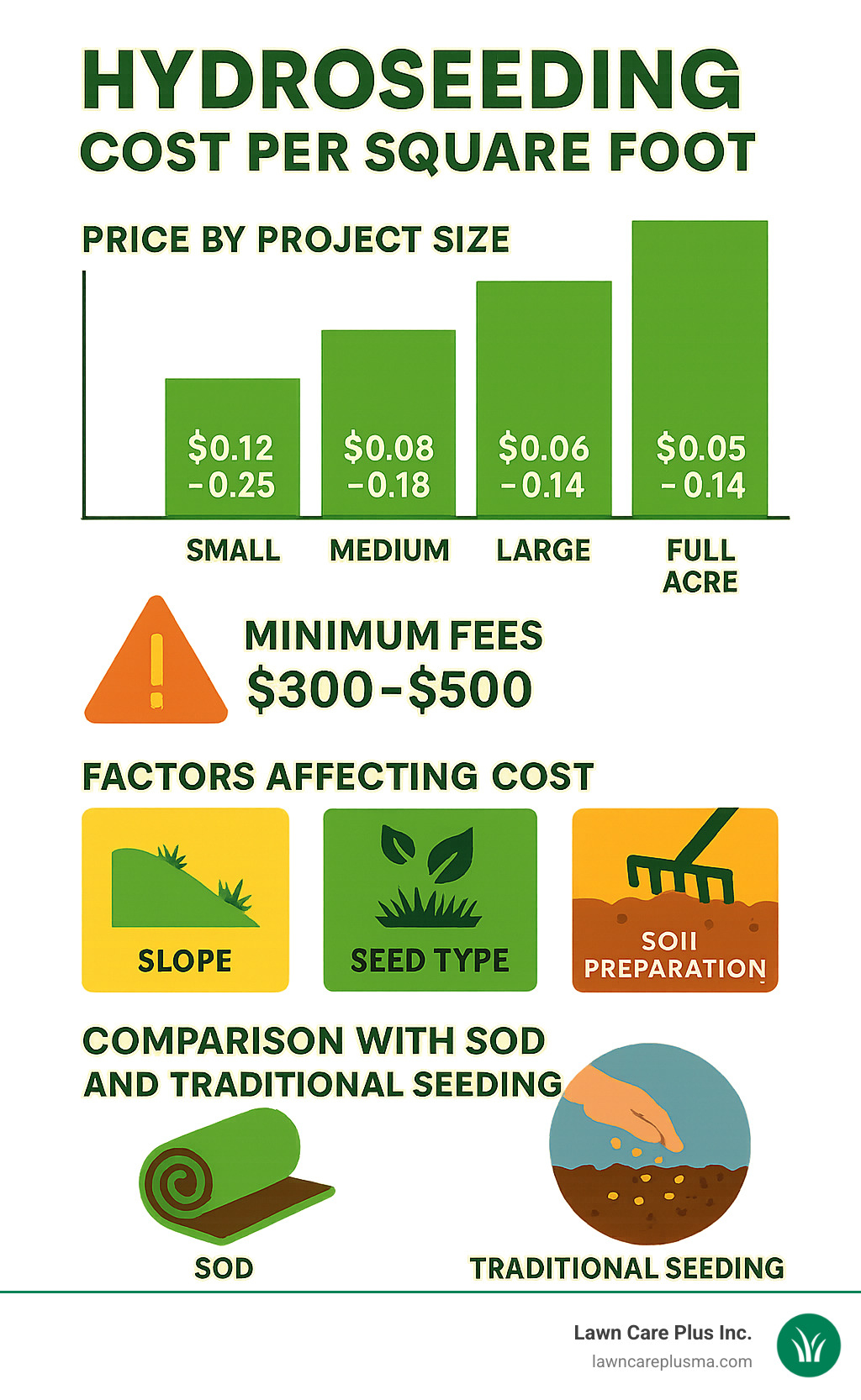
Hydroseeding cost per square foot typically ranges from $0.06 to $0.20, with most homeowners paying between $0.08 and $0.26 depending on factors like lawn size, terrain, and seed mix quality.
| Lawn Size | Average Cost Per Square Foot | Typical Total Cost |
|---|---|---|
| Small (under 3,000 sq ft) | $0.12 – $0.25 | $300 – $500 (minimum fee applies) |
| Medium (3,000 – 10,000 sq ft) | $0.08 – $0.18 | $500 – $1,600 |
| Large (over 10,000 sq ft) | $0.06 – $0.14 | $1,000 – $3,000+ |
| Full Acre (43,560 sq ft) | $0.05 – $0.14 | $2,000 – $6,000 |
Looking to transform your bare soil into a lush, green lawn? Hydroseeding offers a cost-effective solution between traditional hand seeding and expensive sod installation.
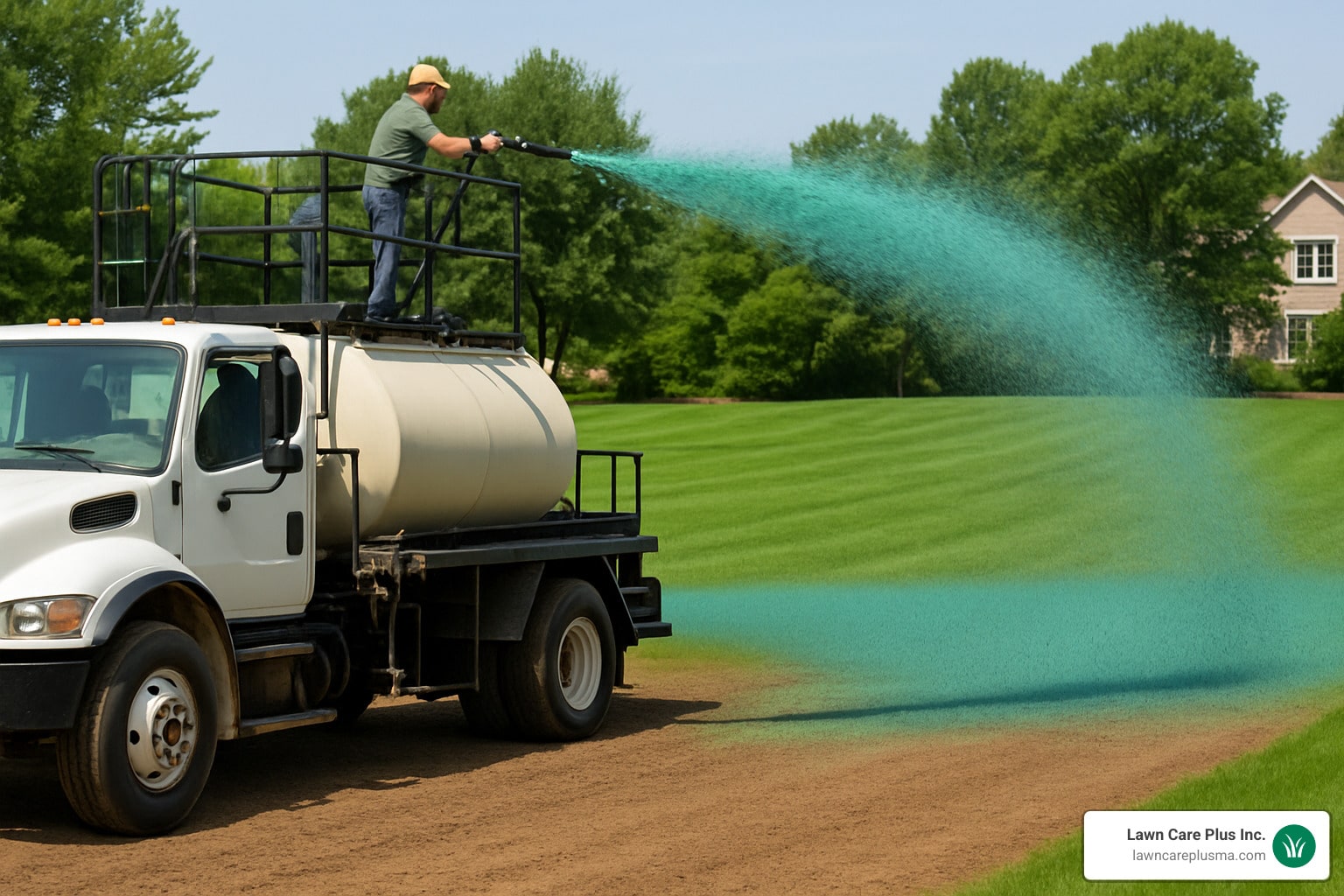
Hydroseeding applies a specialized mixture of grass seed, mulch, fertilizer, and water through a high-pressure spray system, resulting in faster germination, better erosion control, and more uniform coverage than traditional methods.
Most hydroseeding companies have a minimum service fee of $300-$500, which can make small projects seem expensive per square foot. However, as project size increases, the price per square foot typically decreases.
For Boston Metro-West property owners, hydroseeding offers an excellent solution that stands up well to our New England climate, with ideal application times being early fall or spring.
Hydroseeding cost per square foot terms you need:
– hydroseeding
– what is hydroseeding
– hydro grass seed
What Is Hydroseeding & How Does It Work?
Ever watched a barren landscape transform into a lush green lawn in what seems like record time? That’s the magic of hydroseeding, sometimes called hydromulching – the perfect middle ground between traditional seeding and sod installation.
Hydroseeding uses a special slurry mixture that’s sprayed onto prepared soil using high-pressure equipment. This method has been revolutionizing lawn establishment for nearly a century, starting in agriculture and now becoming the go-to choice for homeowners throughout Massachusetts and the Boston Metro-West area.
What makes this process effective is the perfect combination of components. The mulch creates a microenvironment that holds moisture, shields seeds from birds, and prevents soil erosion. Meanwhile, fertilizers provide a nutritional boost that kickstarts growth and helps establish strong roots.
For the science-minded, there’s fascinating research on the hydroseeding process that explains why it works so effectively. And if you’re curious about more details, check out our guide on What is Hydroseeding?
Core Components of the Slurry
A quality hydroseeding mixture contains several essential components:
The foundation is grass seed selected specifically for your property’s conditions. In the Boston area, we typically use cool-season grass varieties like Kentucky bluegrass for its self-healing properties, perennial ryegrass for quick establishment, and various fescues for shade and drought tolerance.
The protective wood or paper mulch creates a blanket over your seeds. Wood fiber mulch excels on slopes, while paper mulch works wonderfully in water-restricted areas.
Starter fertilizer provides critical early nutrients that young grass plants need. The tackifier acts like nature’s glue, helping everything stick to the soil – particularly important on slopes. And that bright green dye helps technicians see where they’ve sprayed and signals to homeowners when watering is needed.
Ideal Seasons & Site Conditions
Timing your hydroseeding project can make all the difference in our New England climate:
Early Fall (late August to September) is the sweet spot for Boston Metro-West properties. Soil temperatures remain warm enough for quick germination, while cooling air temperatures reduce watering demands.
Spring (April to early June) is a strong second choice. The warming soil wakes up those seeds, though you’ll need to be more vigilant with watering as summer approaches.
For optimal results, soil temperatures should hover between 65°F and 85°F for at least six weeks after application. This gives your new grass time to establish before facing extreme temperatures.
Proper site preparation is crucial. Your soil should be cleared of debris, properly graded for drainage, loosened to a depth of 4-6 inches, and tested for pH (ideally 6.0-7.0).
With the right timing and preparation, your Boston-area hydroseeded lawn will typically show those first green sprouts within 7-14 days and be ready for its first mowing in about 3-6 weeks. For region-specific advice on grass varieties that thrive in our climate, the growing guide offers excellent insights.
Hydroseeding Cost Per Square Foot: National Averages & Ranges
Planning your lawn change? Understanding the hydroseeding cost per square foot will help you budget effectively for your green dreams.
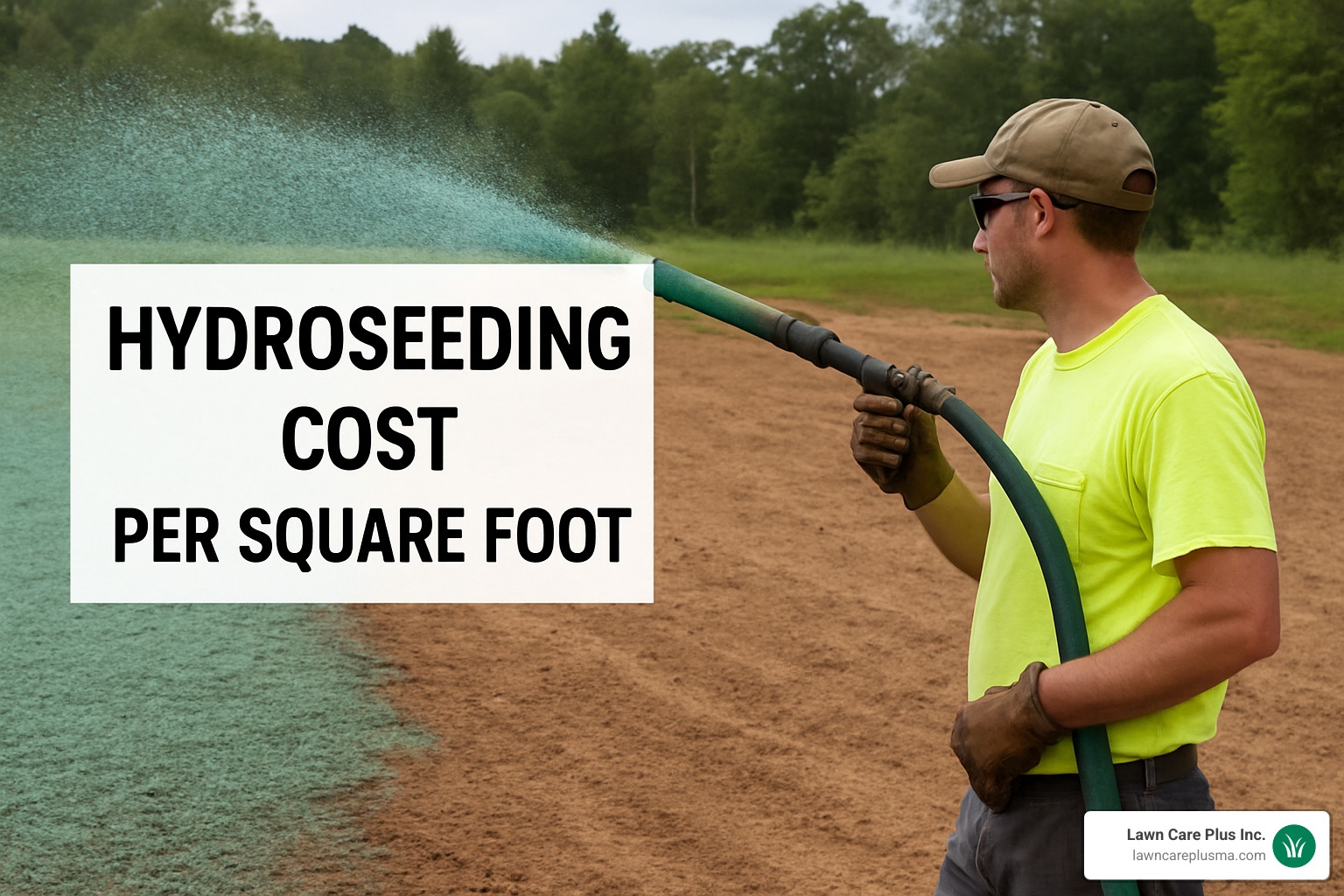
Across the country, hydroseeding cost per square foot typically falls between $0.06 and $0.22. Most homeowners report paying somewhere in the $0.08 to $0.26 range for professional hydroseeding services. These figures represent internet averages and not specific Lawn Care Plus Inc. rates. For an accurate quote custom to your unique property, reaching out directly is always your best bet.
For larger properties, costs typically range from $2,000 to $6,000 per acre (about $0.05 to $0.14 per square foot). This price drop happens thanks to economies of scale – larger projects allow for more efficient use of equipment and materials.
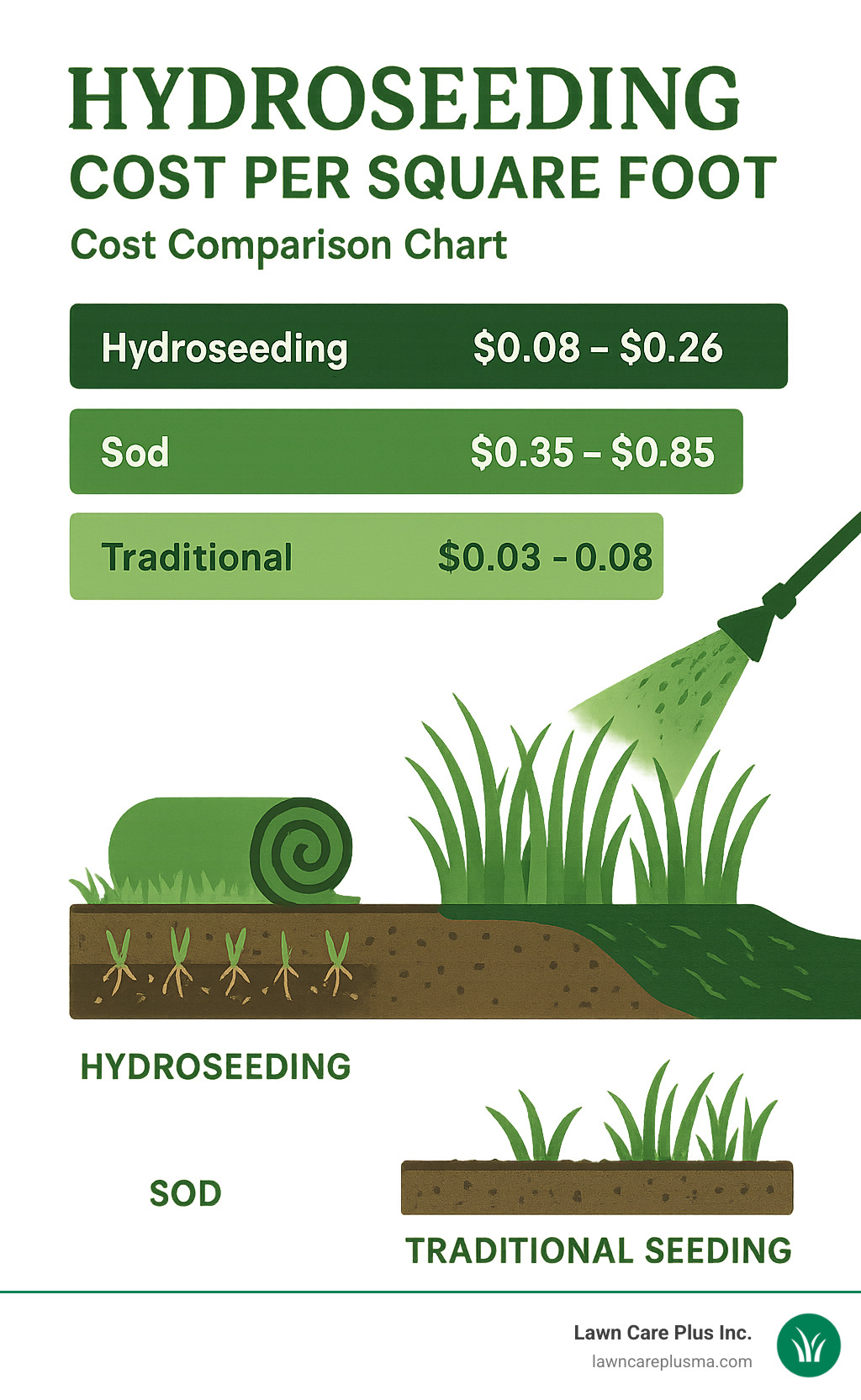
Typical Price Brackets for Hydroseeding Cost per Square Foot
Your lawn’s size significantly impacts what you’ll pay per square foot:
Small Lawns (under 3,000 sq ft) typically cost between $0.12 and $0.25 per square foot. For these compact spaces, you might notice a higher per-square-foot rate due to minimum service fees.
Mid-Size Lawns (3,000 to 10,000 sq ft) generally fall in the $0.08 to $0.18 per square foot range – this is where many suburban Boston Metro-West properties land.
Large Lawns (over 10,000 sq ft) benefit from better rates, usually $0.06 to $0.14 per square foot.
Multi-Acre Properties see the best economies of scale, with costs typically ranging from $0.05 to $0.14 per square foot.
Most hydroseeding companies serving our Boston Metro-West area have minimum service fees ranging from $300 to $500. This means very small projects might have a higher effective cost per square foot.
How Size Drives Price per Square Foot
There’s a simple reason why larger projects enjoy better rates: efficiency.
Equipment Mobilization costs the same whether we’re seeding 500 or 5,000 square feet. The hydroseeding equipment needs to be transported, set up, and cleaned regardless of your lawn’s size.
Tank Efficiency plays a huge role too. Professional hydroseeding machines typically hold 600-900 gallons of slurry. If your project requires just one tank or slightly more, you’ll get more value from that setup cost than a tiny project using just a fraction of a tank.
Labor Efficiency is another factor – preparing and applying one large area flows more smoothly than multiple small areas with stops and starts.
The average American lawn is approximately 10,871 square feet, which typically falls into the mid-size pricing bracket. For very small areas under 500 square feet, traditional hand seeding might be more cost-effective unless you’re also hydroseeding other areas of your property.
10 Key Factors That Change Your Hydroseeding Quote
While the hydroseeding cost per square foot provides a useful baseline, several factors can significantly impact your final price.

Grass Seed Type & Custom Mix
The type and quality of grass seed in your hydroseeding mixture can dramatically affect your overall investment. Premium Kentucky Bluegrass varieties cost considerably more than standard Tall Fescue, but they deliver that picture-perfect lawn many homeowners dream about.
In our New England climate, we typically recommend cool-season grass blends. A quality mix for Boston Metro-West properties often includes Kentucky bluegrass for its lush appearance, perennial ryegrass for quick establishment, and various fescues for their shade and drought tolerance.
Your property’s specific conditions matter too. If you have a shaded yard in wooded Chestnut Hill, we might customize your mix with more shade-tolerant fescues. For sunny, exposed locations in Newton, we’d adjust with more drought-resistant varieties.
Yard Slope, Terrain & Erosion Risk
Flat to gently sloping yards (0-10°) receive standard application rates, but once your property starts to resemble a ski slope, things change quickly.
Moderate slopes (10-20°) typically need about 50% more slurry and tackifier to prevent erosion before establishment. On steeper slopes (20-25°+), we often double the slurry concentration and use specialized tackifiers to keep everything in place during those New England rainstorms.
For particularly challenging slopes, we might recommend Fiber Reinforced Matrix (FRM) applications. These specialized formulations use both chemical and mechanical bonding to lock the matrix in place, providing superior erosion control when it matters most.
Soil Preparation & Testing Costs
Great lawns start with great soil, and proper preparation is non-negotiable for successful hydroseeding. A professional soil test tells us exactly what your soil needs—not just guesswork. In the Boston Metro-West area, our soils often require amendment due to their naturally acidic nature.
Quality topsoil (ideally 4-6 inches) provides the foundation for your new lawn. Professional grading ensures proper drainage and prevents future headaches.
Beyond these major factors, several other elements influence your hydroseeding quote:
Regional labor rates in our Boston Metro-West area tend to run higher than national averages. Special additives like moisture retainers, grub control, or biostimulants can improve lawn performance but add incremental costs. Some municipalities require permits for large-scale projects, especially near wetlands or conservation areas.
Water access matters too—limited access may require additional equipment or water delivery services. Seasonality plays a role, with spring and fall being our busiest seasons. The substantial equipment overhead of professional hydroseeding machines (costing $20,000+) is naturally factored into service pricing.
Lastly, site accessibility can make a significant difference. If your backyard is only accessible through a narrow gate or requires special equipment to reach, that extra labor translates to additional cost.
Hydroseeding vs. Sod vs. Traditional Seeding: Cost & Performance
When you’re dreaming of that perfect green lawn, you’ve got three main paths to get there: hydroseeding, sod installation, or traditional seeding. Each has its own sweet spots and trade-offs that matter for your Boston Metro-West property.

Price Comparison per Square Foot
Let’s talk dollars and cents – because your wallet definitely cares about the difference:
Hydroseeding costs between $0.06-$0.26 per square foot (these are internet averages, not Lawn Care Plus rates).
Sod Installation jumps up considerably to $0.30-$1.76 per square foot.
Traditional Seeding comes in lowest at $0.03-$0.15 per square foot.
For perspective, if you’ve got a typical 5,000 square foot lawn in our Boston area, hydroseeding offers that sweet spot – better results than throwing seed around by hand, without the eye-watering cost of sod.
Don’t be fooled by traditional seeding’s apparent bargain price, though. Those initial savings often vanish when you factor in the extra overseeding, weed battles, and intensive early care.
Establishment Time & Ongoing Care
With hydroseeding, you’ll see those first green sprouts peeking through in just 7-14 days. You’ll be mowing before you know it (typically 3-6 weeks), though you’ll want to keep the kids and pets off for about 4-6 weeks. Full establishment takes 8-12 weeks.
Sod gives you that instant green carpet satisfaction. Your lawn looks finished the day it’s installed, though those roots need 2-3 weeks to actually grab hold. You can carefully walk on it after about 2-3 weeks, with full establishment in 4-6 weeks.
Traditional seeding requires the most patience. Germination takes 10-21 days, with first mowing around 4-8 weeks. You’ll need to keep traffic off for 6-8 weeks, and full establishment stretches to 10-16 weeks.
Hydroseeding provides more even coverage across your lawn. The slurry creates a perfect little microenvironment for seeds to germinate, fights erosion on slopes, and gives those seeds a fighting chance against weeds.
When stacked against sod, hydroseeding costs dramatically less, and those roots develop right in your soil from day one – no transplant shock or adaptation period. You also get more flexibility with grass types to match our unique New England conditions.
Watering needs vary too. Hydroseeded lawns need light, frequent watering (2-3 times daily) for the first few weeks. Sod needs deep soakings 1-2 times daily initially, while traditional seeding demands almost constant moisture for nearly a month.
For long-term performance in our challenging Boston Metro-West climate, hydroseeded lawns typically develop stronger, deeper root systems than sod, making them more resilient during our summer dry spells and harsh winters.
Professional Hydroseeding vs. DIY: True Costs & Hidden Expenses
If you’re weighing your options for greening up your Boston Metro-West property, you might be wondering whether to call the pros or tackle hydroseeding yourself.
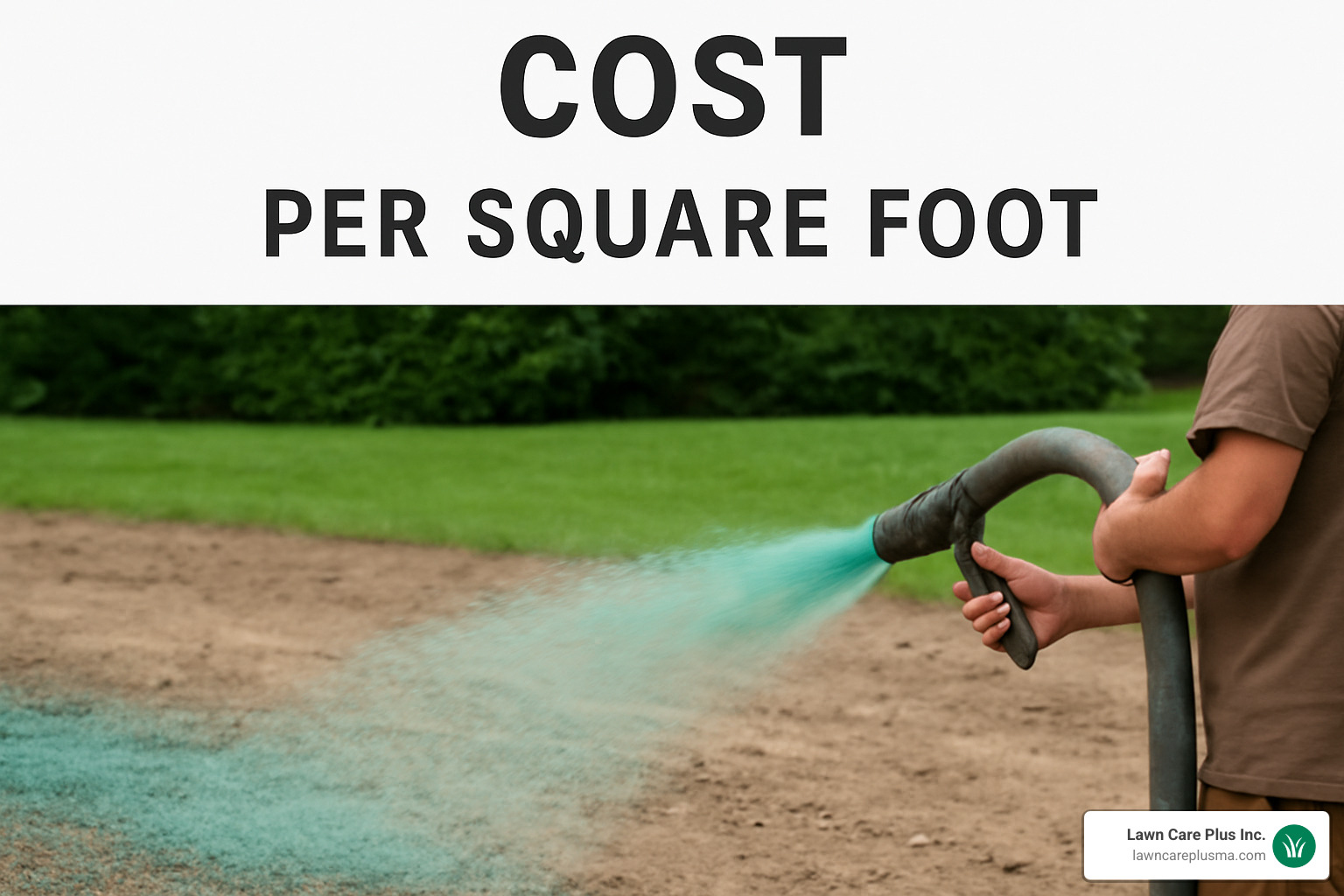
What a Professional Service Includes
When you hire a professional like Lawn Care Plus for hydroseeding, you’re getting much more than just someone spraying your lawn.
Professional hydroseeding typically includes a thorough site evaluation where we assess your property’s unique characteristics. We’ll handle all the soil preparation, including proper grading and removing debris that could interfere with your new lawn’s success.
One major advantage is custom seed selection – we choose grass varieties specifically suited to your property’s microclimate in the Metro-West area. We apply this using professional equipment that ensures even coverage and optimal results.
The calibrated slurry we use is precisely mixed with the right proportions of seed, mulch, fertilizer, and additives for your specific lawn needs. Our experienced technicians understand the proper application techniques to ensure even coverage.
After application, you’ll receive detailed post-care guidance so you’ll know exactly how to water and maintain your new lawn. Plus, our work comes with liability insurance and typically some form of satisfaction guarantee.
The internet average for professional hydroseeding ranges from $0.06 to $0.26 per square foot (not Lawn Care Plus rates), with most Boston area homeowners paying between $0.08 and $0.18 per square foot depending on property size and conditions.
DIY Hydroseeding Kits & Equipment
Going the DIY route? Be prepared for some significant upfront investments and a steep learning curve.
Renting a professional hydroseeder will set you back about $300-$500 per day – and one day might not be enough for first-timers. If you’re considering purchasing equipment, small hydroseeders start around $1,500 and can run up to $10,000 or more.
There are DIY hydroseeding kits available that cost between $25-$35 per 100 square feet (about $0.25-$0.35 per square foot), while store-bought hydroseed typically runs $0.20-$0.50 per square foot.
You’ll also need to purchase quality grass seed, hydro-mulch, fertilizer, and tackifier. Don’t forget to factor in the cost of protective gear – this stuff stains everything it touches!
The logistical challenges can be significant too. Professional hydroseeding machines are massive and require a truck or trailer for transport. You’ll need access to a reliable water source, storage space for materials, and the patience to learn proper mixing and application techniques.
For small repairs, DIY kits might make sense. But for full lawns in our New England climate, professional services typically provide better results and may actually save you money when you consider all factors.
Hidden & Ongoing Costs After Hydroseeding
Water bills will increase significantly during the establishment period – new seedlings need watering 2-3 times daily for the first 2-3 weeks. In our sometimes dry Boston summers, this can add up quickly.
You’ll need starter fertilizer about 4-6 weeks after hydroseeding, then regular fertilization 3-5 times yearly thereafter. Some overseeding of thin or bare spots is almost always necessary, especially in our challenging New England climate.
Weed control becomes important once the lawn is established (after 4-6 weeks), and regular aeration and dethatching services help maintain lawn health. And of course, you’ll be mowing regularly once the grass reaches about 3 inches in height.
For Boston Metro-West homeowners, these ongoing maintenance costs are important budget considerations. When you’re ready to explore your hydro grass seeding near me options, we’re here to help.
Frequently Asked Questions about Hydroseeding Cost Per Square Foot
How long until I can mow my new hydroseeded lawn?
You’ll typically notice those initial seedlings popping up within 7-14 days of application, bringing that first hint of green to your property.
Before reaching for your mower, wait until your new grass reaches about 3 inches in height, which usually happens around the 4-week mark after hydroseeding. This gives those young roots time to establish themselves firmly in the soil.
For that all-important first mowing, set your blade height to about 3 inches and make sure those blades are nice and sharp. Dull blades can actually pull young seedlings right out of the ground instead of cutting them cleanly. Also, try to mow when the soil is relatively dry.
Here in our Boston Metro-West climate, your establishment timeline might vary a bit with the seasons. Spring hydroseeding might take a little longer due to cooler temperatures, while fall applications often establish more quickly.
Is hydroseeding cost-effective for very small yards?
When it comes to tiny lawn areas under 500 square feet, most hydroseeding companies implement minimum service charges ranging from $300-$500 regardless of how small your lawn area is.
What does this mean for your small yard? If you’re hydroseeding just 400 square feet, that minimum fee translates to a much higher hydroseeding cost per square foot – potentially $0.75-$1.25 per square foot compared to the typical lower rates for larger lawns.
For these postage-stamp sized areas, traditional hand seeding might actually be the more budget-friendly route. However, there’s a silver lining if you’re planning to hydroseed other parts of your property simultaneously – adding that small section becomes much more cost-effective when included as part of a larger job.
At Lawn Care Plus Inc., we’re happy to assess your specific property and recommend the most economical approach for your situation.
Should I expect a minimum service charge?
Yes, you should absolutely plan for a minimum service charge when budgeting for hydroseeding. Most companies, including those serving the Boston Metro-West area, have minimum fees typically ranging from $300 to $500. This isn’t just arbitrary pricing – these minimums cover some very real costs:
The equipment used for professional hydroseeding is substantial and expensive (often $20,000+), requiring proper transportation and setup. There’s also the time spent carefully mixing your custom slurry, calibrating the machine for optimal coverage, and the minimum crew hours needed regardless of how small your project might be.
These minimum charges do make smaller hydroseeding projects relatively more expensive on a hydroseeding cost per square foot basis. The good news is that as your lawn size increases, that per-square-foot cost drops significantly.
For Boston-area homeowners with smaller lawns, consider these options to maximize value:
– Combine hydroseeding with other lawn renovation services in a single visit
– Coordinate with neighbors to hydroseed multiple properties on the same day
– Evaluate if alternative seeding methods might be more cost-effective for very small areas
Conclusion
Hydroseeding offers Boston Metro-West homeowners an excellent balance of cost-effectiveness, quality results, and relatively quick establishment. The hydroseeding cost per square foot typically ranges from $0.06 to $0.26 based on internet averages (not Lawn Care Plus rates), making it an affordable middle ground between traditional seeding and sod installation.
Several factors influence your final cost, including lawn size, terrain conditions, soil preparation requirements, seed mix quality, and seasonal timing.
For most homeowners in Belmont, Boston, Brighton, Brookline, and throughout our service area, hydroseeding provides the best value for establishing a new lawn. The process creates stronger root systems than sod while offering significantly better germination rates and erosion control than traditional seeding.
When planning your hydroseeding project, be aware of minimum service fees ($300-$500) that can impact the effective cost per square foot for smaller lawns. For very small areas under 500 square feet, traditional seeding might be more economical unless you’re hydroseeding other sections of your property simultaneously.
At Lawn Care Plus Inc., we bring over four decades of experience to your lawn establishment project. Our team understands the unique challenges of the New England climate and soil conditions throughout the Boston Metro-West area. We provide customized hydroseeding solutions custom to your specific property needs, from selecting the right grass varieties to preparing your soil properly.
Beyond hydroseeding, we offer comprehensive lawn care services to maintain your new lawn’s health and beauty year-round. From regular mowing and fertilization to aeration, dethatching, and seasonal cleanups, our team can help your investment thrive for years to come.
For a personalized quote and to discuss how hydroseeding can transform your property, contact Lawn Care Plus Inc. today. We serve Chestnut Hill, Dedham, Hyde Park, Jamaica Plain, and all surrounding communities with professional, reliable landscaping services.
Learn more about our Lawn Care Services