Your Path to a Beautiful Paver Patio
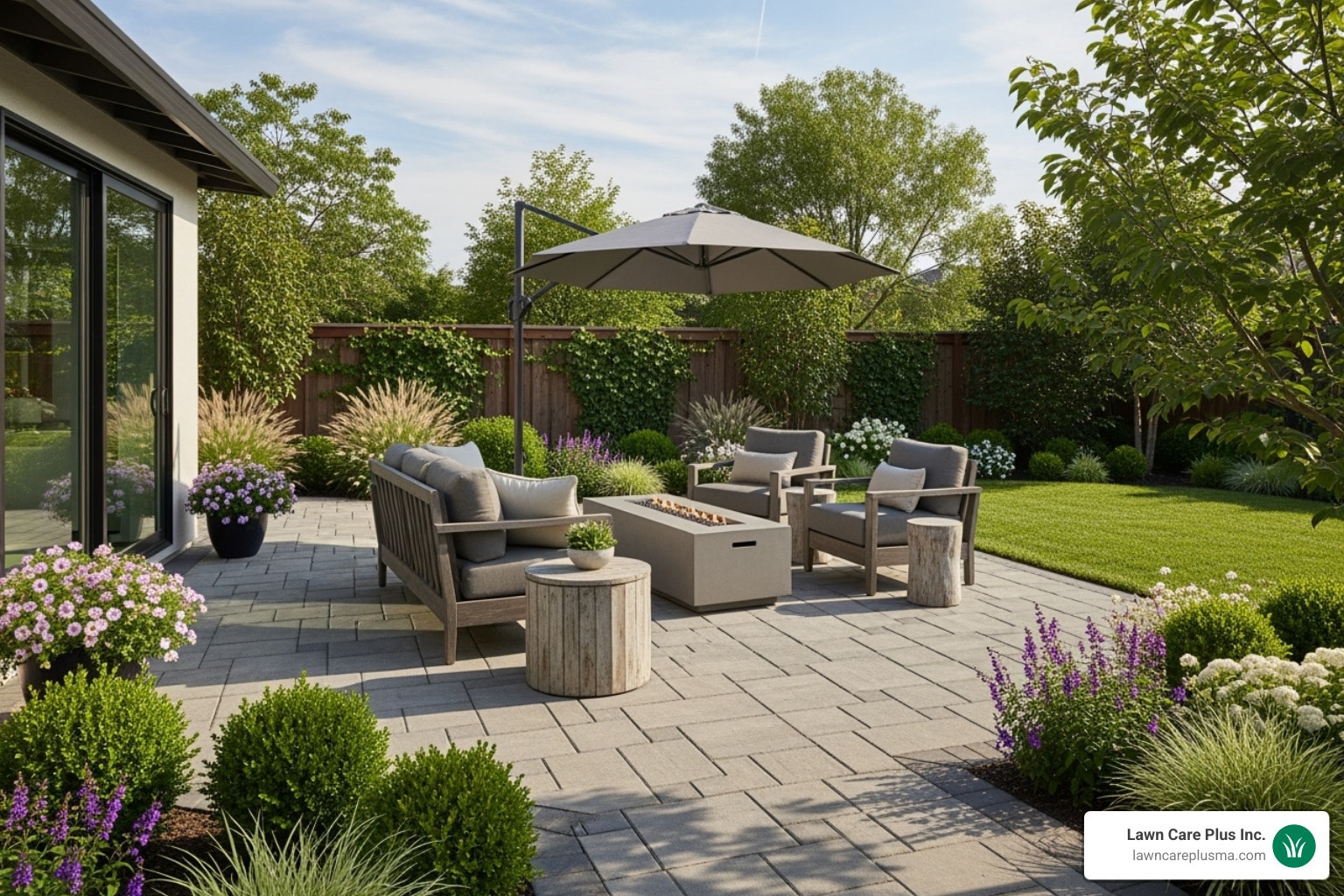
Paver patio installation transforms your backyard into an outdoor living space, adding beauty and value to your home. Whether you dream of weekend barbecues or quiet morning coffee, installing pavers yourself is a rewarding and achievable project.
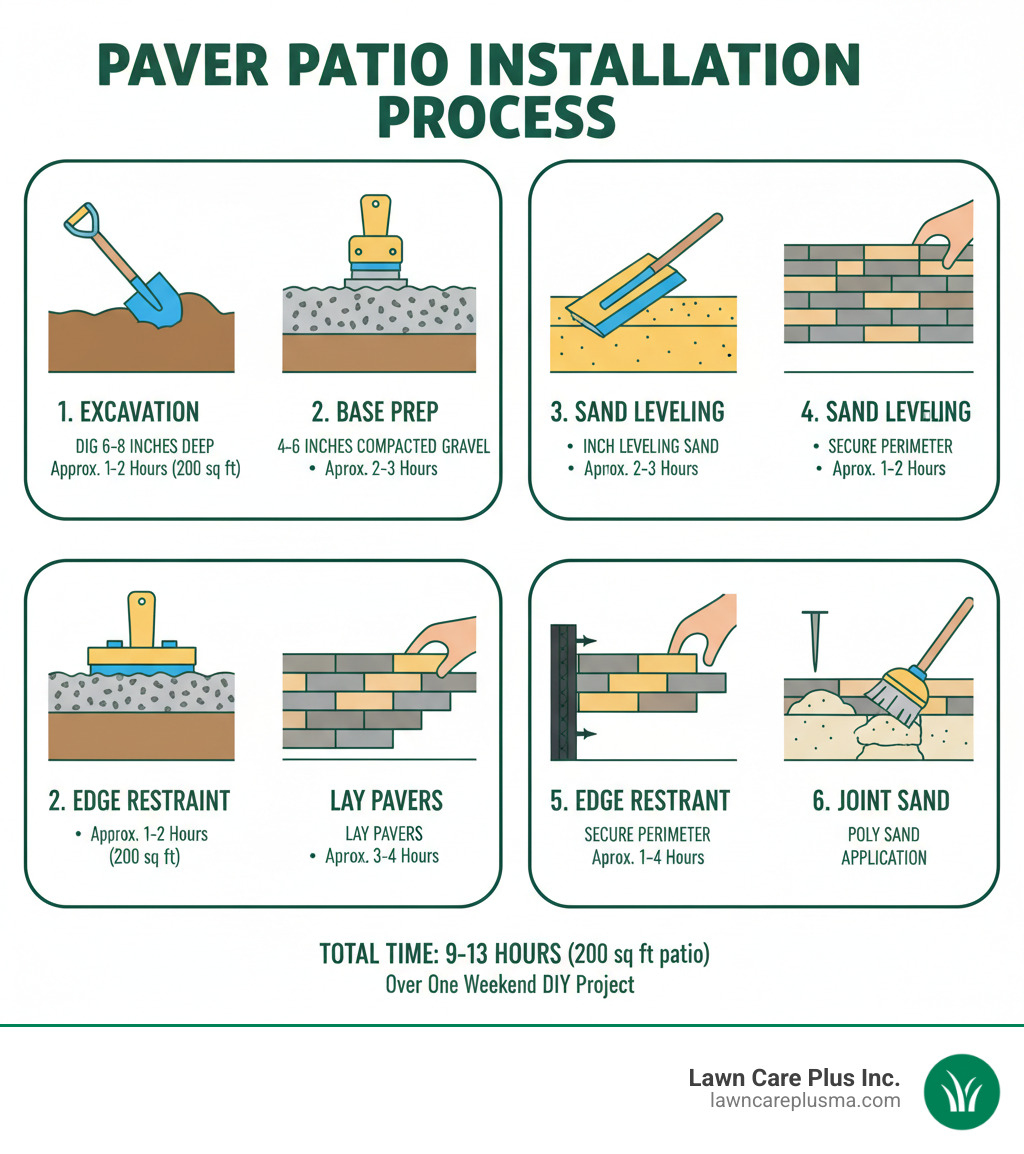
Here’s what paver patio installation involves:
- Planning and layout – Mark your area and establish proper drainage slope
- Excavation – Dig 6-8 inches deep to accommodate base materials
- Base preparation – Install 4-6 inches of compacted gravel
- Sand leveling – Add 1 inch of leveling sand and screed smooth
- Paver installation – Lay pavers using click-and-drop method
- Edge restraints – Secure perimeter to prevent shifting
- Joint sand – Fill gaps with polymeric sand and compact
The reality check: This is serious physical work. A 20×20 foot patio involves moving approximately 10 tons of material. You’ll be digging, hauling gravel, and placing pavers that can weigh 20+ pounds each.
The good news is that most DIY paver patios can be completed in a weekend with proper planning and the right tools.
Why choose pavers over other options?
- Individual pavers can be replaced if damaged
- No cracking like poured concrete
- Immediate use after installation
- Wide variety of colors, patterns, and textures
- Excellent durability in Massachusetts freeze-thaw cycles
The key to success is a proper foundation. As professionals note, “shortcuts can lead to settling”—and nobody wants a wobbly patio.
Ready to start? Let’s break down each step so you can create a patio that rivals a professional installation.
Paver patio installation terms to know:
Step 1: Planning, Preparation, and Design
Before you grab a shovel, focus on the most important part of paver patio installation: the planning phase. Spending time on design and preparation will save you headaches later.
Choosing the perfect location is more than finding an empty spot. Think about how you’ll use the space. Will you host barbecues or enjoy quiet coffee? Consider the view from your kitchen window.
Sunlight matters too. A patio with morning sun and afternoon shade is great for breakfast but less so for evening entertaining. Observe your yard at different times of day to see how the light changes.
Now for the fun part – choosing your paver pattern. The running bond pattern is simple, classic, and forgiving for beginners. Pavers are laid in straight rows, offset by half a paver width. The herringbone pattern creates a sophisticated zigzag look and locks pavers together tightly. If you’re feeling ambitious, the pinwheel pattern uses different sized pavers to create a swirling design that’s guaranteed to impress.
For inspiration on creating stunning outdoor spaces, check out these dreamy hardscapes, pavers, and patios for Massachusetts gardens.
Here’s the non-negotiable part: Call 811 before you dig. This free service marks underground utilities. Hitting a gas line is a dangerous surprise you want to avoid. Call a few days ahead, as they need time to mark your property.
Don’t forget to check with your local building department and HOA about permits or restrictions. Some areas have rules about patio size, setbacks, or drainage requirements. A quick phone call now beats having to tear everything up later.
Essential Tools and Materials for Your Project
Having the right tools is the difference between a satisfying weekend project and a frustrating ordeal.
For tools, you’ll need the basics: a good shovel and spade, a wheelbarrow for moving materials, and a reliable tape measure. A spirit level and line level are crucial for a flat, properly sloped surface. A rubber mallet will gently coax stubborn pavers into place without cracking them.
The plate compactor deserves special mention. While you could use a hand tamper, renting a plate compactor will save your back and create a much better foundation. For cutting pavers, a wet saw or circular saw with a diamond blade gives clean cuts, while a hammer and chisel work for smaller adjustments.
Safety gear isn’t optional – gloves, safety goggles, and a respirator when cutting pavers. The silica dust from cutting is hazardous to your lungs.
Material-wise, you’ll need your pavers, plus the foundation materials. Paver base gravel—typically 3/4-inch crushed stone—forms the backbone of your patio. You’ll also need leveling sand, edge restraints to keep everything locked in place, and polymeric sand to fill the joints and prevent weeds.
Landscape fabric goes down first to separate your base from the native soil while still allowing drainage.
How to Properly Layout and Slope Your Patio
Now, turn your design into reality. Precision here pays off.
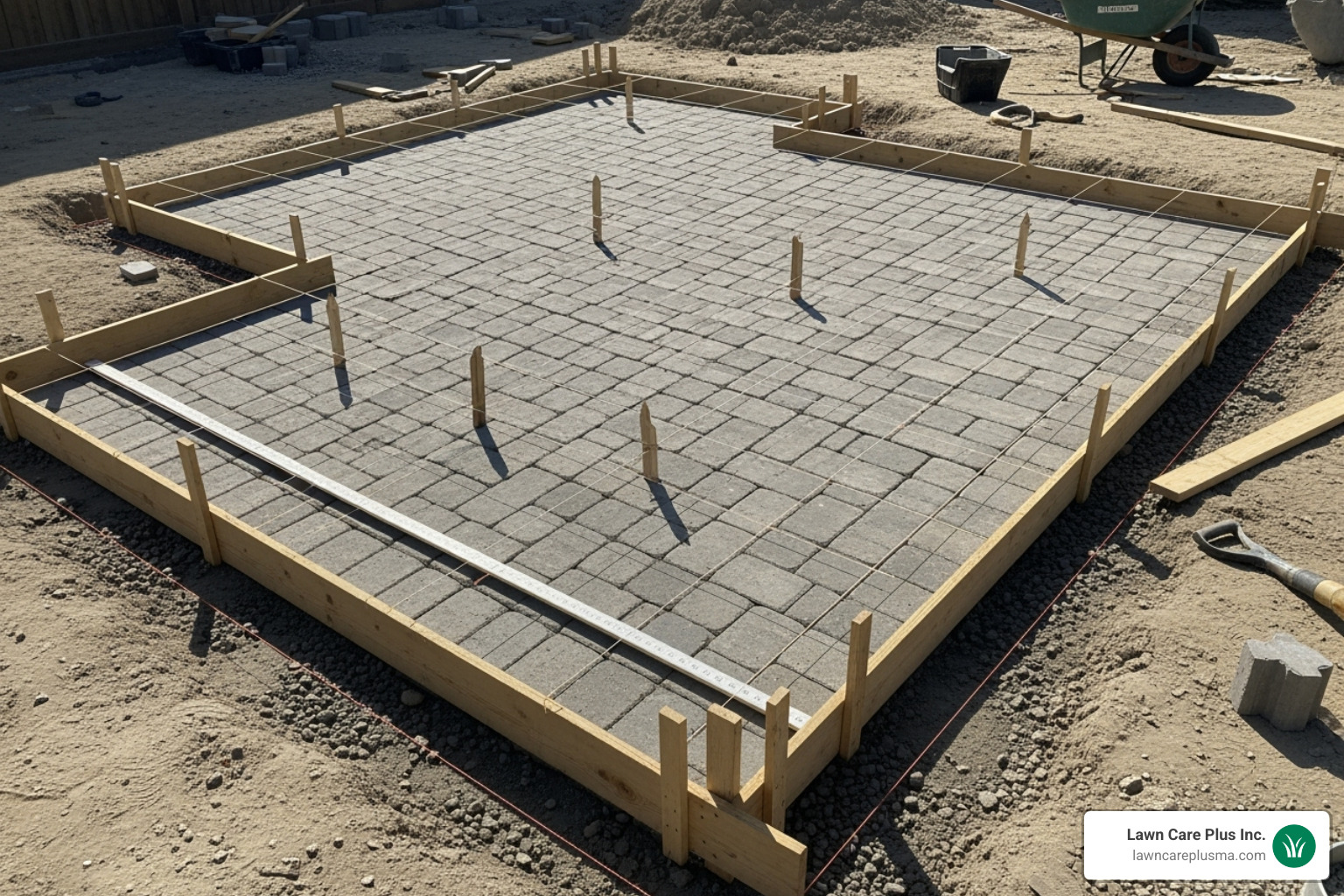
Start by marking your patio perimeter with spray paint, then drive stakes at each corner. String lines between the stakes will outline your patio and serve as your guide.
Getting square corners is easy with the 3-4-5 triangle method. From any corner, measure 3 feet along one string line and 4 feet along the adjacent line. If the distance between these two points is exactly 5 feet, your corner is perfectly square.
Drainage is crucial, especially in Massachusetts with its rain and snow. Your patio needs to slope away from your house at a rate of 1 inch of drop for every 4 to 8 feet of distance.
Set up batter boards just outside your string lines and use a line level to establish this slope. For a 12-foot patio extending from your house, you’d want about 1.5 to 3 inches of total drop. This gentle slope will keep water flowing away from your foundation and prevent puddles.
Understanding the Cost of a Paver Patio
Understanding the costs helps you make informed decisions about your paver patio installation.
DIY costs center on materials and tool rentals. Your biggest expenses will be the pavers, followed by the base material (you might need several tons of gravel). Tool rentals like a plate compactor add a few hundred dollars but are worth it.
Professional installation costs vary widely based on complexity, materials, and location. Based on internet averages, professional paver patio installation can range from $30 to $90+ per square foot, including materials and labor. A 20×20 foot patio could cost anywhere from $12,000 to over $36,000 professionally installed.
Important note: These are average costs based on internet research and don’t reflect actual pricing from Lawn Care Plus Inc. Every project is unique, and costs depend on site conditions, material choices, and project complexity.
The DIY route significantly reduces costs, but you’re trading money for time and physical effort. For detailed cost breakdowns and professional estimates, visit our cost to install a paver patio page.
Whether you go DIY or professional, a well-built paver patio adds real value to your home and creates outdoor living space you’ll enjoy for decades.
Step 2: The Foundation – The Key to a Long-Lasting Patio
The foundation for your paver patio installation is like the roots of a tree: unseen, but essential for long-term stability. Cutting corners here leads to wobbly pavers and future frustration.
The foundation is even more critical in Massachusetts, where freeze-thaw cycles can wreak havoc on poorly prepared bases. A solid foundation provides stability, proper drainage, and the strength to handle New England weather.
Let’s start with the math. Calculate your excavation depth by adding three layers: your paver thickness (typically 2.5 inches), 1 inch for the sand bedding layer, and 4-6 inches for the gravel base. This gives you a total excavation depth of 7.5 to 9.5 inches.
Once you’ve marked your depth, start digging. Remove all sod, topsoil, and organic matter. Roots and organic debris decompose over time, creating voids that lead to settling. After rough excavation, use a plate compactor to make several passes over the native soil. This step, called compacting the subgrade, creates a solid base for everything that follows.
Creating a Stable Gravel and Sand Base
This gravel and sand base is the difference between a patio that lasts 30 years and one that sags after three.
Start by rolling out landscape fabric over your compacted native soil. This geotextile fabric separates gravel from the soil while allowing water to pass through. Overlap the fabric edges by 12 to 18 inches to ensure complete coverage.
You’ll spread your paver base gravel in 4 to 6-inch layers, but do it in 2-inch lifts. Spread 2 inches of gravel, compact it thoroughly with your plate compactor, then add the next 2-inch layer. This layered approach creates a foundation that won’t budge.
Pro tip: lightly mist each gravel layer with water before compacting. The moisture helps stone particles lock together more effectively.
Once your gravel base is compacted and level, it’s time for the sand bedding layer. Spread a consistent 1-inch layer of coarse, washed paver sand over the gravel. This sand cushions the pavers and allows for fine-tuning their level.
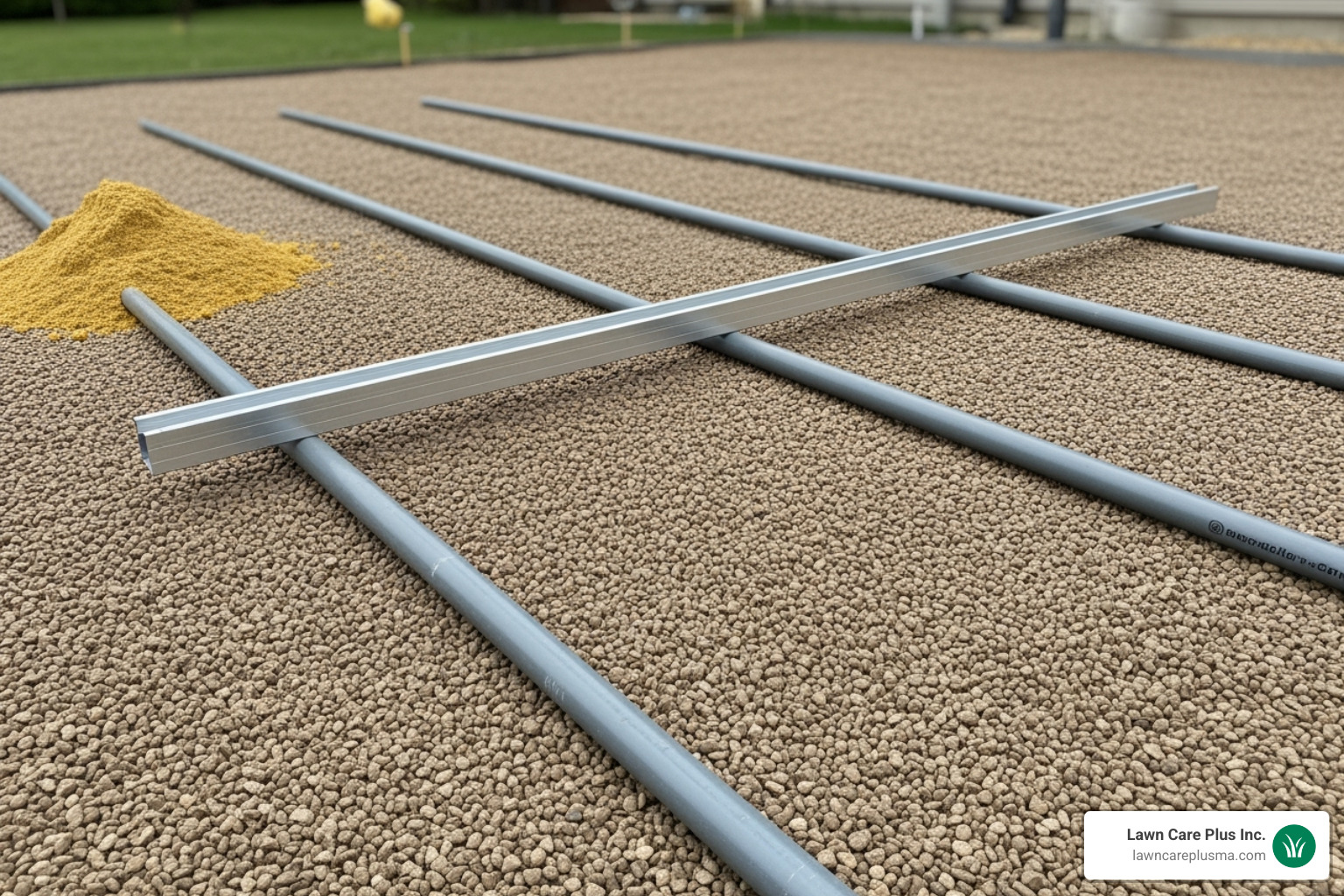
To get a perfectly flat surface, you’ll use a technique called screeding. Place two 1-inch diameter electrical conduits on your compacted gravel, a few feet apart, to act as guides. Pour sand between them, then drag a straight 2×4 board across them to remove excess sand. Once a section is screeded, carefully remove the conduits and fill the depressions with sand, smoothing everything out.
Do not walk on the screeded sand, as it will create uneven spots.
Alternative Base Materials for Paver Patio Installation
While the traditional gravel-and-sand method is proven, newer paver patio installation options can be more manageable for DIYers.
The traditional approach offers unbeatable stability and drainage for Massachusetts’ climate. The main downside is the physical labor of moving tons of gravel.
Alternative base systems like GatorBase or Brock Paver Base use high-density polyethylene panels to replace much of the gravel. These interlocking panels can reduce excavation depth, are significantly lighter, and can speed up installation.
The trade-offs for panel systems: they cost more and may not handle extreme water volume as well as a thick gravel base. They also demand an extremely well-prepared subgrade since the panels offer less forgiveness for imperfections.
For our Massachusetts climate, we typically recommend the proven reliability of a traditional compacted gravel base. It’s more work but delivers maximum longevity and stability.
If you’re feeling overwhelmed, there’s a lot more to learn about hardscaping. Check out our comprehensive guide: Hardscaping 101: Everything You Need to Know.
Step 3: The Paver Patio Installation Process
With the base prepared, it’s time for the most exciting part: laying the pavers. This is where your hard work pays off as the paver patio installation comes to life.
The secret to success is starting from a 90-degree corner or straight edge and working systematically across the patio. This provides a solid reference point and helps maintain crisp, straight lines.
Technique matters here: use the “click-and-drop” method. Place each paver straight down into the sand bed without sliding it. Sliding pavers disturbs the screeded sand, which will affect the final surface.
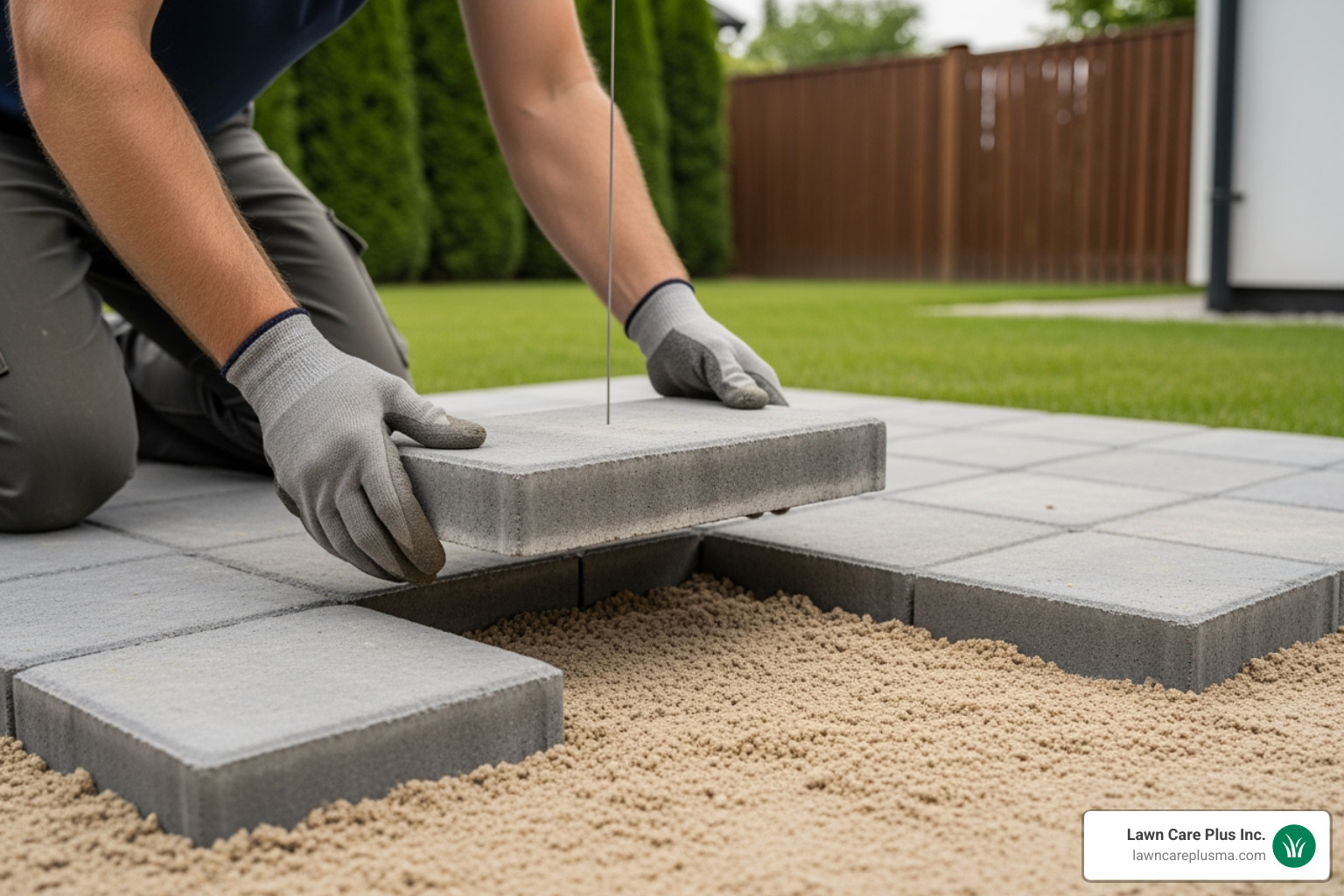
As you lay each paver, maintain consistent gaps of 1/8 to 1/4 inch between them. These gaps are essential for the polymeric sand applied later. Regularly check for levelness with your spirit level across individual pavers and larger sections.
If a paver is too low, carefully lift it and add more sand underneath. If it’s too high (proud), a gentle tap with a rubber mallet should settle it. Patience in getting each paver level saves hours of frustration later.
Lay all full pavers first, leaving areas that need cuts for last. This approach keeps momentum going and ensures your main pattern stays consistent. For more detailed guidance, check out our guide on building a paver patio.
How to Cut Pavers for a Custom Fit
Even well-planned patios will need cut pavers for edges, curves, or obstacles. Cutting pavers is more straightforward than it seems.
Start by marking the cut line with a pencil. For straight cuts, a wet saw or paver saw with a diamond blade is your best friend. These tools can often be rented.
Safety first: always wear eye protection, hearing protection, and a respirator when cutting. The silica dust created is hazardous to breathe.
For smaller adjustments or intricate cuts, a hammer and chisel works well. Score a line where you want the break, then tap gently along the line until the paver splits. For curved cuts, some pros score the surface with a circular saw first, then use a hammer and chisel to chip away material.
Pro tip: Use a cardboard template for complex shapes to avoid wasting pavers.
Installing Edge Restraints and Applying Polymeric Sand
These final steps transform individual pavers into a solid, unified patio.
First are the edge restraints. Install plastic or metal edging strips around the entire perimeter, placing them snugly against the pavers. Secure them into the gravel base with 10-inch spikes every foot or so.
Now for the polymeric sand. It contains special polymers that harden when wet, creating joints that lock pavers together while still allowing for slight movement.
Spread the polymeric sand generously over the patio, then use a stiff-bristled push broom to sweep it into every joint.
Next, run your plate compactor over the entire surface several times. This settles the sand deep into the joints and locks everything together. After compacting, add more sand to any new gaps and compact again.
Critically, blow or sweep all excess sand off the paver surface before adding water. Any sand left on top will create a permanent white haze when it hardens.
Once the surface is clean, lightly mist the entire patio with a garden hose. You want just enough water to activate the polymers without washing sand from the joints. The polymeric sand needs 24 hours to cure before the patio is ready for use.
The satisfaction of completing your own paver patio installation is incredible, but if this process feels overwhelming, the expert team at Lawn Care Plus Inc. has the experience and tools to handle every step professionally.
Frequently Asked Questions about Paver Patios
Here are answers to common questions about paver patio installation projects.
Can you safely install a fire pit on a paver patio?
Yes! A fire pit is a great addition to a paver patio, but safety is key. Your paver patio can accommodate a fire pit if you take the right precautions.
The key is using fire-rated pavers that can handle heat without cracking or discoloring. Check the manufacturer’s specs to be sure. For wood-burning fire pits, we strongly recommend installing a steel insert or ring to contain the flames and protect your pavers from direct heat.
Distance matters. Keep your fire pit at least 10-20 feet away from your house, fences, and anything flammable like shrubs or outdoor furniture.
Before you start, check your local fire codes. Massachusetts communities often have specific rules about fire pit placement, size, and type. A quick call to your local fire department can save you headaches.
Want to explore your options? Check out our guide to patio fire pits for inspiration and safety tips.
What is the difference between installing pavers for a patio vs. a driveway?
While the techniques are similar, driveways must handle significantly more weight and abuse than patios.
The biggest difference is in the base depth. A patio needs a solid 4-6 inch gravel foundation. Driveways, however, need a massive 8-12 inch base to support vehicles without settling or rutting.
Paver thickness is another crucial difference. Standard 2.5-inch patio pavers would crumble under a car’s weight. Driveways need thicker, stronger pavers (usually 3 inches or more) rated for vehicular traffic.
The compaction requirements are also much more stringent for driveways. Any weakness will show up as settling or cracking once cars start driving over it.
Both are great projects, but they require very different approaches.
How do you maintain a paver patio?
Good news: paver patios are low-maintenance. A little regular care keeps them looking fantastic for decades.
Regular sweeping with a broom every week or two clears away leaves and debris. This prevents organic matter from breaking down in the joints and encouraging weeds.
Occasional rinsing with your garden hose washes away surface grime and keeps colors vibrant.
For stains and spills, act quickly. Clean spills like red wine or grease promptly to avoid permanent stains. Use paver-safe cleaners and avoid harsh chemicals that could damage the surface or dissolve your polymeric sand.
Every 2-3 years, check your joint sand and top it up if needed. Some erosion is normal, especially after harsh New England winters. Fresh polymeric sand keeps everything locked together and weeds at bay.
Consider sealing your pavers every few years for extra protection. A quality sealant improves colors, prevents UV fading, and makes stains easier to clean.
Follow these steps, and your patio will remain beautiful and functional for years.
Conclusion: Enjoy Your New Outdoor Living Space
Congratulations on completing a rewarding home improvement project. Your new paver patio installation is more than just stonework; it’s a place for future memories.
Think about it: weekend barbecues with friends, quiet morning coffee moments, evening conversations under the stars. Your patio has transformed from a pile of materials into the heart of your outdoor living space.
The rewards go beyond personal satisfaction. You’ve added real value to your home—the kind that future buyers appreciate. Unlike other home improvements that might go out of style, a well-built paver patio is timeless. The durability built into the foundation means your patio will look great for decades.
This wasn’t easy. The hard work—moving tons of material and focusing on details—is what makes the result so satisfying. You’ll have the pride of knowing you built this with your own hands.
The physical work and careful planning pay off when you see family and friends enjoying the space you created. You’ll have the satisfaction of saying “I built this” when guests compliment your beautiful patio.
Maybe the DIY route feels overwhelming? We understand. The scope of a paver patio installation can feel daunting. If you’re uncertain about tackling this project yourself, that’s completely normal.
The expert team at Lawn Care Plus Inc. has helped countless homeowners in the Boston Metro-West area bring their patio dreams to life. Our comprehensive Hardscape Installation Services handle everything from initial excavation through the final polymeric sand application. We bring the experience, specialized equipment, and skilled craftsmanship to ensure your patio is built to last.
Whether you tackle this project yourself or work with professionals, the end result is the same: a stunning outdoor space that improves your home and your lifestyle. Your patio is ready for whatever memories you’re planning to make.