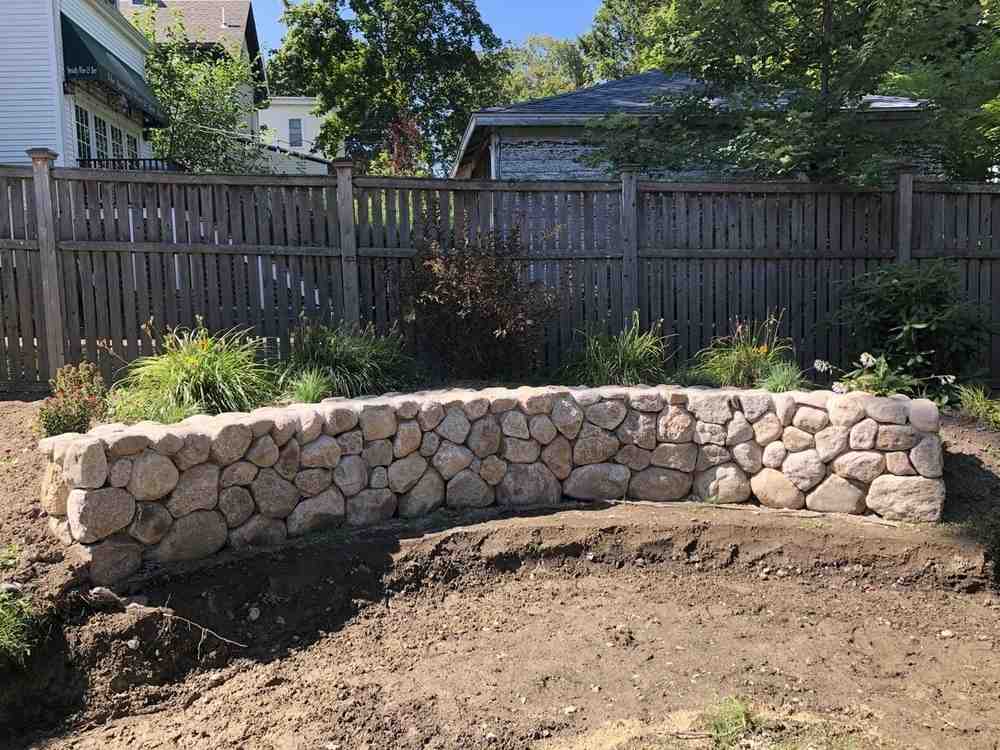
Why a Stone Retaining Wall Is One of the Best Landscaping Investments You Can Make
A stone retaining wall is a structure built to hold back soil on a slope, prevent erosion, and create level, usable ground in your yard. Here’s a quick overview of what you need to know before building one:
- Best for DIY: Dry-stack walls up to 3 feet tall, no mortar or concrete footing required
- Key materials: Angular fieldstone or cut stone, drainage gravel, landscape fabric
- Critical steps: Level trench, gravel base, staggered courses, inward batter, proper backfill drainage
- Permit rules: Many areas require a permit for walls above 30–48 inches — always check local codes first
- When to call a pro: Any wall over 3 feet, on steep slopes, or near structures
If your yard has a slope, you’ve probably seen what happens without one — soil erodes, garden beds wash out, and the land becomes harder to use with every heavy rain. A well-built stone wall solves all of that. And it looks great doing it.
Stone walls are durable, natural-looking, and when built correctly, can last generations. But there’s real technique involved. Get the base wrong, skip drainage, or stack stones without batter, and even a small wall can fail after one New England winter.
This guide walks you through everything — from choosing the right stone to laying the final capstone.
I’m Tim DiAngelis, owner of Lawn Care Plus, Inc., a full-service landscaping and hardscaping company serving Greater Boston and Metro-West, where I’ve seen how a properly built stone retaining wall transforms a sloped property into a functional, beautiful outdoor space. Let’s get into everything you need to build one right the first time.
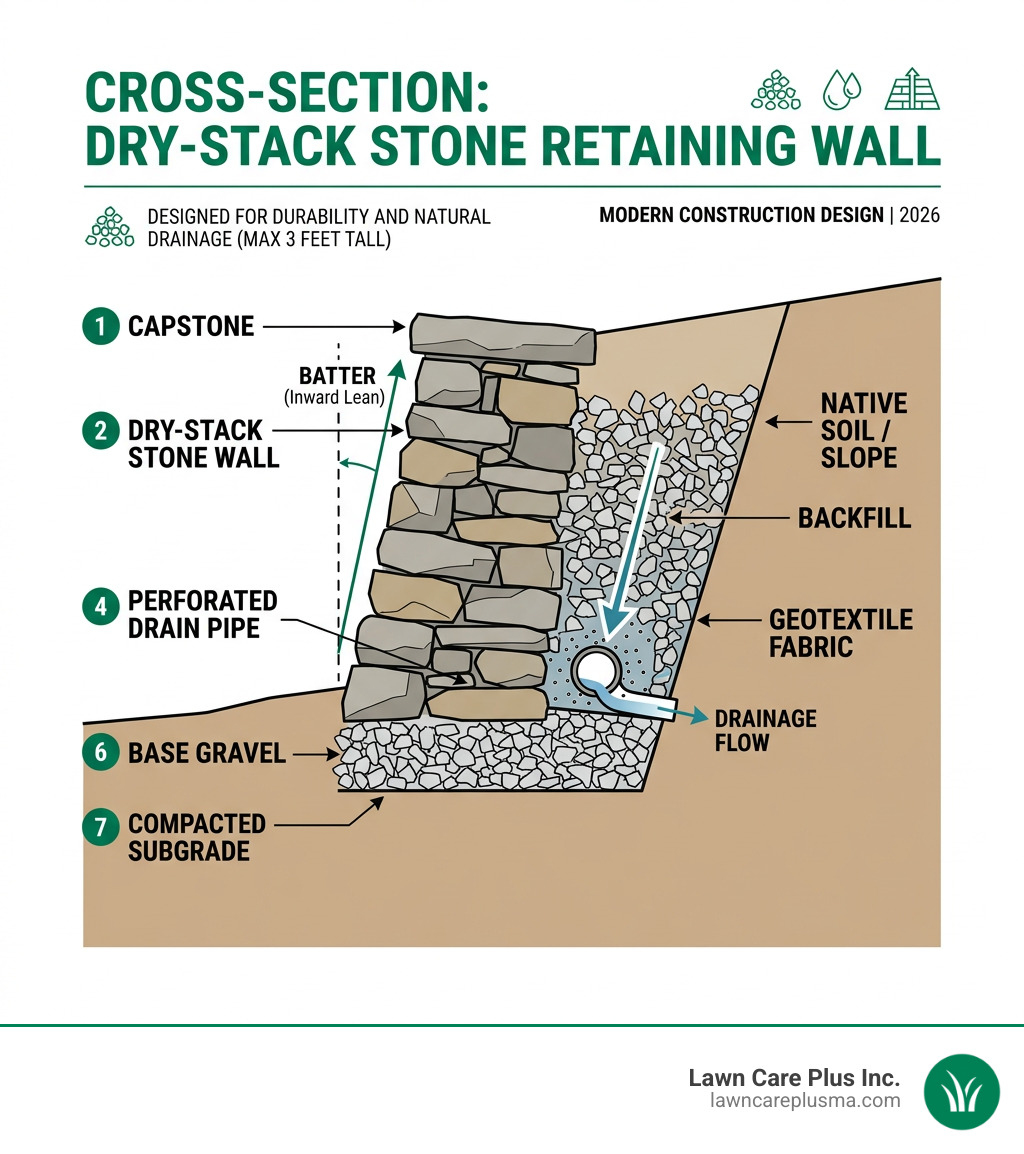
Stone retaining wall vocabulary:
Understanding the Main Types of Stone Retaining Walls
When we talk about a stone retaining wall, we aren’t just talking about one specific look. There are several ways to stack and secure stone, each with its own structural requirements. In Massachusetts, where our soil deals with heavy rains and deep freezes, picking the right type is the first step toward a wall that stays standing.
| Wall Type | Construction Method | Best Use Case | DIY Friendliness |
|---|---|---|---|
| Dry-Stack | Gravity-based (no mortar) | Garden walls, small slopes | High (up to 3ft) |
| Mortared | Rigid (stone + mortar) | Formal landscapes, structural | Low (requires footing) |
| Segmental (SRW) | Interlocking blocks | Modern yards, tall walls | Medium |
| Natural Fieldstone | Irregular stacking | Rustic, New England style | High (with patience) |
Dry-Stack
This is the “classic” New England wall. It relies on gravity and friction rather than glue or cement. Because there is no mortar, the wall is flexible. When the ground freezes and thaws in places like Newton or Needham, a dry-stack wall can shift slightly without cracking. It is the gold standard for DIYers because you don’t need to pour a massive retaining-wall-foundation below the frost line.
Mortared
Mortared walls are rigid. They look formal and “finished,” but they require a concrete footing that reaches below the frost line (usually 4 feet deep in our area) to prevent the wall from snapping when the ground moves. If water gets trapped behind a mortared wall and freezes, the pressure can pop the stones right out.
Natural Fieldstone
If you want to build a stunning retaining wall with fieldstone, you are embracing the irregular. These are stones gathered from the earth, often rounded or jagged. They take more time to fit together—think of it as a 3D puzzle where every piece weighs 40 pounds.
Segmental Blocks
These are manufactured concrete-retaining-wall-blocks designed to look like stone. Systems like the Legacy Stone® are popular because they are uniform in height (usually 6 inches), making them very fast to install. They often have a “lip” or pin system that automatically creates the necessary backward lean (batter).
Pros and Cons of Natural vs. Manufactured Stone
Choosing your material is a balance of “The Look” vs. “The Labor.”
- Natural Stone: It’s beautiful and ages gracefully. A landscape-wall made of real granite or fieldstone gains character over decades. However, it is much slower to install because no two stones are the same size.
- Manufactured Stone (SRW): These blocks-for-retaining-wall are engineered for speed. You can build a block-retaining-wall in a weekend that might take a month with natural stone. The downside? They can look repetitive, and some homeowners find them less “soulful” than real rock.
Choosing Between Dry-Stack and Mortared Construction
For most residential projects in the Boston Metro-West area, we recommend dry-stacking. Why? Drainage. A dry-stack wall has thousands of tiny gaps that allow water to weep through naturally. Mortared walls act like a dam; if you don’t install complex drainage pipes and weep holes, the wall will eventually fail. For DIYers, our professional masonry-services team always suggests dry-stack for anything under 3 feet.
Essential Tools and Materials for Your Stone Retaining Wall
Before you head to the stone yard in Dedham or Norwood, you need a plan and a pile of gear. You can’t just “wing it” with a stone retaining wall.
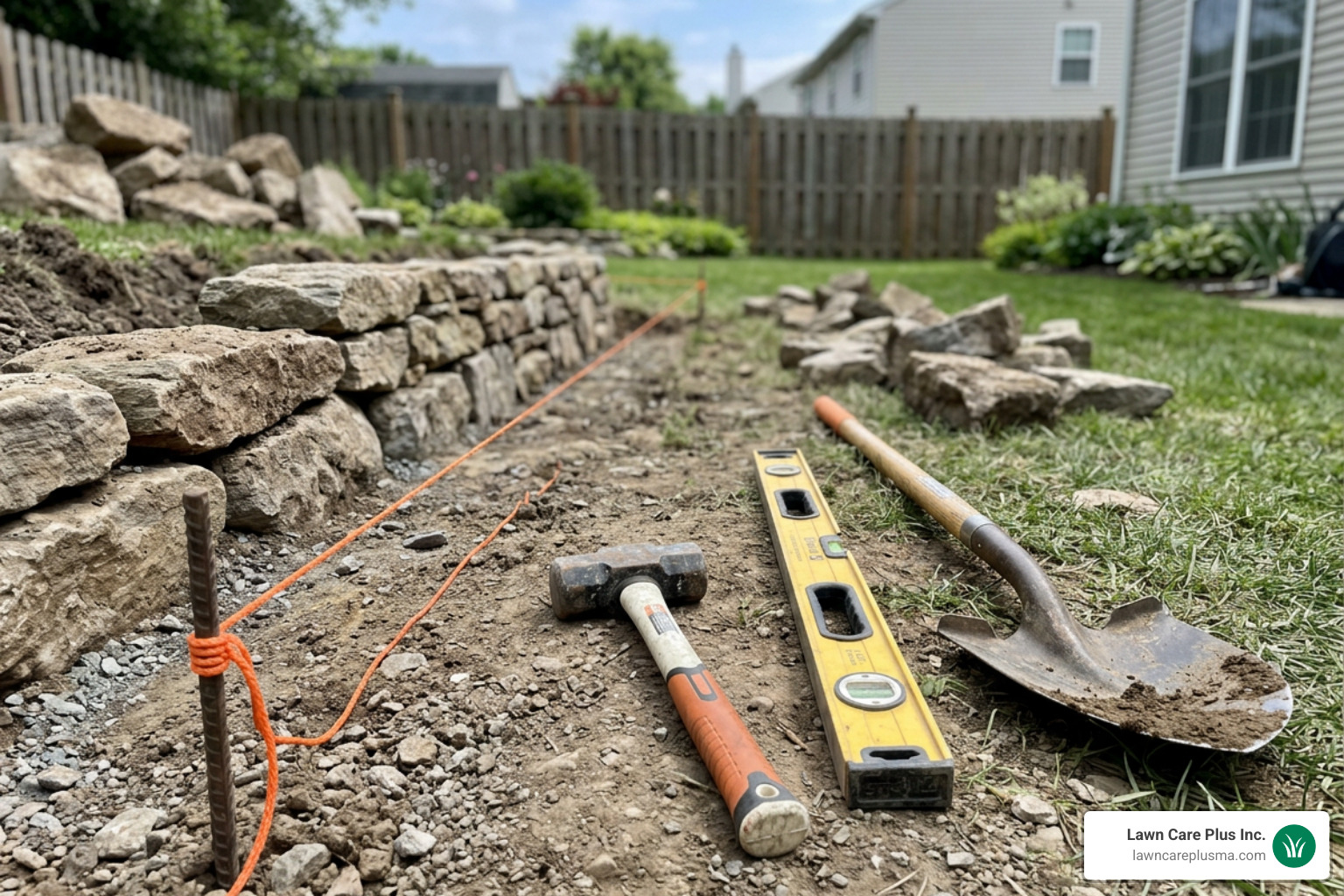
Stone Selection
The best stones for beginners are flat fieldstone or ashlar (pre-cut rectangular stone). Avoid perfectly rounded river rocks—they are “ugly as sin” to stack and will slide around like marbles. Look for stones with at least two relatively flat parallel faces.
Calculating Material Quantities for Your Project
To find out how much stone you need, use this simple formula: Length (ft) x Height (ft) x Average Depth (ft) = Cubic Feet.
If you are buying by the ton (which is common for natural stone), one ton of wall stone typically covers about 15 square feet of wall face. Always order 10% extra for “waste”—those are the stones that are just too weird to fit anywhere. You can check our retaining-wall-cost guide for more help on budgeting.
Essential Masonry Equipment for DIYers
According to expert guides on how to build a dry-stacked stone retaining wall, you will need:
- Sledgehammer: For “persuading” stones into place.
- Mattock: Best for digging through the tough, rocky soil common in Canton and Milton.
- Line Level & String: To keep your courses straight.
- Hand Tamper: Essential for compacting your gravel base.
- Level: A 4-foot level is best for the base; a torpedo level is great for individual stones.
- Gloves: Heavy-duty nitrile or leather. Your hands will thank us later.
Step-by-Step Guide to Building a Dry-Stack Wall
Ready to get dirty? Building a stone retaining wall is a workout, so take your time.
1. Site Preparation and Marking
Start by marking the front face of your wall. Use a garden hose for curves or stakes and string for straight lines. Dig out the “cut” into the slope. You want at least 12 inches of space behind the wall for drainage gravel.
2. Preparing the Foundation and Base Course
The most important part of the wall is the part you can’t see.
- Dig the Trench: For a 3-foot wall, dig a trench about 12 inches deep and 20-24 inches wide.
- Add Gravel: Fill the bottom 6 inches with 3/4-inch crushed stone (not rounded pea gravel). Compact it until it feels like concrete.
- The First Course: Lay your largest, flattest stones here. These are your “foundation” stones. Bury them slightly so the front edge is below ground level. This prevents the wall from kicking out at the bottom. Use a level to ensure they are rock-solid. If a stone wobbles, use small “shims” (flat rock chips) to steady it.
3. Stacking, Battering, and Backfilling for Longevity
As you move up, follow these rules:
- Batter (The Lean): Never build a wall perfectly vertical. It should lean back into the hill about 1 to 2 inches for every foot of height.
- Stagger Joints: Like a brick wall, never let a vertical seam run between two courses. “One over two, two over one.”
- Tie-Back Stones: Every 3 or 4 feet, place a long stone that goes deep into the hillside. These act as anchors. In the industry, we sometimes call these “deadmen.”
- Hearting: As you build, fill the gaps inside the wall with small stone chips (hearting). Don’t use dirt inside the wall! Dirt holds water; stone lets it drain.
- Backfilling: Every time you finish a course, add 12 inches of drainage gravel behind the wall and compact it. This is a great time to use landscape-retaining-walls best practices by adding a layer of filter fabric between the gravel and the soil to keep the “fines” from clogging your drainage.
4. Capstone Placement
The top layer (capstones) should be your widest, flattest stones. They protect the wall from rain and give it a finished look. For extra safety, especially if people will sit on the wall, you can use a bit of masonry adhesive to secure these top stones.
Mastering Drainage and Stability in a Stone Retaining Wall
If you ignore drainage, your stone retaining wall will eventually become a “retained pile of rocks.” Water is heavy, and hydrostatic pressure is the number one killer of walls.
Implementing Proper Drainage
Behind your wall, you should have a “chimney” of clean crushed stone. For walls over 2 feet, we recommend a perforated 4-inch drain pipe at the base of that gravel layer, sloped to “daylight” (an exit point) at the ends of the wall. This ensures that when the snow melts in Brookline or Watertown, the water has a clear path out.
You should also use retaining-wall-drainage techniques like installing “weep holes”—intentional gaps in the stone—to let water escape through the face.
Ensuring Stability with Batter and Tie-Backs
Stability comes from weight and angles.
- The 1:1 Rule: For every 1 foot of height, the base of a natural stone wall should be roughly 1 foot thick.
- Compaction Lifts: When backfilling with soil or gravel, never dump it all at once. Add 6-8 inches, compact it, then add more. This prevents the soil from settling later and pushing the wall forward.
Planning for Costs, Permits, and Local Regulations
Before you start digging up your yard in Belmont or Chestnut Hill, let’s talk about the boring (but important) stuff: laws and money.
Average Pricing and Material Options
Based on internet data, the average cost for a stone retaining wall can range significantly. It is important to note that these figures are average costs based on internet data and not actual costs for Lawn Care Plus. For a DIY project, you’re mostly looking at material costs.
- Natural Stone: $20 to $120 per square foot (materials only).
- Manufactured Blocks: $15 to $90 per square foot.
- Professional Installation: If you hire a team, prices typically range from $40 to $240+ per square foot, depending on the stone type and site difficulty. Note: These are internet averages; actual costs for Lawn Care Plus projects are based on specific site evaluations.
Codes and Permits in Massachusetts
In many of our service areas, like Boston or Brookline, you don’t need a permit if the wall is under 30 or 36 inches. However, some towns have stricter rules.
- The 3-Foot Rule: Generally, any wall over 3 feet tall requires a permit and often an engineered drawing.
- Call 811: Before you dig a single inch, call 811 to have your utility lines marked. It’s free, and it’s the law.
When to Call a Professional
DIY is great for a building-a-small-retaining-wall project, but you should call retaining-wall-installers if:
- The wall needs to be taller than 3 feet.
- The wall is supporting a driveway or a house foundation.
- You have a “surcharge” (a steep slope above the wall).
- You simply don’t want to move 10,000 pounds of rock by yourself!
Frequently Asked Questions about Stone Retaining Walls
How high can I safely build a DIY stone retaining wall?
Stick to 3 feet or less. Once a wall hits 4 feet, the weight of the soil behind it increases exponentially. Professional retaining wall builders near me use geogrid (a structural mesh) to anchor tall walls into the soil—something that is difficult for a first-timer to get right.
What are the most common mistakes to avoid?
- Running Joints: Having a vertical line of gaps. It creates a “fault line” where the wall can split.
- No Batter: Building a perfectly vertical wall. It will eventually lean forward and fall.
- Poor Compaction: If the base isn’t packed tight, the wall will settle unevenly.
- Using Dirt as Backfill: Dirt expands when wet; gravel does not. Always backfill with gravel.
How do stone walls perform in cold climates with freeze-thaw cycles?
In the Boston area, frost heaves are a major concern. This is why we love retaining walls and landscaping that use the dry-stack method. Because the stones aren’t glued together, the wall can “breathe” and move slightly with the frost without falling apart.
Conclusion
Building a stone retaining wall is one of the most rewarding hardscaping projects you can tackle. It combines physical labor with creative problem-solving, and the result is a permanent improvement to your home’s value and beauty. Whether you’re creating a small garden border in Walpole or a structural terrace in Jamaica Plain, the principles remain the same: a solid base, good drainage, and a steady lean.
If you find yourself overwhelmed by the sheer volume of stone or the complexity of a steep slope, we’re here to help. At Lawn Care Plus Inc., we’ve been building durable, beautiful stone walls across the Boston Metro-West area for over 18 years. From Medfield to Roslindale, we know the local soil, the local codes, and exactly what it takes to build a wall that stands the test of time.
Ready to transform your landscape? Contact us for a consultation today, and let’s build something that lasts.