Understanding Your Blacktop Driveway Resurfacing Cost in 2026
Blacktop driveway resurfacing cost is one of the most common questions homeowners ask before tackling a worn-out driveway — and for good reason. Resurfacing can save you thousands compared to a full replacement, but only if your driveway is the right candidate.
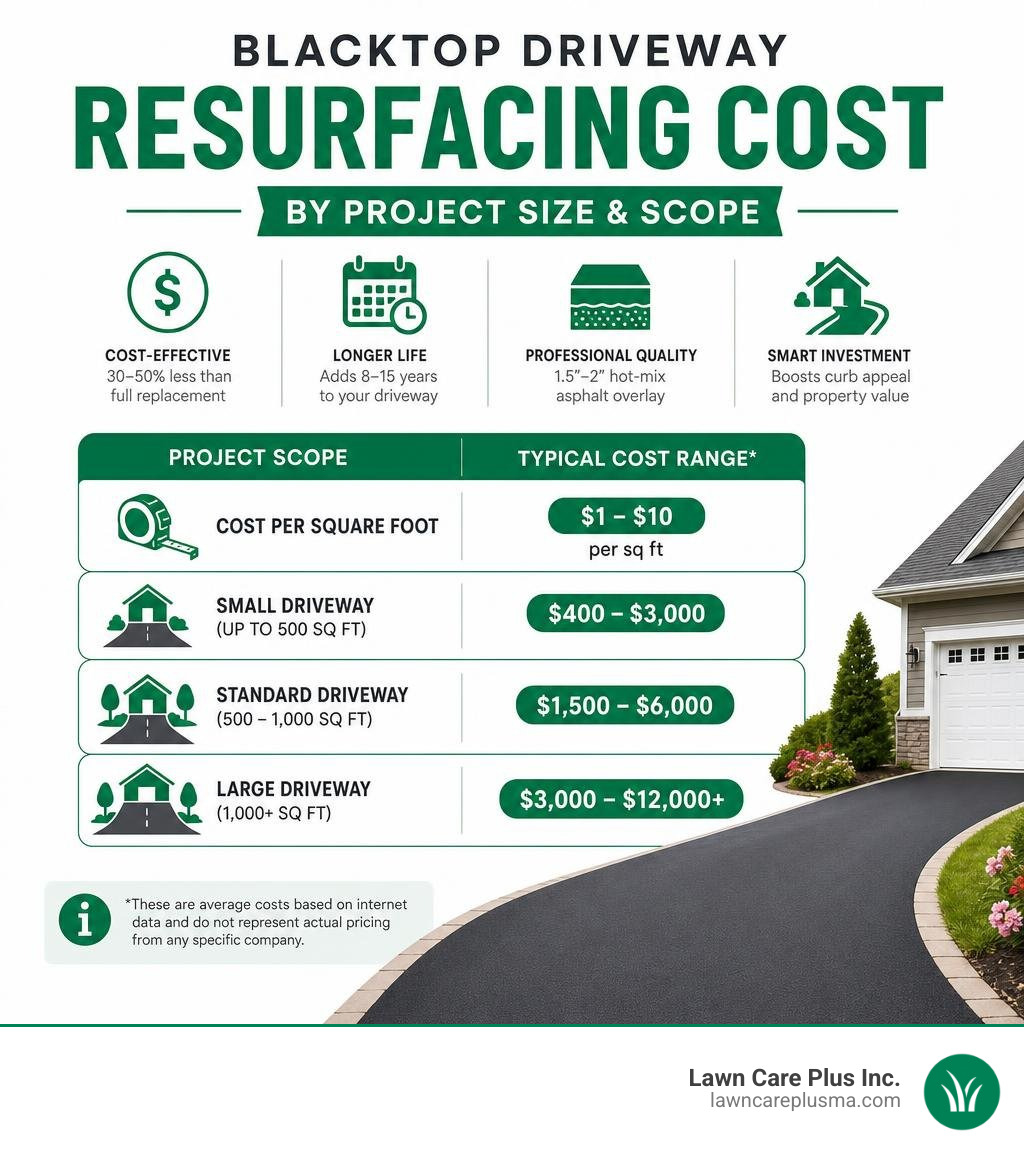
Quick Answer: What Does Blacktop Driveway Resurfacing Cost?
| Project Scope | Typical Cost Range* |
|---|---|
| Cost per square foot | $1 – $10 per sq ft |
| Small driveway (up to 500 sq ft) | $400 – $3,000 |
| Standard driveway (500–1,000 sq ft) | $1,500 – $6,000 |
| Large driveway (1,000+ sq ft) | $3,000 – $12,000+ |
*These are average costs based on internet data and do not represent actual pricing from Lawn Care Plus Inc.
Most homeowners in the Boston area are surprised to learn that resurfacing typically costs 30–50% less than tearing out and replacing their entire driveway — while adding 8 to 15 years of new life. But the final number depends on several factors: your driveway’s size, its current condition, whether milling is needed, and where you live.
This guide breaks it all down clearly so you can budget with confidence, ask the right questions, and avoid costly mistakes.
I’m Tim DiAngelis, owner of Lawn Care Plus Inc., a full-service landscaping and hardscaping company serving Greater Boston and Metro-West — and our team has seen how much blacktop driveway resurfacing cost varies depending on prep work, base conditions, and local material pricing. Whether you’re weighing your options or ready to get a quote, this guide will give you the foundation you need.
To accurately calculate your potential investment, it helps to understand what a professional resurfacing—also known as an asphalt overlay—actually involves. Unlike a simple sealcoating, which is a thin protective liquid layer, resurfacing involves applying a brand-new, structurally sound layer of hot-mix asphalt (usually 1.5 to 2 inches thick) directly over your existing driveway.
According to national data from How Much Does It Cost to Resurface an Asphalt Driveway? (2026), the typical cost of resurfacing spans a wide range of $1 to $10 per square foot. Because every home has different prep requirements, grading challenges, and structural needs, this wide range reflects everything from a basic overlay with minimal prep to an advanced “mill and overlay” job on a complex layout.
Below is a detailed breakdown of how these average online figures translate to different driveway sizes in the Boston Metro-West area:
| Driveway Size & Classification | Dimensions (Typical) | Area (Square Feet) | Estimated Cost Range (Internet Averages Only)* |
|---|---|---|---|
| Small (Single-Car) | 10′ x 20′ to 12′ x 35′ | 200 – 400 sq ft | $400 – $3,000 |
| Medium (Double-Car) | 20′ x 20′ to 20′ x 30′ | 400 – 600 sq ft | $1,200 – $4,500 |
| Standard (Large Double) | 24′ x 30′ to 20′ x 50′ | 600 – 1,000 sq ft | $1,800 – $6,000 |
| Large / Estate (Multi-Car) | 20′ x 75’+ or Circular | 1,500 – 2,000+ sq ft | $4,500 – $12,000+ |
*Please note: These figures are average costs based on national internet data and do not represent actual project pricing for Lawn Care Plus Inc. Local material costs, disposal fees, and labor rates in eastern Massachusetts can shift these ranges.
When you read our comprehensive guide on Driveway Repaving Costs: A Smooth Guide to Your Home’s Curb Appeal, you’ll see that prep work is the single biggest variable. If your existing asphalt has deep cracks, localized sinking, or edge crumbling, those issues must be repaired before the new layer goes on. If a contractor simply paves over them without proper prep, those underlying cracks will reflect right up through your brand-new surface within a year or two—a phenomenon known as “reflective cracking.”
Resurfacing vs. Full Replacement: Which Is Right for You?
One of the most critical decisions you will make is whether to choose a simple overlay or go for a complete tear-out and replacement. Opting for the wrong method can cost you dearly. If you resurface a driveway that has a failed foundation, your money is essentially wasted. Conversely, paying for a full replacement when a simple overlay would suffice is an unnecessary drain on your home improvement budget.
According to industry metrics from How Much Does Driveway Resurfacing Cost? [2025 Data], resurfacing is highly effective when the underlying base is structurally sound and less than 30% of the surface shows significant damage. If your driveway is under 15 to 20 years old, it is usually a prime candidate for an overlay. However, if the subgrade has collapsed, a full Asphalt Driveway Replacement is the only permanent solution.
How Base Stability Affects Your Blacktop Driveway Resurfacing Cost
A successful resurfacing project relies entirely on the strength of the gravel base beneath the asphalt. Think of the existing blacktop as the foundation for your new layer. If that foundation is shifting, sinking, or rotting, the new asphalt will do the same.
Before committing to a resurfacing project, we recommend performing a simple “screwdriver test” or having a professional inspect the base. If you can easily push a screwdriver deep into wide cracks and feel soft, muddy earth rather than compacted gravel, your base may be compromised.
If your driveway only displays:
- Minor surface hairline cracks (under 1/4 inch wide)
- Slight surface fading or graying from UV exposure
- Minor, isolated oil stains or superficial raveling (loose gravel on top)
Then a standard Driveway Repair followed by a professional overlay is highly viable and will save you thousands of dollars compared to a complete tear-out.
When Full Replacement Is Necessary
Sometimes, an overlay is just a temporary band-aid on a terminal problem. You will need a complete tear-out and reconstruction if you observe any of the following warning signs:
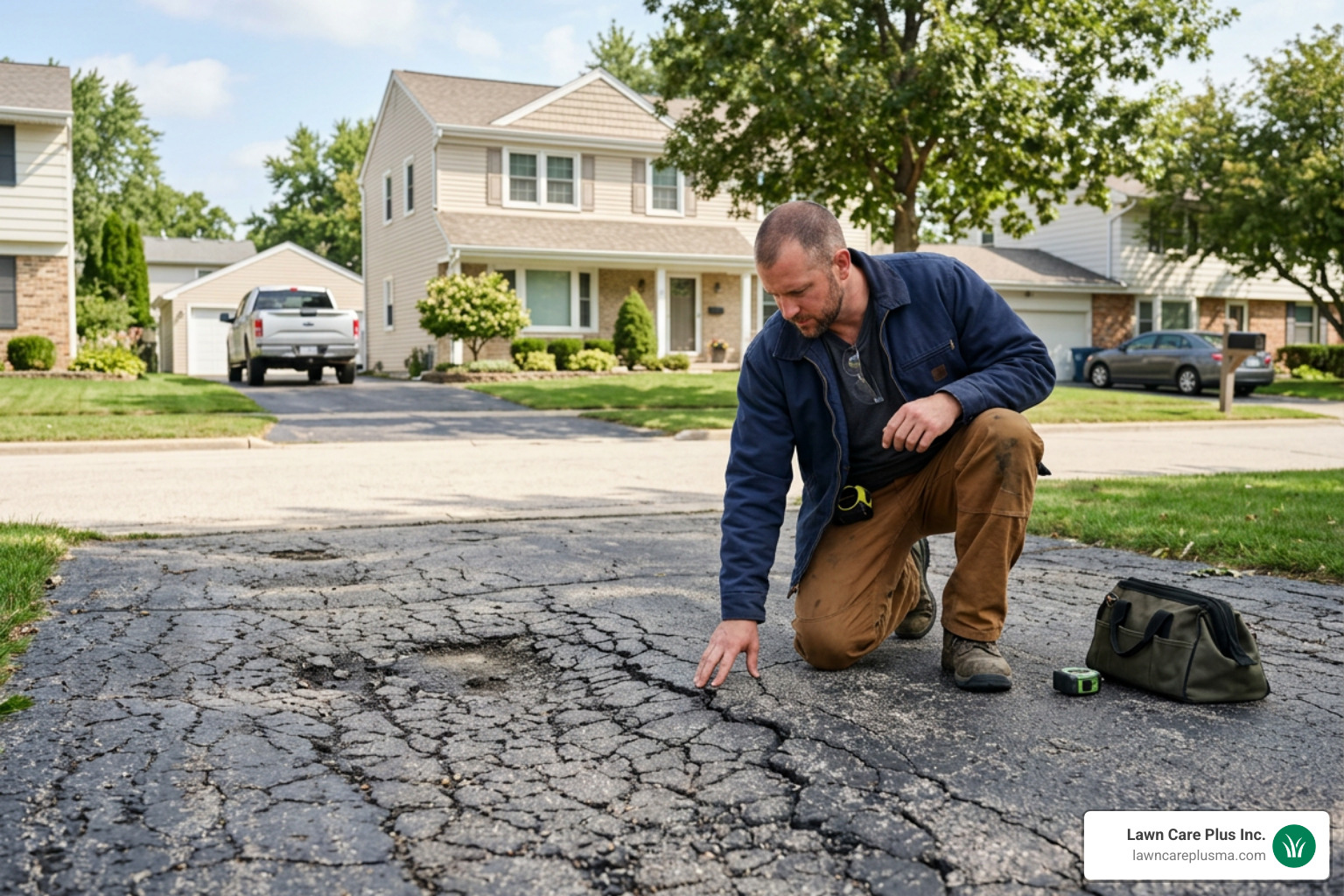
- Alligator Cracking: This looks like a spiderweb or the back of an alligator’s hide. It is a definitive sign of deep base failure. The gravel beneath has lost its compaction, and the asphalt is flexing and breaking under vehicle weight.
- Deep, Recurring Potholes: If a pothole keeps returning even after being patched, the subbase has washed away.
- Severe Sinking or Heaving: Sinking near the garage apron or heaving along the edges indicates that water has gotten under the base and frozen, ruining the foundation.
- Age: If your blacktop is over 20 to 25 years old, the liquid asphalt binder has completely oxidized, making the entire structure brittle.
In these situations, attempting to save money with an overlay will backfire. For a deep dive into replacement pricing and options, check out our guide on How Much Does It Cost to Replace a Driveway? to understand what goes into building a reliable, long-lasting gravel foundation from scratch.
Key Factors That Influence Blacktop Resurfacing Expenses

When contractors evaluate your property to provide a bid for a blacktop driveway resurfacing cost, they look at several distinct variables. No two driveways are identical, and local conditions play a massive role—especially here in Massachusetts, where our severe freeze-thaw cycles require robust construction standards.
As detailed in the Asphalt Driveway Cost Per Square Foot 2026: Install & Repair guide, several key elements drive the final estimate:
- Driveway Size: Because asphalt paving involves heavy machinery, mobilization costs are high. Smaller driveways often carry a higher cost per square foot because the contractor must cover their equipment transportation and crew setup costs. Larger driveways benefit from economies of scale, lowering the per-square-foot rate.
- Asphalt Thickness: A standard residential overlay is typically 1.5 to 2 inches thick after compaction. If your driveway services heavy vehicles (like large commercial delivery trucks or heavy-duty RVs), you may need a 3-inch layer, which increases material costs proportionately.
- Slope and Access: Steeply sloped driveways (common in hilly areas of Newton, Brookline, or Waltham) require specialized equipment, hand-laying in tight corners, and additional safety measures, adding to the labor cost.
- Regional Material Pricing: Asphalt is a petroleum-based product, meaning its wholesale price fluctuates alongside global oil prices. Additionally, local environmental regulations and transport distances from the nearest asphalt batch plant will impact your local Asphalt Driveway Cost.
How Milling and Prep Work Add to the Blacktop Driveway Resurfacing Cost
The physical act of rolling out new hot-mix asphalt is actually the fastest part of the job. The real craftsmanship—and a significant portion of the cost—lies in the prep work.
- Asphalt Milling: Milling is the process of using a grinding machine to shave off the top 1 to 2 inches of the old asphalt. While it adds to the upfront cost, it is highly recommended. Milling allows the new asphalt to sit flush with your garage apron, concrete walkways, and the street edge, preventing dangerous trip hazards and water pooling. It also removes surface defects, ensuring a perfectly level finish.
- Crack Sealing and Patching: Before paving, any existing cracks wider than 1/4 inch must be filled with a rubberized hot-pour crack sealant. Potholes must be cleaned out, filled with hot-mix asphalt, and compacted. Neglecting this step will cause the new overlay to fail prematurely.
- Tack Coat Application: A tack coat is a liquid asphalt emulsion sprayed over the old, cleaned driveway. It acts as a powerful adhesive, chemically bonding the new overlay to the old surface to prevent delamination.
- Transition Grading: Hand-stamping and beveling the exposed edges of the driveway ensures clean drainage and prevents the edges from crumbling under tire pressure.
For minor issues, early intervention is key. Performing timely Driveway Crack Repair can delay the need for a full resurfacing or replacement by keeping destructive water out of your gravel subbase.
Frequently Asked Questions About Driveway Resurfacing
Navigating asphalt paving can be confusing. To help you make the best decision for your home, we have compiled answers to the most common questions homeowners ask during the planning phase.
How long does a resurfaced asphalt driveway last?
A professionally installed asphalt overlay typically lasts 8 to 15 years. The exact lifespan depends heavily on three factors:
- Subgrade Condition: If the original base was solid and dry, your overlay will last much longer.
- Climate Impact: In Greater Boston, our harsh winter freeze-thaw cycles cause the ground to shift. Water that seeps into small cracks freezes and expands, which can shorten the lifespan of the surface if it is not properly maintained.
- Maintenance Schedule: To maximize your return on investment, you should apply a high-quality coal-tar or asphalt-emulsion sealcoat 6 to 12 months after resurfacing, and then repeat the sealcoating every 3 to 5 years.
How soon can you drive on a newly resurfaced driveway?
We recommend keeping all vehicles off your newly resurfaced blacktop for at least 24 to 48 hours.
While the asphalt may feel cool to the touch within a few hours, it takes time to fully cure and harden. Walking on it is generally fine after a few hours, but heavy vehicles can leave permanent tire ruts or scuff marks, especially during hot summer days. If the weather is exceptionally warm, you may want to wait an extra day or spray the surface with water to help cool and set the liquid binders.
Does driveway resurfacing require a permit?
In many Massachusetts municipalities—including Boston, Brookline, Dedham, and Newton—you may need a permit if your project alters the footprint of the driveway, changes the slope, or impacts the public sidewalk/street curb cut.
If you are performing a straightforward overlay within the exact same boundaries, some towns do not require a formal building permit, while others charge a nominal fee to ensure proper drainage compliance. Additionally, if you live in a neighborhood governed by a Homeowners Association (HOA), you must check their specific bylaws regarding work hours, material types, and aesthetic finishes before scheduling any paving crew.
Conclusion
Understanding your blacktop driveway resurfacing cost is the first step toward restoring your home’s curb appeal and protecting your property value. When your driveway’s gravel foundation is still strong, choosing an overlay is an incredibly smart, budget-friendly alternative to a full tear-out.
At Lawn Care Plus Inc., we pride ourselves on providing honest assessments, expert hardscaping craftsmanship, and reliable service throughout the Boston Metro-West area—from Belmont and Brookline to Newton, Dedham, and beyond. We don’t believe in cutting corners with thin overlays or skipping the vital prep work that keeps your driveway looking pristine through our tough New England winters.
If you are ready to stop guessing about your driveway’s condition and want an expert, honest recommendation on whether you need a simple repair, an overlay, or a full replacement, we are here to help. Contact our local team today to discuss your project and schedule a professional on-site evaluation for our Lawn Care Plus Inc. Asphalt Driveway Replacement Services.