
Why Homeowners in Greater Boston Are Stuccoing Their Concrete Block Retaining Walls
Applying concrete block retaining wall stucco is one of the most effective ways to transform a drab, aging CMU wall into a clean, polished feature that holds up for years — but only if it’s done right.
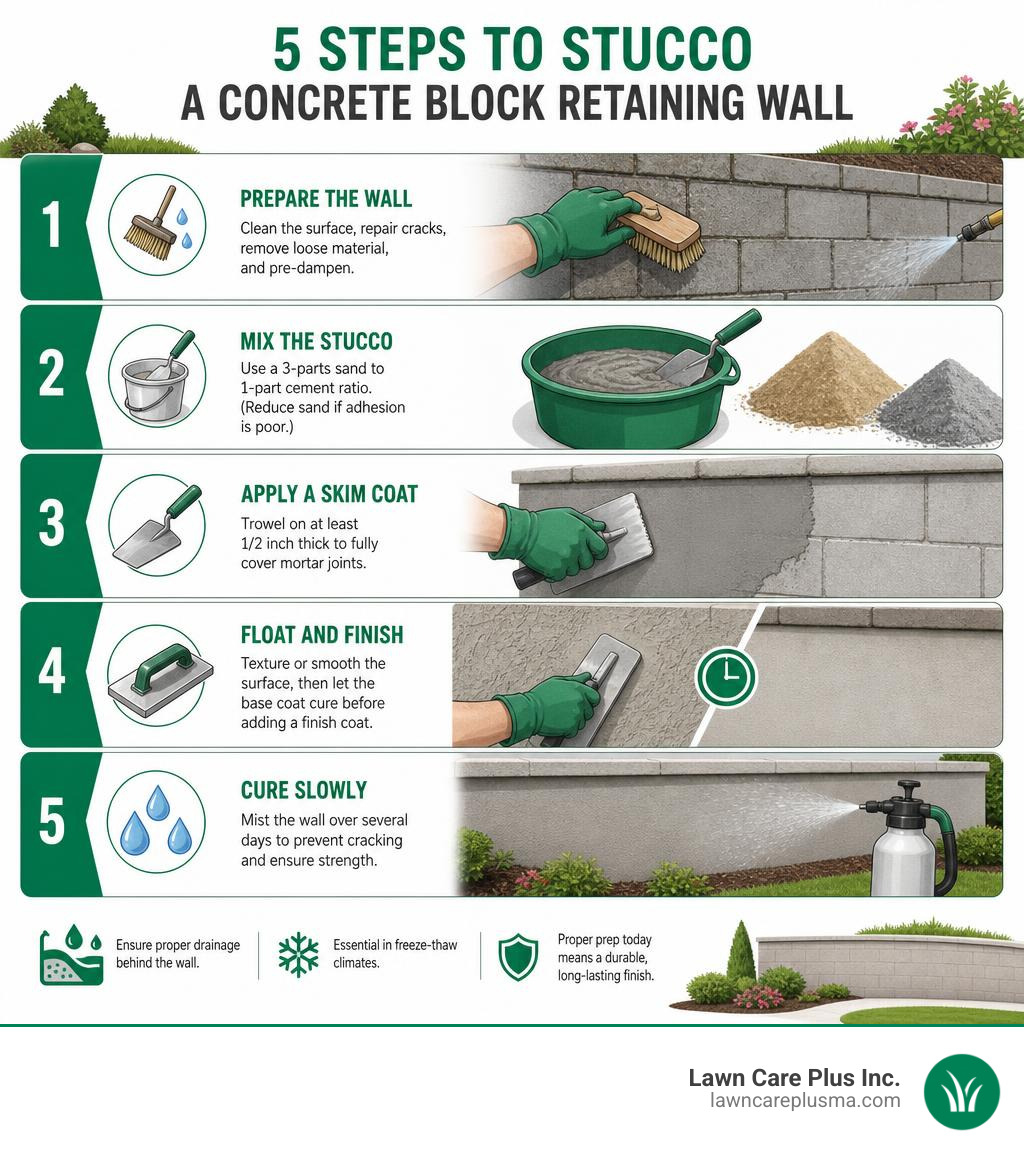
Here’s a quick overview of how to stucco a concrete block retaining wall:
- Prepare the wall — clean, repair cracks, remove loose material, and pre-dampen the surface
- Mix the stucco — use a 3-parts sand to 1-part cement ratio (reduce sand if adhesion is poor)
- Apply a skim coat — trowel on at least 1/2 inch thick to fully cover mortar joints
- Float and finish — texture or smooth the surface, then let the base cure before adding a finish coat
- Cure slowly — mist the wall over several days to prevent cracking
A few things matter before you start:
- Stucco needs a damp (not sealed) concrete surface to bond properly
- One skim coat is typically enough for concrete block — no scratch coat required on porous CMU
- Drainage behind the wall must be addressed first or moisture will push the stucco off from behind
- In New England’s freeze-thaw climate, skipping proper prep leads to premature failure
I’m Tim DiAngelis, owner of Lawn Care Plus, Inc., a full-service landscaping and hardscaping company based in Roslindale, Massachusetts — and our team has hands-on experience with concrete block retaining wall stucco projects across the Greater Boston and Metro-West area. Whether you’re resurfacing a failing coating or finishing a new wall, the steps below reflect what actually works in our climate.
Concrete Block Retaining Wall Stucco: What to Know Before You Start
Stucco can be applied directly over concrete masonry units, also called CMU, cinder block, or concrete block, because the block surface is porous enough to create a strong mechanical bond. That is the big difference between stuccoing a block wall and stuccoing over wood framing, where paper, wire lath, and multi-coat systems are usually required.
For a retaining wall, though, the wall is not just a decorative surface. It is holding soil. That means moisture, pressure, freeze-thaw movement, and drainage all matter.
Before applying stucco, we look at:
- Whether the wall is structurally stable
- Whether water is collecting behind the wall
- Whether the face is painted, sealed, dusty, or crumbling
- Whether old stucco or parging is loose
- Whether mortar joints are recessed enough to telegraph through a thin coat
- Whether the wall has weep holes, drainage stone, or other drainage paths
If the wall itself is leaning, bulging, badly cracked, or actively leaking, stucco is not the fix. It is the finish. The structure and drainage need to be corrected first. For more on wall structure, see our guide to a Concrete Block Retaining Wall.
Concrete Block Retaining Wall Stucco Thickness: How Thick Should It Be?
For most concrete block retaining walls, the practical minimum thickness is 1/2 inch.
That thickness matters because mortar joints can show through if the coat is too thin, especially when the wall gets wet. A 3/8-inch coat may look fine on a dry sunny day, but after rain, the block pattern can appear like a ghost image. Spooky? Maybe. Professional-looking? Not really.
A good target is:
- Minimum direct skim coat: about 1/2 inch
- Scratch coat in a multi-coat system: often about 1/4 inch
- Brown coat in a multi-coat system: often about 1/4 inch
- Finish coat: thinner, depending on texture and product
- Total direct-applied system thickness: follow the product specification, since some systems limit total thickness
Technical stucco systems may specify maximum thicknesses and coat requirements. For example, this Portland cement stucco guide specifications document includes direct-application guidance for concrete and CMU surfaces, including coat thickness, curing, joints, and substrate requirements.
The simple field rule: apply enough material to hide the block joints, but do not overload the wall with a thick, wet, heavy coat that shrinks and cracks.
Is a Scratch Coat Required on Concrete Block?
Usually, no. A scratch coat is not always required on clean, porous concrete block.
A scratch coat is most important when stucco needs to grab onto wire lath. On bare CMU, the block itself provides tooth. If the wall is clean, rough, absorbent, and dampened correctly, a single 1/2-inch skim coat can bond well.
However, there are exceptions. A scratch coat or reinforced base may be smart when:
- The block is painted and the paint cannot be fully removed
- The wall is very smooth or dense
- The old coating failed and left an uneven surface
- The retaining wall has a history of cracking
- The wall has mixed materials, such as block plus concrete patches
- You are using wire lath
- The finish system manufacturer requires it
So the real answer is: clean porous block can often take one direct skim coat, but problem walls may need lath, a scratch coat, or a full multi-coat system.
Wire Lath vs Direct Application on Block Walls
Both methods can work. The best choice depends on the wall condition.
| Method | Best For | Advantages | Disadvantages |
|---|---|---|---|
| Direct application over CMU | Clean, unpainted, porous block | Faster, fewer materials, good bond when block is damp and clean | Depends heavily on surface prep; not ideal over paint or sealers |
| Wire lath over block | Painted, questionable, cracked, or uneven walls | Mechanical attachment, better crack resistance, less reliance on surface bond | More labor, more fasteners, must use corrosion-resistant materials |
| Bonding agent plus direct coat | Dense or slightly questionable block | Improves adhesion when used correctly | Not a substitute for fixing loose paint, dust, or moisture problems |
| Mesh-reinforced base coat | Walls needing extra crack control | Helps distribute surface stress | Adds steps and must be embedded correctly |
For retaining walls in the Boston Metro-West climate, we pay close attention to moisture. Wire lath can help the stucco stay attached to the wall face, but it does not solve water pressure from behind the wall. If water is trapped behind the block, it will still look for a way out. Stucco is tough, but it is not a submarine hatch.
Step 1: Prepare the Wall for Strong Adhesion

Preparation is the step that decides whether the stucco lasts or fails.
Concrete block can bond well, but only if the surface is sound. Dirt, dust, algae, loose parging, old flaking paint, efflorescence, and sealed surfaces all reduce adhesion.
Start by inspecting the wall. Look for:
- Loose or hollow-sounding coatings
- Crumbling block faces
- Failed mortar joints
- Horizontal cracks
- Stair-step cracking
- Bulging or leaning
- White powdery salts
- Wet spots after rain
- Soil or mulch touching the wall face
If the wall needs structural work first, do not cover it up. Our Retaining Wall Repair Near Me page explains when repair should come before resurfacing.
Concrete Block Retaining Wall Stucco Prep Checklist
Use this checklist before mixing anything:
-
Inspect the structure
- Make sure the wall is not leaning, separating, or actively moving.
-
Fix drainage first
- If water is pushing through the wall, stop and correct drainage before stucco.
-
Remove loose material
- Chip off failing stucco, loose parging, flaking paint, and soft mortar.
-
Clean the wall
- Pressure wash carefully or scrub with a stiff brush. Do not damage the block face.
-
Remove efflorescence
- Brush off white salts and rinse the wall. Persistent efflorescence usually means ongoing moisture movement.
-
Repair cracks and holes
- Patch voids and bad mortar joints with compatible masonry repair material.
-
Create surface profile
- Smooth block or painted areas may need grinding, wire brushing, or lath.
-
Test suction
- Spray water on the wall. If it absorbs slightly, good. If it beads up, the surface may be sealed or painted.
-
Pre-dampen the block
- The wall should be damp but not dripping. Bone-dry block steals water from the stucco too fast.
-
Mask and protect
- Cover nearby paving, planting beds, caps, siding, railings, and steps.
-
Keep stucco above soil
- Do not bury the stucco edge in dirt or mulch. That invites moisture wicking and freeze damage.
Moisture Control Before Stucco Goes On
Retaining wall stucco often fails because of water behind the wall, not because of the stucco itself.
Water trapped in backfill creates hydrostatic pressure. In winter, that water can freeze and expand. Over time, it can push salts through the block, stain the stucco, crack the coating, or cause delamination.
Before applying stucco, make sure the wall has:
- Free-draining gravel behind it
- A perforated drain pipe where appropriate
- Weep holes or a drainage path
- Backside waterproofing where the design allows it
- Properly sloped grade above the wall
- Capstones or coping to shed water
- No irrigation spraying directly onto the wall
- Soil and mulch kept away from the stucco face
We cover this topic in more detail in our Retaining Wall Drainage guide.
A simple rule we use: if the wall stays wet long after the rain stops, do not stucco it yet.
Steps 2–5: Mix, Apply, Cure, and Finish the Stucco
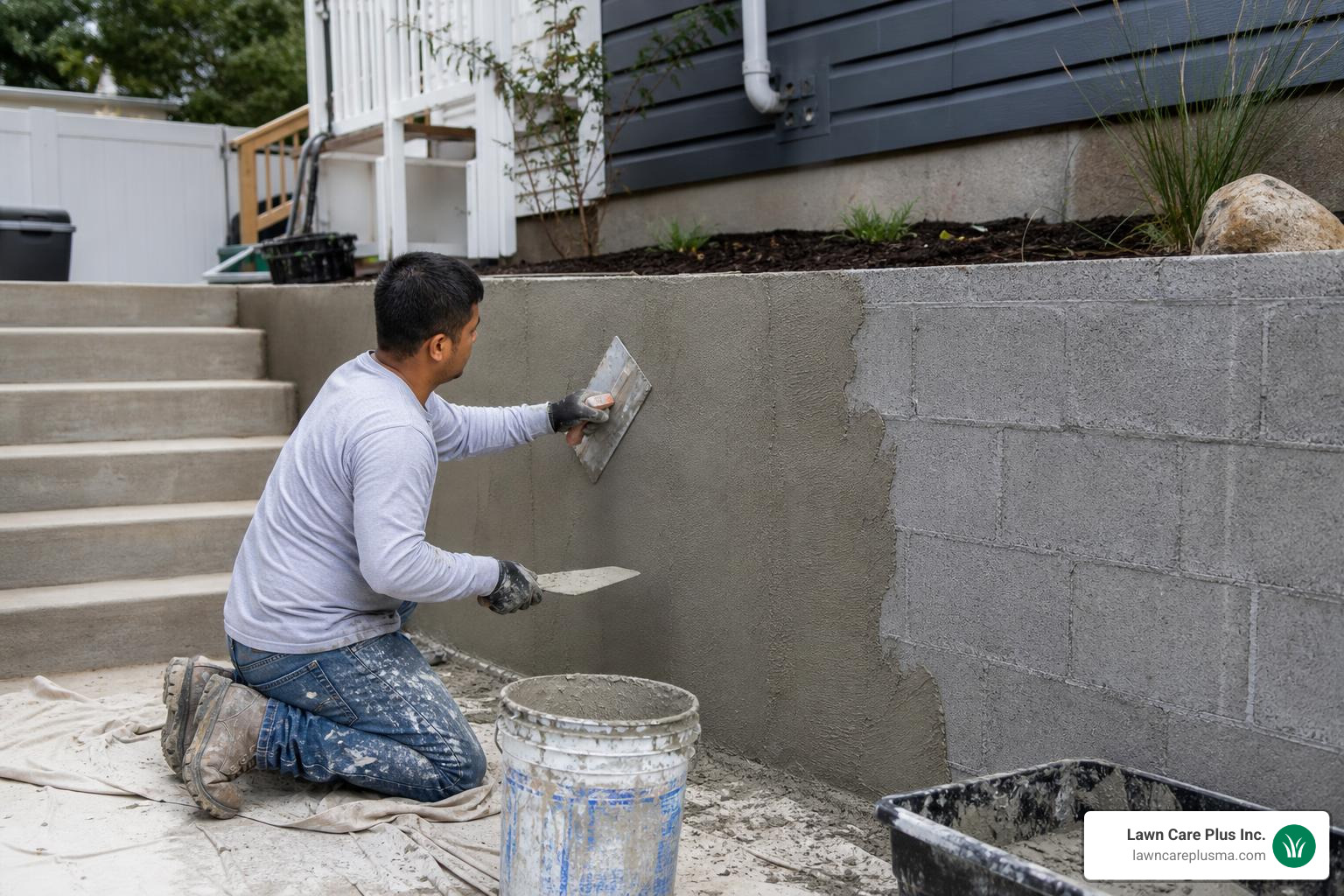
Once the wall is clean, stable, and damp, the work becomes much more straightforward: mix, apply, finish, and cure.
You will need basic masonry tools:
- Hawk
- Trowels
- Margin trowel
- Mixing tub or mortar mixer
- Drill mixer for small batches
- Sponge float or rubber float
- Masonry brush
- Bucket and clean water
- Straightedge
- Gloves and eye protection
Step 2: Mix the Stucco Cement at the Right Ratio
A common field mix for stucco over concrete block is:
3 parts clean masonry sand to 1 part Portland cement
That ratio is a solid starting point. If the mix is not sticking well to the block, reducing the sand slightly can make the mix stickier and improve grip. The goal is not soup and not beach sand with cement sprinkled in. You want a workable, cohesive mix that holds on the trowel.
Good mixing guidelines:
- Use clean masonry sand, not dirty fill sand.
- Add water slowly.
- Mix to a pudding-like consistency for base application.
- Avoid too much water, which increases shrinkage and cracking.
- Mix small batches so the material does not stiffen before use.
- Avoid quick-set mixes unless the product is specifically designed for this application.
- Use a polymer bonding additive only if compatible with your stucco system.
- Follow manufacturer instructions if using bagged stucco.
Lime is sometimes included in stucco mixes to improve workability, but bagged products often already include the needed ingredients. If you are using a proprietary mix, do not freestyle the chemistry like a backyard wizard. Follow the bag.
Step 3: Apply a 1/2-Inch Skim Coat or Reinforced Base
For clean, porous CMU, apply the stucco directly to the damp wall.
Work from the bottom up or in manageable sections. Press the material firmly into the block face and mortar joints. The first pass should not just sit on the surface; it should be forced into the pores.
Key application tips:
- Keep the wall damp, not dripping.
- Fill mortar joints completely.
- Build to at least 1/2 inch where block joints need hiding.
- Maintain even thickness.
- Avoid feather-thin edges.
- Use corner beads or formed corners where needed.
- Keep the bottom edge above soil or mulch.
- Do not bridge over moving cracks without repair.
If using wire lath:
- Use corrosion-resistant lath and fasteners.
- Fasten securely into the block or mortar joints.
- Overlap lath according to the product requirements.
- Keep lath tight to the wall.
- Embed the first coat fully through the lath.
- Scratch the surface if a brown coat will follow.
On retaining walls, corrosion resistance matters. Moisture exposure is higher than on a sheltered vertical wall, so cheap metal can become tomorrow’s rusty surprise.
Step 4: Float, Texture, or Add a Finish Coat
After the base coat firms up, you can float or texture it depending on the desired look.
Common finish options include:
- Sponge float finish: soft, sandy, and traditional
- Sand finish: clean and simple
- Lace texture: hides minor imperfections well
- Smooth trowel finish: modern, but less forgiving
- Parging look: practical and understated
- Acrylic finish: more color and texture options
- Elastomeric coating: flexible coating option for hairline crack resistance
- Stone veneer over prepared base: heavier and more decorative, but requires proper support and prep
Before applying acrylic finishes, primers, or coatings, the stucco must be cured and suitable for coating. Some technical systems require checking that the surface pH is below 10 before applying certain finishes. You can see more technical assembly details in this stucco assembly detail booklet.
If you want a colored finish, integral pigment or acrylic finish can work, but samples matter. Colors look different in sun, shade, rain, and next to natural stone or pavers.
Step 5: Cure the Wall Slowly
Curing is where patience pays off.
Cement-based stucco gains strength as it hydrates. If it dries too fast, it can shrink, dust, craze, or crack. Wind, hot sun, and dry air can pull moisture out too quickly.
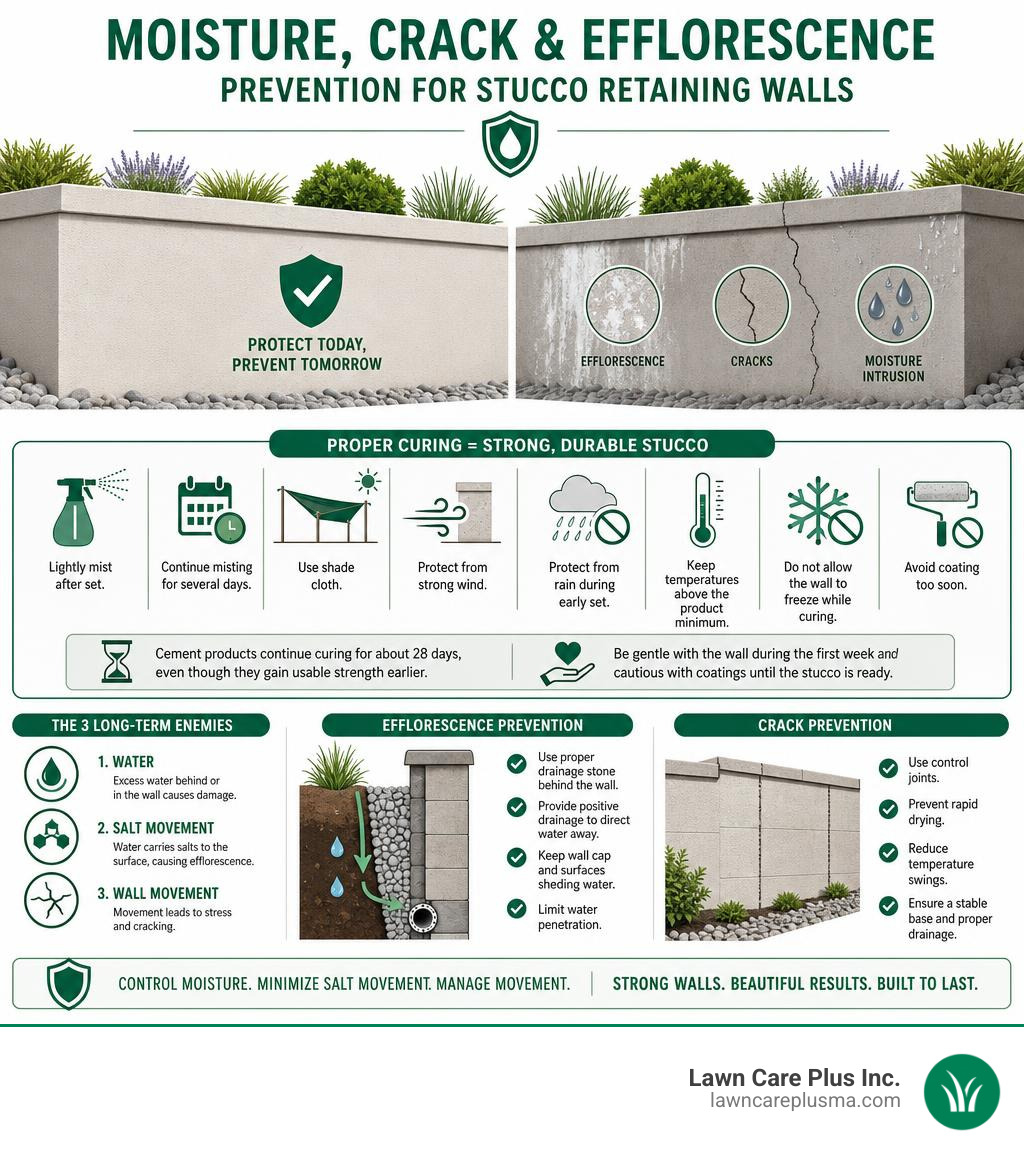
Best curing practices:
- Lightly mist the wall after the stucco has set enough not to wash away.
- Continue misting periodically for several days.
- Use shade cloth in hot sun.
- Protect from strong wind.
- Protect from rain during early set.
- Keep temperatures above the product minimum.
- Do not allow the wall to freeze while curing.
- Avoid coating too soon.
Cement products continue curing for about 28 days, even though they gain usable strength earlier. In practical terms, be gentle with the wall during the first week and cautious with coatings until the stucco is ready.
Prevent Moisture, Efflorescence, and Cracks for Long-Term Performance
Stucco on a retaining wall has three long-term enemies:
- Water
- Salt movement
- Wall movement
Efflorescence is the white powdery staining that appears when moisture carries salts to the surface. It is common in cement-based materials, but heavy or recurring efflorescence usually means too much water is moving through the wall.
Cracking can come from shrinkage, rapid drying, temperature swings, settlement, poor drainage, missing joints, or structural movement. Some tiny hairline cracking can happen in cement stucco, but wide, spreading, or wet cracks need attention.
For the wall behind the finish, our Retaining Wall Installation Guide explains why proper base, backfill, and drainage are so important.
Best Practices for Efflorescence Prevention
To reduce efflorescence:
- Use proper drainage stone behind the wall.
- Install weep holes or drainage paths where needed.
- Keep surface grade sloped away from the wall.
- Use clean sand and clean mixing water.
- Avoid adding excess water to the stucco mix.
- Do not over-mist during curing.
- Use breathable coatings rather than trapping moisture.
- Install wall caps that shed water.
- Keep deicing salts away from the wall face where possible.
- Avoid burying the stucco edge in soil or mulch.
Backside moisture control is the big one. A beautiful front finish cannot overcome a swamp behind the wall.
How to Minimize Cracking in Stucco on Retaining Walls
To reduce cracking:
- Repair structural cracks before stucco.
- Do not stucco over a moving wall.
- Use mesh reinforcement on walls with crack history.
- Maintain even coat thickness.
- Avoid overly wet mixes.
- Cure slowly.
- Protect from sun and wind.
- Use flexible sealant at dissimilar materials.
- Add control joints where wall size and layout require them.
- Break large wall faces into manageable panels.
Technical stucco guidance often recommends joints so wall sections do not get too large. Common design limits include maximum joint spacing around 18 feet in any direction and panel areas in the general range of 144 to 250 square feet, depending on the system and conditions. Always follow the specific product and project requirements.
Weather and Temperature Rules for Stucco Application
In Greater Boston and Metro-West Massachusetts, weather planning is not optional. Spring, early summer, and fall often provide the best working windows, but every day is different.
General rules:
- Keep ambient and surface temperatures above 40 degrees F during application and early curing.
- Avoid freezing nights.
- Avoid applying in direct hot sun if the wall is baking.
- Do not apply before heavy rain.
- Protect fresh work from wind.
- Mist more carefully in hot or dry weather.
- Allow extra drying time in damp, cool conditions.
- Use tarps or shade when needed.
Humidity can help slow curing, but wet weather can delay finishing. Wind can be worse than heat because it dries the surface fast. Basically, stucco likes mild weather. So do most of us.
Finish Options, Average Internet Costs, and When to Choose Each
Finish choice depends on the wall condition, desired look, moisture exposure, and budget. We are not listing project pricing here because actual costs depend on site access, prep, drainage repairs, wall size, coatings, reinforcement, and finish selection. For planning help, visit our Retaining Wall Cost guide.
Here are the common options:
| Finish | Best For | Notes |
|---|---|---|
| Stucco skim coat | Clean CMU walls needing a finished surface | Good balance of appearance and durability |
| Parging | Practical resurfacing | Simpler cementitious look, often used for utility walls |
| Painted parge | Decorative upgrade over parging | Paint must be breathable and compatible |
| Acrylic stucco finish | Color and texture choices | Requires proper curing and surface condition |
| Elastomeric coating | Hairline crack resistance | Must not trap active moisture behind wall |
| Manufactured stone veneer | Decorative feature walls | Heavier system, needs correct base and drainage |
| Natural stone veneer | Premium landscape look | Requires skilled installation and proper support |
For design inspiration, see our Retaining Wall Ideas.
Frequently Asked Questions About Concrete Block Retaining Wall Stucco
What is the best mix ratio for stucco on cinder block walls?
A typical starting ratio is 3 parts clean masonry sand to 1 part Portland cement.
If the stucco does not grip the block well, reducing the sand slightly can make the mix stickier. Use clean water, avoid making the mix too wet, and consider a compatible bonding additive if the product allows it.
For many homeowners, a quality bagged stucco or masonry resurfacing mix is easier and more consistent than site-mixing from scratch.
Can you stucco a retaining wall that gets wet after rain?
Yes, but only after you understand why it gets wet.
A wall that is briefly damp after rain is normal. A wall that leaks, stays wet for days, grows heavy efflorescence, or has water pushing through cracks has a drainage problem.
Before stucco:
- Check the backfill.
- Confirm drainage stone is present.
- Add or clear weep holes if needed.
- Redirect surface water.
- Keep sprinklers off the wall.
- Repair cracks and open joints.
Do not trap active moisture behind a new coating. Water pressure can push stucco off the block from behind.
How long does stucco last on a concrete block retaining wall?
Stucco can last many years when the wall is stable, drainage is correct, prep is thorough, and the finish is maintained. The biggest life-shorteners are poor drainage, freeze-thaw damage, impact damage, buried stucco edges, and ignored cracks.
Long-term maintenance should include:
- Annual inspection after winter
- Cleaning dirt and algae with gentle methods
- Avoiding aggressive pressure washing
- Repairing hairline cracks early
- Checking caps and joints
- Keeping soil, mulch, and plants off the wall face
- Watching for recurring efflorescence
- Recoating compatible finishes when needed
If the wall starts leaning or cracking structurally, call a professional before patching the surface.
Conclusion
Stucco can turn a tired concrete block retaining wall into a clean, finished landscape feature, but the best results come from doing the boring parts well: drainage, cleaning, prep, proper thickness, and slow curing.
For most clean CMU walls, a direct 1/2-inch stucco skim coat is the practical standard. A scratch coat is not always required, but wire lath or mesh reinforcement may be the better choice for painted, cracked, smooth, or moisture-stressed walls.
At Lawn Care Plus Inc., we take a drainage-first approach because retaining walls in Boston, Belmont, Brookline, Newton, Dedham, Hyde Park, Roslindale, West Roxbury, Watertown, Needham, Norwood, Walpole, and nearby Metro-West communities have to handle real New England weather.
If you want help evaluating, repairing, resurfacing, or finishing your wall, we can help with hardscaping, masonry services, drainage improvements, and full landscape installation.
Ready to make your block wall look like it belongs in the yard instead of behind a warehouse? Schedule concrete block retaining wall help.
