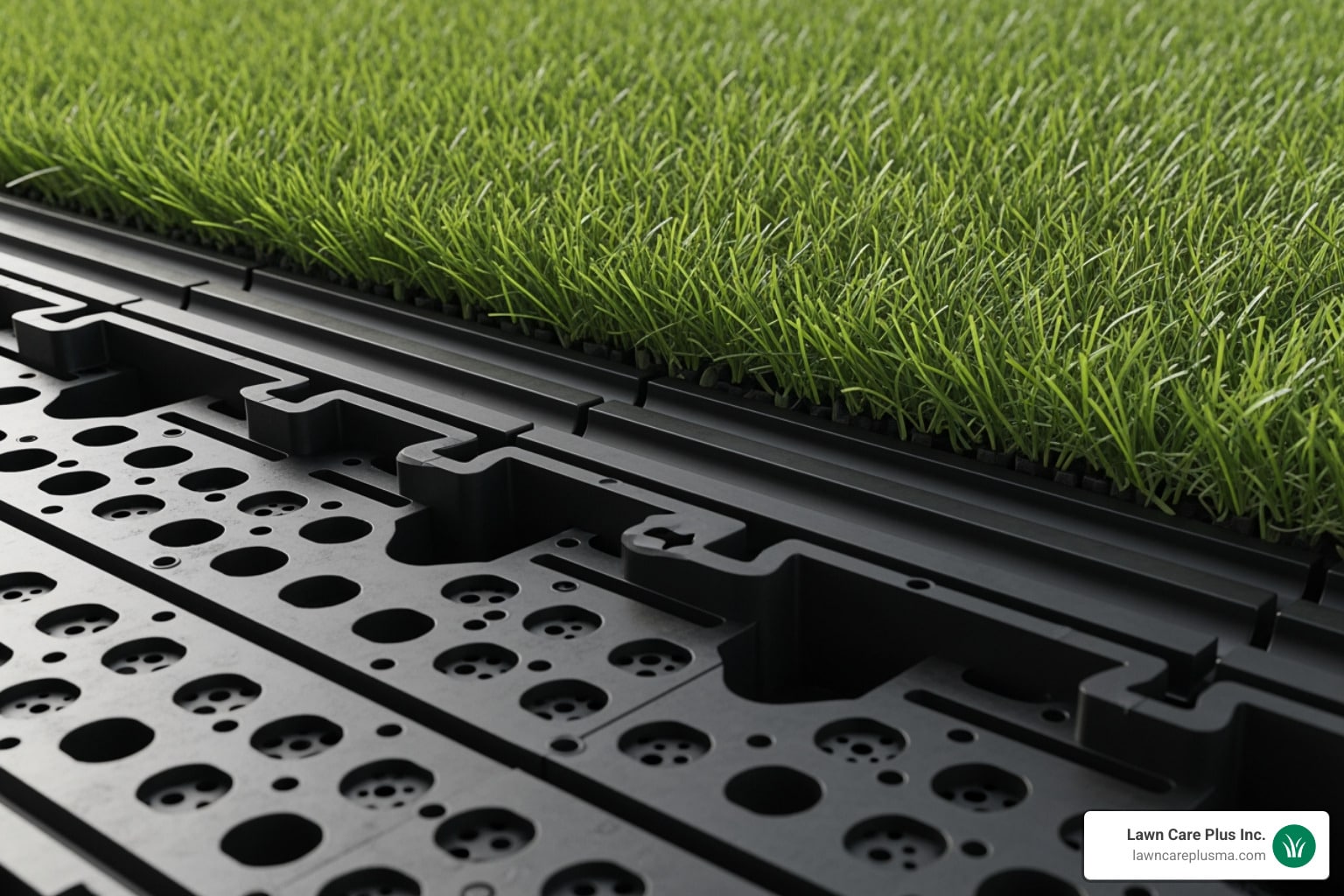
Why Artificial Grass Drainage Tiles Make or Break Your Turf Installation
Artificial grass drainage tiles are interlocking plastic panels installed beneath artificial turf to channel water away quickly, prevent pooling, and allow air to circulate under the surface.
Here’s a quick summary of what you need to know:
| Question | Quick Answer |
|---|---|
| What are they? | Interlocking plastic panels placed under artificial turf as a sub-base |
| What do they do? | Drain water rapidly, reduce odors, and improve airflow |
| Who needs them? | Anyone installing turf over concrete, rooftops, pet areas, or poor-draining soil |
| Key materials | Recycled HDPE or recycled copolymer plastic |
| Top benefit | Some tiles drain up to 2,856 inches of water per hour |
Think about this: a homeowner lays artificial grass directly on a concrete patio. The first rainstorm leaves it completely waterlogged. The surface stays wet for days, odors build up, and the turf becomes a muddy mess. This is exactly the problem drainage tiles solve.
Without a proper drainage layer, even the best artificial turf will underperform on an impermeable surface. Water has nowhere to go. Bacteria and mold thrive. Pet waste lingers. The whole installation suffers.
Drainage tiles create a critical gap between your turf and the surface below. That gap does a lot of work — moving water out, letting air in, and keeping the surface clean and stable.
I’m Tim DiAngelis, owner of Lawn Care Plus, Inc., a full-service landscaping company serving Greater Boston and Metro-West Massachusetts, where I’ve seen how the right sub-base — including artificial grass drainage tiles — determines whether an artificial turf installation holds up through New England’s wet springs and heavy rains. In this guide, I’ll walk you through everything you need to choose and use them correctly.
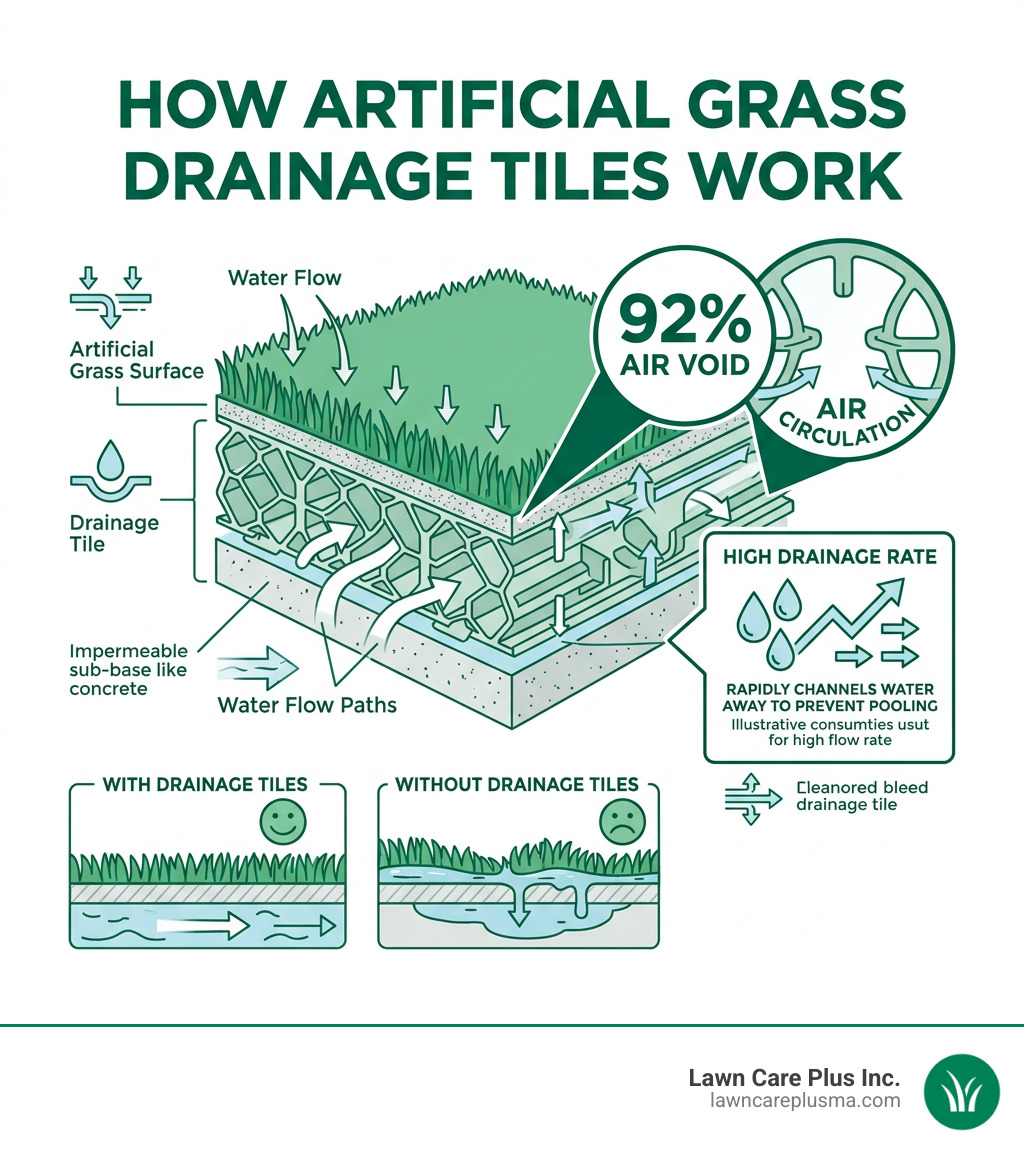
Artificial grass drainage tiles terminology:
What are Artificial Grass Drainage Tiles?
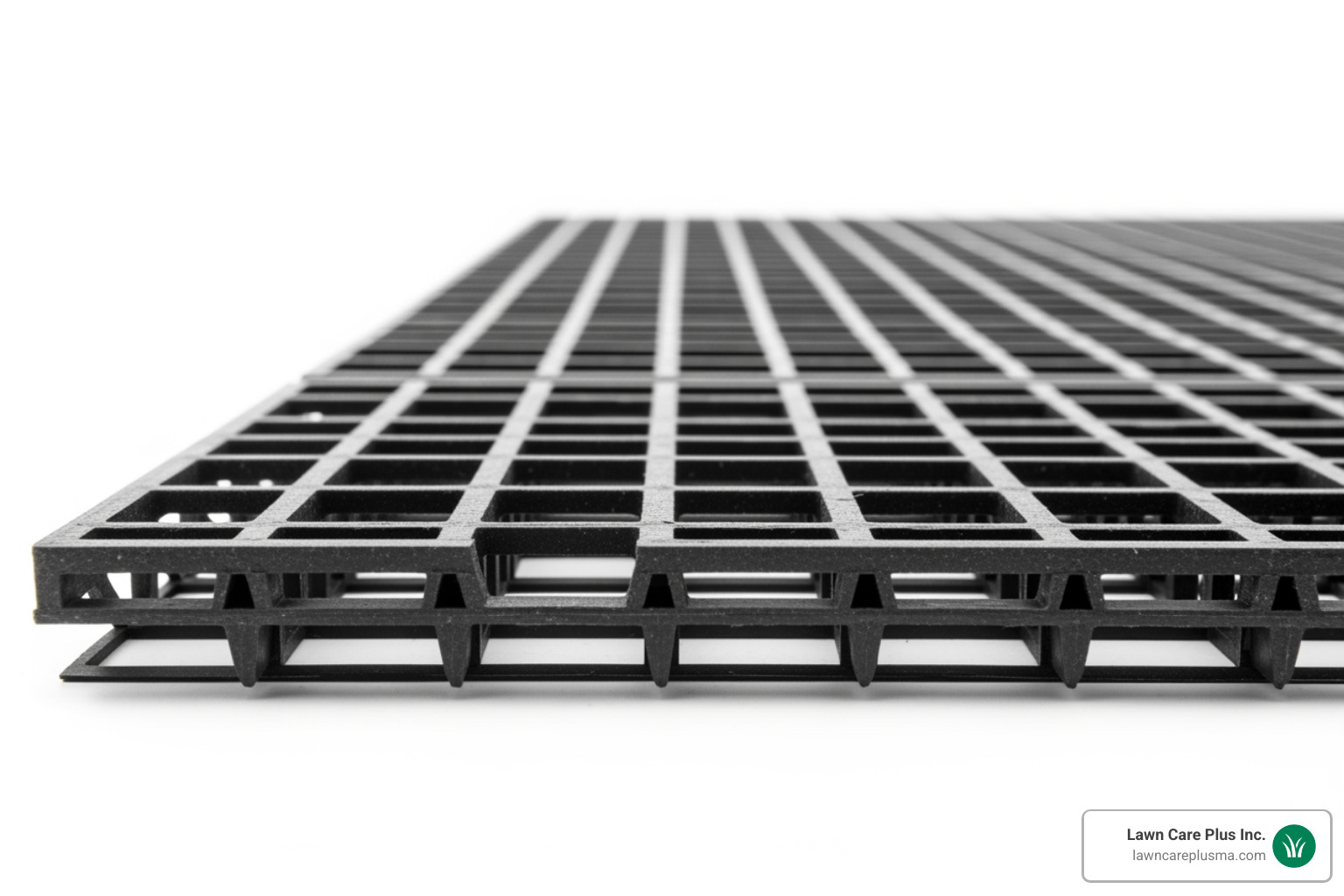
When we talk about artificial grass drainage tiles, we are referring to the “skeleton” of a high-performance turf system. These aren’t just pieces of plastic; they are engineered sub-base panels designed to replace or supplement traditional crushed stone bases.
In our work across the Boston Metro-West area, from Newton to Milton, we often encounter “impermeable” surfaces—think concrete patios, rooftop decks, or heavily compacted soil. On these surfaces, water cannot soak into the ground. Drainage tiles act as a raised platform, lifting the turf about 0.75 to 1 inch off the ground.
These tiles are typically made from high-density polyethylene (HDPE) or recycled copolymer plastic. They feature a patented design that allows for both vertical drainage (water falling straight through the turf) and horizontal flow (water moving sideways along the concrete toward a drain or the edge of the patio). This dual-action movement is a cornerstone of any surface drainage system ultimate guide.
Furthermore, some advanced tiles offer “water buffering.” For example, certain grid systems can store up to 30 liters of water per square meter within the tile itself. This prevents the “flash flood” effect on your patio during a heavy downpour in Canton or Dedham, holding the water and releasing it slowly as the drainage system catches up.
Technical Specifications and Materials
If you’re a fan of the “nitty-gritty” details, the specs on these tiles are quite impressive. Most professional-grade artificial grass drainage tiles are built to handle serious weight. We’re talking about a compression strength of over 180 psi. You could park a car on some of these systems without them flinching.
Here are the standard specs we look for:
- Design: An open-grid or “honeycomb” design for maximum air and water movement.
- Connections: Patented interlocking systems (often with 24 or more connection points per tile) to ensure the floor stays flat and doesn’t shift underfoot.
- Weight: They are surprisingly lightweight, often around 917 grams (roughly 2 lbs) per tile, making them perfect for weight-sensitive rooftops in downtown Boston.
- Thermal Buffering: In the freezing winters of Massachusetts, these tiles provide a thermal break between the frozen ground and the turf, which can actually make the grass more comfortable to walk on during a cold snap.
- Anti-Slip: Quality tiles feature an anti-slip grip on the top surface to keep the turf from sliding around like a rug on a hardwood floor.
Key Benefits of Using Drainage Tiles Under Artificial Turf
Why bother with the extra step? Why not just throw the turf down and call it a day? Well, if you’ve ever smelled “wet dog” coming from a lawn that hasn’t seen a dog in weeks, you’ll understand the importance of airflow.
The most significant benefit is the drainage rate. Some of these tiles provide a drainage capacity of 2856 inches per hour. To put that in perspective, that’s over 930 gallons of water per minute per square yard. Even the most intense New England hurricane can’t dump water that fast!
By elevating the turf, you create a 90% to 92% air void. This constant airflow helps the turf dry rapidly and keeps the surface temperature significantly lower. In the heat of a July afternoon in Brighton or Brookline, artificial turf can get hot. Having a “cushion” of air underneath helps dissipate that heat, making the yard safer for kids and paws. For more on managing water in your yard, check out our garden land drainage solutions.
Odor Control and Hygiene
If you have pets, artificial grass drainage tiles are not a luxury—they are a necessity. When a pet uses the “facilities” on artificial grass, the waste needs to be flushed away. Without tiles, urine can get trapped between the turf backing and the concrete, leading to a nasty ammonia smell and bacterial buildup.
The tiles create a flushing system. When you hose down the grass, the water carries the waste through the turf, into the tile channels, and away to the nearest drain. This 1-inch air gap prevents the “wicking” of odors back up into the turf fibers. It’s the difference between a fresh-smelling backyard in Needham and one that makes the neighbors in Walpole turn up their noses. Learn more about drainage solutions for enclosed spaces to see how others have tackled these challenges.
Best Applications for Drainage Grid Systems
Where do we use these “Sub-base Saviors” most often?
- Rooftops and Balconies: In places like Watertown or the Seaport, rooftops are prime real estate. Tiles allow for a lush green look without damaging the roof’s rubber membrane.
- Playgrounds: The added shock absorption of the tiles helps improve the “G-Max” and “HIC” (Head Injury Criterion) scores, making the surface safer for falls.
- Sports Fields: From backyard putting greens to local soccer patches, tiles ensure the field is playable minutes after a rainstorm.
- Pet Facilities: Dog daycares and veterinary clinics use these systems to maintain a sterile, easy-to-clean environment.
For residential owners, these are perfect for domestic surface water drainage systems where the natural soil just won’t cooperate.
Why Pet Areas Need Artificial Grass Drainage Tiles
We often get calls from rabbit owners or dog lovers in West Roxbury who are frustrated with waterlogged pens. For small enclosures, like a rabbit run on a concrete pad, the turf can become a swamp. Drainage tiles provide “gravity-fed” drainage. Even on a flat surface, the weight of the water itself pushes it through the channels. This mitigation is key to keeping your pets dry and healthy.
Rooftop and Concrete Surface Solutions
Installing on a rooftop requires a delicate touch. You can’t exactly haul five tons of crushed stone up a service elevator in a Brookline apartment complex. Artificial grass drainage tiles provide a lightweight alternative that distributes weight evenly. Because they don’t require drilling into the roof, they protect the integrity of the rubber membrane while still providing a massive 30-liter-per-square-meter water storage capacity to handle runoff.
Installation and Maintenance Guide
Installing these tiles is like putting together a giant, high-tech LEGO set. We start with a clean, leveled base. If we’re working over soil, we always lay down a geotextile for french drain to prevent weeds and keep the tiles from sinking into the dirt.
- Preparation: Ensure the surface has a slight slope (at least 1-2%) toward a drain or exit point.
- Laying the Tiles: Start in a corner and work row-by-row. Most tiles use a “snap-lock” or “six-point locking” system. You should hear a satisfying click.
- Cutting: You can easily cut these tiles with a circular saw or a jigsaw to fit around posts, planters, or curved edges.
- Securing: On concrete, we often use perimeter gluing or specialized fixing caps to keep the edges from lifting.
Installing Artificial Grass Drainage Tiles on Concrete
When working on the hard concrete surfaces common in Newton and Belmont, you have to account for expansion and contraction. Plastic expands when it gets hot! We leave a small gap at the edges to prevent the tiles from buckling. If the concrete is slanted, that’s actually good news—it means the small french drain pipe you might have at the edge will work even better.
Long-Term Maintenance and Durability
One of the best things about these systems is that they are virtually “set it and forget it.” Because they are made of HDPE, they won’t rot, rust, or degrade. They are 100% recyclable, so they are eco-friendly too.
Maintenance involves:
- Flushing: Once every few months (or more often if you have pets), give the turf a deep soak with a garden hose to clear out any fine dust or sediment that might have settled in the channels.
- Debris Removal: Keep the edges of your turf clear so the water can actually exit the tile system.
- Longevity: These tiles often outlast the turf itself. When the grass eventually wears out in 15 years, you can usually just pull it up and lay new turf right over the same tiles.
Cost Analysis and Comparison
How do artificial grass drainage tiles stack up against other “budget” DIY fixes?
| Solution | Drainage Efficiency | Durability | Ease of Install | Best Use |
|---|---|---|---|---|
| Drainage Tiles | Excellent (930 GPM) | High (15+ years) | Easy (Interlocking) | All high-drainage needs |
| PVC Screening | Moderate | Low (Can crush) | Medium | Very small, low-traffic areas |
| Rubber Mats | Low | High | Easy | Indoor gyms, non-drainage areas |
| Crushed Stone | Good | High | Hard (Labor intensive) | Large lawn areas |
While tiles represent an upfront investment, the return on investment (ROI) comes from the extended life of your turf and the lack of mold remediation costs later. You’re effectively buying an insurance policy for your yard. For a broader look at costs, see our land drainage system overview.
Average Pricing and Factors
Based on average internet data, artificial grass drainage tiles generally cost between $1.00 and $12.00 per square foot. Please note that these are average costs found online and do not represent the actual pricing for Lawn Care Plus, Inc., as every project in the Boston area has unique requirements.
Factors that affect your final price include:
- Material Quality: 100% recycled HDPE is usually more expensive than cheaper plastics.
- Brand Variations: High-end systems with antimicrobial properties or higher psi ratings will sit at the top of the range.
- Project Size: Bulk orders for a large sports field in Newton might lower the per-square-foot cost compared to a small patio in Jamaica Plain.
- Shipping: These tiles are lightweight but bulky, so shipping costs can add up if you aren’t buying locally.
Frequently Asked Questions about Drainage Tiles
Can drainage tiles be used on sloped or uneven surfaces?
Yes! Most high-quality tiles feature “flexible zones” or 9-point contact systems that allow them to contour to slight imperfections in the ground. On sloped concrete, the tiles actually work better because gravity helps pull the water through the channels even faster.
Do drainage tiles make the artificial turf feel too firm?
This is a common concern. Because the tiles are a hard plastic grid, they can make the surface feel slightly firmer than grass on a plush dirt base. However, this is easily fixed by using a thicker turf with a higher pile height or adding more infill (like sand or rubber granules) to provide that “squish” we all love.
How do tiles compare to traditional aggregate bases?
Traditional bases require excavating several inches of soil and hauling in tons of stone. Tiles are much cleaner and faster to install. In tight urban spaces like Brighton or Hyde Park, where bringing in heavy machinery is impossible, tiles are the only logical choice.
Conclusion
At Lawn Care Plus Inc., we believe that a beautiful lawn starts from the ground up—literally. Whether you’re looking to transform a rooftop in downtown Boston or solve a muddy pet mess in Wellesley, artificial grass drainage tiles are the secret weapon for a long-lasting, fresh-smelling, and high-performing landscape.
We’ve spent years perfecting the art of Massachusetts landscaping, from the rocky soils of Medfield to the urban decks of Roslindale. If you’re ready to stop worrying about waterlogging and start enjoying your “sub-base saved” yard, our team is here to help with professional installation and expert advice. Don’t let a poor foundation ruin your investment; invest in a proper land drainage system and see the difference for yourself!